NIOS Class 12 Question Paper 2021 (Jan Feb) Chemistry
Finished viewing? Save it for later —
Download NIOS Class 12 Question Paper 2021 (Jan Feb) Chemistry (PDF · 12 pages)About NIOS Class 12 Question Paper 2021 (Jan Feb) Chemistry
NIOS Class 12 Question Paper 2021 (Jan Feb) Chemistry is available here for free download. Published by NIOS for National Institute of Open Schooling Class 12, this question paper can be viewed online or downloaded as a PDF (12 pages). Candidates preparing for National Institute of Open Schooling Class 12 can use NIOS Class 12 Question Paper 2021 (Jan Feb) Chemistry to understand the exam pattern, the type of questions asked, and the overall difficulty level.
Frequently Asked Questions
How can I download NIOS Class 12 Question Paper 2021 (Jan Feb) Chemistry?
Open this page and click the Download button to save NIOS Class 12 Question Paper 2021 (Jan Feb) Chemistry as a PDF. It is completely free on AglaSem Docs.
Is NIOS Class 12 Question Paper 2021 (Jan Feb) Chemistry free to download?
Yes. NIOS Class 12 Question Paper 2021 (Jan Feb) Chemistry can be viewed online and downloaded as a PDF free of cost on AglaSem Docs.
How many pages does NIOS Class 12 Question Paper 2021 (Jan Feb) Chemistry have?
NIOS Class 12 Question Paper 2021 (Jan Feb) Chemistry contains 12 pages, which you can read online or download together as a single PDF.
Where can I find more National Institute of Open Schooling Class 12 study material?
You can find more National Institute of Open Schooling Class 12 question papers, sample papers, syllabus, and answer keys on AglaSem Docs.
NIOS Class 12 Question Paper 2021 (Jan Feb) Chemistry – Text
Read the full text of this question paper below — useful to quickly search, copy and reference the content online without downloading the PDF.
📄 View text version (12 pages)
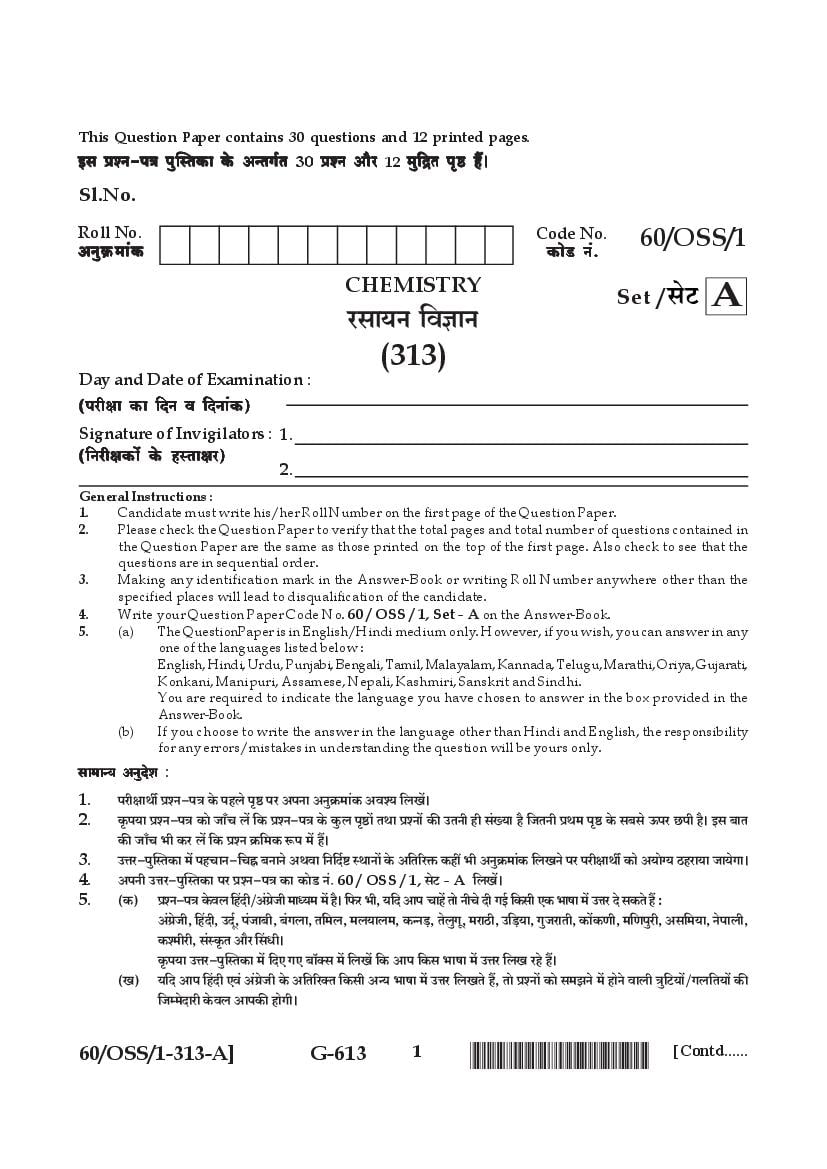
Page 1
Bg àíZ-nÌ nw p ñVH$m Ho $ AÝVJ© V 30 àíZ Am¡ a 12 ‘w { ÐV n¥ ð > h¢ &
Sl.No.
Roll No.
AZw H « $ _m§ H $
Code No.
H$mo S > Z§ .
60/OSS/1
CHEMISTRY
Set / go Q > A
agm¶Z {dkmZ
(313)
Day and Date of Examination :
(narjm H$m {XZ d {XZm§ H $)
Signature of Invigilators : 1.
({ZarjH$m| Ho $ hñVmja)
2.
General Instructions :
1. Candidate must write his/her Roll Number on the first page of the Question Paper.
2. Please check the Question Paper to verify that the total pages and total number of questions contained in
the Question Paper are the same as those printed on the top of the first page. Also check to see that the
questions are in sequential order.
3. Making any identification mark in the Answer-Book or writing Roll Number anywhere other than the
specified places will lead to disqualification of the candidate.
4. Write your Question Paper Code No. 60 / OSS / 1, Set - A on the Answer-Book.
5. (a) The QuestionPaper is in English/Hindi medium only. However, if you wish, you can answer in any
one of the languages listed below :
English, Hindi, Urdu, Punjabi, Bengali, Tamil, Malayalam, Kannada, Telugu, Marathi, Oriya, Gujarati,
Konkani, Manipuri, Assamese, Nepali, Kashmiri, Sanskrit and Sindhi.
You are required to indicate the language you have chosen to answer in the box provided in the
Answer-Book.
(b) If you choose to write the answer in the language other than Hindi and English, the responsibility
for any errors/mistakes in understanding the question will be yours only.
gm_mÝ` AZwXoe :
1. narjmWu àíZ-nÌ Ho$ nhbo n¥ð> na AnZm AZwH«$‘m§H$ Adí¶ {bI|&
2. H¥$n¶m àíZ-nÌ H$mo Om±M b| {H$ àíZ-nÌ Ho$ Hw$b n¥ð>m| VWm àíZm| H$s CVZr hr g§»¶m h¡ {OVZr àW‘ n¥ð> Ho$ g~go D$na N>nr h¡& Bg ~mV
H$s Om±M ^r H$a b| {H$ àíZ H«${‘H$ ê$n ‘| h¢&
3. CÎma-nwpñVH$m ‘| nhMmZ-{M• ~ZmZo AWdm {Z{X©ï> ñWmZm| Ho$ A{V[aº$ H$ht ^r AZwH«$‘m§H$ {bIZo na narjmWu H$mo A¶mo½¶ R>ham¶m Om¶oJm&
4. AnZr CÎma-nwpñVH$m na àíZ-nÌ H$m H$moS> Z§. 60 / OSS / 1, goQ> - A {bI|&
5. (H$) àíZ-nÌ Ho$db qhXr/A§JO o« r _mÜ`_ ‘| h¡& {’$a ^r, ¶{X Amn Mmh| Vmo ZrMo Xr JB© {H$gr EH$ ^mfm ‘| CÎma Xo gH$Vo h¢ :
A§J«oOr, qhXr, CXÿ©, n§Om~r, ~§Jbm, V{‘b, ‘b¶mb‘, H$ÝZ‹S>, VobwJy, ‘amR>r, C{‹S>¶m, JwOamVr, H$m|H$Ur, ‘{Unwar, Ag{‘¶m, Zonmbr,
H$í‘rar, g§ñH¥$V Am¡a qgYr&
H¥$n¶m CÎma-nwpñVH$m ‘| {XE JE ~m°³g ‘| {bI| {H$ Amn {H$g ^mfm ‘| CÎma {bI aho h¢&
(I) ¶{X Amn qhXr Ed§ A§J«oOr Ho$ A{V[a³V {H$gr Aݶ ^mfm ‘| CÎma {bIVo h¢, Vmo àíZm| H$mo g‘PZo ‘| hmoZo dmbr Ìw{Q>¶m|/Jb{V¶m| H$s
{Oå‘oXmar Ho$db AmnH$s hmoJr&
60/OSS/1-313-A] G-613 1 [ Contd......
Page 2
agm¶Z {dkmZ
(313)
Time : 3 Hours] [Maximum Marks : 80
g_` : 3 KÊQ>]o [nyUmªH$ : 80
Note : (i) All questions are compulsory.
(ii) Marks allotted are indicated against each question.
(iii) Each question from Question Nos. 1 to 10 has four alternatives - (A), (B), (C) and (D), out of which one
is the most appropriate. Choose the correct answer among the four alternatives and write it in your
Answer-Book against the Number of the question. No extra time is allotted for attempting multiple
choice questions.
(iv) Use log tables, if necessary.
{ZX}e :(i) g^r àíZm| Ho$ CÎma Xr{OE&
(ii) à˶oH$ àíZ Ho$ gm‘Zo CgHo$ A§H$ Xem©¶o JE h¢&
(iii) àíZ g§»¶m 1 go 10 ‘| à˶oH$ àíZ ‘| Mma {dH$ën - (A), (B), (C) VWm (D) h¢, {OZ‘| go EH$ g~go Cn¶w³V h¢& Mmam| {dH$ënm| ‘|
go ghr CÎma MwZ| VWm AnZr CÎma-nwpñVH$m ‘| àíZ g§»¶m Ho$ gm‘Zo CÎma {bI|& ~hþ{dH$ënr àíZm| Ho$ {b¶o A{V[a³V g‘¶ Zht Xr¶m
Om¶oJm&
(iv) ¶{X Adí¶H$ hmo, Vmo bm°J Q>o~b H$m à¶moJ H$a|&
1. Some unusual properties of water, such as its solid form (ice) being lighter than
liquid form (water) is due to the presence of which type of intermolecular forces?[1]
(A) London forces (B) Dipole - dipole forces
(C) Dipole-induced dipole forces (D) Hydrogen bonding
nmZr Ho$ Hw$N> Agm‘mݶ JwUY‘©, O¡go BgHo$ R>mog én (~’©$) H$m Ðd én (nmZr) H$s Anojm hëH$m hmoZm, {H$g
àH$ma Ho$ A§Vam AmpÊdH$ ~b Ho$ H$maU hmoVo h¢?
(A) b§S>Z ~b (B) {ÛY«wd - {ÛY«wd ~b
(C) {ÛY«wd-ào[aV {ÛY«wd ~b (D) hmBS´>moOZ Am~§YZ
2. A liquid will be wetting in nature if [1]
(A) adhesive forces are stronger than cohesive forces
(B) cohesive forces are stronger than adhesive forces
(C) both cohesive and adhesive forces are of equal magnitude
(D) it forms convex miniscus in a capillary tube
60/OSS/1-313-A] G-613 2 [ Contd......
Page 3
(A) H$mohr{gd ~bm| H$s VwbZm ‘| ES>hr{gd ~b à~b hm|&
(B) ES>hr{gd ~bm| H$s VwbZm ‘| H$mohr{gd ~b à~b hm|&
(C) H$mohr{gd Am¡a ES>hr{gd XmoZmo§ ~b g‘mZ hm|&
(D) dh ereo H$s Zbr ‘| CÎmb {‘{ZñH$g ~ZmVm hm|&
·
3. Which of the following is not a Lewis Acid? [1]
(A) SnCl4 (B) AlCl3
(C) BF3 (D) BeCl2
{ZåZ{b{IV ‘| go H$m¡Z-gm byBg Aåb Zhr h¡?
(A) SnCl4 (B) AlCl3
(C) BF3 (D) BeCl2
4. Below are given four species: _ [1]
I) H2CO3 II) F
+
III) H3O IV) NH3
Out of these Bronstead-Lowry acids are
(A) I and II (B) I and III
(C) II and III (D) III and IV
ZrMo Mma ñnrerµO Xr JB© h¢- _
I) H2CO3 II) F
+
III) H3O IV) NH3
BZ‘| go ~«m±ñQ>oS>-bm°ar Aåb h¢
(A) I and II (B) I and III
(C) II and III (D) III and IV
5. Identify the compound which forms carbon with conc. sulphuric acid. [1]
(A) Sugar (B) Oxalic acid
(C) Formic acid (D) Methyl alcohol
Cg ¶m¡{JH$ H$s nhMmZ H$s{OE Omo gmÝÐ gëâ¶y[aH$ Aåb Ho$ gmW H$m~©Z ~ZmVm h¡&
(A) eH©$am (B) Am°³g¡{bH$ Aåb
(C) ’$m{‘©H$ E{gS> (D) ‘o{Wb EoëH$mohm°b
60/OSS/1-313-A] G-613 3 [ Contd......
Page 4
(A) Ti4+ (B) Zn2+
(C) Cr3+ (D) Sc 3+
Cg YZm¶Z H$s nhMmZ H$s{OE Omo a§JrZ h¡
(A) Ti4+ (B) Zn2+
(C) Cr3+ (D) Sc 3+
7. The group which shows +I effect is [1]
+
(A) (CH3)3C– (B) (CH3)3 N
(C) –OH (D) –NO2
+I à^md Xem©Zo dmbm g‘yh h¡
+
(A) (CH3)3C– (B) (CH3)3 N
(C) –OH (D) –NO2
8. Ethene on oxidation with cold dilute alkaline solution of KMnO4 gives [1]
(A) CH2 – CH2 (B) CH3
O CH2OH
(C) CH3 (D) CH2OH
CHO CH2OH
EWrZ, R>§S>o VZw jmar¶ KMnO4 {db¶Z Ho$ gmW Am³grH¥$V hmoH$a XoVr h¡
(A) CH2 – CH2 (B) CH3
O CH2OH
(C) CH3 (D) CH2OH
CHO CH2OH
60/OSS/1-313-A] G-613 4 [ Contd......
Page 5
(A) Nylon –6, 6
(B) Polyethylene glycol phthalate
(C) Poly glycolic acid
(D) Poly vinyl chloride
{ZåZ{b{IV ‘| go H$m¡Z O¡d ~hþbH$ h¡?
(A) ZmBbm°Z –6, 6 (B) nm°{b BWmBbrZ ½bmBH$m°b W¡boQ>
(C) nm°{b ½bmBH$mo{bH$ E{gS> (D) nm°{b {dZmBb ³bmoamBS>
10. Which of the following is a natural polymer? [1]
(A) Poly isoprene (B) Buna - S
(C) Neoprene (D) Butyl rubber
{ZåZ{b{IV ‘| go H$m¡Z àmH¥${VH$ ~hþbH$ h¡?
(A) nm°{b AmBgmoàrZ (B) ã¶wZm-S
(C) {ZAmoàrZ (D) ã¶y{Q>b a~a
11. Define molar volume of a substance. What is the molar volume of an ideal gas at
S.T.P.? What values of standard temperature and pressure are taken in this case?[2]
‘moba Ð춑mZ H$s n[a^mfm {b{IE& {H$gr AmXe© J¡g H$m ‘mZH$ Vmn Am¡a Xm~ (S.T.P.) na Am¶VZ ³¶m
h¡? BgHo$ {bE ‘mZH$ Vmn d Xm~ Ho$ ‘mZ ³¶m {bE OmVo h¡?
12. Define the following terms : [2]
a) Macromolecular colloids
b) Associated colloids
{ZåZ{b{IV nXm| H$mo n[a^m{fV H$s{OE…
a) ~¥hXmUwH$ H$mobm°BS>
b) g§K{Q>V H$mobm°BS>
13. Give the relation between enthalpy change and internal energy change of a system.
Under what condition enthalpy change is nearly same as the internal energy change?
Explain. [2]
{H$gr {ZH$m¶ Ho$ {bE EÝW¡ënr n[adV©Z Am¡a Am§V[aH$ D$Om© n[adV©Z ‘| nañna g§~§Y Xr{OE& {H$g AdñWm ‘|
EÝW¡ënr n[adV©Z, Am§V[aH$ D$Om© n[adV©Z Ho$ bJ^J ~am~a hmoVm h¡? ì¶m»¶m H$s{OE&
60/OSS/1-313-A] G-613 5 [ Contd......
Page 6
Write chemical equations involved. [2]
{g{bH$Z Q>oQ´>m³bmoamBS> H$m {daMZ H¡$go {H$¶m OmVm h¡? ³¶m hmoVm h¡ O~ ¶h Ob Ho$ gmW A{^{H«$¶m H$aVm h¡?
g§~Õ amgm¶{ZH$ g‘rH$aU {b{IE&
4–
15. Write the I.U.P.A.C. name of [Fe(CN)6] . Write its hybridisation and magnetic
character. [At.No. : Fe = 26]. [2]
4–
[Fe(CN)6] H$m AmB.¶w.nr.E.gr. Zm‘ {b{IE& BgH$m g§H$aU Am¡a Mwå~H$s¶ JwU {b{IE& [Fe H$m
na‘mUw H«$‘m§H$ = 26]
16. Account for the following : [2]
a) HOClO3 is the strongest acid among the oxoacids of chlorine.
b) HF is liquid at room temperature whereas HCl, HBr and HI are gases.
{ZåZ{b{IV Ho$ H$maU Xr{OE:
a) ³bmoarZ Ho$ Am°³gmo Aåbm| ‘| HOClO3 à~bV‘ Aåb h¡&
b) H$j Vmn na HF Ðd én ‘| hmoVm h¡ O~{H$ HCl, HBr Am¡a HI J¡g| hmoVr h¢&
17. Write reactions of phenol with bromine [2]
a) in aqueous solution and
b) in less polar solvent such as carbon disulphide
’$sZm°b H$s ~«mo‘rZ Ho$
a) Obr¶ {db¶Z VWm
b) H$‘ Y«wdr¶ {dbm¶H$ O¡go H$m~©ZS>mBgë’$mBS> ‘| A{^{H«$¶mE§ {b{IE&
18. Explain the process of saponification. Write chemical equation involved. [2]
gm~wZrH$aU àH«$‘ H$s ì¶m»¶m H$s{OE& g§~Õ amgm¶{ZH$ g‘rH$aU {b{IE&
60/OSS/1-313-A] G-613 6 [ Contd......
Page 7
empirical formula. [At. mass: H = 1.0 u, C = 12.0 u, O = 16.0 u] [2]
{dQ>m{‘Z C ‘| 40.92% H$m~©Z, 4.58% hmBS´>moOZ Am¡a 54.50% Am°³grOZ h¡& BgH$m ‘ybmZwnmVr gyÌ kmV
H$s{OE& [na‘mUw Ð춑mZ … H = 1.0 u, C = 12.0 u, O = 16.0 u]
20. a) Differentiate between continuous spectrum and line spectrum.
b) With the help of boundary surface diagram, describe the shape of 2s orbital.
Give two differences between 2s and 1s orbital.
[4]
a) bmBZ ñno³Q´>‘ Am¡a gVV ñno³Q´>‘ ‘| AÝVa ñnï> H$s{OE&
b) gr‘m gVh AmaoI H$s ghm¶Vm go 2s H$jH$ H$s AmH¥${V H$m dU©Z H$s{OE& 2s H$jH$ Am¡a 1s H$jH$
Ho$ ~rM Xmo AÝVa Xr{OE&
21. a) Explain, what are non-ideal solutions.
b) 2g of benzoic acid (molar mass = 122 g mol–1) when dissolved in 25g of
benzene shows a depression in freezing point equal to 1.62 K. what is the
percentage of association of the acid if it forms dimer in the solution.
[Kf for benzene = 4.9 K kg mol–1]
[4]
a) AZmXe© {db¶Z ³¶m h¢, ì¶m»¶m H$s{OE&
b) 2g ~oÝOmoBH$ Aåb (‘moba Ð춑mZ = 122g mol–1) 25g ~oÝOrZ ‘| KmobZo na {h‘m§H$ ‘| AdZ‘Z
1.62 K Xem©Vm h¡& ¶Xr ¶h {db¶ {ÛV¶ (dimer) ~ZmVm h¡, Aåb H$m g§JwUZ {H$VZo à{VeV hmoJm?
[~oÝOrZ Ho$ {bE Kf = 4.9 K kg mol–1]
22. a) Define enthalpy of formation. Can its value be taken as zero? Justify your
answer.
b) Calculate r H for the reaction
C3H8(g)+5O2(g) 3CO2(g)+4H2O(l)
Given : f H (H2O,l) = –285.5 kJ mol–1
f H (CO2,g) = –393 kJ mol–1
f H (C3H8,g) = –104 kJ mol–1
[4]
60/OSS/1-313-A] G-613 7 [ Contd......
Page 8
H$s{OE&
b) A{^{H«$¶m …
C3H8(g)+5O2(g) 3CO2(g)+4H2O(l) Ho$ {bE Δ r H n[aH${bV H$s{OE&
{X¶m h¡ : Δ f H° (H2O,l) = –285.5 kJ mol–1
Δ f H° (CO2,g) = –393 kJ mol–1
Δ f H° (C3H8,g) = –104 kJ mol–1
23. a) Express instantaneous rate of the following reaction in terms of disappearance
of hydrogen
N2(g) + 3H2(g) 2 NH3(g)
b) For a reaction
X + Y Z, the rate law is given by
rate = k [X]½ [Y]2
What is the order of reaction with respect to X and overall order of reaction?
c) A first order reaction is found to have a rate constant, k = 5.5×10⁻¹⁴ s–1. Find
the half-life of the reaction.
[4]
a) {ZåZ{b{IV A{^{H«$¶m H$s hmBS´>moOZ Ho$ {dbmonZ Ho$ gÝX^© ‘| VmËH$m{bH$ Xa 춺$ H$s{OE :
N2(g) + 3H2(g) 2NH3(g)
b) A{^{H«$¶m X + Y Z Ho$ {bE Xa {Z¶‘ h¡
Xa = k [X]½ [Y]2
X Ho$ à{V Am¡a g‘J« A{^{H«$¶m H$s H$mo{Q> ³¶m h¡?
c) {H$gr àW‘ H$mo{Q> H$s A{^{H«$¶m H$m Xa pñWam§H$, k = 5.5×10⁻¹⁴ s–1 h¡& Bg A{^{H«$¶m H$s
AY©-Am¶w kmV H$s{OE&
60/OSS/1-313-A] G-613 8 [ Contd......
Page 9
formed. When CO2 is passed into this solution, it turns milky due to the formation
of compound 'C'. Identify the compounds 'A', 'B' and 'C'. Write the chemical
reactions involved. Give biological role of Ca2+. [4]
O~ {H$gr H¡$pëe¶‘ Ho$ ¶m¡{JH$ 'A' ‘| nmZr {‘bm¶m OmVm h¡ Vmo ¶m¡{JH$ 'B' H$m {db¶Z ~ZVm h¡& O~ Bg
{db¶Z ‘| CO2 J¡g àdm{hV H$s OmVr h¡ Vmo ¶h ¶m¡{JH$ 'C' Ho$ ~ZZo Ho$ H$maU Xþ{Y¶m hmo OmVm h¡& ¶m¡{JH$
'A', 'B' Am¡a 'C' H$s nhMmZ H$s{OE& g§~Õ amgm¶{ZH$ A{^{H«$¶mE§ {b{IE& Ca2+ H$s O¡{dH$ ^y{‘H$m
{b{IE&
25. a) Write I.U.P.A.C. name of the following compound :
OH Cl
–
–
CH3–CH–CH2–CH–COOH
b) Name the reaction which is represented by the following sequential reactions
and write the structures of A, B and C.
OH
NaOH
A
CHCl3
Reflux
B
H 3O
C
Write the structure and name of the final product if carbon tetrachloride is
used in place of chloroform in the above reaction.
[4]
a) {ZåZ{b{IV ¶m¡{JH$ H$m I.U.P.A.C. Zm‘ {b{IE:
OH Cl
–
–
CH3–CH–CH2–CH–COOH
b) {ZåZ{b{IV AmZwH«${‘H$ A{^{H«$¶mAm| H$mo {Zê${nV H$aZo dmbr A{^{H«$¶m H$m Zm‘ {b{IE, VWm A,B
Am¡a C H$s g§aMZmE± {b{IE&
OH
NaOH
A
CHCl3
Reflux
B
H 3O
C
Cn¶©wº$ A{^{H«$¶m ‘| ³bmoamo’$m°‘© Ho$ ñWmZ na H$m~©Z Q>oQ´>m³bmoamBS> à¶wº$ H$aZo na àmá ApÝV‘ CËnmX
H$s g§aMZm Am¡a Zm‘ {b{IE&
60/OSS/1-313-A] G-613 9 [ Contd......
Page 10
compounds :
i) Propanal and propanone
ii) Methanamine and N-Methyl methanamine
b) How will you carry out the following conversions :
i) Benzene to aniline
ii) Ethyl chloride to propanoic acid
[4]
a) {ZåZ{b{IV ¶m¡{JH$ ¶w½‘m| Ho$ ~rM {d^oX H$aZo Ho$ {bE gab amgm¶{ZH$ narjU Xr{OE:
i) àmonoZ¡b Am¡a àmonoZmoZ
ii) ‘oWoZm‘rZ Am¡a N- ‘o{Wb ‘oWoZm‘rZ
b) Amn {ZåZ{b{IV ê$nmÝVaU H¡$go H$a|Jo:
i) ~oÝOrZ H$mo Eo{ZbrZ ‘|
ii) E{Wb ³bmoamBS> H$mo àmonoZmoBH$ Aåb ‘|&
27. a) Although geometries of NH3 and H2O molecules are distorted tetrahedral,
bond angle in H2O is less than that of NH3. Explain why.
b) Why is concept of resonance needed? What is a resonance hybrid? How
does it differ from canonical structures drawn for a molecule? Explain with
the help of an example. Draw canonical structures of dinitrogen oxide (N2O).
[6]
a) ¶Ú{n NH3 Am¡a H2O AUwAm| H$s Á¶m{‘{V {dH¥$V MVwî’$bH$s¶ h¡, {’$a ^r H2O ‘o Am~ÝY H$moU
NH3 AUw H$s Anojm H$‘ h¡& ì¶m»¶m H$s{OE ³¶m|&
b) AZwZmX H$s AdYmaUm H$s Amdí¶H$Vm ³¶m| hþB©? AZwZmX g§H$[aV g§aMZm ³¶m h¡? ¶h {H$g àH$ma
{H$gr AUw H$s AZwZmX g§aMZmAm| go {^Þ hmoVr h¡? EH$ CXmhaU H$s ghm¶Vm go ì¶m»¶m H$s{OE&
S>mBZmBQ´>moOZ Am°³gmBS> (N2O) H$s AZwZmX g§aMZmE§ Amao{IV H$s{OE&
60/OSS/1-313-A] G-613 10 [ Contd......
Page 11
and 'B' connected in series containing electrolytes FeSO4 and ZnSO4 until
2.8g of Fe deposited at the cathode of cell 'A'. Find out the time of flow of
current in the cell. Also calculate the mass of Zn deposited at the cathode of
cell 'B' in the same time:
[Molar mass: Fe= 56.0g mol–1, Zn = 65.3g mol–1, 1F = 96500 C mol–1]
b) Predict the products of electrolysis of aqueous CuSO4 solution using
Pt- electrodes. Justify your answer.
[6]
a) FeSO4 Am¡a ZnSO4 {dÚwV AnKQ²>¶ go ^ao loUr H«$‘ ‘| g§¶mo{OV Xmo {dÚwV AnKQ>Zr gob 'A' Am¡a
'B' ‘| 2 Eånr¶a H$s ñWm¶r {dÚwV Ymam V~ VH$ àdm[hV H$s JB© O~ VH$ Fe Ho$ 2.8g gob 'A' Ho$
H¡$WmoS> na {Zjo{nV hþE& kmV H$s{OE {H$ gob ‘| {dÚwV Ymam {H$VZo g‘¶ VH$ àdm{hV H$s JB©? CVZo hr
g‘¶ ‘| gob 'B' Ho$ H¡$WmoS> na {Zjo{nV Zn H$s ‘mÌm ^r n[aH$m{bV H$s{OE&
[‘moba Ð춑mZ : Fe = 56.0g mol–1, Zn = 65.3g mol–1, 1F = 96500 C mol–1]
b) Pt- Bbo³Q´>moS> à¶moJ H$aHo$ Obr¶ CuSO4 Ho$ {dÚwV AnKQ>Z go àmá CËnmXm| H$s àmJw{º$ H$s{OE&
AnZo CÎma H$s nw{ï> H$s{OE&
29. a) Explain the method of preparation of potassium dichromate from mineral
chromite. Write chemical equations involved.
b) Explain the application of complexes in the extraction of metals. Write chemical
equations involved.
[6]
a) I{ZO H«$mo‘mBQ> go nmoQ>o{e¶‘ S>mBH«$mo‘oQ> H$s {daMZ {d{Y H$s ì¶m»¶m H$s{OE& g§~Õ amgm¶{ZH$
g‘rH$aU Xr{OE&
b) YmVwAm| Ho$ {ZîH$f©U ‘| g§Hw$bm| Ho$ AZwà¶moJ H$s ì¶m»¶m H$s{OE VWm g§~Õ amgm¶{ZH$ g‘rH$aU
{b{IE&
60/OSS/1-313-A] G-613 11 [ Contd......
Page 12
alcoholic solution of KOH? Which will be the major product and why?
Write chemical equation involved.
ii) Which of these two alkenes will yield propanal and methanal on
ozonolysis? Give chemical equation in support of your answer.
b) Account for the following :
i) p-dichlorobenzene has higher melting point than that of ortho or meta
isomer.
ii) Alcohols have higher boiling points than that of alkanes and haloalkanes
of comparable molecular mass.
[6]
a) i) 2- ³bmoamoã¶yQ>oZ H$mo KOH Ho$ EoëH$mohm°br {db¶Z Ho$ gmW A{^H¥$V H$aZo na ³¶m CËnmX àmá
hmoVo h¢? H$m¡Z-gm ‘w»¶ CËnmX hmoJm Am¡a ³¶m|?
ii) BZ Xmo ‘| go H$m¡Z-gm EëH$sZ AmoOmoZ AnKQ>Z Ho$ ’$bñdê$n àmonoZ¡b Am¡a ‘oWoZ¡b XoJm? AnZo
CÎma Ho$ g‘W©Z ‘| amgm¶{ZH$ g‘rH$aU Xr{OE&
b) {ZåZ{b{IV Ho$ H$maU Xr{OE :
i) AmWm} d ‘oQ>m g‘md¶dm| H$s VwbZm ‘| n¡am-S>mB³bmoamo ~oݵOrZ H$m JbZm§H$ CƒVa hmoVm h¡&
ii) g‘mZ AUw^ma dmbr EëH$sZm| Am¡a h¡bmoEoëHo$Zm| H$s VwbZm ‘| EoëH$mohm°bm| Ho$ ³dWZm§H$ CƒVa
hmoVo h¢&
60/OSS/1-313-A] G-613 12
Document Details
| Board / Org | NIOS |
| Exam | National Institute of Open Schooling Class 12 |
| Type | Question Paper |
| Pages | 12 |
| Updated | 22 Jul 2026 |