HBSE Class 12 Sample Paper 2026 Answers Sociology
Finished viewing? Save it for later —
Download HBSE Class 12 Sample Paper 2026 Answers Sociology (PDF · 18 pages)About HBSE Class 12 Sample Paper 2026 Answers Sociology
HBSE Class 12 Sample Paper 2026 Answers Sociology is available here for free download. Published by Haryana Board for Class 12, this answer key can be viewed online or downloaded as a PDF (18 pages). Candidates preparing for Class 12 can use HBSE Class 12 Sample Paper 2026 Answers Sociology to understand the exam pattern, the type of questions asked, and the overall difficulty level.
Frequently Asked Questions
How can I download HBSE Class 12 Sample Paper 2026 Answers Sociology?
Open this page and click the Download button to save HBSE Class 12 Sample Paper 2026 Answers Sociology as a PDF. It is completely free on AglaSem Docs.
Is HBSE Class 12 Sample Paper 2026 Answers Sociology free to download?
Yes. HBSE Class 12 Sample Paper 2026 Answers Sociology can be viewed online and downloaded as a PDF free of cost on AglaSem Docs.
How many pages does HBSE Class 12 Sample Paper 2026 Answers Sociology have?
HBSE Class 12 Sample Paper 2026 Answers Sociology contains 18 pages, which you can read online or download together as a single PDF.
Where can I find more Class 12 study material?
You can find more Class 12 question papers, sample papers, syllabus, and answer keys on AglaSem Docs.
HBSE Class 12 Sample Paper 2026 Answers Sociology – Text
Read the full text of this answer key below — useful to quickly search, copy and reference the content online without downloading the PDF.
📄 View text version (18 pages)
Page 1
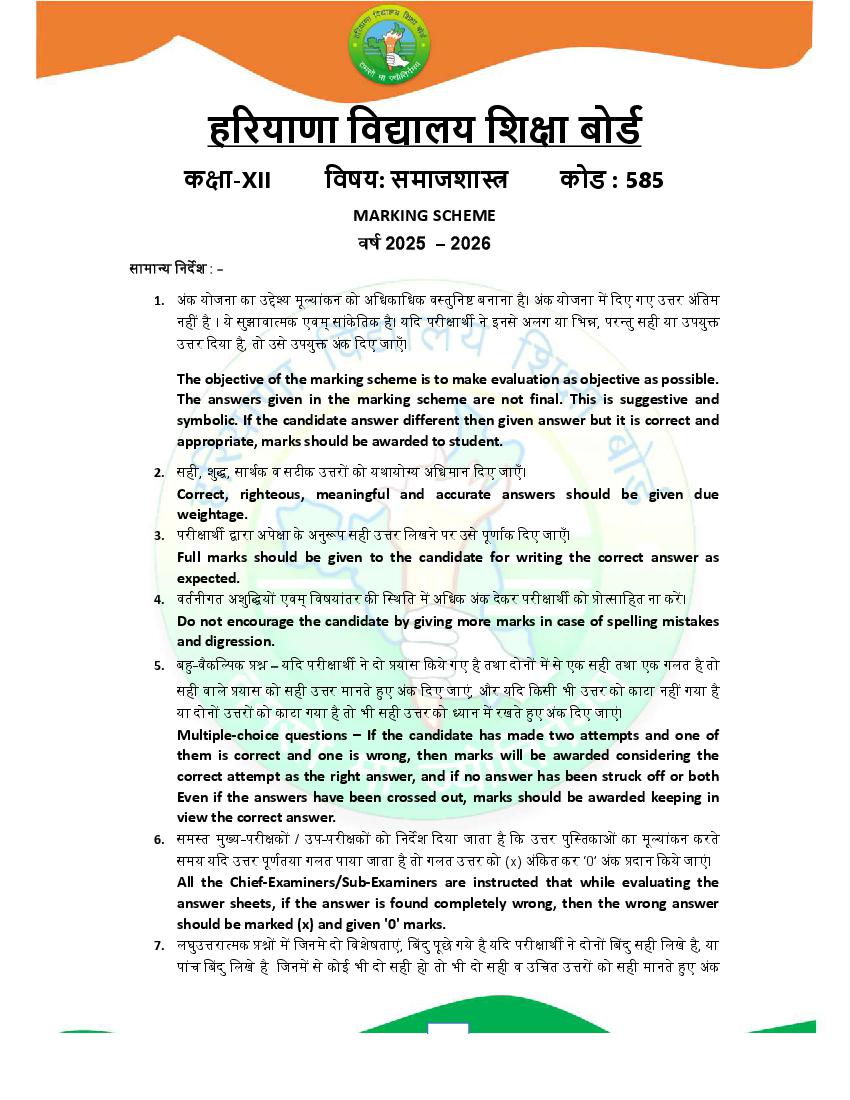
क ा-XII िवषय: समाजशा कोड : 585
MARKING SCHEME
वष 2025 – 2026
सामा य िनदश : -
1. अंक योजना का उ े य मू यांकन को अिधकािधक व तुिन बनाना है। अंक योजना म दए गए उ र अंितम
नह है । ये सुझावा मक एवम् सांकेितक है। य द परी ाथ ने इनसे अलग या िभ , पर तु सही या उपयु
उ र दया है, तो उसे उपयु अंक दए जाएँ।
The objective of the marking scheme is to make evaluation as objective as possible.
The answers given in the marking scheme are not final. This is suggestive and
symbolic. If the candidate answer different then given answer but it is correct and
appropriate, marks should be awarded to student.
2. सही, शु , साथक व सटीक उ र को यथायो य अिधमान दए जाएँ।
Correct, righteous, meaningful and accurate answers should be given due
weightage.
3. परी ाथ ारा अपे ा के अनु प सही उ र िलखने पर उसे पूणाक दए जाएँ।
Full marks should be given to the candidate for writing the correct answer as
expected.
4. वतनीगत अशुि य एवम् िवषयांतर क ि थित म अिधक अंक देकर परी ाथ को ो सािहत ना कर।
Do not encourage the candidate by giving more marks in case of spelling mistakes
and digression.
5. ब -वैकि पक – य द परी ाथ ने दो यास कये गए है तथा दोन म से एक सही तथा एक गलत है तो
सही वाले यास को सही उ र मानते ए अंक दए जाएं, और य द कसी भी उ र को काटा नह गया है
या दोन उ र को काटा गया है तो भी सही उ र को यान म रखते ए अंक दए जाएं।
Multiple-choice questions – If the candidate has made two attempts and one of
them is correct and one is wrong, then marks will be awarded considering the
correct attempt as the right answer, and if no answer has been struck off or both
Even if the answers have been crossed out, marks should be awarded keeping in
view the correct answer.
6. सम त मु य-परी क / उप-परी क को िनदश दया जाता है क उ र पुि तका का मू यांकन करते
समय य द उ र पूणतया गलत पाया जाता है तो गलत उ र को (x) अं कत कर ‘0’ अंक दान कये जाएं।
All the Chief-Examiners/Sub-Examiners are instructed that while evaluating the
answer sheets, if the answer is found completely wrong, then the wrong answer
should be marked (x) and given '0' marks.
7. लघुउ रा मक म िजनमे दो िवशेषताएं, बदु पूछे गये है य द परी ाथ ने दोन बदु सही िलखे है, या
पांच बदु िलखे है िजनम से कोई भी दो सही हो तो भी दो सही व उिचत उ र को सही मानते ए अंक
1
Page 2
In short answer type questions in which two points are asked, if the examinee has
written both the points correctly, or has written five points out of which any two
are correct, even then marks should be given considering two correct and
appropriate answers as correct.
8. भागवार तथा अंकवार बांटे गए न के उ र का मू यांकन भी भागवार तथा अंकवार ही कया जाना
चािहए, िजतना भाग परी ाथ ने सही उ र दया है, उस भाग हेतु िनधा रत पूण अंक दान कये जाएं ।
वणा मक न के उ र जांच करते समय परी क अपने िववेकानुसार अंकन कर सकता है पर तु परी ाथ
को सकारा मक अंकन कया जाएं ।
The answer to the question paper distributed part-wise and number-wise should
also be evaluated part-wise and number-wise, full marks should be awarded for
that part for which the candidate has given the correct answer. While checking the
answers to the descriptive type questions, the examiner can mark according to his
discretion, but the candidate should be given positive marking.
9. भाषा- मता एवं अिभ ि - कौशल पर यान दया जाएं।
Attention should be paid to language-ability and expression-skills.
10. मु य-परी क / उप-परी क को उ र पुि तका का मू यांकन करने के िलए के वल सामा य िनदश/
मागदशन उपल ध करवाया जा रहा है, य द मू यांकन िनदश म कसी कार क ु ट हो, उ र प ना
हो, उ र िनदश म दए गए उ र से अलग हो तो परी क, मु य परी क से िवचार- िवमश करके उस
का मू यांकन अपने िववेक अनुसार कर।
Only general instructions/guidance is being provided to the Chief-Examiners/Sub-
Examiners to evaluate the answer sheets, if there is any error in the evaluation
instructions, the answer is not clear, from the answer given in the answer
instructions If there is a difference, the examiner, after discussing with the chief
examiner, evaluates that question according to his discretion.
11. प म कु ल 38 है। प कु ल चार भाग म िवभ है ।
There are total 38 questions in the question paper. The question paper is divided
into total four parts.
12. भाग 1 म म सं या 01 व 20 तक के शािमल है, सभी 1-1 अंक के है ।
Section A consists of questions up to serial number 01 and 20, each questions is
carrying 1 mark.
13. भाग 2 म म सं या 21 से 29 तक के शािमल है, सभी 2-2 अंक के है सभी अित
लघुउ रा मक है, उ र अिधकतम 30 श द से अिधक ना हो ।
Section B consists of questions from serial number 21 to 29, all questions are of 2
marks each, all questions are very short answer type, answer should not exceed
the maximum limit 30 words.
14. भाग 3 म म सं या 30 से 35 तक के शािमल है, सभी 4-4 अंक के है सभी लघुउ रा मक है,
उ र अिधकतम 80 श द से अिधक ना हो ।
Section C includes questions from serial number 30 to 35, all questions are of 4
marks each, all questions are short answer type, answer should not exceed limit
maximum 80 words.
2
Page 3
है, उ र अिधकतम 200 श द से अिधक ना हो, सं. 36 का उ र ग ांश क सहायता से दया जाना
है।
Section D consists of questions from serial number 36 to 38, all questions carry 6
marks each, all questions are long answer type, answer should not exceed limit 200
words, question no. 36 is to be answered with the help of the passage.
अंक
सं.
भाग – 1
PART – A
1 जनसांि यक य सं मण स धांत (Theory of Demographic Transition) से 1
न न म से कौन जुड़े हुए ह?
Who among the following is associated with the Theory of Demographic
Transition?
a) काल मा स / Karl Marx
b) थॉमस रॉबट मा थस / Thomas Robert Malthus
c) कं सले डे वस / Kingsley Davis
d) ड यूनोए ट न .ड यू .थो पसन और क .एम ./ W. M. Thompson
and Frank W. Noaustin
उ र d) ड यू .ड यू .थो पसन और क .एम .नोए ट न/
W. M. Thompson and Frank W. Noaustin
2 नभरता अनप ु ात को सह प से कैसे प रभा षत कया गया है ? 1
Which of the following correctly defines the Dependency Ratio?
a) कायशील और गैर-कायशील जनसं या का अनुपात
The ratio of working to non-working population
b) ब च और व ृ ध के बीच का अनप ु ात
The ratio of children to elderly in the population
c) 0–14 और 60+ वष के आ त का 15–59 वष क कायशील जनसं या से
अनपु ात
The ratio of the economically dependent population (0–14 and 60+ years) to the
working-age population (15–59 years)
d) ामीण और शहर जनसं या का अनप ु ात
The ratio of rural to urban population
उ र c) 0–14 और 60+ वष के आ त का 15–59 वष क कायशील जनसं या से
अनप ु ात
The ratio of the economically dependent population (0–14 and 60+ years) to
the working-age population (15–59 years)
3
Page 4
What was the major outcome of the Global Influenza Pandemic of 1918–19 in
India?
a) ज म दर म वृ ध / Increase in birth rate
b) सा रता दर म व ृ ध / Increase in literacy rate
c) मृ यु दर म ती व ृ ध और जनसं या म गरावट
Sharp rise in death rate and population decline
d) वा य बीमा क शु आत / Introduction of health insurance
उ र c) मृ यु दर म ती व ृ ध और जनसं या म गरावट
Sharp rise in death rate and population decline
4 "अ य हाथ (Invisible Hand)" और मु त बाज़ार क अवधारणा कस 1
समाजशा ी से जड़ ु ी है ?
The concept of the "Invisible Hand" and free market is associated with which
economist?
a) काल मा स / Karl Marx
b) एडम ि मथ / Adam Smith
c) मै स वेबर / Max Weber
d) म टन डमैन / Milton Friedman
उ र b) एडम ि मथ / Adam Smith
5 सा ता हक जनजातीय बाजार (Weekly Tribal Market) कस कार क सामािजक 1
यव था को दशाता है ?
What kind of social structure is reflected in a Weekly Tribal Market?
a) केवल आ थक लेन-दे न / Purely economic exchange
b) सामािजक और सां कृ तक मेल-जोल / Social and cultural interaction
c) अंतरा य यापार / International trade
d) उपभो ता सं कृ त / Consumer culture
उ र b) सामािजक और सां कृ तक मेल / जोल-Social and cultural interaction
6 जजमानी था का संबंध कससे है? 1
The Jajmani System is primarily associated with:
a) जा त-आधा रत पेशागत वभाजन / Caste-based occupational division
b) आधु नक पंज
ू ीवाद / Modern capitalism
c) वै वीकरण / Globalization
d) ऑनलाइन वपणन / Online marketing
उ र a) जा त-आधा रत पेशागत वभाजन / Caste-based occupational division
4
Page 5
The Mandal Commission was established for what purpose?
a) सा रता बढ़ाने के लए / To improve literacy
b) पछड़े वग क सामािजक और आ थक ि थ त जानने के लए
To identify the social and economic condition of Backward Classes
c) गर बी रे खा तय करने के लए / To fix poverty line
d) म हला अ धकार को बढ़ावा दे ने के लए / To promote women’s rights
उ र b) पछड़े वग क सामािजक और आ थक ि थ त जानने के लए
To identify the social and economic condition of Backward Classes
8 न न ल खत म से कौन-सा उदाहरण सामािजक ब ह कार (Social Exclusion) को 1
दशाता है ?
Which of the following is an example of Social Exclusion?
a) एक छा क पर ा म असफलता / A student failing in exams
b) कसी म हला को पंचायत म बोलने से रोकना / A woman being stopped from
speaking in a village council
c) नौकर के लए सा ा कार दे ना / Attending a job interview
d) उ च श ा ा त करना / Getting higher education
उ र b) कसी म हला को पंचायत म बोलने से रोकना /
A woman being stopped from speaking in a village council
9 भारत म गर बी रे खा के नीचे जीवन यापन करने वाले लोग का तशत नधारण 1
मु यतः कस आधार पर कया जाता है ?
In India, the percentage of population living below the poverty line is primarily
determined on the basis of:
a) श ा तर / Education level
b) खान-पान और आय / Food consumption and income
c) संप का वा म व / Ownership of property
d) बेरोजगार दर / Unemployment rate
उ र b) खान-पान और आय / Food consumption and income
10 Which term refers to exclusive loyalty to one’s own region over the nation? 1
कस श द का योग उस भावना के लए होता है िजसम यि त रा के बजाय
अपने े को ाथ मकता दे ता है?
उ र Regionalism / े वाद
11 एक ऐसी राजनी तक इकाई को या कहते ह िजसक स भुता और सीमाएँ 1
नि चत होती ह?
उ र State / रा य
5
Page 6
language, and history?
एक ऐसे समूह को या कहते ह िजनक पहचान, सं कृ त, भाषा और इ तहास
समान होता है ?
उ र Nation / रा
13 The _________ industry in Assam relied heavily on migrant laborers recruited 1
from tribal and backward regions.
असम क _________ उ योग मु य प से जनजातीय और पछड़े े से लाए
गए वासी मजदरू पर नभर थी।
उ र tea / चाय
14 After independence, industrial towns like _________ and Bhilai were 1
developed to promote industrialization.
वतं ता के बाद, औ योगीकरण को बढ़ावा दे ने के लए _________ और भलाई
जैसे औ यो गक शहर वक सत कए गए।
उ र Bokaro / बोकारो
15 The cities of Mumbai, Kolkata, and Chennai developed as major _________ 1
cities under British rule.
मुंबई, कोलकाता और चे नई जैसे शहर टश शासन के दौरान मुख _________
शहर के प म वक सत हुए।
उ र coastal / तट य
16 Assertion (A): Social movements are always spontaneous and unorganized. 1
Reason (R): Movements do not require leadership or a defined structure.
कथन (A): सामािजक आंदोलन हमेशा अचानक और असंग ठत होते ह।
कारण (R): आंदोलन के लए नेत ृ व या एक नि चत ढांचे क आव यकता नह ं
होती।
a) Both A and R are true. A और R दोन स य ह।
b) Both A and R are false. A और R दोन अस य ह।
c) A is true, but R is false. A स य है, ले कन R अस य है ।
d) A is false, but R is true. A अस य है , ले कन R स य है ।
उ र b) Both A and R are false. A और R दोन अस य ह।
6
Page 7
revolutionary movement.
Reason (R): Revolutionary movements aim to completely overthrow the existing
system.
कथन (A): सूचना का अ धकार अ भयान एक ां तकार आंदोलन का उदाहरण
है।
कारण (R): ां तकार आंदोलन का उ दे य मौजूदा यव था को परू तरह से
उखाड़ फकना होता है ।
a) Both A and R are true, and R is the correct explanation of A.
दोन कथन सह ह, और कारण कथन का सह प ट करण है।
b) Both A and R are true, but R is not the correct explanation of A.
दोन कथन सह ह, पर कारण कथन का प ट करण नह ं है।
c) A is true, but R is false.
कथन सह है , ले कन कारण गलत है।
d) A is false, but R is true.
कथन गलत है , ले कन कारण सह है ।
उ र d) A is false, but R is true.
कथन गलत है , ले कन कारण सह है ।
18 Who led the Champaran Satyagraha related to the indigo farmers' 1
struggles?
चंपारण स या ह, जो नील कसान के संघष से संबं धत था, का नेत ृ व कसने
कया था?
a) Sardar Vallabhbhai Patel / सरदार व लभभाई पटे ल
b) Dr. B.R. Ambedkar / डॉ. बी.आर. अंबेडकर
c) Mahatma Gandhi / महा मा गांधी
d) Subhas Chandra Bose / सुभाष चं बोस
उ र c) Mahatma Gandhi / महा मा गांधी
19 Who invented the modern printing press, which marked the beginning of 1
modern mass media?
आधु नक मु ण ेस का आ व कार कसने कया, िजसने आधु नक जनसंचार
मा यम क शु आत क ?
a) James Augustus Hicky / जे स ऑग टस हक
b) Raja Ram Mohan Roy / राजा राम मोहन राय
c) Johann Gutenberg / योहान गुटेनबग
d) Jawaharlal Nehru / जवाहरलाल नेह
उ र c) Johann Gutenberg / योहान गुटेनबग
7
Page 8
and a turning point in mass media?
भारतीय टे ल वजन पर पहला हंद सोप ओपेरा कौन सा था िजसे जनसंचार
मा यम म एक मील का प थर माना जाता है ?
a) Buniyaad / बु नयाद
b) Mahabharat / महाभारत
c) Ramayan / रामायण
d) Hum Log / हम लोग
उ र d) Hum Log / हम लोग
भाग – 2
PART – B
21 What does fertility rate refer to? 2
जनन दर कसे कहते ह?
Or
What is meant by sex ratio?
लंगानप
ु ात से आप या समझते ह?
उ र The average number of children born to a woman during her reproductive years. 2
एक म हला वारा उसक जनन आयु के दौरान ज मे ब च क औसत सं या।
Or
Number of females per 1000 males in a population.
कसी जनसं या म त 1000 पु ष पर म हलाओं क सं या।
22 What is a nuclear family? 2
ना भक य प रवार या होता है ?
Or
What is the difference between caste and varna?
जा त और वण म या अंतर है ?
उ र A family consisting of husband, wife, and their unmarried children. 2
प त, प नी और उनके अ ववा हत ब च से बना प रवार।
Or
The Varna system is a four-tier classification based on work, whereas caste is a
real social category based on birth.
वण समाज का एक कम आधा रत चार- तर य वभाजन है , जब क जा त ज म
पर आधा रत वा त वक सामािजक ेणी है।
23 What are acquired traits in tribal communities? 2
आ दवासी समुदाय म अिजत गण ु (Acquired Traits) या होते ह?
8
Page 9
religion.
वे गुण जो मु यधारा समाज के संपक से ा त होते ह, जैसे भाषा, पहनावा और
धम।
24 Define civil society. 2
नाग रक समाज (Civil Society) को प रभा षत क िजए।
Or
What is integrationist policy?
एक करणवाद (Integrationist) नी त या है ?
उ र Civil society refers to institutions and organizations independent of the state that 2
promote public interests.
नाग रक समाज वे सं थाएँ और संगठन होते ह जो रा य से वतं होते ह और
जन हत को बढ़ावा दे ते ह।
Or
It seeks to integrate diverse communities while allowing them to retain their
identities.
यह व भ न समुदाय को एक कृत करने का यास करती है , साथ ह उ ह अपनी
पहचान बनाए रखने क अनम ु त दे ती है ।
25 What is Smart City Mission? 2
माट सट मशन या है ?
उ र A government initiative to develop urban infrastructure and services. 2
शहर ढांचे और सेवाओं के वकास के लए एक सरकार पहल।
26 What is the role of Nyaya Panchayats? 2
याय पंचायत क या भू मका है ?
उ र They settle minor civil and criminal disputes at the village level. 2
वे गांव तर पर छोटे नाग रक और आपरा धक ववाद का नपटारा करती ह।
27 What was the main objective of the Land Ceiling Acts? 2
भू म सीमा अ ध नयम का मु य उ दे य या था?
उ र To fix a maximum limit on landholding and redistribute surplus land. 2
भू म रखने क अ धकतम सीमा तय करना और अ त र त भू म का पन ु वतरण
करना।
28 What is the role of advertisements in mass media? 2
जनसंचार मा यम म व ापन क या भू मका होती है ?
उ र Revenue generation / आय उ प न करना 2
29 Name the ecological movement launched in Karnataka similar to Chipko. 2
चपको आंदोलन क तरह कनाटक म शु कया गया पा रि थ तक आंदोलन
कौन सा था?
उ र Appiko Movement / अि पको आंदोलन 2
भाग – 3
PART – C
9
Page 10
Development?
रा य वकास और जनजातीय वकास म या संबंध है ?
अथवा
What are the Permanent and Acquired Traits of Tribal Communities?
आ दवासी समुदाय के थायी और अिजत ल ण या ह?
उ र National development must include the welfare of tribal communities through
inclusion in education, employment, and health while preserving their identity.
रा य वकास म आ दवा सय क श ा, रोजगार और वा य म भागीदार
सु नि चत करते हुए उनक पहचान क र ा भी ज र है।
1+1+
अथवा
1+1
Permanent traits include physical features, language, region, and customs.
Acquired traits include changes due to interaction with mainstream society, like
education, occupation, and migration.
थायी ल ण म शार रक वशेषताएँ, भाषा, े और परं पराएँ आती ह।
अिजत ल ण म मु यधारा से संपक के कारण आए प रवतन जैसे श ा, रोजगार
और वास शा मल ह।
31 Explain the changes brought by industrialisation in Indian society. 4
भारत म औ योगीकरण से आए सामािजक प रवतन क या या क िजए।
उ र Industrialisation led to:
Shift from agrarian to industrial economy
Rise of urban centres and decline of joint families
Growth of factory work, labour unions, and industrial towns
Increased migration and occupational mobility
भारत म औ योगीकरण के कारण:
1+1+
कृ ष आधा रत अथ यव था से औ यो गक अथ यव था क ओर बदलाव
1+1
शहर करण से संयु त प रवार म गरावट
फै काय, मक संघ और औ यो गक शहर का वकास
वास और पेशागत ग तशीलता म व ृ ध हुई
32 Explain the concept of Westernisation and its impact on Indian society. 4
पा चा यकरण क अवधारणा को समझाइए और भारतीय समाज पर उसके भाव
को ल खए।
10
Page 11
dress, food habits, etc. It also includes changes brought about by British rule,
such as the introduction of modern law, secularism, and rational thinking.
Impact:
1. Rise in secular and rational thought.
2. Spread of modern education and science.
3. Change in clothing, lifestyle, and institutions. 2+2
4. New aspirations and identity formation.
पा चा यकरण का अथ है पि चमी मू य , रहन-सहन, श ा, पहनावे, खानपान आ द
को अपनाना। यह टश शासन के कारण भारत म आए प रवतन जैसे क
आधु नक कानून, धम नरपे ता और ता कक सोच को भी दशाता है।
भाव:
1. धम नरपे और ता कक सोच म व ृ ध।
2. आधु नक श ा और व ान का सार।
3. पहनावे और जीवनशैल म प रवतन।
4. नई आकां ाओं और पहचान का नमाण।
33 Mention any four problems faced by industrial workers in India. 1+1+
भारत म औ यो गक मक को आने वाल चार सम याएँ ल खए।
1+1
अथवा
Describe the role of government schemes like ‘Make in India’ and ‘Stand Up
India’ in employment generation.
‘मेक इन इं डया’ और ‘ टड अप इं डया’ जैसी सरकार योजनाओं क रोजगार 2+2
सज
ृ न म भू मका बताइए।
उ र Low Wages / कम वेतन – Not enough to meet daily needs.
जीवन यापन के लए पया त नह ं होता। 1+1+
Poor Working Conditions / खराब काय वातावरण – Unsafe and 1+1
unhealthy.
असुर त और अ वा यकर होता है।
Job Insecurity / नौकर क अ नि चतता – Temporary and contractual
jobs.
अ थायी और अनब ु ंध आधा रत काय।
Long Working Hours / लंबे काय समय – No fixed time or rest.
नि चत समय और व ाम क कमी
अथवा
1. Make in India / मेक इन इं डया – Promotes manufacturing in India,
leading to more jobs.
भारत म व नमाण को बढ़ावा दे ता है , िजससे रोजगार के अवसर बढ़ते ह।
2. Stand Up India / टड अप इं डया – Supports SC/ST and women 2+2
entrepreneurs with loans.
अनस ु ू चत जा त/जनजा त और म हलाओं को उ य मता हे तु ऋण दान
करता है ।
11
Page 12
रोज़गार पर वै वीकरण का भाव समझाइए।
उ र Globalisation has led to:
1. Growth in service sector jobs – IT, BPO, and customer support
expanded.
2. Decline in traditional jobs – Handicrafts, small-scale industries faced
losses due to cheap imports.
3. Informalisation – Many workers shifted to contract-based or informal
1+1+
jobs. 1+1
4. New opportunities – Start-ups, online platforms, remote work increased.
वै वीकरण ने न न ल खत भाव डाले ह:
1. सेवा े म व ृ ध – आईट , बीपीओ, ाहक सेवा।
2. पारं प रक नौक रय म गरावट – ह त श प, लघु उ योग भा वत।
3. असंग ठत रोजगार का सार – ठे के पर काय।
4. नए अवसर – टाटअप, ऑनलाइन काय, दरू थ काय।
35 What was the Mandal Commission? State its impact. 4
मंडल आयोग या था? इसके भाव बताइए।
12
Page 13
Second Backward Classes Commission, was established in India in
1979. Its aim was to identify socially and educationally backward classes
(SEBCs), commonly known as other backward classes (OBCs) . The
Commission submitted its report in 1980, noting that 52% of India's 1+3
population consisted of OBCs, and recommended 27% reservation for
OBCs in government jobs.
The main points of impact of Mandal Commission are as follows:
Increased representation of OBCs in government jobs and
education:
Rise in caste based politics:
Violent protests:
Increase in caste tension:
Changing Socio-Political Scenario:
मंडल आयोग (मंडल कमीशन), िजसे वतीय पछड़ा वग आयोग भी कहा जाता
है , 1979 म भारत म था पत कया गया था। इसका उ दे य सामािजक और
शै णक प से पछड़े वग क पहचान करना था (एसईबीसी), िज ह आमतौर
पर अ य पछड़ा वग के प म जाना जाता है। (ओबीसी) आयोग ने 1980 म
अपनी रपोट पेश क , िजसम भारत क आबाद का 52% ओबीसी से बना है , और
उ ह ने सरकार नौक रय म ओबीसी के लए 27% आर ण क सफा रश क थी
मंडल आयोग के भाव के मु य बंद ु इस कार ह:
सरकार नौक रय और श ा म ओबीसी का त न ध व बढ़ा-
जा त आधा रत राजनी त म व ृ ध-
हंसक वरोध दशन-
जा तगत तनाव म व ृ ध-
सामािजक-राजनी तक प र य म बदलाव-
भाग – 4
PART – D
13
Page 14
भारत क जनसं या संरचना म पछले एक सद के दौरान मह वपूण प रवतन आए
ह। 1901 से 2011 के बीच, भारत क जनसं या लगभग 23.8 करोड़ से बढ़कर 120 करोड़
से अ धक हो गई। यह व ृ ध मु य प से वा य सु वधाओं म सुधार के कारण म ृ यु
दर म कमी आने से हुई, जब क ज म दर उतनी तेज़ी से नह ं घट । इस असंतुलन के
कारण जनसं या म ती व ृ ध हुई।
समय के साथ, रा य जनसं या नी त और व भ न वा य अ भयान क मदद से
जनन दर को नयं त कया गया। आज भारत क एक बड़ी जनसं या कायशील आयु
वग (15 से 64 वष) म है , िजसे जनसांि यक य लाभांश (Demographic Dividend) कहा
जाता है । हालाँ क, इस लाभांश का पूरा लाभ उठाने के लए, दे श को श ा, कौशल वकास
और रोजगार के अवसर म नवेश करना होगा।
India’s demographic profile has undergone significant changes over the past
century.
Between 1901 and 2011, India’s population increased from about 238 million to
over 1.2 billion. This growth was influenced by a decline in death rates due to
better health infrastructure, but birth rates did not fall at the same pace. This
created a population boom. Over time, policies like the National Population
Policy and various health campaigns helped control the fertility rate. India now
has a large proportion of its population in the working-age group (15–64 years),
creating what is called a demographic dividend. However, to benefit from this,
the country must invest in education, skills, and jobs.
Q1. What factors contributed to India’s population boom after 1901?
2
1901 के बाद भारत क जनसं या म व ृ ध के या कारण थे?
Q2. What is meant by "demographic dividend"?
"जनसांि यक य लाभांश" से आप या समझते ह? 2
Q3. What steps should India take to make the most of its demographic dividend?
भारत को अपने जनसांि यक य लाभांश का लाभ उठाने के लए या कदम उठाने 2
चा हए?
14
Page 15
1. India’s population boom occurred due to a sharp decline in death rates as a
result of improved healthcare and sanitation, while birth rates remained high for 2
a longer time.
भारत क जनसं या म तेजी से व ृ ध का कारण म ृ यु दर म गरावट थी, जब क ज म
दर अ धक बनी रह ।
2. Demographic dividend refers to the economic benefit arising from a large
proportion of the population being in the working-age group (15–64 years).
2
जनसांि यक य लाभांश उस आ थक लाभ को कहते ह जो तब ा त होता है जब
जनसं या का बड़ा ह सा कायशील आयु वग म होता है ।
3. India should invest in education, skill development, and employment
opportunities to effectively utilize its working-age population.
भारत को श ा, कौशल वकास और रोजगार के अवसर म नवेश करना चा हए ता क 2
कायशील जनसं या का लाभ उठाया जा सके।
37 Discuss the role of social reformers in addressing social inequality and exclusion 6
in 19th and 20th century India.
19वीं और 20वीं शता द म सामािजक असमानता और ब ह करण को दरू करने
म समाज सुधारक क भू मका पर चचा क िजए।
अथवा
ट पणी कर – Comment
यो तबा फुले Jyotirao Phule 3 +3
आय समाज Arya Samaj
15
Page 16
discrimination, gender inequality, and untouchability in India:
1. Raja Rammohun Roy – He led the anti-Sati movement and founded the
Brahmo Samaj to promote social justice and women’s rights.
2. Ishwar Chandra Vidyasagar – He worked for widow remarriage and
girl’s education.
3. Jyotiba Phule – He challenged caste oppression and promoted education
for women and Dalits.
4. Sir Syed Ahmed Khan – He worked for modern education among
Muslims and promoted reform in Muslim society.
5. Sri Narayana Guru – He led a major movement against caste-based
inequality in Kerala and emphasized one caste, one religion, and one god
for all.
6. Dayanand Saraswati & Arya Samaj – Promoted women’s rights, anti-
caste ideology, and Vedic reforms.
7. Tarabai Shinde & Begum Rokeya – Wrote texts like Stree Purush 3
Tulana and Sultana’s Dream which criticized patriarchy and demanded
gender equality.
19वीं और 20वीं शता द म कई समाज सुधारक ने भारत म जातीय भेदभाव,
लंग असमानता और अ प ृ यता को समा त करने के लए काय कया:
1. राजा राममोहन राय – सती था के वरोध म आंदोलन चलाया और म
समाज क थापना क । उ ह ने म हलाओं के अ धकार के लए काय
कया।
2. ई वरचं व यासागर – वधवा पन
ु ववाह और बा लका श ा के समथक
थे।
3. यो तबा फुले – उ ह ने जा तवाद का वरोध कया और द लत व
म हलाओं के लए श ा को बढ़ावा दया।
4. सर सैयद अहमद खान – उ ह ने मुि लम समाज म आधु नक श ा और
सुधार क वकालत क ।
5. ी नारायण गु – उ ह ने केरल म जा त-आधा रत भेदभाव के व ध
आंदोलन चलाया और "एक जा त, एक धम, एक ई वर" का संदेश दया।
6. दयानंद सर वती और आय समाज – म हलाओं के अ धकार, जा त- वरोध
और वै दक सध
ु ार को ो सा हत कया।
ं े व बेगम
7. ताराबाई शद कैया – उ ह ने ी पु ष तुलना और सु ताना का
सपना जैसे ंथ के मा यम से लंग भेदभाव क आलोचना क और
समानता क मांग क ।
16
Page 17
democracy in India.
भारत म सामािजक याय और जमीनी तर पर लोकतं को बढ़ावा दे ने म
6
पंचायती राज क भू मका पर चचा क िजए।
अथवा
What are the main features of the 73rd and 74th Constitutional Amendments,
and how have they contributed to local self-governance in India?
73व और 74व सं वधान संशोधन क मु य वशेषताएँ या ह, और इ ह ने भारत
म थानीय वशासन म कस कार योगदान दया है ?
17
Page 18
implemented in 1993) mark a historic step in strengthening democracy at the
grassroots level in India.
The 73rd Amendment deals with Panchayati Raj Institutions (PRIs) in 6
rural areas.
The 74th Amendment focuses on Municipalities in urban areas.
Key Features:
1. Three-tier structure of local governance – Gram Panchayat, Panchayat
Samiti, Zila Parishad (rural) and Nagar Panchayat, Municipal Council,
Municipal Corporation (urban).
2. Regular elections every five years.
3. Reservation of seats for SCs, STs and women (33%).
4. Creation of State Election Commission for conducting local body
elections.
5. Formation of State Finance Commission every five years to ensure
proper allocation of financial resources.
6. Clear distribution of powers and responsibilities among local bodies.
These amendments institutionalized local democracy, improved public
participation, empowered weaker sections, and made governance more
accountable and transparent.
73व और 74व सं वधान संशोधन (1992 म पा रत, 1993 से लागू) भारत म थानीय
वशासन को सश त करने क दशा म एक ऐ तहा सक कदम थे।
73वां संशोधन ामीण े म पंचायती राज सं थाओं से संबं धत है।
74वां संशोधन शहर े म नगरपा लका सं थाओं से संबं धत है।
मु य वशेषताएँ:
1. थानीय शासन क तीन- तर य संरचना – ाम पंचायत, पंचायत स म त,
िजला प रषद ( ामीण) और नगर पंचायत, नगर प रषद, नगर नगम
(शहर )।
2. हर 5 वष म नय मत चन
ु ाव।
3. SC, ST और म हलाओं (33%) के लए आर ण।
4. रा य नवाचन आयोग का गठन – थानीय नकाय चुनाव के लए।
5. रा य व आयोग का गठन – व ीय संसाधन के यायसंगत वतरण के
लए।
6. थानीय नकाय के लए शि तय और िज मेदा रय का प ट वतरण।
इन संशोधन ने थानीय लोकतं को सं थागत प दया, जनभागीदार
बढ़ाई, वं चत वग को सश त कया और शासन को जवाबदे ह और पारदश बनाया।
18
Document Details
| Board / Org | Haryana Board |
| Exam | Class 12 |
| Type | Sample Paper |
| Pages | 18 |
| Updated | 24 Sep 2026 |