CBSE Class 12 Question Paper 2025 Painting
Finished viewing? Save it for later —
Download CBSE Class 12 Question Paper 2025 Painting (PDF · 12 pages)About CBSE Class 12 Question Paper 2025 Painting
CBSE Class 12 Question Paper 2025 Painting is available here for free download. Published by CBSE for Class 12, this question paper can be viewed online or downloaded as a PDF (12 pages). Candidates preparing for Class 12 can use CBSE Class 12 Question Paper 2025 Painting to understand the exam pattern, the type of questions asked, and the overall difficulty level.
Frequently Asked Questions
How can I download CBSE Class 12 Question Paper 2025 Painting?
Open this page and click the Download button to save CBSE Class 12 Question Paper 2025 Painting as a PDF. It is completely free on AglaSem Docs.
Is CBSE Class 12 Question Paper 2025 Painting free to download?
Yes. CBSE Class 12 Question Paper 2025 Painting can be viewed online and downloaded as a PDF free of cost on AglaSem Docs.
How many pages does CBSE Class 12 Question Paper 2025 Painting have?
CBSE Class 12 Question Paper 2025 Painting contains 12 pages, which you can read online or download together as a single PDF.
Where can I find more Class 12 study material?
You can find more Class 12 question papers, sample papers, syllabus, and answer keys on AglaSem Docs.
CBSE Class 12 Question Paper 2025 Painting – Text
Read the full text of this question paper below — useful to quickly search, copy and reference the content online without downloading the PDF.
📄 View text version (12 pages)
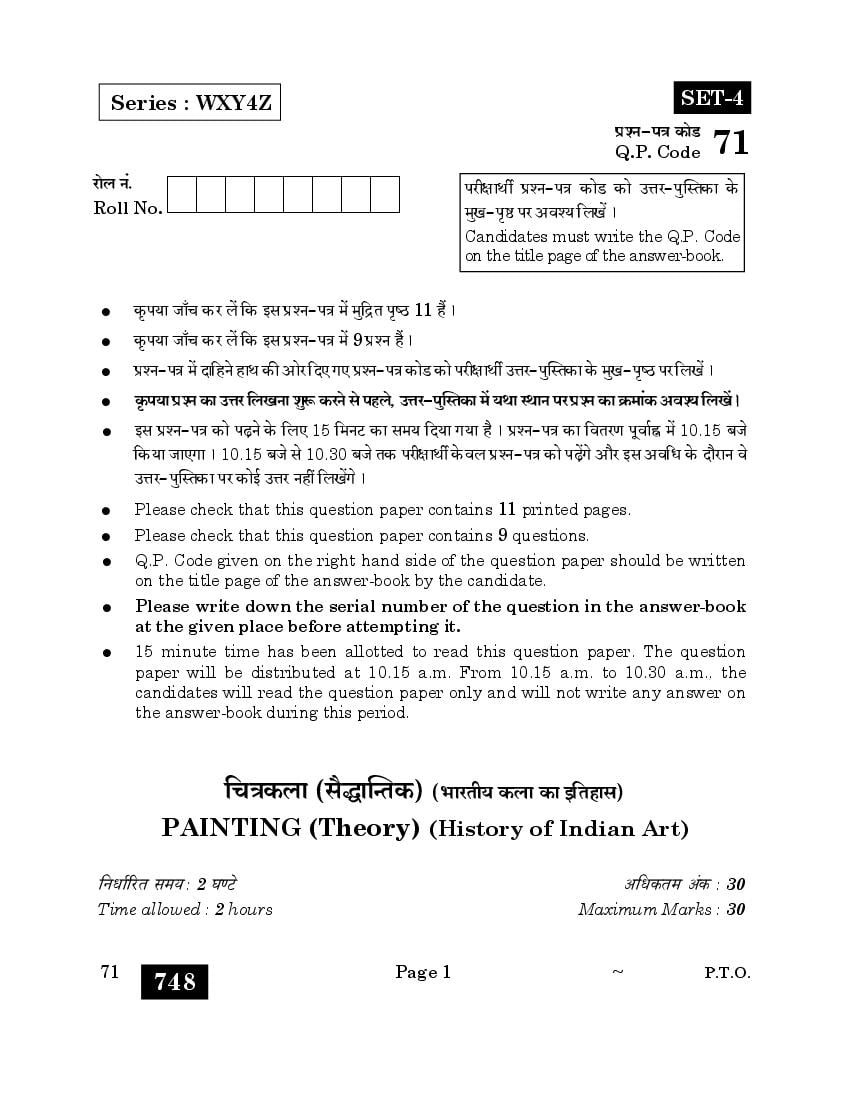
Page 1
-
Q.P. Code 71
. - -
Roll No. -
Candidates must write the Q.P. Code
on the title page of the answer-book.
- 11
- 9
- - - -
, -
- 15 - 10.15
10.15 10.30 -
-
Please check that this question paper contains 11 printed pages.
Please check that this question paper contains 9 questions.
Q.P. Code given on the right hand side of the question paper should be written
on the title page of the answer-book by the candidate.
Please write down the serial number of the question in the answer-book
at the given place before attempting it.
15 minute time has been allotted to read this question paper. The question
paper will be distributed at 10.15 a.m. From 10.15 a.m. to 10.30 a.m., the
candidates will read the question paper only and will not write any answer on
the answer-book during this period.
() ( )
PAINTING (Theory) (History of Indian Art)
{ZYm©[aV g‘¶ : 2 KÊQ>o A{YH$V‘ A§H$ : 30
Time allowed : 2 hours Maximum Marks : 30
71 Page 1 ~ P.T.O.
748
Page 2
– : ( 1 )
– ( 2 )
– ( 6 )
–
( )
1. : 81=8
(i) ‘ (-)’ ? 1
(A)
(B)
(C) (-)
(D)
(ii) (A) :
(R) :
1
(A) (A) (R) (R), (A)
(B) (A) (R) (R), (A)
(C) (A) , (R)
(D) (A) , (R)
(iii) 1
(A) (B)
(C) (D)
71 Page 2 ~
Page 3
SECTION – A : Attempt all questions. (Each Question carries 1 mark)
SECTION – B : Attempt all questions. (Each Question carries 2 marks)
SECTION – C : Attempt any two questions. (Each Question carries 6 marks)
SECTION – A
(Multiple Choice Questions)
1. Select the right answer from the given options : 81=8
(i) Which of these statements is not correct about the painting ‘Radha
(Bani - thani)’ from your syllabus ? 1
(A) It belongs to Kishangarh school of Rajasthan.
(B) Blue colour is used in the background.
(C) Radha (Bani-thani) is shown in a plain white costume.
(D) The painting was made by Nihal Chand.
(ii) Assertion (A) : Basohli and Kangra were the main centers of Pahari
School.
Reason (R) : Pahari school received abundant patronage and
suitable artistic environment in Basohli and Kangra. 1
(A) Both (A) and (R) are true and (R) is the correct explanation of (A).
(B) Both (A) and (R) are true, but (R) is not the correct explanation
of (A).
(C) (A) is true, but (R) is false.
(D) (A) is false, but (R) is true.
(iii) Select the painter associated with Mewar school of miniature
painting according to your course of study. 1
(A) Dana (B) Manaku
(C) Sahibdin (D) Nihal chand
71 Page 3 ~ P.T.O.
Page 4
(A) (B)
(C) (D)
(v) ? 1
(A) (B)
(C) (D)
(vi) ? 1
(A) ( ) (B)
(C) (D)
(vii) , ? 1
(A) (B)
(C) (D)
(viii) ? 1
(A) (B)
(C) (D)
–
( ) 5 2 = 10
( 100 )
2. (a) () -
-
(i)
(ii) 2
71 Page 4 ~
Page 5
painting ? 1
(A) Rajasthani school (B) Mughal school
(C) Pahari school (D) Bengal school
(v) Which painter belongs to the Mughal miniature school of painting,
from your syllabus ? 1
(A) Miskin (B) Nain Sukh
(C) Nihal Chand (D) Sahibdin
(vi) Which colour is used in the National Flag of India as a symbol of
valour and sacrifice ? 1
(A) Indian Green (B) White
(C) Dark Blue (D) Saffron
(vii) Hyderabad, Bijapur and Golconda were the main centers of which
school of miniature painting ? 1
(A) Rajasthani School (B) Deccan School
(C) Pahari School (D) Bengal School
(viii) Which artist did the work of Renaissance of Bengal School ? 1
(A) Abanindranath Tagore (B) Amrita Sher Gill
(C) Amar Nath Sehgal (D) Raja Ravi Varma
SECTION – B 5 2 = 10
(Short Answer Type Questions)
(Answer for these questions is expected in around 100 words.)
2. (a) Chaugan (Polo) was a major recreational game of the royal families
in which women also used to participate enthusiastically. In different
provinces of India, many such paintings by the rulers of that time
are found which confirm the above fact. Rajasthani art is also not
untouched by this.
(i) Identify any such painting made in Rajasthani School of
Miniature and write the name of its title and painter.
(ii) Name the sub-school and describe the compositional
arrangement of the painting. 2
OR
71 Page 5 ~ P.T.O.
Page 6
,
:
(i)
(ii) 2
3. (a)
(i)
(ii) 2
(b) - -
-
(i)
(ii) () 2
4.
(a) ( ) 2
(b) (-) 2
71 Page 6 ~
Page 7
any one such painting made on this subject in Mughal School of
Miniature which is included in your syllabus, and then throw light
on the following points :
(i) Title of the painting and name of the painter.
(ii) Explain compositional arrangement and artistic aspect of the
painting in short. 2
3. (a) In Indian culture, Gurus have been given a higher status than God.
Disciples used to receive education by staying in the proximity of the
Guru. One such Deccan School miniature painting has been included
in your syllabus :
(i) Identify this miniature and write about its title and medium.
(ii) Name the sub-school of the painting and describe the painting. 2
OR
(b) Dara Shikoh was a great admirer of Sufi Saints. To give full respect
and honour to sufi-saints, on the request of Dara Shikoh, the court
painters made many portraits of sufi-sants of that time during
Shahjahan’s reign. One such miniature is related to the great saints
Kabirdas and Raidas.
(i) Identify this miniature included in your syllabus and write
about its painter and medium.
(ii) Explain in short about the painting and name the school. 2
4. Appreciate the following art works with special reference to the use of
medium and technique :
(a) Ganesha (Sculpture) 2
OR
(b) Devi (Graphic - print) 2
71 Page 7 ~ P.T.O.
Page 8
(a) ( ) 2
(b) ( ) 2
6. (a) -
(i)
(ii) 2
(b)
-
(i)
(ii) 2
–
( ) 2 6 = 12
( 200 )
:
7.
,
:
(a)
(b)
(c) 2+2+2=6
8. :
(a)
(b) ( )
(c) ‘’ 2+2+2=6
71 Page 8 ~
Page 9
in which the above feelings have been created.
(a) Journey’s End (Abanindranath Tagore) 2
OR
(b) Shiv and Sati (Nandalal Bose) 2
6. (a) The painters of Basohli school of miniature made Krishna-Leela the
main basis (subject) of their paintings. Many of these paintings
reveal Lord Shri Krishna and his divine and unbreakable love with
the Gopis.
(i) Identify the painting included in your syllabus and write its
title and the name of the painter.
(ii) Give an aesthetic description of the compositional arrangement
of the painting. 2
OR
(b) Pahari School of Miniature has a special place in Indian painting.
Basohli and Kangra are considered its sub-schools.
(i) Write the title and the name of the painter of the Kangra School
of Miniature painting included in your syllabus.
(ii) Describe the artistic features of the painting in your own words. 2
SECTION – C 2 6 = 12
(Long Answer Type Questions)
(Answer for these questions is expected in around 200 words.)
Attempt any two questions from the given options :
7. This painting of Rajasthani school depicts an important event from
‘Ramayana’ which shows ideal human values, devotion to duty and depth
of family relationships. Identify any such painting included in your
syllabus which has the above mentioned characteristics. Thereafter
explain this painting on the basis of the following points :
(a) Title of the painting and name of its painter.
(b) Medium and sub-school of the painting.
(c) Subject matter and compositional arrangement of the painting.
2+2+2=6
8. Discuss the following points in detail through a critical essay on Bengal school :
(a) Origin and Development of Bengal School.
(b) Four major painters of Bengal School (From your syllabus).
(c) Aesthetic description of the painting named ‘Radhika’ included in the
syllabus. 2+2+2=6
71 Page 9 ~ P.T.O.
Page 10
:
(a)
(b)
(c) 2+2+2=6
__________________
71 Page 10 ~
Page 11
period wedding. Based on your study, answer the following :
(a) Name the painting and its artist.
(b) Describe the overall composition focusing on the use of colours and
detail of figures.
(c) Write about any 2 stylistic features of Mughal School of Miniature
painting. 2+2+2=6
____________
71 Page 11 ~ P.T.O.
Page 12
Document Details
| Board / Org | CBSE |
| Exam | Class 12 |
| Type | Question Paper |
| Pages | 12 |
| Updated | 24 Sep 2026 |