MBSE HSSLC Sample Question Paper Biology – Text
Read the full text of this sample paper below — useful to quickly search, copy and reference the content online without downloading the PDF.
📄 View text version (2 pages)
Page 1
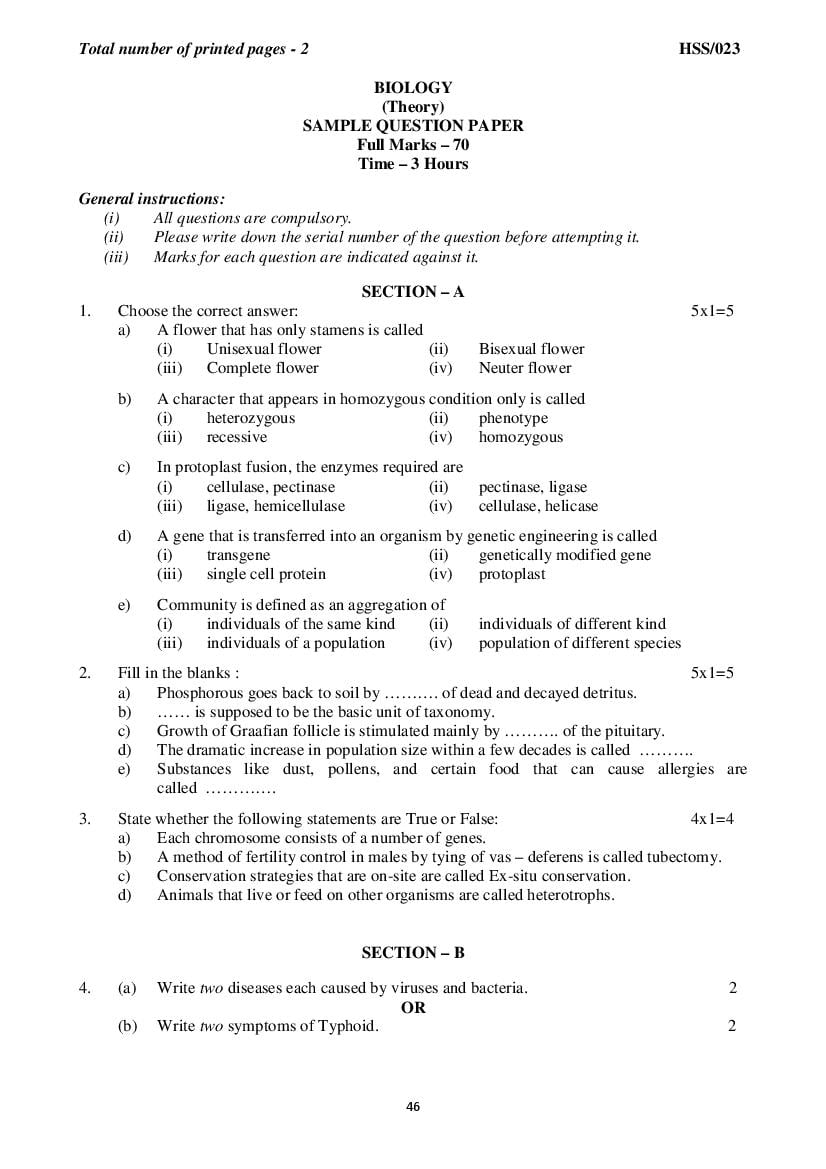
Total number of printed pages - 2 HSS/023 BIOLOGY (Theory) SAMPLE QUESTION PAPER Full Marks – 70 Time – 3 Hours General instructions: (i) All questions are compulsory. (ii) Please write down the serial number of the question before attempting it. (iii) Marks for each question are indicated against it. SECTION – A 1. Choose the correct answer: 5x1=5 a) A flower that has only stamens is called (i) Unisexual flower (ii) Bisexual flower (iii) Complete flower (iv) Neuter flower b) A character that appears in homozygous condition only is called (i) heterozygous (ii) phenotype (iii) recessive (iv) homozygous c) In protoplast fusion, the enzymes required are (i) cellulase, pectinase (ii) pectinase, ligase (iii) ligase, hemicellulase (iv) cellulase, helicase d) A gene that is transferred into an organism by genetic engineering is called (i) transgene (ii) genetically modified gene (iii) single cell protein (iv) protoplast e) Community is defined as an aggregation of (i) individuals of the same kind (ii) individuals of different kind (iii) individuals of a population (iv) population of different species 2. Fill in the blanks : 5x1=5 a) Phosphorous goes back to soil by ………. of dead and decayed detritus. b) …… is supposed to be the basic unit of taxonomy. c) Growth of Graafian follicle is stimulated mainly by ………. of the pituitary. d) The dramatic increase in population size within a few decades is called ………. e) Substances like dust, pollens, and certain food that can cause allergies are called …………. 3. State whether the following statements are True or False: 4x1=4 a) Each chromosome consists of a number of genes. b) A method of fertility control in males by tying of vas – deferens is called tubectomy. c) Conservation strategies that are on-site are called Ex-situ conservation. d) Animals that live or feed on other organisms are called heterotrophs. SECTION – B 4. (a) Write two diseases each caused by viruses and bacteria. 2 OR (b) Write two symptoms of Typhoid. 2 46
Page 2
HSS/023 5. Differentiate between active and passive immunity. 2 6. What is STD? Give four examples of STD. 2 7. How is test cross used to determine the genotype of an organism? 2 8. What is the role of restriction endonuclease and DNA ligase in rDNA technology? 2 9. Differentiate between Ectotherms and Endotherms. 2 10. What are biogeochemical cycles? Give two examples. 2 SECTION – C 11. (a) What are the effects of soil erosion? 3 OR (b)What is noise pollution? Write two effects of noise pollution. 3 12. How does biodiversity vary with altitude and latitude? 3 13. Explain palindromic nucleotide sequence with example. 3 14. What is a Bio-reactor? What are the important aspects of a Bio-reactor? 3 15. What are the different blood groups and the kinds of antigens and antibodies? 3 16. What is ‘semi-conservative’ DNA replication? How was it experimentally proved? 3 17. Explain the secondary treatment of sewage and write how it differs from physical treatment. 3 18. Draw a well labelled diagram of somatic hybridization and explain the steps. 3 19. Describe the process of pollen germination with a labelled diagram. 3 SECTION – D 20. (a) Explain spermatogenesis in detail with a diagram. 5 OR (b) Explain the different steps in fertilization with the help of a diagram. 5 21. (a) (i) What is colour blindness ? What will happen if a colour blind male marries a normal female? 3 (ii) Differentiate between co-dominance and incomplete dominance. 2 OR (b) What is genetic code? Explain four characteristics of genetic code. 5 22. (a) Explain with diagram, amplification of gene of interest using PCR. 5 OR (b) What is the cause of ADA deficiency? Explain the steps in gene therapy to treat SCID patient with a suitable diagram. 5 ___________________ HSS/023 47