MBSE HSSLC Sample Question Paper Accountancy
Finished viewing? Save it for later —
Download MBSE HSSLC Sample Question Paper Accountancy (PDF · 6 pages)About MBSE HSSLC Sample Question Paper Accountancy
MBSE HSSLC Sample Question Paper Accountancy is available here for free download. Published by Mizoram Board for Class 12, this sample paper can be viewed online or downloaded as a PDF (6 pages). Candidates preparing for Class 12 can use MBSE HSSLC Sample Question Paper Accountancy to understand the exam pattern, the type of questions asked, and the overall difficulty level.
Frequently Asked Questions
How can I download MBSE HSSLC Sample Question Paper Accountancy?
Open this page and click the Download button to save MBSE HSSLC Sample Question Paper Accountancy as a PDF. It is completely free on AglaSem Docs.
Is MBSE HSSLC Sample Question Paper Accountancy free to download?
Yes. MBSE HSSLC Sample Question Paper Accountancy can be viewed online and downloaded as a PDF free of cost on AglaSem Docs.
How many pages does MBSE HSSLC Sample Question Paper Accountancy have?
MBSE HSSLC Sample Question Paper Accountancy contains 6 pages, which you can read online or download together as a single PDF.
Where can I find more Class 12 study material?
You can find more Class 12 question papers, sample papers, syllabus, and answer keys on AglaSem Docs.
MBSE HSSLC Sample Question Paper Accountancy – Text
Read the full text of this sample paper below — useful to quickly search, copy and reference the content online without downloading the PDF.
📄 View text version (6 pages)
Page 1
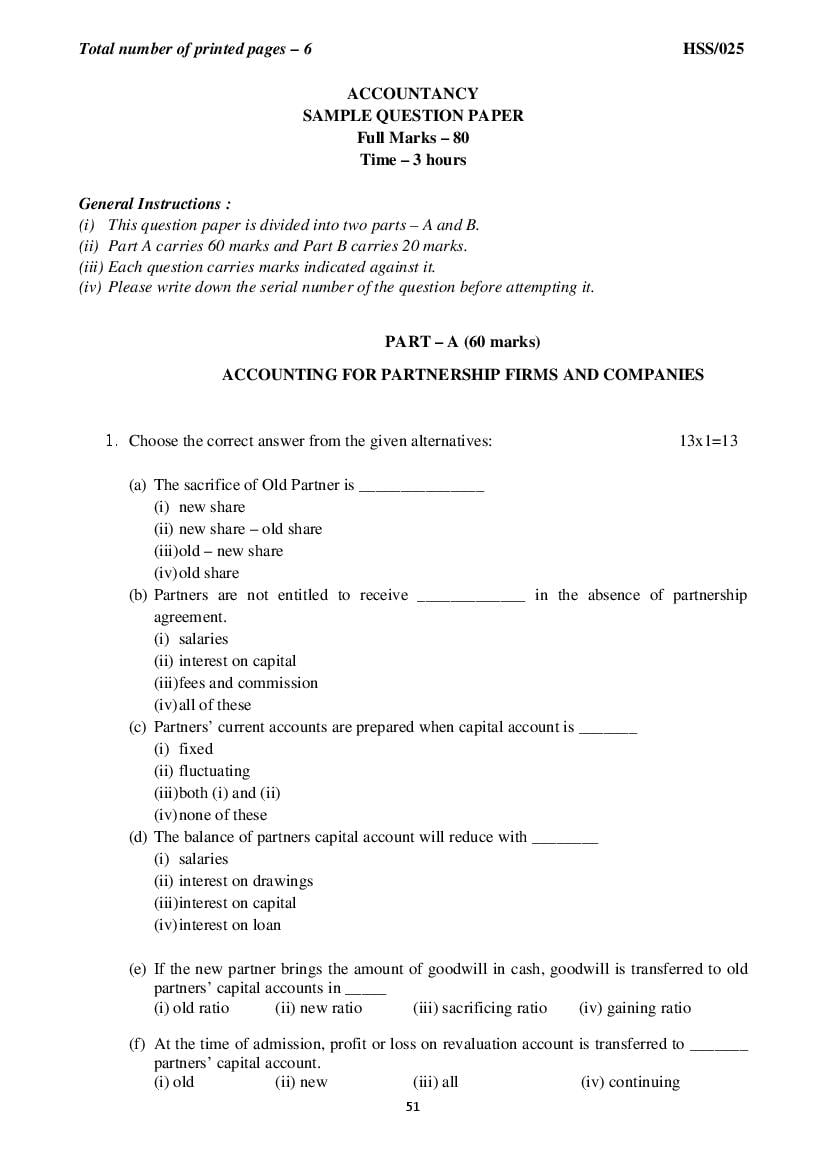
ACCOUNTANCY
SAMPLE QUESTION PAPER
Full Marks – 80
Time – 3 hours
General Instructions :
(i) This question paper is divided into two parts – A and B.
(ii) Part A carries 60 marks and Part B carries 20 marks.
(iii) Each question carries marks indicated against it.
(iv) Please write down the serial number of the question before attempting it.
PART – A (60 marks)
ACCOUNTING FOR PARTNERSHIP FIRMS AND COMPANIES
1. Choose the correct answer from the given alternatives: 13x1=13
(a) The sacrifice of Old Partner is _______________
(i) new share
(ii) new share – old share
(iii)old – new share
(iv) old share
(b) Partners are not entitled to receive _____________ in the absence of partnership
agreement.
(i) salaries
(ii) interest on capital
(iii)fees and commission
(iv) all of these
(c) Partners’ current accounts are prepared when capital account is _______
(i) fixed
(ii) fluctuating
(iii)both (i) and (ii)
(iv) none of these
(d) The balance of partners capital account will reduce with ________
(i) salaries
(ii) interest on drawings
(iii)interest on capital
(iv) interest on loan
(e) If the new partner brings the amount of goodwill in cash, goodwill is transferred to old
partners’ capital accounts in _____
(i) old ratio (ii) new ratio (iii) sacrificing ratio (iv) gaining ratio
(f) At the time of admission, profit or loss on revaluation account is transferred to _______
partners’ capital account.
(i) old (ii) new (iii) all (iv) continuing
51
Page 2
(i) new ratio (ii) old ratio (iii) sacrificing ratio (iv) gaining ratio
(h) On the death of a partner, the deceased partner’s capital account will be credited
with _______
(i) his/her share of goodwill
(ii) goodwill of the firm
(iii)share of goodwill of remaining partners
(iv) none of these
(i) In the absence of any information regarding the acquisition of share in profit of the
retiring/deceased partner by the remaining partners, it is assumed that they will acquire
his/her share in ______
(i) old ratio (ii) new ratio (iii) equal ratio (iv) none of these
(j) A company is created by ______
(i) General law
(ii) agreement between investors or potential shareholders
(iii)Status of its members
(iv) Special act of parliament
(k) Securities Premium Account can be used for _______
(i) paying dividend on share
(ii) writing off the expenses on any issue of shares or debentures
(iii)paying tax liabilities
(iv) meeting the loss on the sale of an asset
(l) Capital reserve is formed if shares are ________
(i) issued
(ii) forfeited
(iii)forfeited and reissued
(iv) in all the above cases
(m) Share allotment account is _______
(i) Personal account
(ii) Impersonal account
(iii)Real account
(iv) Nominal account
2. R and S were partners in a firm sharing in the ratio of 2:1. Their capitals were Rs 3,00,000
and Rs 2,00,000 respectively. They agreed to allow interest on capital @12% p.a. The profit
of the firm before interest on capital amounts to Rs 48,000. Show the allocation of interest
on capital if there is no agreement except for interest on capital. 3
52
Page 3
(i) If 1000 are drawn for 1st day of every month for seven months.
(ii) 5000 are drawn (date not specified).
4. A firm earned net profit during the last five years as follows.
I-21,000 II- 19,500 III- 24,000 IV- 22,500 V- 18,000
The capital investment of the firm is Rs 1,20,000. A fair return on capital in the market is
12%.Find out the value of goodwill, if it is based on three years’ purchase of average super
profit of the last five years. 4
5. A and B are partners sharing in the ratio of 3:2. C is admitted as a new partner. C brings
Rs 20,000 as capital and Rs 10,000 as goodwill. Pass necessary journal entries regarding
goodwill in the following cases:
(i) C is admitted for 1/5th share.
(ii) C, the new partner is given 1/5th share equally from A and B. 4
6. A, B and C are partners sharing profit and losses in the ratio of 4 : 3 : 2 respectively.
B retires, selling his share of profit to A and C for Rs 36,000, Rs 9,000 being paid by A and
Rs 27,000 being paid by C. The profit of the firm after B’s retirement is Rs 1,62,000.
Distribute the above profit between A and C, showing how you arrive at the same. 4
7. A, B and C were partners sharing profit and losses in the ratio of 2:2:1. Individual policies
of Rs. 50,000, Rs. 30,000 and Rs. 20,000 on the lives of A, B and C respectively were taken
and premium paid was charged to P/L account (prepared on 31st December each year).
C died on 31st March, 2005. On this date surrender values are 50% of the amount of
policies. Under the partnership deed the executors of deceased partner were entitled to:
(i) His capital as per balance sheet
(ii) Interest on capital @ 10% p.a to the date of death.
(iii) His share of profit to the date of death, calculated on the basis of last year profit.
(iv) His share of insurance money.
Interest on drawings is to be charged at an average rate of 6% irrespective of the
period.
C’s capital on 31st December 2004 stood at Rs. 80,000 and his drawings from that
date to the date of his death were Rs.14,000. Last year profits were Rs. 40,000. Prepare C’s
executors accounts. 6
8. A company issues 1,00,000 shares of Rs. 10 each, payable Rs.5 on application, Rs.3 on
allotment and Rs.2 on call. The shares were oversubscribed to the extent of 20,000 shares.
One applicant, who applied for 5,000 shares, was served with letter of regret and another
shareholder, who applied for 25,000 shares, was allotted only 10,000 shares. His excess
money on application, were to be utilized on allotment and calls. Allotment and calls were
made and duly received. Pass necessary journal entries. 6
53
Page 4
Their Balance sheet on 31st Dec. 2000 was as follows.
Liabilities Amount Assets Amount
Sundry creditors 4,000 cash in hand 300
Bills payable 2,000 Bank balance
500
Capital Accounts: Debtors
7,200
A 12,000 Stock
8,000
B 10,000 Machinery
12,000
28,000 28,000
On the above date the partners decide to admit C as a partner on the following terms:
(i) The new profit sharing ratio A, B and C will be 7:5:4 respectively.
(ii) C shall bring Rs.8,000 as his capital and Rs.4,000 for his share of goodwill.
(iii) A and B will draw half of the goodwill in cash.
(iv) Machinery is to be valued at Rs.15,000, stock at Rs.10,000 and a provision for bad debts
of Rs.1,000 is to be created.
(v) There is a liability of Rs.2,000, being the outstanding salary payable to employees of the
firm. This liability is not included in sundry creditors. Partners decided to show this liability
in the books of accounts of the new firm.
Prepare Revaluation account, Partners’ capital accounts and Balance sheet of the
reconstituted firm. 8
OR
(b) M , N and O were in partnership sharing profits and losses in the proportion of
3 : 2 :1. On 1st January,2001, N retires from the firm. On that date, their balance sheet
was as follows:
Liabilities Amount Assets Amount
Trade creditors 3,000 Cash at bank 7,500
Bills payable 4,500 Cash in hand 1,500
Expenses owing 4,500 Debtors 15,000
Reserve fund 13,500 Stock 12,000
Capital accounts: Factory premises 22,500
M 15,000 Machinery 8,000
N 15,000 Loose tools 4,000
O 15,000 45,000
70,500 70,500
54
Page 5
(i) Goodwill of the firm was valued at Rs.13,500.
(ii) Expenses owing to be brought down to Rs.3,750.
(iii) Unrecorded liability worth Rs.600 was paid.
(iv) Machinery and loose tools are to be valued at 10% less than their book’s values.
(v) Factory premises are to be revalued at Rs.24,300
Show the Revaluation account, Partners’ capital accounts and prepare the Balance
sheet of the firm after the retirement of N. 8
10. (a) D Ltd. offered to the public 20,000 Equity Shares of Rs 10 each, payable Rs 4 on
application, Rs 2 on allotment, Rs 2 on 1st call and the balance on final call. Application
totaled 35,000 shares. Applications for 10,000 shares were rejected. Those totaling 15,000
shares were allotted 10,000 shares and the remaining applications were accepted in full.
Excess application money was utilized towards the money due on allotment. Both the calls
were made. One shareholder, holding 500 shares failed to pay the two calls and as a
consequence his shares were forfeited. 200 of these shares were reissued as fully paid at Rs
6 per share. Pass necessary journal entries. 8
OR
(b) A Ltd. Company forfeited has a nominal capital of Rs 2,50,000 in Rs 10 shares. Of
these shares 4,000 shares were issued as fully paid for against Building purchased, 8,000
shares were subscribed for by the public, and during the 1st year Rs 5 per share were called
up, payable Rs 2 on application, Re 1 on 1st call and Re 1 on 2nd call. The amounts received
in respect of these shares were as follows:
On 6,000 shares the full amount called.
On 1,250 shares Rs 4 per share.
On 500 shares Rs 3 per share.
On 250 shares Rs 2 per share.
The directors forfeited 750 shares on which less than Rs 4 had been paid. The shares were
subsequently reissued at Rs 3 per share. Pass necessary journal entries. 8
PART-B (20 marks)
FINANCIAL STATEMENT ANALYSIS
11. Choose the correct answer from the given alternatives: 3x1=3
(a) Analysis of financial statements serves the purpose of ________
(i) investors
(ii) shareholders
(iii)debenture holders
(iv) all of these
(b) Cash from operating activities consists of _______
(i) operational net profit
(ii) decrease in current assets
(iii)increase in current liabilities
(iv) all of these
55
Page 6
(i) redemption of Debentures
(ii) repayment of borrowings
(iii)purchase of Land and Building
(iv) proceeds from issue of Shares
12. Calculate Accounting Ratios: 2+2+2=6
(i) Current ratio is 2.2:1 and the Net Working Capital is Rs 36,000. Calculate current
assets and current liabilities.
(ii) Opening stock is Rs 19,000, Closing stock is Rs 21,000, sale Rs 2,00,000, Gross
Profit Ratio on sales is 25% Calculate Stock Turnover Ratio.
(iii) Net sales Rs 9,00,000, Total long term debts Rs 3,00,000, Shareholder funds
Rs 5,00,000, Deposits in Bank Rs 1,00,000, Fixed assets at written down value
Rs 2,00,000, Purchases less return outwards Rs 6,00,000. Calculate Debts Equity
Ratio.
13. Calculate Operating Net Profit from the following Profit and Loss Account: 3
Particulars Amount Particulars Amount
Expenses paid 1,80,000 Gross profit 9,60,000
Depreciation 42,000 Profit on sale of land 36,000
Loss on sales of machine 2,400
Goodwill 12,000
Net profit 7,59,600
9,96,000 9,96,000
14. Prepare a Comparative Income Statement. 4
Particulars 2011 2012
Revenue from operations 30,00,000 40,00,000
Cost of sales 60% of sales 55% of sales
Wages 25,000 30,000
Operating expenses 20% of G.P 25% of GP
Income tax 40% 40%
15. From the following comparative balance sheet, prepare statement of Cash Flow. 4
Liabilities 2010 2011 Assets 2010 2011
Share Capital 1,44,000 1,53,000 Building 90,000 90,000
Profit and Loss A/c 26,100 44,100 Plant 45,000 63,000
Creditors 16,200 9,000 Stock 14,400 10,800
Mortgage - 9,000 Debtors 28,800 34,200
Cash 8,100 17,100
1,86,300 2,15,100 1,86,300 2,15,100
____________________
56
Document Details
| Board / Org | Mizoram Board |
| Exam | Class 12 |
| Type | Sample Paper |
| Pages | 6 |
| Updated | 29 Aug 2026 |