MBSE HSSLC Sample Question Paper Chemistry
Finished viewing? Save it for later —
Download MBSE HSSLC Sample Question Paper Chemistry (PDF · 3 pages)About MBSE HSSLC Sample Question Paper Chemistry
MBSE HSSLC Sample Question Paper Chemistry is available here for free download. Published by Mizoram Board for Class 12, this sample paper can be viewed online or downloaded as a PDF (3 pages). Candidates preparing for Class 12 can use MBSE HSSLC Sample Question Paper Chemistry to understand the exam pattern, the type of questions asked, and the overall difficulty level.
Frequently Asked Questions
How can I download MBSE HSSLC Sample Question Paper Chemistry?
Open this page and click the Download button to save MBSE HSSLC Sample Question Paper Chemistry as a PDF. It is completely free on AglaSem Docs.
Is MBSE HSSLC Sample Question Paper Chemistry free to download?
Yes. MBSE HSSLC Sample Question Paper Chemistry can be viewed online and downloaded as a PDF free of cost on AglaSem Docs.
How many pages does MBSE HSSLC Sample Question Paper Chemistry have?
MBSE HSSLC Sample Question Paper Chemistry contains 3 pages, which you can read online or download together as a single PDF.
Where can I find more Class 12 study material?
You can find more Class 12 question papers, sample papers, syllabus, and answer keys on AglaSem Docs.
MBSE HSSLC Sample Question Paper Chemistry – Text
Read the full text of this sample paper below — useful to quickly search, copy and reference the content online without downloading the PDF.
📄 View text version (3 pages)
Page 1
CHEMISTRY
(Theory)
SAMPLE QUESTION PAPER
Full Marks – 70
Time – 3 Hours
General Instructions:
(i) All questions are compulsory.
(ii) Marks for each question are indicated against it.
(iii) Use log tables if necessary.
(iv) Use of calculator is not allowed.
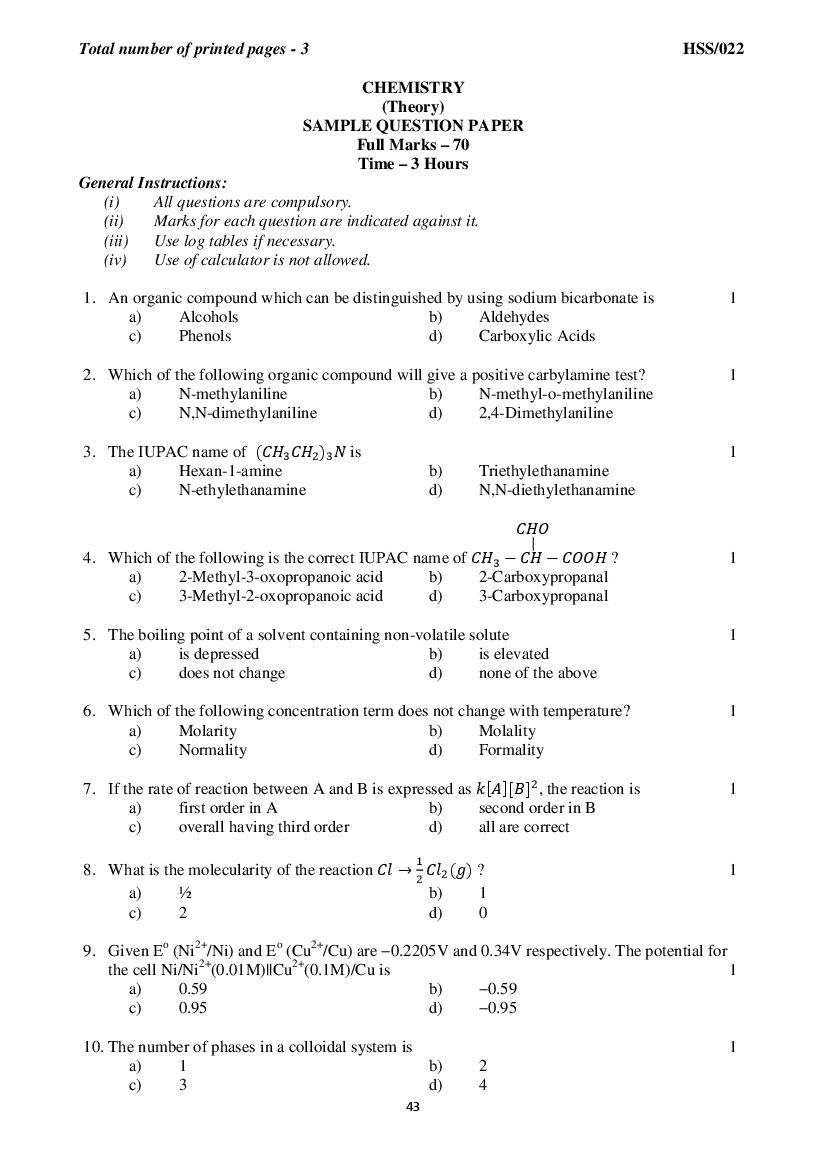
1. An organic compound which can be distinguished by using sodium bicarbonate is 1
a) Alcohols b) Aldehydes
c) Phenols d) Carboxylic Acids
2. Which of the following organic compound will give a positive carbylamine test? 1
a) N-methylaniline b) N-methyl-o-methylaniline
c) N,N-dimethylaniline d) 2,4-Dimethylaniline
3. The IUPAC name of 'yM 'y! M z is 1
a) Hexan-1-amine b) Triethylethanamine
c) N-ethylethanamine d) N,N-diethylethanamine
'y{
4. Which of the following is the correct IUPAC name of 'yM − 'y − '{{y ? 1
a) 2-Methyl-3-oxopropanoic acid b) 2-Carboxypropanal
c) 3-Methyl-2-oxopropanoic acid d) 3-Carboxypropanal
5. The boiling point of a solvent containing non-volatile solute 1
a) is depressed b) is elevated
c) does not change d) none of the above
6. Which of the following concentration term does not change with temperature? 1
a) Molarity b) Molality
c) Normality d) Formality
7. If the rate of reaction between A and B is expressed as J| }|S}! , the reaction is 1
a) first order in A b) second order in B
c) overall having third order d) all are correct
6
8. What is the molecularity of the reaction '( → ! '(! * ? 1
a) ½ b) 1
c) 2 d) 0
9. Given Eo (Ni2+/Ni) and Eo (Cu2+/Cu) are −0.2205V and 0.34V respectively. The potential for
the cell Ni/Ni2+(0.01M)||Cu2+(0.1M)/Cu is 1
a) 0.59 b) −0.59
c) 0.95 d) −0.95
10. The number of phases in a colloidal system is 1
a) 1 b) 2
c) 3 d) 4
43
Page 2
a) 269K b) 296K
c) 369K d) 396K
12. Which of the following ions does not give coloured solution? 1
a) Fe2+ b) Zn2+
c) Cr2+ d) Mn2+
13. Which of the following ions has paramagnetic character ? 1
a) '~^ b) • M^
c) z- !^ d) €- ^
14. Which of the following gives positive Fehling’s solution test? 1
a) Sucrose b) Glucose
c) Fats d) Protein
15. Ethyl amine is a stronger base than ammonia. Explain. 2
16. (a) Write notes on Esterification reaction with suitable chemical equation. 2
OR
(b) Write notes on Hunsdiecker reaction with suitable chemical equation. 2
17. Differentiate between Schottky and Frenkel defect. 2
18. H3PO2 and H3PO3 are good reducing agent but H3PO4 is not. Why? 2
19. Write mechanism for the reaction 'yM M ''( + •{y ‚ → 'yM M '{y + •'( ‚ . 2
20. Explain why haloarenes undergo electrophilic substitution reaction at ortho and para
positions? 2
21. Why are phenols more acidic than alcohols ? 2
22. Write notes on Friedel Craft Alkylation reaction with suitable chemical reaction. 2
23. Define Rosenmund reduction with suitable chemical reaction. 2
24. Write the correct chemical reaction for the conversion of Aniline to benzoic acid. 2
25. Write the reaction for the conversion of Propan-1-ol to propan-2-ol. 2
26. Define the following: 1+1+1= 3
(a)Electrophoresis
(b)Tyndall effect
(c)Coagulation or flocculation
27. Why are Mn2+ compounds more stable than Fe2+ compounds towards oxidation to their +3
state? 3
44
Page 3
(a) Coordination number
(b) Ambident ligands
(c) Homoleptic complexes
29. With the help of valence bond theory, predict the hybridization state, magnetic character and
geometry of the complex|') zyM L }M^. 3
30. What are reducing sugars? What are the characteristic groups present in these sugars? Why is
Sucrose a non-reducing sugar? 3
31. The compound CuCl has fcc structure like ZnS. Its density is 3.4 g v$M. What is the edge
length of the Unit cell? (mass of Cu=63.5 and mass of Cl=35.5) 3
32. The boiling point of benzene is 353.23 K. When 1.80g of non-volatile solute was dissolved in
90 g of benzene, the boiling point is raised to 354.11 K. Calculate the molar mass of the solute.
(•l for benzene is 2.53K Kg/mol) 3
33. (a) The thermal decomposition of a compound is of first order. If 50% of the compound is
decomposed in 120 minutes, how long will it take for 90% of the compound to
decompose? 3
OR
(b) The three-fourth of a first order reaction is completed in 32 minutes. What is the half
life period of the reaction? 3
34. (a) Can we store copper sulphate in a vessel made of iron? Justify your answer. 2
(b) Calculate the resistance of 0.01N solution of an electrolyte whose equivalent
conductivity is 420 ohm-1 cm2 equi-1(The cell constant of the cell is 0.88cm-1) 3
OR
(a) Why is the alternating current used for measuring the resistance of an electrolytic
solution? 2
(b) Calculate the e.m.f of the cell in which the following reaction take place:
z- , + 2 *^ 0.002ƒ → z- !^ 0.160ƒ + 2 * , . Given that standard electrode
potential of the cell is 1.05V. 3
35. (a) (i) Why does Ammonia form hydrogen bonds while Phosphine does not? 2
(ii) Bond enthalpy of Fluorine is lower than that of Chlorine. Why? 3
OR
(b) (i) Give reason why oxygen is a gas but sulphur is a solid at room temperature. 2
(ii) Why are noble gases very inert? Draw the structure of the four types of interhalogen
compounds in which the central atom is Iodine. 3
__________________
45
Document Details
| Board / Org | Mizoram Board |
| Exam | Class 12 |
| Type | Sample Paper |
| Pages | 3 |
| Updated | 29 Aug 2026 |