MBSE HSSLC Sample Question Paper Geography
Finished viewing? Save it for later —
Download MBSE HSSLC Sample Question Paper Geography (PDF · 3 pages)About MBSE HSSLC Sample Question Paper Geography
MBSE HSSLC Sample Question Paper Geography is available here for free download. Published by Mizoram Board for Class 12, this sample paper can be viewed online or downloaded as a PDF (3 pages). Candidates preparing for Class 12 can use MBSE HSSLC Sample Question Paper Geography to understand the exam pattern, the type of questions asked, and the overall difficulty level.
Frequently Asked Questions
How can I download MBSE HSSLC Sample Question Paper Geography?
Open this page and click the Download button to save MBSE HSSLC Sample Question Paper Geography as a PDF. It is completely free on AglaSem Docs.
Is MBSE HSSLC Sample Question Paper Geography free to download?
Yes. MBSE HSSLC Sample Question Paper Geography can be viewed online and downloaded as a PDF free of cost on AglaSem Docs.
How many pages does MBSE HSSLC Sample Question Paper Geography have?
MBSE HSSLC Sample Question Paper Geography contains 3 pages, which you can read online or download together as a single PDF.
Where can I find more Class 12 study material?
You can find more Class 12 question papers, sample papers, syllabus, and answer keys on AglaSem Docs.
MBSE HSSLC Sample Question Paper Geography – Text
Read the full text of this sample paper below — useful to quickly search, copy and reference the content online without downloading the PDF.
📄 View text version (3 pages)
Page 1
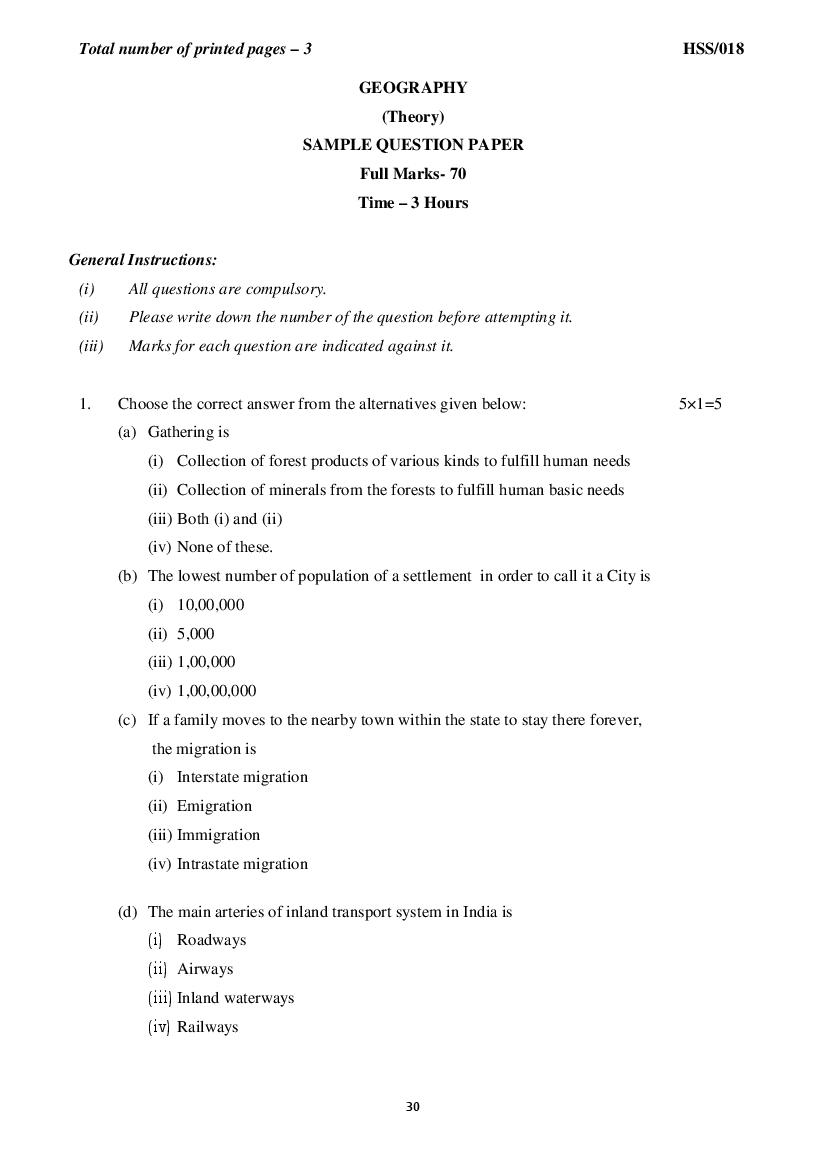
GEOGRAPHY
(Theory)
SAMPLE QUESTION PAPER
Full Marks- 70
Time – 3 Hours
General Instructions:
(i) All questions are compulsory.
(ii) Please write down the number of the question before attempting it.
(iii) Marks for each question are indicated against it.
1. Choose the correct answer from the alternatives given below: 5×1=5
(a) Gathering is
(i) Collection of forest products of various kinds to fulfill human needs
(ii) Collection of minerals from the forests to fulfill human basic needs
(iii) Both (i) and (ii)
(iv) None of these.
(b) The lowest number of population of a settlement in order to call it a City is
(i) 10,00,000
(ii) 5,000
(iii) 1,00,000
(iv) 1,00,00,000
(c) If a family moves to the nearby town within the state to stay there forever,
the migration is
(i) Interstate migration
(ii) Emigration
(iii) Immigration
(iv) Intrastate migration
(d) The main arteries of inland transport system in India is
(i) Roadways
(ii) Airways
(iii) Inland waterways
(iv) Railways
30
Page 2
because of
(i) Non availability of technically fit labour
(ii) Scarcity of water
(iii) Absence of seeds
(iv) Absence of agricultural machinery
2. State whether the following statements are True or False: 5×1=5
(a) Non-Conventional sources of energy are those things which can be used for energy
generation in the future.
(b) The urban and industrial areas of India are the largest contributors of carbon monoxide
because of large number of automobiles and greater concentration of industries.
(c) The doordarshan is not the national television service of India.
(d) A port which has natural docks and a safe large anchorage area is an artificial port or
man-made harbour.
(e) Transportation on ocean and high seas is not the cheapest form of transport.
3. Match Column A with Column B : 4×1=4
A B
(a) Human Geography (i) The most distinguishing feature of
Indian house types.
(b) Natural growth (ii) The seasonal change of pastures by
nomadic herders along with them.
(c) Transhumance (iii) The increase in population over a time
period due to higher birth rates over
death rates.
(d) Courtyard (iv) The study of human activities and
interrelationship with the physical
features of the land.
4. Explain briefly the traditional approaches in the study of Human geography. 2
5. Mention the two advantages of road transport. 2
6. Mention two reasons why the state of West Bengal has the highest density of population
in India. 2
7. Classify the working population of India into two categories. 2
8. Explain briefly how the relief features of the earth distribute the population of the world. 2
9. Migration is happening around the world. Explain briefly the main cause of migration. 2
10. Describe briefly the three cropping seasons in India. 3
11. Determine any three conditions for the successful cultivation of Rice. 3
12. Air transport is the fastest means of transport. Mention the three physical factors affecting the
development of air transport. 3
31
Page 3
14. You are going to establish a medium size industry. What are the three geographical factors
that must be considered before actually establishing that industry? State how they will affect
your success. 3
15. Urban waste is an environmental problem. Suggest three points of safe disposal of urban
waste in your town or city. 3
16. Describe briefly any four bases of international trade. 4
17. Explain briefly the four popular patterns of rural settlements. 4
18. What techniques and methods are necessary to harvest rain water? 4
19. Explain briefly the reasons why railway networks are not equally distributed in India. 4
20. Write a detailed description of the commercial animal grazing under the following
sub heads: 5
(a) How it is done
(b) Where it is done
(c) Which type of animals and management
(d) Reasons of doing
(e) Benefits and disadvantages
21. On the outline map of the world provided to you, locate and label the following: 1+1=2
(a) The temperate grassland of Argentina.
(b) The transcontinental railway that runs across the continent of Europe and Asia.
22. On the outline map of India provided to you, locate and label the following: 1+1+1=3
(a) The state with the highest concentration of Scheduled Tribes (1991).
(b) The most urbanized state in India (2001).
(c) The highest sex ratio among the states of India (2001).
____________________
32
Document Details
| Board / Org | Mizoram Board |
| Exam | Class 12 |
| Type | Sample Paper |
| Pages | 3 |
| Updated | 29 Aug 2026 |