NIOS Class 12 Question Paper 2021 (Jan Feb) History
Finished viewing? Save it for later —
Download NIOS Class 12 Question Paper 2021 (Jan Feb) History (PDF · 12 pages)About NIOS Class 12 Question Paper 2021 (Jan Feb) History
NIOS Class 12 Question Paper 2021 (Jan Feb) History is available here for free download. Published by NIOS for National Institute of Open Schooling Class 12, this question paper can be viewed online or downloaded as a PDF (12 pages). Candidates preparing for National Institute of Open Schooling Class 12 can use NIOS Class 12 Question Paper 2021 (Jan Feb) History to understand the exam pattern, the type of questions asked, and the overall difficulty level.
Frequently Asked Questions
How can I download NIOS Class 12 Question Paper 2021 (Jan Feb) History?
Open this page and click the Download button to save NIOS Class 12 Question Paper 2021 (Jan Feb) History as a PDF. It is completely free on AglaSem Docs.
Is NIOS Class 12 Question Paper 2021 (Jan Feb) History free to download?
Yes. NIOS Class 12 Question Paper 2021 (Jan Feb) History can be viewed online and downloaded as a PDF free of cost on AglaSem Docs.
How many pages does NIOS Class 12 Question Paper 2021 (Jan Feb) History have?
NIOS Class 12 Question Paper 2021 (Jan Feb) History contains 12 pages, which you can read online or download together as a single PDF.
Where can I find more National Institute of Open Schooling Class 12 study material?
You can find more National Institute of Open Schooling Class 12 question papers, sample papers, syllabus, and answer keys on AglaSem Docs.
NIOS Class 12 Question Paper 2021 (Jan Feb) History – Text
Read the full text of this question paper below — useful to quickly search, copy and reference the content online without downloading the PDF.
📄 View text version (12 pages)
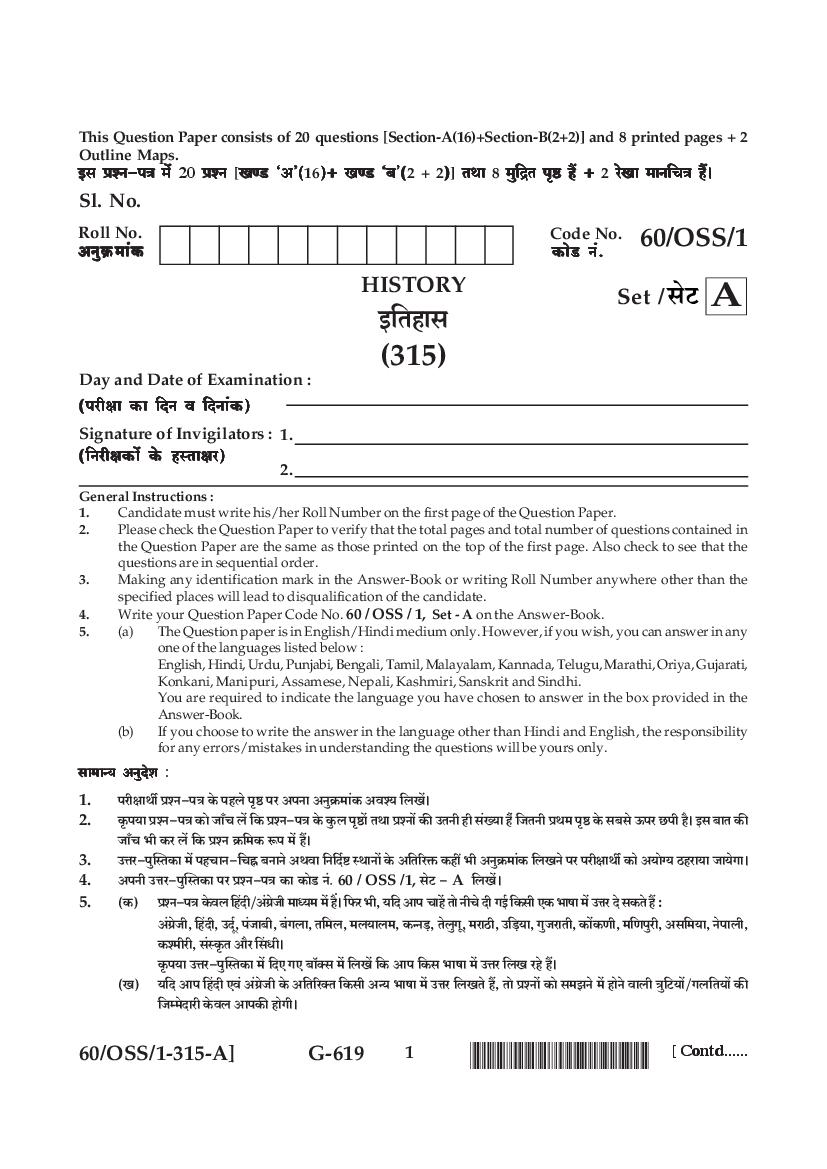
Page 1
Outline Maps.
Bg àíZ-nÌ _| 20 àíZ [IÊS> "A'(16)+ IÊS> "~'(2 + 2)] VWm 8 ‘w{ÐV n¥ð> h¢ + 2 aoIm ‘mZ{MÌ h¢&
Sl. No.
Roll No. Code No. 60/OSS/1
AZw H « $ _m§ H $ H$mo S > Z§ .
HISTORY
Set / go Q > A
B{Vhmg
(315)
Day and Date of Examination :
(narjm H$m {XZ d {XZm§ H $)
Signature of Invigilators : 1.
({ZarjH$m| Ho $ hñVmja)
2.
General Instructions :
1. Candidate must write his/her Roll Number on the first page of the Question Paper.
2. Please check the Question Paper to verify that the total pages and total number of questions contained in
the Question Paper are the same as those printed on the top of the first page. Also check to see that the
questions are in sequential order.
3. Making any identification mark in the Answer-Book or writing Roll Number anywhere other than the
specified places will lead to disqualification of the candidate.
4. Write your Question Paper Code No. 60 / OSS / 1, Set - A on the Answer-Book.
5. (a) The Question paper is in English/Hindi medium only. However, if you wish, you can answer in any
one of the languages listed below :
English, Hindi, Urdu, Punjabi, Bengali, Tamil, Malayalam, Kannada, Telugu, Marathi, Oriya, Gujarati,
Konkani, Manipuri, Assamese, Nepali, Kashmiri, Sanskrit and Sindhi.
You are required to indicate the language you have chosen to answer in the box provided in the
Answer-Book.
(b) If you choose to write the answer in the language other than Hindi and English, the responsibility
for any errors/mistakes in understanding the questions will be yours only.
gm_mÝ` AZwXoe :
1. narjmWu àíZ-nÌ Ho$ nhbo n¥ð> na AnZm AZwH«$‘m§H$ Adí¶ {bI|&
2. H¥$n¶m àíZ-nÌ H$mo Om±M b| {H$ àíZ-nÌ Ho$ Hw$b n¥ð>m| VWm àíZm| H$s CVZr hr g§»¶m h§¡ {OVZr àW‘ n¥ð> Ho$ g~go D$na N>nr h¡& Bg ~mV H$s
Om±M ^r H$a b| {H$ àíZ H«${‘H$ ê$n ‘| h¢&
3. CÎma-nwpñVH$m ‘| nhMmZ-{M• ~ZmZo AWdm {Z{X©ï> ñWmZm| Ho$ A{V[aº$ H$ht ^r AZwH«$‘m§H$ {bIZo na narjmWu H$mo A¶mo½¶ R>ham¶m Om¶oJm&
4. AnZr CÎma-nwpñVH$m na àíZ-nÌ H$m H$moS> Z§. 60 / OSS /1, goQ> - A {bI|&
5. (H$) àíZ-nÌ Ho$db qhXr/A§JO o« r ‘mܶ‘ ‘| h&§¡ {’$a ^r, ¶{X Amn Mmh| Vmo ZrMo Xr JB© {H$gr EH$ ^mfm ‘| CÎma Xo gH$Vo h¢ :
A§J«oOr, qhXr, CXÿ©, n§Om~r, ~§Jbm, V{‘b, ‘b¶mb‘, H$ÝZ‹S>, VobwJy, ‘amR>r, C{‹S>¶m, JwOamVr, H$m|H$Ur, ‘{Unwar, Ag{‘¶m, Zonmbr,
H$í‘rar, g§ñH¥$V Am¡a qgYr&
H¥$n¶m CÎma-nwpñVH$m ‘| {XE JE ~m°³g ‘| {bI| {H$ Amn {H$g ^mfm ‘| CÎma {bI aho h¢&
(I) ¶{X Amn qhXr Ed§ A§J«oOr Ho$ A{V[a³V {H$gr Aݶ ^mfm ‘| CÎma {bIVo h¢, Vmo àíZm| H$mo g‘PZo ‘| hmoZo dmbr Ìw{Q>¶m|/Jb{V¶m| H$s
{Oå‘oXmar Ho$db AmnH$s hmoJr&
60/OSS/1-315-A] G-619 1 [ Contd......
Page 2
B{Vhmg
(315)
Time : 3 Hours] [Maximum Marks : 100
g_` : 3 KÊQ>o] [nyUmªH$ : 100
Note : (i) This Question paper consists of two Sections, viz., 'A' and 'B'.
(ii) All the questions of Section 'A' are to be attempted.
(iii) Section 'B' has two options. Candidates are required to attempt questions from one option only.
(iv) Answer Question Nos. 1 to 4 in not more than 20 words each, Question Nos. 5 to 11 and 17 in not
more than 80 words each and Question Nos. 12 to 15 and 18 in not more than 200 words each.
{ZX} e : (i) Bg àíZ-nÌ ‘| Xmo IÊS> h¢-IÊS> "A' VWm IÊS> "~~'&
(ii) A' Ho$ g^r àíZm| H$mo hb H$aZm h¡&
IÊS> "A
(iii) IÊS> "~~' ‘| Xmo {dH$ën h¢& narjm{W©¶m| H$mo Ho$db EH$ {dH$ën Ho$ hr àíZm| Ho$ CÎma XoZo h¢&
(iv) àíZ g§»¶m 1 go 4 VH$ Ho$ à˶oH$ àíZ H$m CÎma 20 eãXm| ‘|, àíZ g§»¶m 5 go 11 VH$ VWm 17 ‘| à˶oH$ àíZ H$m CÎma 80 eãXm|
‘| Am¡a àíZ g§»¶m 12 go 15 VH$ VWm 18 ‘| à˶oH$ àíZ H$m CÎma 200 eãXm| ‘| Xr{OE&
SECTION-A
IÊS-A
1. Mention the name of the earliest work on grammer. Who wrote it? [2]
g~go nhbo a{MV ì¶mH$aU J«W
§ Ho$ Zm‘ H$m C„oI H$s{OE& ¶h H$gZo {bIr?
2. What are ‘Jatakas’? [2]
"OmVH$' ³¶m h¢?
3. Who founded Islam and when? [2]
"Bñbm‘' H$s ñWmnZm H$~ Am¡a {H$gZo H$s?
4. Examine the event which led to the outbreak of World War - I [2]
àW‘ {díd¶wÕ Ho$ {bE CÎmaXm¶r KQ>Zm H$s Om±M H$s{OE&
60/OSS/1-315-A] G-619 2 [ Contd......
Page 3
d¡{XH$ H$mb ‘| "JmoÌ' Ho$ ‘hËd H$m dU©Z H$s{OE&
OR/AWdm
Describe the importance of ‘Yajna’ in the later Vedic period.
CÎma d¡{XH$ H$mb ‘| "¶k' Ho$ ‘hËd H$m dU©Z H$s{OE&
6. Was Muhammad Ghori interested in establishing a permanent empire in India?
Discuss. [4]
³¶m ‘whå‘X Jm¡ar H$s ^maV ‘| ñWm¶r gm‘«mÁ¶ H$s é{M Wr? MMm© H$s{OE&
OR/AWdm
Discuss the Significant contributions of Iltutmish to the Delhi sultanate
administration.
BëVwV{‘e Ûmam {X„r gëVZV Ho$ àemgZ ‘| {XE JE ‘hËdnyU© ¶moJXmZ H$s MMm© H$s{OE&
7. Explain the main causes of the “Plassey Revolt” in 1757. [4]
1757 H$s "ßbmgr H$s b‹S>mB©' Ho$ ‘w»¶ H$maUm| H$s ì¶m»¶m H$s{OE&
OR/AWdm
Explain the ‘Dual system’ of administration of Bengal.
~§Jmb Ho$ {ÛemgZ àUmbr H$s ì¶m»¶m H$s{OE&
8. How was the idea of Nationalism first expressed in the field of culture? Explain.
[4]
g§ñH¥${V Ho$ joÌ ‘| amï´>dmX Ho$ {dMma H$mo g~go nhbo H¡$go 춺$ {H$¶m J¶m?
OR/AWdm
Explain the ‘Drain Theory’.
"{ZîH$mgZ {gÕm§V' H$s ì¶m»¶m H$s{OE&
60/OSS/1-315-A] G-619 3 [ Contd......
Page 4
npíM‘r ¶yamon ‘| nyO
§ rdmX Ho$ {dH$mg H$m dU©Z H$s{OE&
OR/AWdm
Describe the impact of colonialism and capitalism on social relations of the colonies.
Cn{ZdoedmX Ho$ à^md Am¡a nyO
§ rdmX H$m Cn{Zdoem| Ho$ gm‘m{OH$ g§~Y§ m| na n‹S>o à^mdm| H$m dU©Z H$s{OE&
10. How was World War-I different from previous wars in History? Discuss. [4]
àW‘ {díd¶wÕ B{Vhmg Ho$ {nN>bo ¶wÕm| go {H$g àH$ma {^Þ Wm?
OR/AWdm
Discuss the ‘Triple Alliance’ and the ‘Triple Entente’.
"{Ìnjr¶ g§{Y' d "{Ìnjr¶ g‘Pm¡V'o H$s MMm© H$s{OE&
11. Explain the causes of the failure of the ‘League of Nations’. [4]
"amï´>gK§ ' H$s Ag’$bVm Ho$ H$maUm| H$s ì¶m»¶m H$s{OE&
OR/AWdm
Explain the contribution of Mustafa Kamal to the establishment of a republic in
Turkey.
VwH$s© JUamÁ¶ H$s ñWmnZm ‘| ‘wñV’$m H$‘mb Ûmam {XE ¶moJXmZ H$s ì¶m»¶m H$s{OE&
12. Who was the founder of Buddhism? Explain the ‘Astangika marg’ of Buddhism.
[1+9=10]
~m¡Õ Y‘© Ho$ g§ñWmnH$ H$m¡Z Wo? ~m¡Õ Y‘© Ho$ "Aï>m{§ JH$m ‘mJ©' H$s ì¶m»¶m H$s{OE&
OR/AWdm
Describe Ashoka’s ‘Dhamma’. What was Ashoka’s attitude towards other religions?
AemoH$ Ho$ "Yå‘' H$s ì¶m»¶m H$s{OE& Xÿgao Y‘m] Ho$ à{V AemoH$ H$m ³¶m ad¡¶m Wm?
60/OSS/1-315-A] G-619 4 [ Contd......
Page 5
~m~a H$s ‘¥Ë¶w Ho$ ~mX hþ‘m¶y± Ho$ gm‘Zo AmB© g‘ñ¶mAm| H$s naI H$s{OE&
OR/AWdm
Examine the policy of Aurangzeb towards the Deccan states.
X¸$Z amÁ¶m| Ho$ à{V Am¡aJ§ Oo~ H$s Zr{V H$m narjU H$s{OE&
14. Discuss the recommendations of Hunter Commission (1882). [10]
h§Q>a H$‘reZ (1882) H$s {g’$m[aem| na MMm© H$s{OE&
OR/AWdm
Discuss the objective of Macaulay’s minutes on education in India.
^maV ‘| {ejm na ‘¡H$mbo Ho$ {‘ZQ²>g Ho$ CÔoí¶ na MMm© H$s{OE&
15. Who founded the Indian National Congress and when? How was the Indian
National Congress different from previous associations? Discuss. [1+1+8=10]
^maVr¶ amï´>r¶ H$m±Jg
o« H$s ñWmnZm H$~ Am¡a {H$gZo H$s? ^maVr¶ amï´>r¶ H$m±Jg
o« {nN>bo g§JR>Zm| go {H$g àH$ma
{^Þ Wm? ì¶m»¶m H$s{OE&
OR/AWdm
“Swadeshi Movement” was the new form of protest. Explain.
"ñdXoer AmÝXmobZ' {damoY H$m Z¶m ñdén Wm H$WZ H$s ì¶m»¶m H$s{OE&
16. a) On the given political outline map of India, mark the following:
i) 1) Harappa [1]
2) Lothal [1]
ii) 1) Extent of Sher Shah’s Kingdom [2]
2) Patna [1]
3) Kannauj [1]
iii) Meerut [1]
iv) The place where the congress session was held in 1929. [1]
v) 1) Magadha (Option – I) [1]
OR
2) Sanchi Stupa (Option – II)
b) On the given Outline map of Europe, Mark Czechoslovakia. [1]
60/OSS/1-315-A] G-619 5 [ Contd......
Page 6
i) 1) hS>ßnm
2) bmoWb
ii) 1) eoaemh Ho$ gm‘«mÁ¶ H$m {dñVma
2) nQ>Zm
3) H$Þm¡O
iii) ‘oaR>
iv) dh ñWmZ Ohm± 1929 ‘| H$m±Jg
o« H$m A{YdoeZ hþAm?
v) ‘JY ({dH$ën – I)
AWdm
gm§Mr ñVyn ({dH$ën – II)
b) ¶yamon Ho$ {XE JE ‘mZ{MÌ ‘| MoH$moñbmodm{H$¶m H$mo Xem©B¶o&
Note : The following questions are for the visually impaired candidates only in
lieu of Question No. 16.
i) Name any two centres of Harappan Civilization. [2]
ii) 1) Who was Sher Shah Suri? Mention any one of his achievements.
[1+1=2]
2) Name any two Maratha confederacies. [2]
iii) Where did the Revolt of 1857 start? [1]
iv) Where was the congress session held in 1929. [1]
v) Name any one Mahajanapada (Option – I) [1]
OR
Who built the Sanchi Stupa (Option – II)
vi) What was the immediate cause of World War – I? [1]
60/OSS/1-315-A] G-619 6 [ Contd......
Page 7
i) hS>ßnm gä¶Vm Ho$ {H$Ýht Xmo Ho$ÝÐm| Ho$ Zm‘ {b{IE&
ii) 1) eoaemh gyar H$m¡Z Wm? CgH$s H$moB© EH$ CnbpãY H$mo {bImo&
2) H$moB© Xmo ‘amR>m amÁ¶ g§K Ho$ Zm‘&
iii) 1857 H$m {dÐmoh H$~ ewê$ hþAm?
iv) 1929 H$m H$m±Jg
o« H$m A{YdoeZ H$hm± hþAm?
v) {H$gr EH$ ‘hmOZnX H$m Zm‘ {b{IE& ({dH$ën - I)
AWdm
gm§Mr ñVyn {H$gZo ~Zdm¶m? ({dH$ën - II)
vi) àW‘ {díd ¶wÓ H$m VmËH$m{bH$ H$maU ³¶m Wm?
SECTION-B
IÊS>-~
OPTION-I
{dH$ën- I
(Evolution of State)
(amÁ¶ H$m {dH$mg)
17. What do you mean by the term state? Explain. [4]
"amÁ¶' eãX go Amn ³¶m g‘PVo h¡? ì¶m»¶m H$s{OE&
OR/AWdm
In what context was the term ‘Raja’ used in the Rigveda?
F$½doX ‘| "amOm' eãX H$m à¶moJ {H$g g§X^© ‘| {H$¶m J¶m?
18. ‘The emergence of Ashoka the great strengthened the political notion of monarchy.
Explain. [10]
AemoH$ Ho$ CX²^d Zo amOV§Ì Ho$ amï´> amÁ¶ H$mo ‘O~yV {H$¶m& ì¶m»¶m H$s{OE&
OR/AWdm
The Mauryan Empire consisted of a great variety of political formations and
ecological zones. Explain.
‘m¡¶© gm‘«mÁ¶ ‘| AZoH$ àH$ma Ho$ amOZr{VH$ g§JR>Z Am¡a nm[apñW{VH$s joÌ gpå‘{bV Wo& ì¶m»¶m H$s{OE&
60/OSS/1-315-A] G-619 7 [ Contd......
Page 8
{dH$ën- II
(Culture of India)
(^maVr¶ g§ñH¥${V)
17. There are a variety of cultural forms in India. Describe them. [4]
^maV ‘| AZoH$ àH$ma Ho$ gm§ñH¥${VH$ ê$n h¡& CZH$m dU©Z H$s{OE&
OR/AWdm
Describe how archaeologists define culture.
nwamVËddoVm g§ñH¥${V H$mo {H$g àH$ma n[a^m{fV H$aVo h¡, dU©Z H$s{OE&
18. What is the influence of geographical and climatic factors on clothing of Indians?
Explain. [10]
^maV Ho$ H$n‹S>mo| na ^m¡Jmo{bH$ Am¡a Obdm¶w H$maH$ ³¶m à^md S>mbVo h¡? ì¶m»¶m H$s{OE&
OR/AWdm
What are the characteristic features of paintings of Ajanta-Ellora caves? Explain.
AO§Vm-Ebmoam Jw’$mAm| H$s {MÌH$bm H$s ‘w»¶ {deofVmE± ³¶m Wr? ì¶m»¶m H$s{OE&
60/OSS/1-315-A] G-619 8 [ Contd......
Page 9
Outline Map of India (Political)
60/OSS/1-315-A] G-619 9 [ Contd......
Page 10
G
PA
K
N
LA
B
60/OSS/1-315-A] G-619 10 [ Contd......
Page 11
Outline Map of Europe
60/OSS/1-315-A] G-619 11 [ Contd......
Page 12
G
PA
K
N
A
BL
60/OSS/1-315-A] G-619 12 [ Contd......
Document Details
| Board / Org | NIOS |
| Exam | National Institute of Open Schooling Class 12 |
| Type | Question Paper |
| Pages | 12 |
| Updated | 22 Jul 2026 |