MBSE HSSLC Sample Question Paper Geology – Text
Read the full text of this sample paper below — useful to quickly search, copy and reference the content online without downloading the PDF.
📄 View text version (2 pages)
Page 1
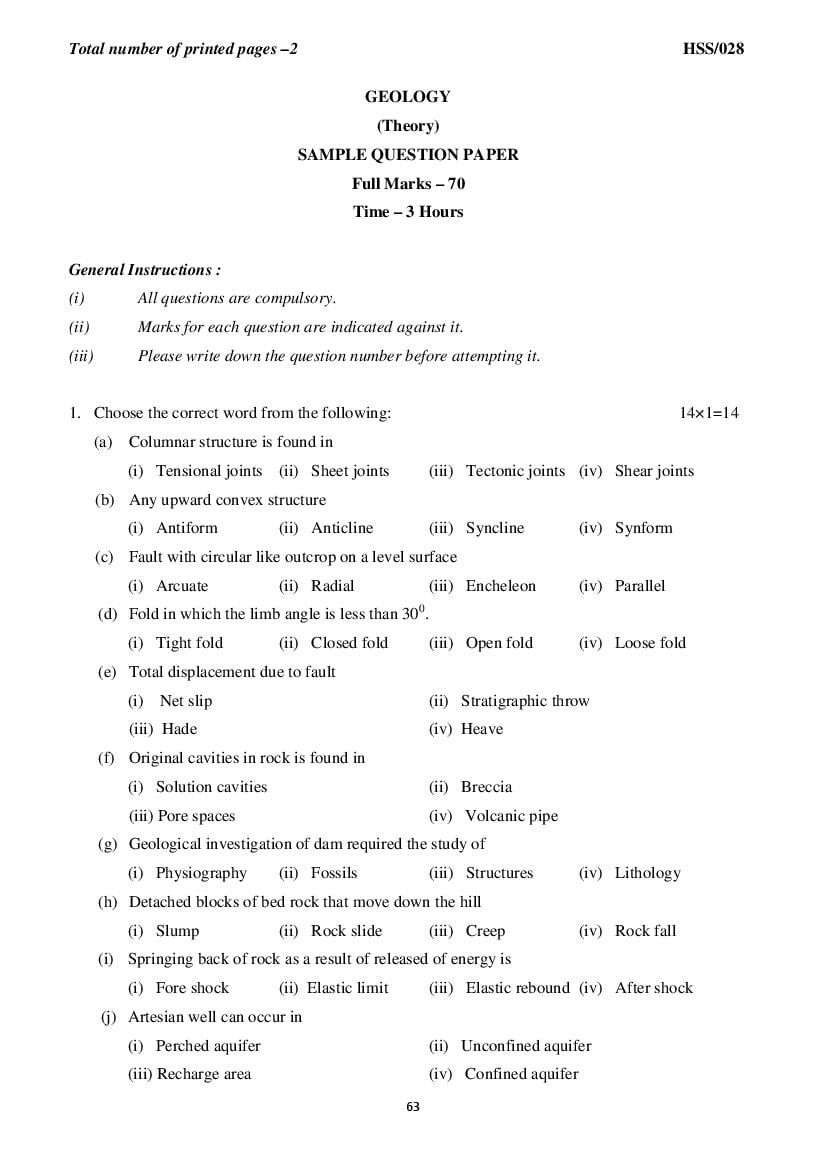
Total number of printed pages –2 HSS/028 GEOLOGY (Theory) SAMPLE QUESTION PAPER Full Marks – 70 Time – 3 Hours General Instructions : (i) All questions are compulsory. (ii) Marks for each question are indicated against it. (iii) Please write down the question number before attempting it. 1. Choose the correct word from the following: 14×1=14 (a) Columnar structure is found in (i) Tensional joints (ii) Sheet joints (iii) Tectonic joints (iv) Shear joints (b) Any upward convex structure (i) Antiform (ii) Anticline (iii) Syncline (iv) Synform (c) Fault with circular like outcrop on a level surface (i) Arcuate (ii) Radial (iii) Encheleon (iv) Parallel (d) Fold in which the limb angle is less than 300. (i) Tight fold (ii) Closed fold (iii) Open fold (iv) Loose fold (e) Total displacement due to fault (i) Net slip (ii) Stratigraphic throw (iii) Hade (iv) Heave (f) Original cavities in rock is found in (i) Solution cavities (ii) Breccia (iii) Pore spaces (iv) Volcanic pipe (g) Geological investigation of dam required the study of (i) Physiography (ii) Fossils (iii) Structures (iv) Lithology (h) Detached blocks of bed rock that move down the hill (i) Slump (ii) Rock slide (iii) Creep (iv) Rock fall (i) Springing back of rock as a result of released of energy is (i) Fore shock (ii) Elastic limit (iii) Elastic rebound (iv) After shock (j) Artesian well can occur in (i) Perched aquifer (ii) Unconfined aquifer (iii) Recharge area (iv) Confined aquifer 63
Page 2
HSS/028 (k) Horny calcareous plate which close the aperture of gastropods (i) Suture (ii) Operculum (iii) Apex (iv) Whorl (l) A species of gastropods (i) Turritella (ii) Arca (iii) Terebratula (iv) Orthis (m) The embryonic shell prodissoconch belongs to (i) Brachiopods (ii) Ammonoids (iii) Pelecypods (iv) Gastropods (n) The word fossils is derived from (i) Latin (ii) Greek (iii) Roman (iv) Italian. 2. Answer the following questions : 7×2=14 (a) (i) What is earthquake ? OR (ii) What is water table ? (b) What is carbonization ? (c) What are sheet joints ? (d) What is metasomatic replacement ? (e) Define tenor. (f) What is geosynclines ? (g) Define eluvial placers. 3. What are the description of joints? 3 4. Explain the different types of faults on the basis of rake of fault. 3 5. What is the difference between asymmetrical and symmetrical faults ? 3 6. What are primary and secondary mineral deposits? 3 7. Write the nature and mode of preservation of fossils. 3 8. What is the difference between umbilicus and columnella in gastropods? 3 9. Describe the occurrence of ground water beneath land area. 3 10. What are the different types of dams? 3 11. (a) Write short notes on precipitation that occur in Mizoram. 3 OR (b) What are the six green house gases? 3 12. (a) What is fold ?Explain with a diagram the different parts of fold. 3+2=5 OR (b) Describe with a neat diagram the terminologies associated with a fault. 3+2=5 13 (a) Show with a labelled diagram the morphological characters of gastropods. 3+2=5 OR (b) Explain briefly with a neat diagram the morphological characters of Pelecypods. 3+2=5 14. (a) What is spiral angle? What are the different variety of coiled shell of gastropods? 2+3=5 OR (b) Define hinge. What are the different types of dentition in Pelecypods? 2+3=5 _________________ HSS/028 64