MBSE HSSLC Sample Question Paper History
Finished viewing? Save it for later —
Download MBSE HSSLC Sample Question Paper History (PDF · 3 pages)About MBSE HSSLC Sample Question Paper History
MBSE HSSLC Sample Question Paper History is available here for free download. Published by Mizoram Board for Class 12, this sample paper can be viewed online or downloaded as a PDF (3 pages). Candidates preparing for Class 12 can use MBSE HSSLC Sample Question Paper History to understand the exam pattern, the type of questions asked, and the overall difficulty level.
Frequently Asked Questions
How can I download MBSE HSSLC Sample Question Paper History?
Open this page and click the Download button to save MBSE HSSLC Sample Question Paper History as a PDF. It is completely free on AglaSem Docs.
Is MBSE HSSLC Sample Question Paper History free to download?
Yes. MBSE HSSLC Sample Question Paper History can be viewed online and downloaded as a PDF free of cost on AglaSem Docs.
How many pages does MBSE HSSLC Sample Question Paper History have?
MBSE HSSLC Sample Question Paper History contains 3 pages, which you can read online or download together as a single PDF.
Where can I find more Class 12 study material?
You can find more Class 12 question papers, sample papers, syllabus, and answer keys on AglaSem Docs.
MBSE HSSLC Sample Question Paper History – Text
Read the full text of this sample paper below — useful to quickly search, copy and reference the content online without downloading the PDF.
📄 View text version (3 pages)
Page 1
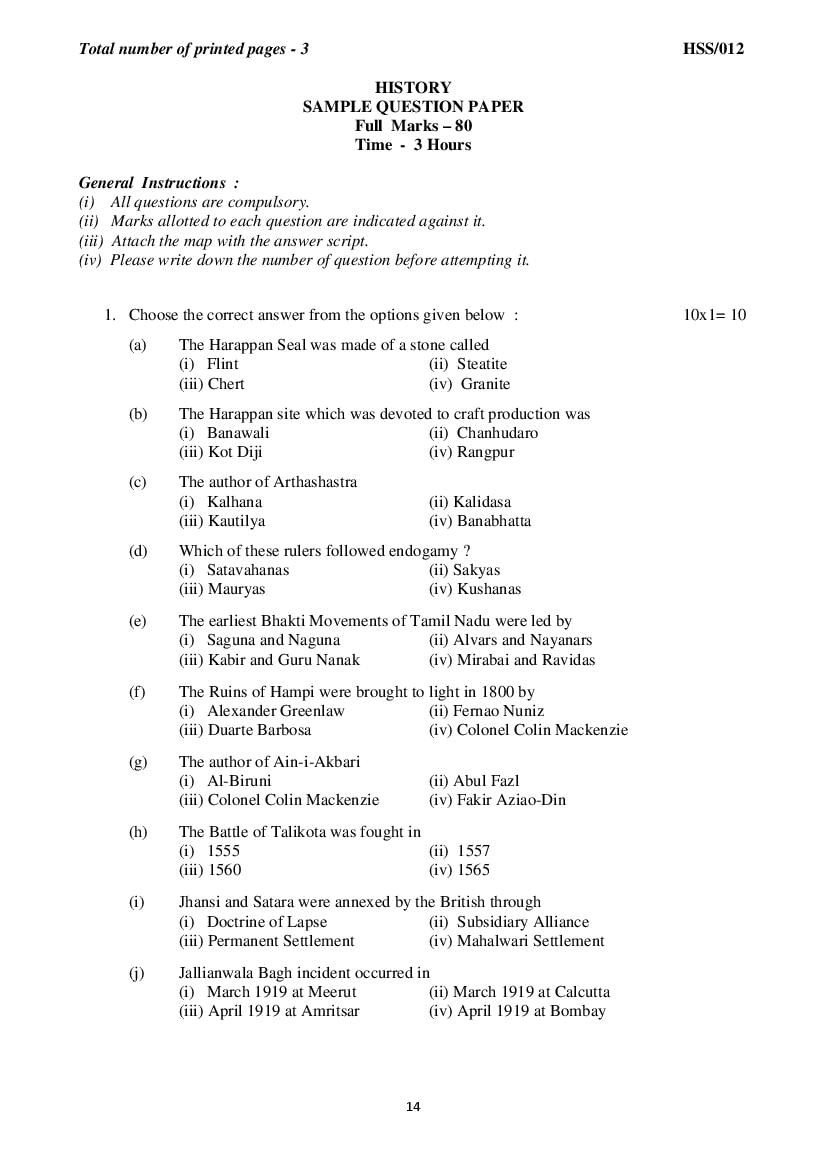
HISTORY
SAMPLE QUESTION PAPER
Full Marks – 80
Time - 3 Hours
General Instructions :
(i) All questions are compulsory.
(ii) Marks allotted to each question are indicated against it.
(iii) Attach the map with the answer script.
(iv) Please write down the number of question before attempting it.
1. Choose the correct answer from the options given below : 10x1= 10
(a) The Harappan Seal was made of a stone called
(i) Flint (ii) Steatite
(iii) Chert (iv) Granite
(b) The Harappan site which was devoted to craft production was
(i) Banawali (ii) Chanhudaro
(iii) Kot Diji (iv) Rangpur
(c) The author of Arthashastra
(i) Kalhana (ii) Kalidasa
(iii) Kautilya (iv) Banabhatta
(d) Which of these rulers followed endogamy ?
(i) Satavahanas (ii) Sakyas
(iii) Mauryas (iv) Kushanas
(e) The earliest Bhakti Movements of Tamil Nadu were led by
(i) Saguna and Naguna (ii) Alvars and Nayanars
(iii) Kabir and Guru Nanak (iv) Mirabai and Ravidas
(f) The Ruins of Hampi were brought to light in 1800 by
(i) Alexander Greenlaw (ii) Fernao Nuniz
(iii) Duarte Barbosa (iv) Colonel Colin Mackenzie
(g) The author of Ain-i-Akbari
(i) Al-Biruni (ii) Abul Fazl
(iii) Colonel Colin Mackenzie (iv) Fakir Aziao-Din
(h) The Battle of Talikota was fought in
(i) 1555 (ii) 1557
(iii) 1560 (iv) 1565
(i) Jhansi and Satara were annexed by the British through
(i) Doctrine of Lapse (ii) Subsidiary Alliance
(iii) Permanent Settlement (iv) Mahalwari Settlement
(j) Jallianwala Bagh incident occurred in
(i) March 1919 at Meerut (ii) March 1919 at Calcutta
(iii) April 1919 at Amritsar (iv) April 1919 at Bombay
14
Page 2
(a) Epigraphy is the study of __________. (coins / inscriptions)
(b) Duryodhana and his brothers were known as _________. (Kauravas / Pandavas)
(c) The word ‘zimmi’ was derived from the Arabic word ’zimma’ which means ______.
(protection / submission)
(d) A form of tribute collected by the Mughal state was called _________ (Zabt / Peshkash)
(e) The British became the ruler of Bengal after the decisive victory in the battle of Plassey
in ____________. (1757 / 1775)
(f) The ‘Purna Swaraj’ was accepted as Congress goal at the Lahore Congress in December
_______________ . (1929 / 1930)
3. Answer the following questions in two or more sentences : 8x2 = 16
(a) How do seals and sealings facilitate long distance communication?
(b) What were the sources to reconstruct the history of the Mauryan Empire?
(c) Explain two strategies evolved by Brahmanas to enforce the norms of the Varna order.
(d) In which two categories did historians often classify Bhakti tradition ?
(e) What is ‘Sharia’ ?
(f) Who was Mirabai ?
(g) What is Sunset Law ?
(h) What was the Rowlatt Act ?
4. (a) Which state emerged as the strongest among the Sixteen Mahajanapadas during
the 6th to 4th century BCE ? What were the reasons ? 1+2 = 3
OR
(b) Explain why patriliny may have been particularly important among elite families. 3
5. (a) Explain what historians meant by the integration of cults. 3
OR
(b) How were the water requirements of Vijayanagara met? 3
6. (a) Describe the major teachings of Baba Guru Nanak. 3
OR
(b) What are the problems in using the Ain as a source for reconstructing agrarian history? 3
7. (a) What do you think were the advantages and disadvantages of enclosing agricultural land
within the fortified area of the city ? 3
OR
(b) Examine the evidence that suggests that land revenue was important for the Mughal
fiscal system. 3
8. (a) Why was the Jotedar a powerful figure in many areas of rural Bengal ? 3
OR
(b) How did the Paharias respond to the coming of outsiders ? 3
9. (a) What steps did the British take to quell the uprising of 1857 ? 3
OR
(b) What were the factors which started the Non-Cooperation movement of 1920 ? 3
15
Page 3
OR
(b) Briefly explain how archaeologists reconstruct the past. 5
11. (a) Describe in brief the notions of Kingship that developed in the post- Mauryan period. 5
OR
(b) How important were gender differences in early societies? Give reasons for your answer.
3+2 = 5
12. (a) What were the major beliefs and practices that characterised Sufism ? 5
OR
(b) How were the lives of forest dwellers transformed in the 16th and 17th centuries ? 5
13. (a) In what way was the livelihood of the Paharias different from that of the Santhals ? 5
OR
(b) What were the military and religious causes that led to the revolt of 1857 ? 5
14. (a) Briefly describe the developments which preceded the Civil Disobedience Movement of
1930. 5
OR
(b) In what way did Mahatma Gandhi transform the nature of the national movement ? 5
15. (a) On the given outline map of India, indicate five mature Harappan sites. 5
OR
(b) On the given outline map of India, locate any five states of South India during the
14th to 18th century. 5
___________________
16
Document Details
| Board / Org | Mizoram Board |
| Exam | Class 12 |
| Type | Sample Paper |
| Pages | 3 |
| Updated | 29 Aug 2026 |