MBSE HSSLC Sample Question Paper Physics
Finished viewing? Save it for later —
Download MBSE HSSLC Sample Question Paper Physics (PDF · 3 pages)About MBSE HSSLC Sample Question Paper Physics
MBSE HSSLC Sample Question Paper Physics is available here for free download. Published by Mizoram Board for Class 12, this sample paper can be viewed online or downloaded as a PDF (3 pages). Candidates preparing for Class 12 can use MBSE HSSLC Sample Question Paper Physics to understand the exam pattern, the type of questions asked, and the overall difficulty level.
Frequently Asked Questions
How can I download MBSE HSSLC Sample Question Paper Physics?
Open this page and click the Download button to save MBSE HSSLC Sample Question Paper Physics as a PDF. It is completely free on AglaSem Docs.
Is MBSE HSSLC Sample Question Paper Physics free to download?
Yes. MBSE HSSLC Sample Question Paper Physics can be viewed online and downloaded as a PDF free of cost on AglaSem Docs.
How many pages does MBSE HSSLC Sample Question Paper Physics have?
MBSE HSSLC Sample Question Paper Physics contains 3 pages, which you can read online or download together as a single PDF.
Where can I find more Class 12 study material?
You can find more Class 12 question papers, sample papers, syllabus, and answer keys on AglaSem Docs.
MBSE HSSLC Sample Question Paper Physics – Text
Read the full text of this sample paper below — useful to quickly search, copy and reference the content online without downloading the PDF.
📄 View text version (3 pages)
Page 1
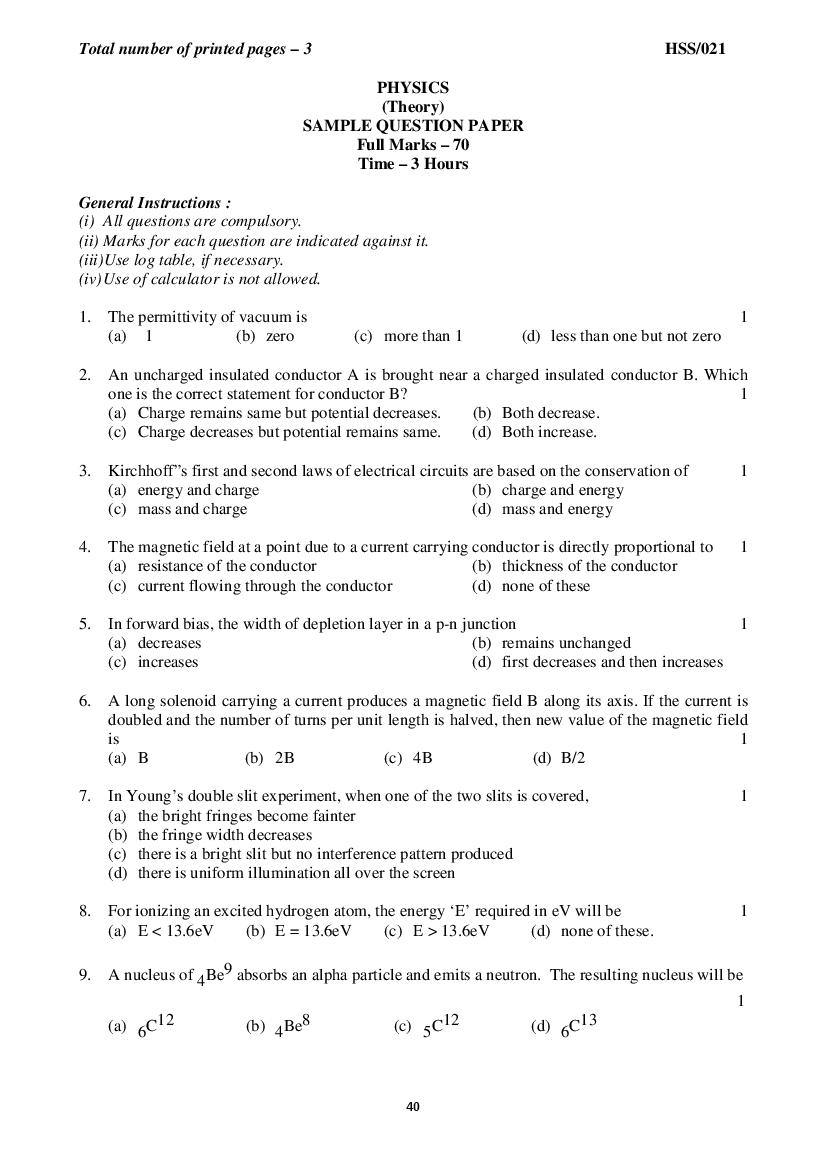
PHYSICS
(Theory)
SAMPLE QUESTION PAPER
Full Marks – 70
Time – 3 Hours
General Instructions :
(i) All questions are compulsory.
(ii) Marks for each question are indicated against it.
(iii)Use log table, if necessary.
(iv) Use of calculator is not allowed.
1. The permittivity of vacuum is 1
(a) 1 (b) zero (c) more than 1 (d) less than one but not zero
2. An uncharged insulated conductor A is brought near a charged insulated conductor B. Which
one is the correct statement for conductor B? 1
(a) Charge remains same but potential decreases. (b) Both decrease.
(c) Charge decreases but potential remains same. (d) Both increase.
3. Kirchhoff”s first and second laws of electrical circuits are based on the conservation of 1
(a) energy and charge (b) charge and energy
(c) mass and charge (d) mass and energy
4. The magnetic field at a point due to a current carrying conductor is directly proportional to 1
(a) resistance of the conductor (b) thickness of the conductor
(c) current flowing through the conductor (d) none of these
5. In forward bias, the width of depletion layer in a p-n junction 1
(a) decreases (b) remains unchanged
(c) increases (d) first decreases and then increases
6. A long solenoid carrying a current produces a magnetic field B along its axis. If the current is
doubled and the number of turns per unit length is halved, then new value of the magnetic field
is 1
(a) B (b) 2B (c) 4B (d) B/2
7. In Young’s double slit experiment, when one of the two slits is covered, 1
(a) the bright fringes become fainter
(b) the fringe width decreases
(c) there is a bright slit but no interference pattern produced
(d) there is uniform illumination all over the screen
8. For ionizing an excited hydrogen atom, the energy ‘E’ required in eV will be 1
(a) E < 13.6eV (b) E = 13.6eV (c) E > 13.6eV (d) none of these.
9. A nucleus of 4Be9 absorbs an alpha particle and emits a neutron. The resulting nucleus will be
1
(a) 6 C12 (b) 4Be8 (c) 5 C12 (d) 6 C13
40
Page 2
(a) conductor (b) semiconductor (c) insulator (d) none of these
11. Electron volt is a unit of 1
(a) charge (b) momentum (c) potential difference (d) energy
12. The de-Broglie wavelength of an electron of energy 400eV is 1
(a) 20 Ǻ (b) 60 Ǻ (c) 0.6 Ǻ (d) 0.2 Ǻ
13. The electromagnetic theory of light was developed by 1
(a) Max Planck (b) Maxwell (c) Newton (d) Huygens
14. Which of the following has minimum wavelength? 1
(a) Heat rays (b) Ultraviolet rays (c) Gamma rays (d) X-rays.
15. A lamp of 100W works at 220V. What is its resistance and current capacity? 2
16. (a) Differentiate between geographic meridian and magnetic meridian. 2
OR
(b) Define magnetic dipole and magnetic dipole moment. 2
17. Write the general equation for instantaneous emf of 50Hz generator whose peak voltage is
200V. 2
18. Write two properties of microwaves. 2
19. (a) Calculate the power of a convex lens of focal length 20cm. 2
OR
(b) Calculate the refractive index of the material of equilateral prism for which the angle of
minimum deviation is 600. 2
20. Calculate the speed of light in a medium whose critical angle is 30°. 2
21. Explain, with the help of a circuit diagram, how a junction diode acts as a half wave
rectifier. 2
22. (a) What is Lorentz force? An electron is moving northwards with a velocity 107 m/s
in a magnetic field of 3T directed eastwards. Calculate the instantaneous force on the
electron. 1+2=3
OR
(b) A horizontal overhead power line carries a current of 90A in the east to west direction.
What is the magnitude and direction of magnetic field due to the current at a point 1.5m
below the line? 3
23. (a) The magnetic flux through a coil perpendicular to its plane is varying according to the
relation Φ=(4t3 +5t2+8t+7) weber. Calculate the induced current through the coil at
t=2 s, if the resistance of the coil is 3.1 ohm. 3
OR
(b) An e.m.f. 0.5V is developed in the secondary coil, when current in the primary coil changes
from 5A to 2 A in 300 millisecond. Calculate the mutual inductance of the two coils. 3
41
Page 3
25. Distinguish between electromotive force and terminal potential difference of a cell. What are
their SI units? 2+1=3
26. A cell gives a balance with 85cm of a potentiometer wire. When the terminals of the cell are
connected to a resistance of 7.5ohm, the balance is obtained at 75cm. Find the internal
resistance of the cell. 3
27. Prove laws of reflection on the basis of Huygens’ principle. 3
28. Explain what will happen to the focal length of a convex lens of refractive index 1.2, if it is
immersed in a liquid of refractive index 1.3. 3
29. With the help of a diagram, explain the effect of anode potential on photoelectric current and
hence define stopping potential. 2+1 = 3
30. Show that the velocity of an electron in Bohr’s orbit is inversely proportional to the principal
quantum number. 3
31. (a) Define electric field. Derive an expression for electric field on equitorial line of an electric
dipole. 1+4=5
OR
(b) What is Gaussian surface? Derive the expression for electric field due to an infinitely long
line charge having uniform charge density. 1+4=5
32. (a) What is phasor diagram? With the help of a suitable phasor diagram, derive an expression
for impedance in an a.c. series LCR- circuit. 1+1+ 3 =5
OR
(b) Explain the principle, construction and working of an AC generator with a neat labelled
diagram. 5
33. (a) Explain the construction and working of an astronomical telescope. Derive the expression
for its magnifying power, when final image is formed at the least distance of distinct
vision. 1+1+3=5
OR
(b) Derive an expression for fringe width in Young’s double slit experiment with a neat
diagram. 5
___________________________________
Physical constants :
6
= 9 × 10s Nm2C-2
0pq
tu = 8.854 × 10⁻¹² C2 N-1m-2
c = 3 × 10⁸ ms-1
e = 1.6 × 10⁻¹⁹C
v = 9.1 × 10⁻³¹ Kg
vw = 1.67 × 10⁻²⁷ Kg
h = 6.62 × 10⁻³⁴ Js
G = 6.67 × 10⁻¹¹ Nm2 Kg-2
g = 9.8 ms-2
1Å = 10-10m
1 amu = 931 MeV
xu = 4π × 10-7 TA-1m
leV = 1.6 × 10⁻¹⁹J
42
Document Details
| Board / Org | Mizoram Board |
| Exam | Class 12 |
| Type | Sample Paper |
| Pages | 3 |
| Updated | 29 Aug 2026 |