NIOS Class 12 Question Paper 2021 (Jan Feb) Physics
Finished viewing? Save it for later —
Download NIOS Class 12 Question Paper 2021 (Jan Feb) Physics (PDF · 12 pages)About NIOS Class 12 Question Paper 2021 (Jan Feb) Physics
NIOS Class 12 Question Paper 2021 (Jan Feb) Physics is available here for free download. Published by NIOS for National Institute of Open Schooling Class 12, this question paper can be viewed online or downloaded as a PDF (12 pages). Candidates preparing for National Institute of Open Schooling Class 12 can use NIOS Class 12 Question Paper 2021 (Jan Feb) Physics to understand the exam pattern, the type of questions asked, and the overall difficulty level.
Frequently Asked Questions
How can I download NIOS Class 12 Question Paper 2021 (Jan Feb) Physics?
Open this page and click the Download button to save NIOS Class 12 Question Paper 2021 (Jan Feb) Physics as a PDF. It is completely free on AglaSem Docs.
Is NIOS Class 12 Question Paper 2021 (Jan Feb) Physics free to download?
Yes. NIOS Class 12 Question Paper 2021 (Jan Feb) Physics can be viewed online and downloaded as a PDF free of cost on AglaSem Docs.
How many pages does NIOS Class 12 Question Paper 2021 (Jan Feb) Physics have?
NIOS Class 12 Question Paper 2021 (Jan Feb) Physics contains 12 pages, which you can read online or download together as a single PDF.
Where can I find more National Institute of Open Schooling Class 12 study material?
You can find more National Institute of Open Schooling Class 12 question papers, sample papers, syllabus, and answer keys on AglaSem Docs.
NIOS Class 12 Question Paper 2021 (Jan Feb) Physics – Text
Read the full text of this question paper below — useful to quickly search, copy and reference the content online without downloading the PDF.
📄 View text version (12 pages)
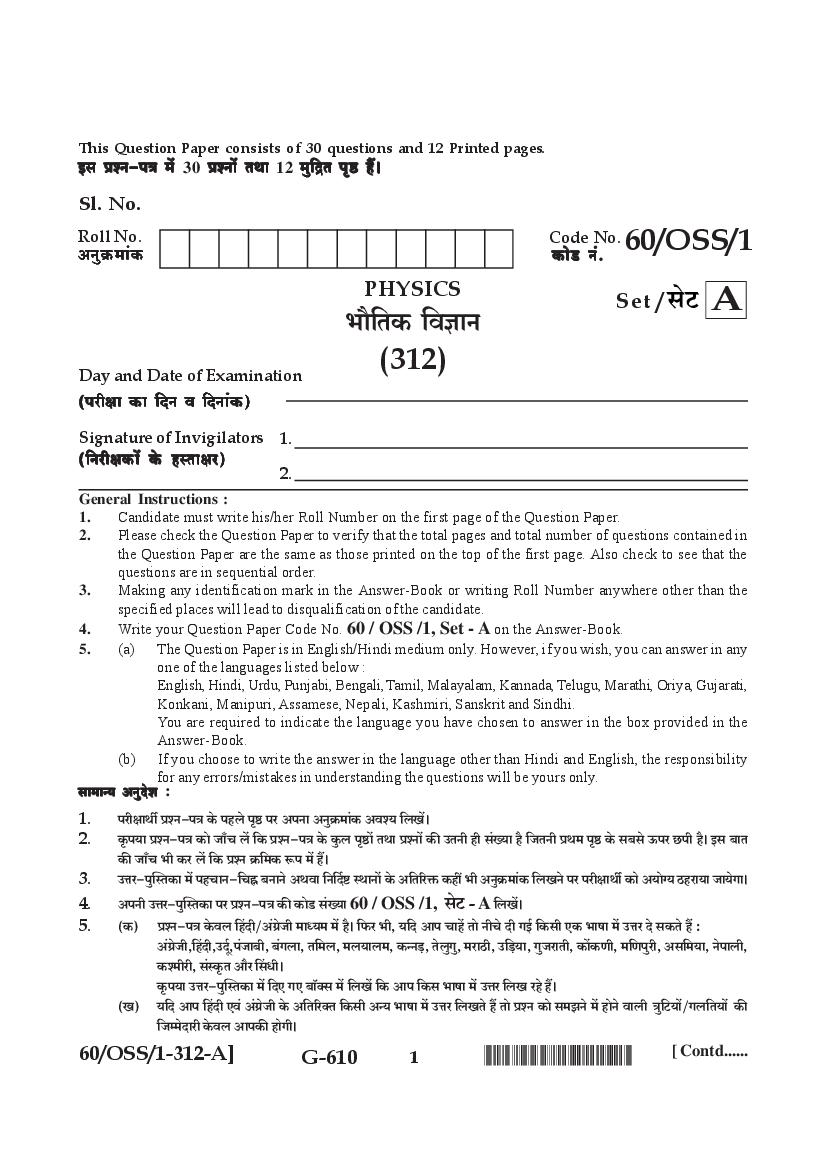
Page 1
Bg àíZ-nÌ ‘| 30 àíZm| VWm 12 ‘w{ÐV n¥ð> h¢&
Sl. No.
Roll No.
AZw H « $ _m§ H $
Code No.
H$mo S > Z§ .
60/OSS/1
PHYSICS
Set / go Q > A
^m¡{VH$ {dkmZ
Day and Date of Examination
(312)
(narjm H$m {XZ d {XZm§ H $)
Signature of Invigilators 1.
({ZarjH$m| Ho $ hñVmja)
2.
General Instructions :
1. Candidate must write his/her Roll Number on the first page of the Question Paper.
2. Please check the Question Paper to verify that the total pages and total number of questions contained in
the Question Paper are the same as those printed on the top of the first page. Also check to see that the
questions are in sequential order.
3. Making any identification mark in the Answer-Book or writing Roll Number anywhere other than the
specified places will lead to disqualification of the candidate.
4. Write your Question Paper Code No. 60 / OSS /1, Set - A on the Answer-Book.
5. (a) The Question Paper is in English/Hindi medium only. However, if you wish, you can answer in any
one of the languages listed below :
English, Hindi, Urdu, Punjabi, Bengali, Tamil, Malayalam, Kannada, Telugu, Marathi, Oriya, Gujarati,
Konkani, Manipuri, Assamese, Nepali, Kashmiri, Sanskrit and Sindhi.
You are required to indicate the language you have chosen to answer in the box provided in the
Answer-Book.
(b) If you choose to write the answer in the language other than Hindi and English, the responsibility
for any errors/mistakes in understanding the questions will be yours only.
gm_mÝ` AZwXoe :
1. narjmWu àíZ-nÌ Ho$ nhbo n¥ð> na AnZm AZwH«$‘m§H$ Adí¶ {bI|&
2. H¥$n¶m àíZ-nÌ H$mo Om±M b| {H$ àíZ-nÌ Ho$ Hw$b n¥ð>m| VWm àíZm| H$s CVZr hr g§»¶m h¡ {OVZr àW‘ n¥ð> Ho$ g~go D$na N>nr h¡& Bg ~mV
H$s Om±M ^r H$a b| {H$ àíZ H«${‘H$ ê$n ‘| h¢&
3. CÎma-nwpñVH$m ‘| nhMmZ-{M• ~ZmZo AWdm {Z{X©ï> ñWmZm| Ho$ A{V[aº$ H$ht ^r AZwH«$‘m§H$ {bIZo na narjmWu H$mo A¶mo½¶ R>ham¶m Om¶oJm&
4. AnZr CÎma-nwpñVH$m na àíZ-nÌ H$s H$moS> g§»¶m 60 / OSS /1, goQ> - A {bI|&
5. (H$) àíZ-nÌ Ho$db qhXr/A§J«oOr ‘mܶ‘ ‘| h¡& {’$a ^r, ¶{X Amn Mmh| Vmo ZrMo Xr JB© {H$gr EH$ ^mfm ‘| CÎma Xo gH$Vo h¢ :
A§J«oOr,qhXr,CX©ÿ,n§Om~r, ~§Jbm, V{‘b, ‘b¶mb‘, H$ÝZ‹S>, VobwJw, ‘amR>r, C{‹S>¶m, JwOamVr, H$m|H$Ur, ‘{Unwar, Ag{‘¶m, Zonmbr,
H$í‘rar, g§ñH¥$V Am¡a qgYr&
H¥$n¶m CÎma-nwpñVH$m ‘| {XE JE ~m°³g ‘| {bI| {H$ Amn {H$g ^mfm ‘| CÎma {bI aho h¢&
(I) ¶{X Amn qhXr Ed§ A§J«oOr Ho$ A{V[a³V {H$gr Aݶ ^mfm ‘| CÎma {bIVo h¢ Vmo àíZ H$mo g‘PZo ‘| hmoZo dmbr Ìw{Q>¶m|/Jb{V¶m| H$s
{Oå‘oXmar Ho$db AmnH$s hmoJr&
60/OSS/1-312-A] G-610 1 [ Contd......
Page 2
^m¡{VH$ {dkmZ
(312)
Time : 3 Hours] [Maximum Marks : 80
g_` : 3 KÊQ>o] [nyUmªH$ : 80
Note : i) All questions are compulsory.
ii) Marks allotted are indicated against each question.
iii) Each question from Question Nos. 1 to 10 has four alternatives - (A), (B), (C) and (D) out of
which one is most appropriate. Choose the correct answer among the four alternative and write
it in your answer-book against the number of the question. No separate time is allotted for
attempting multiple choice questions.
{ZX} e : i) g^r àíZ A{Zdm¶© h¢&
ii) à˶oH$ àíZ Ho$ gm‘Zo A§H$ Xem©¶o J¶o h¢ &
iii) àíZ H«$‘m§H$ 1 go 10 ‘| à˶oH$ ‘| Mma {dH$ën - (A), (B), (C) Am¡a (D) {X¶o J¶o h¢, {OZ‘| EH$ ghr h¡ & Mmam|
{dH$ënm| ‘| go ghr CÎma Mw{Z¶o Am¡a AnZr CÎma-nwpñVH$m ‘| àíZ H«$‘m§H$ Ho$ gm‘Zo {b{I¶o& ~hþd¡H$ënrH$ àíZm| Ho$ {b¶o
A{V[aº$ g‘¶ Zht {X¶m Om¶oJm &
1. The idea of nuclear model of atom was proposed by ___ [1]
(A) John Dalton
(B) Lord Rutherford
(C) Niels Bohr
(D) Linus Pauling
Zm{^H$s¶ na‘mUw H$s g§H$ënZm àñVwV H$s JB© Wr -
(A) OmohZ² S>mëQ>Z Ûmam
(B) bm°S>© aXa’$moS>© Ûmam
(C) Zrëg ~moha² Ûmam
(D) bmBZg nmD$qbJ Ûmam
60/OSS/1-312-A] G-610 2 [ Contd......
Page 3
atoms of the element of the ___ [1]
(A) 3rd group of periodic table
(B) 4th group of periodic table
(C) 5th group of periodic table
(D) 6th group of periodic table
p-àH$ma AY©MmbH$ àmá hmoVm h¡ O~ h‘ An{‘{lV H$aVo h¢ {g{bH$Z ‘| H$moB© VÎd AmdÎm© gmaUr Ho$ -
(A) V¥Vr¶ g‘yh H$m
(B) MVwW© g‘yh H$m
(C) n§M‘ g‘yh H$m
(D) fîQ>‘ g‘yh H$m
3. The phenomenon responsible for the blue colour of the sky is ___. [1]
(A) Diffraction
(B) Dispersion
(C) Absorption
(D) Scattering
AmH$me Ho$ Zrbo a§J Ho$ {bE CÎmaXm¶r n[aKQ>Zm h¡ -
(A) {ddV©Z
(B) dU©{djonU
(C) AdemofU
(D) àH$sU©Z
60/OSS/1-312-A] G-610 3 [ Contd......
Page 4
(A) h v c
(B) h v/c
(C) h c/v
(D) c v/h
v Amd¥{Îm Ho$ ’$moQ>mZo H$m g§dJ
o hmoVm h¡ -
(A) h v c
(B) h v/c
(C) h c/v
(D) c v/h
238
5. The number of neutrons in the atom of 92 U are ___ [1]
(A) 92
(B) 238
(C) 146
(D) 330
238
U na‘mUw ‘| ݶwQ>´ mZ
° m| H$s g§»¶m h¡ -
92
(A) 92
(B) 238
(C) 146
(D) 330
60/OSS/1-312-A] G-610 4 [ Contd......
Page 5
dinate axis is [1]
(A) Zener diode
(B) Light Emitting diode
(C) Photo diode
(D) Solar cell
{ZåZ{b{IV ‘o§ go {H$g g§{Y S>m¶moS> Ho$ I-V A{^bjU {ZX}em§H$ Ajmo Ho$ MVwW© ³dmS´>Q¢ > ‘| hmoVo h¢?
(A) OoZa S>m¶moS>
(B) àH$me CËgO©H$ S>m¶moS>
(C) ’$moQ>mo S>m¶moS>
(D) gmoba gob
7. The relation between phase difference () and path () is given by ___ [1]
2
(A)
λ
2
(B)
(C) 2
(D) 2
H$bm-AÝVa () Ed§ nW-AÝVa () Ho$ ~rM g§~Y§ 춳V H$aZo dmbm gyÌ h¡ -
2
(A)
λ
2
(B)
(C) 2
(D) 2
60/OSS/1-312-A] G-610 5 [ Contd......
Page 6
27 4 30
Al He
Si x, is ___
13 2 14
(A) electron
(B) proton
(C) neutron
(D) photon
27 4 30
A{^{H«$¶m 13 Al 2 He
Si x, ‘| CËg{O©V H$U ‘x’ h¡ ___
14
(A) Bbo³Q´>mZ°
(B) àmoQ>mZo
(C) ݶyQ>´ mZ°
(D) ’$moQmoZ
9. From the Boolean expressions listed below, identify the one which corresponds to
A
the symbol Y - [1]
B
(A) Y A B (B) Y A B
(C) Y A (D) Y A + B
A
ZrMo Xr JB© ~y{b¶Z ì¶ÄOH$m| H$s gyMr ‘| go g§H$o V Y Ho$ g§JV ì¶ÄOH$
B
H$s nhMmZ H$s{OE &
(A) Y A B (B) Y A B
(C) Y A (D) Y A + B
60/OSS/1-312-A] G-610 6 [ Contd......
Page 7
and collector current Ic = 1mA. The current gain will be ___ [1]
(A) 1000
(B) more than 1000
(C) less than 1000 but not less than 100
(D) less than 100
C^¶{ZîR> CËgO©Z {dݶmg ‘| g§¶{w OV {H$gr n-p-n Q´>m{§ OñQ>a ‘| AmYma Ymam Ib = .001mA VWm g§Jm« hH$
Ymam Ic = 1mA h¡, BgH$s Ymam bpãY hmoJr -
(A) 1000
(B) 1000 go H$‘
(C) 1000 go H$‘ bo{H$Z 100 go H$‘ Zht
(D) 100 go ^r H$‘
11. Define electric dipole moment. Give its S.I. unit. [2]
d¡ÚVw {ÛYwd« AmKyU© H$s n[a^mfm {b{IE & BgH$m S.I. ‘mÌH$ ~VmB©E &
12. Write any two applications of photo cell. [2]
’$moQ>mo gob Ho$ H$moB© Xmo AZwà¶moJ {b{IE &
13. Write Newton’s formula for velocity of sound in air. What did laplace suggest to
correct the formula. Write the corrected formula and specifyings the meanings of
the symbols used. [2]
dm¶w ‘| Üd{Z Ho$ doJ Ho$ {bE ݶyQ>Z H$m gyÌ {b{IE & bmßbmg Zo Bg gyÌ ‘| ³¶m g§emoYZ àñVm{dV {H$¶m?
g§emo{YV gyÌ ^r {b{IE & gyÌ ‘| Cn¶moJ {H$E JE g§H$o Vm| Ho$ {Z{hVmW© ~VmB©E &
60/OSS/1-312-A] G-610 7 [ Contd......
Page 8
Explain how will the energy stored in the capacitor change when the separation
between its plates is doubled keeping the value of V same. [2]
EH$ g‘m§Va ßboQ> g§Ym[aÌ H$mo BgH$s ßboQ>mo Ho$ ~rM V dmoëQ>Vm Ho$ {d^dm§Va VH$ Amdo{eV {H$¶m J¶m h¡ &
ì¶m»¶m H$s{OE {H$ V Ho$ ‘mZ H$mo pñWa aIVo hþE BgH$s ßboQ>mo Ho$ ~rM H$s Xÿar Xmo JwZr H$aZo na Bg‘| g§M{¶V
D$Om© {H$g àH$ma n[ad{V©V hmoJr?
15. Out of fission and fusion which is more efficient a nuclear reaction to convert mass
into energy and why? [2]
{dI§S>Z Am¡a g§b¶Z ‘| go H$m¡Z gr Zm{^H$s¶ A{^{H«$¶m Ð춑mZ H$mo D$Om© ‘| ê$nm§V[aV H$aZo H$s A{YH$ Xj
A{^{H«$¶m h¡, Am¡a ³¶m| Eogm h¡?
16. How is the conductivity of a semiconductor affected with the increase in its tem-
perature? Explain. [2]
Vmn ~‹T>Zo go {H$gr AY©MmbH$ H$s MmbH$Vm {H$g àH$ma à^m{dV hmo OmVr h¡? ì¶m»¶m H$s{OE &
17. A woman weighing 50 kg is standing on a weighing machine in a lift. Calculate her
weight recorded by the weighing machine when the lift is moving upwards with an
acceleration of 5ms–2. (Take g = 10ms–2) [2]
50 kg ^ma H$s EH$ ‘{hbm {H$gr {bâQ> ‘| ^ma ‘mnH$ Vwbm na IS>r hþB© h¡ & ^ma ‘mnH$ Vwbm Ûmam [aH$m°S>© {H$E
JE ‘{hbm Ho$ ^ma H$m n[aH$bZ H$s{OE O~ {bâQ> 5ms–2 Ho$ ËdaU go D$na H$s Amoa J{V H$a ahr hmo &
(g = 10ms–2 br{OE )
18. The two thigh bones each of cross sectional area 10 cm2 support the upper part of
human body of mass 40 kg. Estimate the average pressure sustained by the thigh
bones. [2]
Xmo Hy$ëho H$s h{S²>S>¶m± {OZ‘| go à˶oH$ H$m AZwàñWH$mQ> joÌ’$b 10 cm2 h¡ 40 kg Ð춑mZ Ho$ eara Ho$
D$nar ^mJ H$mo AmYma àXmZ H$aVm h¡ & Hy$ëho H$s h{S²>S>¶m| Ûmam ~Xm©íV {H$E OmZo dmbo Am¡gV Xm~ H$m AmH$bZ
H$s{OE &
60/OSS/1-312-A] G-610 8 [ Contd......
Page 9
the element and (ii) Resistance of the filament. [2]
EH$ D$î‘H$ Ad¶d na 220V, 660W A§{H$V h¡ & n[aH${bV H$s{OE : (i) Bg D$î‘H$ Ad¶d ‘| àdm{hV
hmoZo dmbr Ymam, VWm (ii) BgHo$ VÝVw H$m à{VamoY &
20. What is meant by coherent sources of light? Why are coherent sources required to
show interference of light? Give one example of interference of light from daily
life? [4]
àH$me Ho$ gwg~§ Õ òmoVm| go ³¶m VmËn¶© h¡? àH$me H$m ì¶{VH$aU àX{e©V H$aZo Ho$ {bE gwg~§ Õ g«mVo mo H$s
Amdí¶H$Vm ³¶m| hmoVr h¡? X¡{ZH$ OrdZ go àH$me Ho$ ì¶{VH$aU H$m EH$ CXmhaU Xr{OE &
21. Explain how an intrinsic semiconductor can be converted into a (i) n-type semicon-
ductor and (ii) p-type semiconductor. Give one example of each and their energy
band diagrams. [4]
ì¶m»¶m H$s{OE {H$ EH$ Z¡O AY©MmbH$ H$mo EH$ (i) n - àH$ma Ho$ AY©MmbH$ ‘|, Ed§ $(ii) p - àH$ma Ho$
AY©MmbH$ ‘| {H$g àH$ma n[ad{V©V {H$¶m Om gH$Vm h¡ & à˶oH$ H$m EH$-EH$ CXmhaU Am¡a CZHo$ D$Om© ~¢S>
AmaoI ~ZmB©E &
22. i) A capillary tube has a large soap bubble formed at its one end and a small one
at the other. Which of the two will grow at the expense of the other and why?
ii) Explain why do a large number of droplets of mercury coalesce together to
form a large drop when brought in contact.
[4]
i) EH$ H$mo{eH$m Zbr Ho$ EH$ {gao na EH$ ~S>m gm~wZ H$m ~wb~wbm Am¡a Xÿgao {gao na EH$ N>mQo >m gm~wZ H$m
~wb~wbm {dÚ‘mZ h¡ & BZ‘| go H$m¡Z-gm ~wb~wbm Xÿgao go dm¶w J«hU H$aHo$ AmH$ma ‘| ~‹T>Jo m & Eogm ³¶m|
hmoJm?
ii) nmao H$s ~hþV N>mQo >r-N>mQo >r AZoH$ ~±Xy mo§ H$mo g§nH©$ ‘| bmZo na d| {‘bH$a EH$ ~S>r ~±Xy ³¶m| ~Zm boVr h¢?
g‘PmB©E &
60/OSS/1-312-A] G-610 9 [ Contd......
Page 10
wave. Prove that particle velocity is a head of particle displacement in phase by . [4]
2
EH$ g‘Vb àJm‘r AmdVu Va§J Ho$ H$U-doJ Ho$ {bE ì¶ÄOH$ ì¶wËnÞ H$s{OE & {gÕ {H${OE {H$ H$U doJ
{dñWmnZ go H$bm ‘| 2 H$moU AmJo hmoVm h¡ &
24. Write expression for dispersive power of the material of a prism and hence explain
the following: [4]
i) How does the width of the spectrum depend on dispersive power?
ii) How does the width of spectrum depend on the angle of prism?
iii) Out of crown glass and flint glass, flint glass is preferred for a prism and
crown glass for a lens. Why?
{H$gr {àµÁ‘ Ho$ nXmW© H$s n[ajonU j‘Vm Ho$ {bE ì¶ÄOH$ {b{IE Am¡a CgH$s ghm¶Vm go {ZåZ{b{IV H$s
ì¶m»¶m H$s{OE :
i) ñno³Q´>‘ H$s Mm¡S>mB© n[ajonU j‘Vm na {H$g à«H$ma {Z^©a H$aVr h¡?
ii) ñno³Q´>‘ H$s Mm¡S>mB© {àµÁ‘ H$moU na {H$g àH$ma {Z^©a H$aVr h¡?
iii) H«$mCZ-H$m±M Am¡a pâb¨Q>-H$m±M ‘| go [àµÁ‘ Ho$ {bE pâb§Q> H$m±M Am¡a boÝg Ho$ {bE H«$mCZ H$m±M H$mo
dar¶Vm ³¶m| Xr OmVr h¡ ?
25. i) Can you move a stationary charge by applying (a) an electric field,
(b) a magnetic field? Give reason for your answer.
ii) Explain why an electric field is able to change the kinetic energy of a charged
particle moving in it however a magnetic field does not bring a change in
the kinetic energy of a charged particle moving.
[4]
i) ³¶m Amn EH$ pñWa Amdoe H$mo (A) d¡ÚVw joÌ (~) Mwå~H$s¶ joÌ Amamo{nV H$aHo$ J{V àXmZ H$a
gH$Vo h¡? AnZo CÎma Ho$ g‘W©Z ‘| VH©$ Xr{OE &
ii) ì¶m»¶m H$s{OE {H$ ³¶m| EH$ d¡ÚVw joÌ Bg‘o J{V‘mZ Amdoe H$s J{VO D$Om© ‘| n[adV©Z bm XoVm h¡
O~{H$ Mwå~H$s¶ joÌ Bg‘| J{V‘mZ Amdoe H$s J{VO D$Om© ‘| n[adV©Z Zhr bm nmVm?
60/OSS/1-312-A] G-610 10 [ Contd......
Page 11
experiment having separation 0.15mm. The screen is placed at a distance of 1.0m
from the slits. Find the separation of second bright fringe from the seventh dark
fringe on the screen. [4]
= 450nm Va§JX¡Ü¶© H$m EH$dUu àH$me ¶§J Ho$ à¶moJ ‘| EH$ Xÿgao go 0.15mm na ~Zr {Û{P[a¶m| H$mo
àH$m{eV H$aVm h¡ & nXm© BZgo 1.0m H$s Xÿar na aIm h¡ & nX} na àmá {ÛVr¶ Xrá q’«$O Am¡a gmVdt AXrá
q’«$O Ho$ ~rM H$s Xÿar kmV H$s{OE &
OR/AWdm
If one of the two identical slits in young’s double slit experiment is covered with a
glass plate so that the intensity of light passing through it is reduced to 50%.
Calculate the ratio of maximum to minimum intensity in interference fringes.
¶§J Ho$ à¶moJ H$s Xmo gd©g‘ {P[a¶mo ‘| go ¶{X EH$ H$mo EH$ H$m±M H$s nQ²>Q>r go Bg àH$ma T‹ >H§ $ {X¶m OmE {H$
Bggo JwOaZo dmbo àH$me H$s Vrd«Vm Ho$db 50% ah OmE Vmo q’«$O n¡Q>Z© ‘§o A{YH$V‘ Am¡a ݶyZV‘ Vrd«Vm
AZwnmV H$m n[aH$bZ H$s{OE &
27. With the help of examples, explain the meaning of thermodynamical equilibrium of a
system. [6]
Cn¶wº$ CXmhaUm| H$s ghm¶Vm go {H$gr {ZH$m¶ Ho$ D$î‘m J{VH$s¶ g§Vb
w Z Ho$ AW© H$s ì¶m»¶m {H${OE &
28. a) Differentiate between perfectly elastic and perfectly inelastic collisions.
b) A body of mass m1 moving with a velocity u1 undergoes a heat on perfectly
inelastic collision with a body of mass m2 initially at rest. Show that the ratio of
final k.e and initial k.e. of the system is m1/m1 + m2. [6]
a) nyU© à˶mñW g§KQ²>Q> Am¡a nyU© Aà˶mñW g§KQ²>Q>$ ‘| AÝVa ñnîQ> H$s{OE &
b) m1 Ð춑mZ H$m u1 doJ go J{V‘mZ H$moB© qnS> {dam‘ ‘| aIo m2 Ð춑mZ Ho$ {H$gr Xÿgao qnS> Ho$ gmW
nyUV© : Aà˶mñW g§KQ²>Q> H$aVm h¡ & Xem©BE© {H$ V§Ì H$s A§{V‘ J{VO D$Om© Ed§ àma§{^H$ J{VO D$Om© H$m
AZwnmV (m1/m1 + m2) h¡ &
60/OSS/1-312-A] G-610 11 [ Contd......
Page 12
capacitor C and resistance R. Draw a phasor diagram and obtain expressions for
(i) impedance of the circuit and (ii) phase angle between the applied voltage and
the current flowing through the circuit. Find the condition of resonance and the
impedance of the circuit at resonance. [6]
EH$ ào[aÌ L, EH$ g§Ym[aÌ C VWm EH$ à{VamoYH$ R Ho$ loUrH«$‘ g§¶moOZ Ho$ {gam| Ho$ ~rM EH$ ac dmoëQ>Vm
e = e0 sin cot bJr h¡ & H$bm-AmaoI ~ZmB©E VWm (i) n[anW H$s à{V~mYm, VWm (ii) n[anW ‘| àdm{hV
hmoZo dmbr Ymam VWm Bg‘| bJr dmoëQ>Vm Ho$ ~rM H$bm-AÝVa H$m n[aH$bZ H$s{OE & n[anW Ho$ AZwZmX H$s
eV© VWm AZwZmX H$s pñW{V ‘| n[anW H$s à{V~mYm kmV H$s{OE &
30. A particle of mass m = 0.2 kg has an initial speed of 5 ms–1 at the bottom of a rough
inclined plane of inclination 30° and vertical height 0.5m. Find the speed of the
1
particle as it reaches the top of the inclined plane. ( , g 10ms 2 ) [6]
3
m = 0.2 kg Ð춑mZ H$m H$moB© H$U 30° na PwH$o Am¡a 0.5m D±$MmB© Ho$ {H$gr IwaXao AmZV Vb H$s Vbr
go Bg na 5 ms–1 Ho$ àma§{^H$ doJ go J{V H$aVm h¡ & H$U O~ AmZV g‘Vb Ho$ D$nar N>mao na nh±M
þ Vm h¡ Vmo
1
BgH$s Mmb {H$VZr hmoJr, kmV H$s{OE & ( 3
, g 10ms 2 )
OR/AWdm
A body of mass m1 = 10 kg is placed on a smooth horizontal table. It is connected
to a pulley string which passes over a frictionless pulley and carries at the other end
a body m2 of mass 5kg. Calculate. (i) the acceleration of the bodies and (ii) the
tension in the string when m2 is let free. Take g = 9.8 N/kg.
m1 = 10 kg Ð춑mZ H$m EH$ qnS> EH$ Kf©U {dhrZ j¡{VO ‘oO na aIm h¡ & ¶h EH$ S>mao r go OwS>m h¡ {Ogo
EH$ Kf©U {dhrZ {KaZr Ho$ D$na go JwOmam OmVm h¡ Am¡a CgHo$ Xÿgao {gao na m2 = 5kg Ð춑mZ H$m EH$ Xÿgam
qnS> OwS>m h¡ & qnS> m2 H$mo ñdV§Ì N>mSo >Zo na (i) qnS>mo H$m ËdaU, VWm (ii) S>mao r ‘§o VZmd Ho$ ‘mZ n[aH${bV
H$s{OE&
g = 9.8 N/kg br{OE &
60/OSS/1-312-A] G-610 12
Document Details
| Board / Org | NIOS |
| Exam | National Institute of Open Schooling Class 12 |
| Type | Question Paper |
| Pages | 12 |
| Updated | 22 Jul 2026 |