NIOS Class 12 Question Paper 2021 (Jan Feb) Psychology
Finished viewing? Save it for later —
Download NIOS Class 12 Question Paper 2021 (Jan Feb) Psychology (PDF · 8 pages)About NIOS Class 12 Question Paper 2021 (Jan Feb) Psychology
NIOS Class 12 Question Paper 2021 (Jan Feb) Psychology is available here for free download. Published by NIOS for National Institute of Open Schooling Class 12, this question paper can be viewed online or downloaded as a PDF (8 pages). Candidates preparing for National Institute of Open Schooling Class 12 can use NIOS Class 12 Question Paper 2021 (Jan Feb) Psychology to understand the exam pattern, the type of questions asked, and the overall difficulty level.
Frequently Asked Questions
How can I download NIOS Class 12 Question Paper 2021 (Jan Feb) Psychology?
Open this page and click the Download button to save NIOS Class 12 Question Paper 2021 (Jan Feb) Psychology as a PDF. It is completely free on AglaSem Docs.
Is NIOS Class 12 Question Paper 2021 (Jan Feb) Psychology free to download?
Yes. NIOS Class 12 Question Paper 2021 (Jan Feb) Psychology can be viewed online and downloaded as a PDF free of cost on AglaSem Docs.
How many pages does NIOS Class 12 Question Paper 2021 (Jan Feb) Psychology have?
NIOS Class 12 Question Paper 2021 (Jan Feb) Psychology contains 8 pages, which you can read online or download together as a single PDF.
Where can I find more National Institute of Open Schooling Class 12 study material?
You can find more National Institute of Open Schooling Class 12 question papers, sample papers, syllabus, and answer keys on AglaSem Docs.
NIOS Class 12 Question Paper 2021 (Jan Feb) Psychology – Text
Read the full text of this question paper below — useful to quickly search, copy and reference the content online without downloading the PDF.
📄 View text version (8 pages)
Page 1
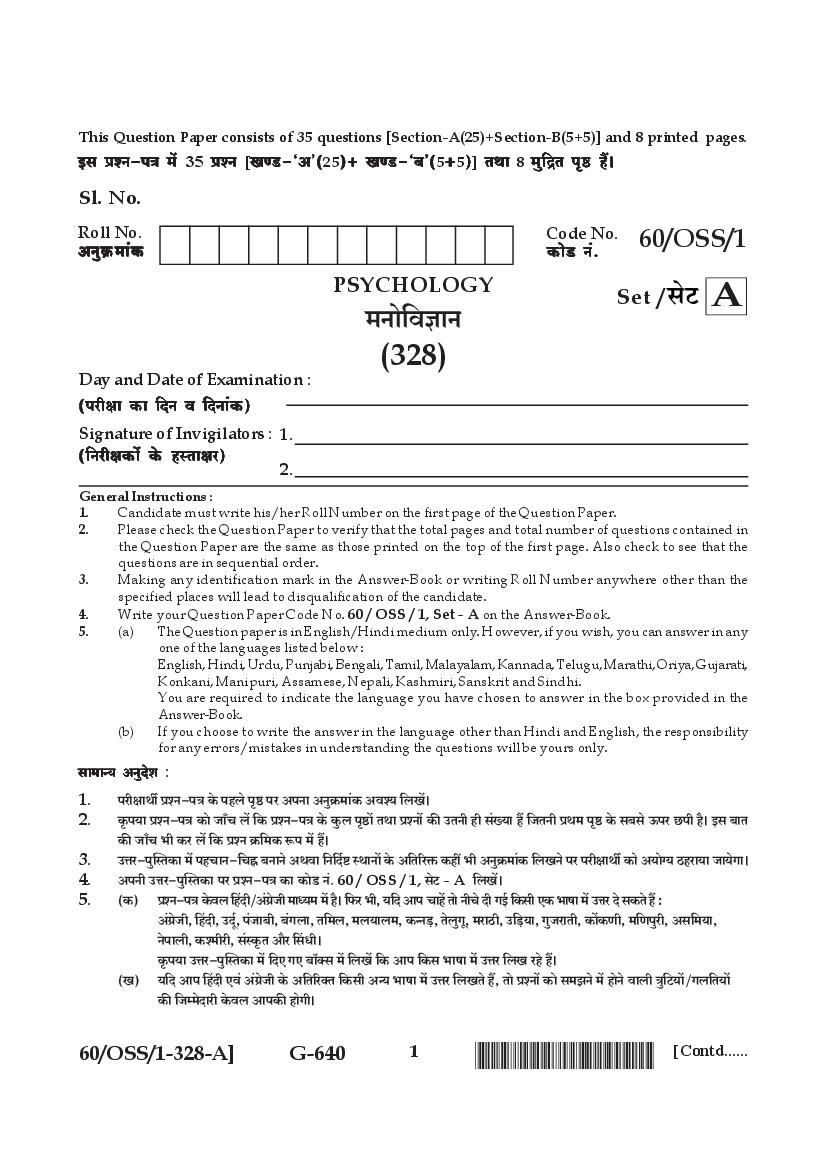
Bg àíZ-nÌ _| 35 àíZ [IÊS>-"A'( 25)+ IÊS>-"~'( 5+ 5) ] VWm 8 ‘w { ÐV n¥ ð > h¢ &
Sl. No.
Roll No.
AZw H « $ _m§ H $
Code No.
H$mo S > Z§ .
60/OSS/1
PSYCHOLOGY
Set / go Q > A
‘Zmo{dkmZ
(328)
Day and Date of Examination :
(narjm H$m {XZ d {XZm§ H $)
Signature of Invigilators : 1.
({ZarjH$m| Ho $ hñVmja)
2.
General Instructions :
1. Candidate must write his/her Roll Number on the first page of the Question Paper.
2. Please check the Question Paper to verify that the total pages and total number of questions contained in
the Question Paper are the same as those printed on the top of the first page. Also check to see that the
questions are in sequential order.
3. Making any identification mark in the Answer-Book or writing Roll Number anywhere other than the
specified places will lead to disqualification of the candidate.
4. Write your Question Paper Code No. 60 / OSS / 1, Set - A on the Answer-Book.
5. (a) The Question paper is in English/Hindi medium only. However, if you wish, you can answer in any
one of the languages listed below :
English, Hindi, Urdu, Punjabi, Bengali, Tamil, Malayalam, Kannada, Telugu, Marathi, Oriya, Gujarati,
Konkani, Manipuri, Assamese, Nepali, Kashmiri, Sanskrit and Sindhi.
You are required to indicate the language you have chosen to answer in the box provided in the
Answer-Book.
(b) If you choose to write the answer in the language other than Hindi and English, the responsibility
for any errors/mistakes in understanding the questions will be yours only.
gm_mÝ` AZwXoe :
1. narjmWu àíZ-nÌ Ho$ nhbo n¥ð> na AnZm AZwH«$‘m§H$ Adí¶ {bI|&
2. H¥$n¶m àíZ-nÌ H$mo Om±M b| {H$ àíZ-nÌ Ho$ Hw$b n¥ð>m| VWm àíZm| H$s CVZr hr g§»¶m h¢ {OVZr àW‘ n¥ð> Ho$ g~go D$na N>nr h¡& Bg ~mV
H$s Om±M ^r H$a b| {H$ àíZ H«${‘H$ ê$n ‘| h¢&
3. CÎma-nwpñVH$m ‘| nhMmZ-{M• ~ZmZo AWdm {Z{X©ï> ñWmZm| Ho$ A{V[aº$ H$ht ^r AZwH«$‘m§H$ {bIZo na narjmWu H$mo A¶mo½¶ R>ham¶m Om¶oJm&
4. AnZr CÎma-nwpñVH$m na àíZ-nÌ H$m H$moS> Z§. 60 / OSS / 1, goQ> - A {bI|&
5. (H$) àíZ-nÌ Ho$db qhXr/A§JO o« r ‘mܶ‘ ‘| h¡& {’$a ^r, ¶{X Amn Mmh| Vmo ZrMo Xr JB© {H$gr EH$ ^mfm ‘| CÎma Xo gH$Vo h¢ :
A§J«oOr, qhXr, CXÿ©, n§Om~r, ~§Jbm, V{‘b, ‘b¶mb‘, H$ÝZ‹S>, VobwJy, ‘amR>r, C{‹S>¶m, JwOamVr, H$m|H$Ur, ‘{Unwar, Ag{‘¶m,
Zonmbr, H$í‘rar, g§ñH¥$V Am¡a qgYr&
H¥$n¶m CÎma-nwpñVH$m ‘| {XE JE ~m°³g ‘| {bI| {H$ Amn {H$g ^mfm ‘| CÎma {bI aho h¢&
(I) ¶{X Amn qhXr Ed§ A§J«oOr Ho$ A{V[a³V {H$gr Aݶ ^mfm ‘| CÎma {bIVo h¢, Vmo àíZm| H$mo g‘PZo ‘| hmoZo dmbr Ìw{Q>¶m|/Jb{V¶m|
H$s {Oå‘oXmar Ho$db AmnH$s hmoJr&
60/OSS/1-328-A] G-640 1 [ Contd......
Page 2
‘Zmo{dkmZ
(328)
Time : 3 Hours] [Maximum Marks : 100
g_` : 3 KÊQ>o] [nyUmªH$ : 100
Note : (i) This Question Paper consists of two Sections, viz., 'A' and 'B'.
(ii) All questions from Section 'A' are to be attempted.
(iii) Section 'B' has two options. Candidates are required to attempt questions from one option only.
(iv) Marks are indicated against each question.
(v) For multiple-choice questions, choose the correct answer from the four options (A), (B), (C) or (D) and
write it in your answer book.
{ZX} e : (i) Bg àíZ-nÌ ‘| Xmo IÊS> h¢-IÊS> "A' Ed§ IÊS> "~'&
(ii) IÊS> "A' Ho$ g^r àíZm| H$mo hb H$aZm h¢&
(iii) IÊS> "~' ‘| Xmo {dH$ën h¢& narjm{W©¶m| H$mo Ho$db EH$ {dH$ën Ho$ hr àíZm| Ho$ CÎma XoZo h¢&
(iv) à˶oH$ àíZ H$m A§H$ CgHo$ gm‘Zo A§{H$V h¢&
(v) ~hþ{dH$ënr¶ àíZm| Ho$ {bE, Mma {dH$ënm| (A), (B), (C) AWdm (D) ‘| go ghr CÎma H$m M¶Z H$a| Am¡a Cgo AnZr CÎma-nwpñVH$m
‘| {bI|&
SECTION-A
IÊS-A
1. During cognitive development, the process by which children change their actions
to manage new objects and situations is called: [1]
(A) Accommodation (B) Assimilation
(C) Adaptation (D) Equilibrium
g§kmZmË‘H$ {dH$mg Ho$ Xm¡amZ, dh à{H«$¶m {OgHo$ ‘mܶ‘ Ûmam ~ƒo ZB© dñVw VWm n[apñW{V¶m| Ho$ gmW Vmb ‘ob
ñWm{nV H$a AnZo H$m¶© H$mo ~XbVo h¡ Cgo H$hVo h¡:
(A) g‘m¶moOZ (B) AmË‘gmVH$aU
(C) AZwHy$bZ (D) g‘¶mdñWm
60/OSS/1-328-A] G-640 2 [ Contd......
Page 3
[1]
(A) Oral (B) Anal
(C) Latency (D) Ego
{ZåZ ‘| go H$m¡Z gm MaU ’«$m¶°S> Ho$ ‘ZmoH$m{‘H$ {dH$mg H$m MaU Zht h¡:
(A) Amoab (B) EZb
(C) boQ>§ogr (D) BJmo
3. Which one of the following is a cue that artists use to create depth in their paintings.
[1]
(A) Non visual Cues (B) Monocular Cues
(C) Binocular Cues (D) Good Form Cues
{ZåZ{b{IV ‘| go H$m¡Z - gm g§Ho$V {MÌH$ma AnZr n§oqQ>J ‘| JhamB© go g§~§{YV gyMZm Ho$ àH$ma ‘| H$aVo h¡?
(A) ½m¡a-Ñpí¶H$ g§Ho$V (B) EH$m{jH$ g§Ho$V
(C) {ÛA{jH$ g§Ho$V (D) AÀN>m ê$n g§Ho$V
4. As a psychologist, you have been given the task to assess intelligence of an illiterate
person who is not familiar with the language. Which type of intelligence test will be
most suitable to use: [1]
(A) Group test (B) Performance test
(C) Verbal test (D) Self report tests
EH$ ‘Zmod¡km{ZH$ Ho$ Vm¡a na, AmnH$mo EH$ {Zaja ì¶{º$ H$s ~w[Õ H$m AmH$bZ H$aZm h¡ Omo ^mfm go AZ{^k
h¡& {H$g àH$ma Ho$ ~w[Õ narjU H$m Cn¶moJ g~go Cn¶wº$ hmoJm:
(A) gm‘y{hH$ narjU (B) {ZînmXZ narjU
(C) ‘m¡{IH$ narjU (D) goë’$ [anmoQ>© narjU >
60/OSS/1-328-A] G-640 3 [ Contd......
Page 4
cannot reply back. She returns to her office room and screams at the peon for not
wishing her. This is an example of : [1]
(A) Denial (B) Projection
(C) Rationalisation (D) Displacement
H$m¶m©b¶ ‘| erZm H$m d[að> CgHo$ gmW ~hþV A{eï> Wm na My±H$s dh CgH$m A{YH$mar Wm dh Cgo H$moB© Odm~
Zhr Xo gH$Vr Wr& O~ dh AnZo H$m¶m©b¶ H$j ‘o§ dm{ng AmVr Vmo AnZo Mnamgr na {M„mVr {H$ CgZo CgH$m
A{^dmXZ Zht {H$¶m& ¶h EH$ CXmhaU h¡:
(A) à{VdmX (B) AmamonU
(C) ¶w{º$H$aU (D) {dñWmnZ
6. With the help of examples, differentiate between primary and secondary needs. [2]
CXmhaUm| H$s ghm¶Vm go àmW{‘H$ VWm {ÛVr¶H$ Amdí¶H$VmAm| Ho$ ‘ܶ {d^oX H$s{OE&
7. How does self evolve in adolescence? [2]
{H$emoamdñWm ‘| AmË‘ H$m {dH$mg {H$g àH$ma hmoVm h¡?
8. How does the presence of people help one's performance? [2]
Xÿgam| H$s CnpñW{V {H$gr ì¶{º$ Ho$ H$m¶© {ZînmXZ ‘| H¡$go ghm¶Vm H$aVr h¡?
9. What is the basic principle behind humanistic perspective in the understanding of
personality? [2]
ì¶{º$Ëd H$mo g‘PZo ‘| ‘mZdr¶Vm n[anoj¶ H$m H$m¡Z-gm AmYma^yV {gÕmÝV h¡?
60/OSS/1-328-A] G-640 4 [ Contd......
Page 5
‘Zmod¡km{ZH$ n¶m©daU ³¶m h¡?
11. What is an extraneous variable? What are the steps to control them in an experimental
method? [4]
~mh²¶ {dMaU ³¶m hmoVo h¡? àm¶mo{JH$ {d{Y ‘| BZ na {Z¶§ÌU H$aZo Ho$ ³¶m MaU h¡?
12. What are the ways undertaken to measure memory? [4]
à{VYmaUm H$m ‘mnZ H$aZo Ho$ {bE H$m¡Z-go Cnm¶ Cn¶moJ ‘| bmE OmVo h¡?
13. What are the distinguishing criteria that determine any behaviour as away from
normal? Briefly describe any four. [4]
gm‘mݶ go {dbJ ì¶dhma H$mo {ZpíMV H$aZo Ho$ {bE H$m¡Z-go ‘mnXÊS> h¡? {H$Ýht Mma H$m g§jon ‘| dU©Z
H$s{OE&
14. How do needs differ from motives? [4]
Amdí¶H$VmE§ H¡$go A{^àoaH$mo go {^Þ h¡?
15. How can the elderly cope with the problems of old age? Discuss any four effective
coping strategies. [4]
~µT>Vr C‘« H$s g‘ñ¶mAm| H$m gm‘Zm d¥Õ {H$g àH$ma H$a gH$Vo h¡? {H$Ýht Mma à^mdembr Zr{V¶m| na MMm©
H$s{OE&$
16. What are the principles of development? Discuss any four. [4]
{dH$mg Ho$ {gÕm§V ³¶m h¡? {H$Ýht Mma na MMm© H$s{OE&
17. Discuss any four Defence Mechanisms. [4]
{H$Ýht Mma ajmË‘H$ à{V{H«$¶mAm| na MMm© H$s{OE&
60/OSS/1-328-A] G-640 5 [ Contd......
Page 6
Discuss any two.
[4]
ì¶dhmanaH$ CnMma ‘| CnmJ‘mo Ûmam ì¶{º$ Ho$ H$ï> H$mo H$‘ H$aZo ‘| H¡$go ghm¶Vm {‘bVr h¡? {H$Ýht Xmo na
MMm© H$s{OE&
19. With the help of examples, discuss the laws of perceptual organization. [4]
CXmhaUm| H$s ghm¶Vm go à˶jUmË‘H$ g§JR>Z H$s {d{Y¶m| na MMm© H$s{OE&
20. Discuss any four major steps that you would suggest to your friend to develop self
control. [4]
{H$Ýht Mma ‘w»¶ MaUm| na MMm© H$s{OE {OÝho Amn AnZo {‘Ì H$mo AmË‘ g§¶‘ Ho$ {dH$mg Ho$ {bE gwPmE±Jo&
21. With the help of examples, discuss the various stages of development. [6]
CXmhaUm| H$s ghm¶Vm go {dH$mg Ho$ {d{^Þ MaUm| na MMm© H$s{OE&
22. Explain the various stages of group formation with the help of an example. [6]
g‘yh Ho$ {Z‘m©U H$s {d{^Þ AdñWmAm| H$s CXmhaUm| H$s ghm¶Vm go ì¶m»¶m H$ao|&
23. How are psychometric tests different from projective tests? [6]
‘Zmo{‘{VH$ narjU H¡$go àjonr narjUm| go {^Þ h¡?
24. Discuss any four health promoting behaviours. [6]
{H$Ýht Mma ñdmñ϶dY©H$ ì¶dhmam| na MMm© H$s{OE&
25. What is an arousal? What changes take place in the organism functioning during
emotional arousal? [6]
^md à~moYZ ³¶m h¡? g§doJmË‘H$ ^md à~moYZ H$s pñWV ‘| Ord {H«$¶mH$aU ‘| ³¶m ~Xbmd AmVo h¡?
60/OSS/1-328-A] G-640 6 [ Contd......
Page 7
IÊS>-~
OPTION-I
{dH$ën-I
(World of Work)
(H$m¶© OJV)
26. Identify the step in yoga which helps to focus the mind on a particular object: [1]
(A) Dhyan (B) Samadhi
(C) Pratyahar (D) Dharna
¶moJ Ho$ Cg MaU H$s nhMmZ H$s{OE {Og‘| ‘Z H$mo {H$gr EH$ Img dñVw na ܶmZ Ho$pÝÐV H$aZo ‘| ghm¶Vm
{‘bVr h¡:
(A) ܶmZ (B) g‘mYr
(C) à˶mhma (D) YmaUm
27. How does stress influence the immune system? [2]
X~md {H$g àH$ma h‘mar à{VajU àUmbr H$mo à^m{dV H$aVm h¡?
28. What are the stress reduction techniques? Give an example of a technique which is
scientific and systematic in nature. [2]
X~md H$mo H$‘ H$aZo H$s H$m¡Z gr VH$ZrHo$ h¢? {H$gr Eogr EH$ VH$ZrH$ H$m CXmhaU Xr{OE Omo d¡km{ZH$ VWm
H«$‘~Õ hmo&
29. Suggest any four types of institutions in our country where students can undergo
special training for entry into their chosen occupation. [4]
h‘mao Xoe H$s Eogr {H$Ýht Mma àH$ma Ho$ g§ñWmZmo H$m gwPmd Xr{OE Ohm§ {dÚmWu AnZo MwZo hþE ì¶dgm¶ Ho$ {bE
{d{eîQ> à{ejU àmá H$a gH$Vo h¡?
30. How does Yoga promote physical and psychological well being of an individual?
Discuss any three important steps of yoga. [6]
{H$gr ì¶{º$ Ho$ emar[aH$ VWm ‘Zmod¡km{ZH$ ñdmñ϶ H$mo ¶moJ {H$g àH$ma àmoËgm{hV H$aVr h¡? ¶moJ Ho$ {H$Ýht
VrZ H$X‘m| na MMm© H$s{OE&
60/OSS/1-328-A] G-640 7 [ Contd......
Page 8
{dH$ën-II
(Facilitating Early Childhood Education)
(àm§a{^H$ ~MnZ H$s {ejm)
26. Identify the one which is not a characteristic of good play equipment in the play
centre: [1]
(A) Design characteristics
(B) Constructional characteristics
(C) Educational characteristics
(D) Disposable characteristics
{H$gr ßbo g|Q>a ‘o Iob Ho$ AÀN>o CnH$aU H$s H$m¡Z gr EH$ {deofVm {ZåZ ‘| go Zht h¡, CgH$s nhMmZ H$s{OE&
(A) ê$n aoIm {deofVm (B) ~ZmdQ> {deofVm
(C) e¡{jH$ {deofVm (D) Cn¶moJ Ho$ ~mX ’|$H$ XoZo H$s {deofVm
27. How can Mahila Mandals help in the running of a Play Centre? Discuss any two
points. [2]
ßbo g|Q>a MbmZo ‘| ‘{hbm ‘§S>b H¡$go ghm¶H$ hmo gH$Vo h¢? {H$Ýht Xmo {~ÝXþAm| na MMm© H$s{OE&
28. Suggest some ways to conduct nutrition education activities in a Play Centre. [2]
{H$gr ßbo g|Q>a ‘o§ nmofU {ejU g§~§Yr J{V{d{Y¶m§ Am¶mo{OV H$aZo Ho Hw$N>$VarH$m| H$m gwPmd Xr{OE&
29. Discuss how development is a result of complex interactions between many
processes. Support your answer with examples. [4]
{dH$mg AZoH$ à{H«$¶mAm| Ho$ ‘ܶ H¡$go O{Q>b A§V{H«$¶mAm| H$m n[aUm‘ h¡, na MMm© H$s{OE& CXmhaUm| Ûmam
{gÕ H$s{OE&
30. How can the teacher make the Play Centre and home relations effective? [6]
EH$ AܶmnH$ Iob Ho$ÝÐ VWm Ka Ho$ g§~§Ym| H$mo à^mdembr H¡$go ~Zm gH$Vm h¡?
60/OSS/1-328-A] G-640 8
Document Details
| Board / Org | NIOS |
| Exam | National Institute of Open Schooling Class 12 |
| Type | Question Paper |
| Pages | 8 |
| Updated | 22 Jul 2026 |