CBSE Class 12 Question Paper 2025 Sociology
Finished viewing? Save it for later —
Download CBSE Class 12 Question Paper 2025 Sociology (PDF · 23 pages)About CBSE Class 12 Question Paper 2025 Sociology
CBSE Class 12 Question Paper 2025 Sociology is available here for free download. Published by CBSE for Class 12, this question paper can be viewed online or downloaded as a PDF (23 pages). Candidates preparing for Class 12 can use CBSE Class 12 Question Paper 2025 Sociology to understand the exam pattern, the type of questions asked, and the overall difficulty level.
Frequently Asked Questions
How can I download CBSE Class 12 Question Paper 2025 Sociology?
Open this page and click the Download button to save CBSE Class 12 Question Paper 2025 Sociology as a PDF. It is completely free on AglaSem Docs.
Is CBSE Class 12 Question Paper 2025 Sociology free to download?
Yes. CBSE Class 12 Question Paper 2025 Sociology can be viewed online and downloaded as a PDF free of cost on AglaSem Docs.
How many pages does CBSE Class 12 Question Paper 2025 Sociology have?
CBSE Class 12 Question Paper 2025 Sociology contains 23 pages, which you can read online or download together as a single PDF.
Where can I find more Class 12 study material?
You can find more Class 12 question papers, sample papers, syllabus, and answer keys on AglaSem Docs.
CBSE Class 12 Question Paper 2025 Sociology – Text
Read the full text of this question paper below — useful to quickly search, copy and reference the content online without downloading the PDF.
📄 View text version (23 pages)
Page 1
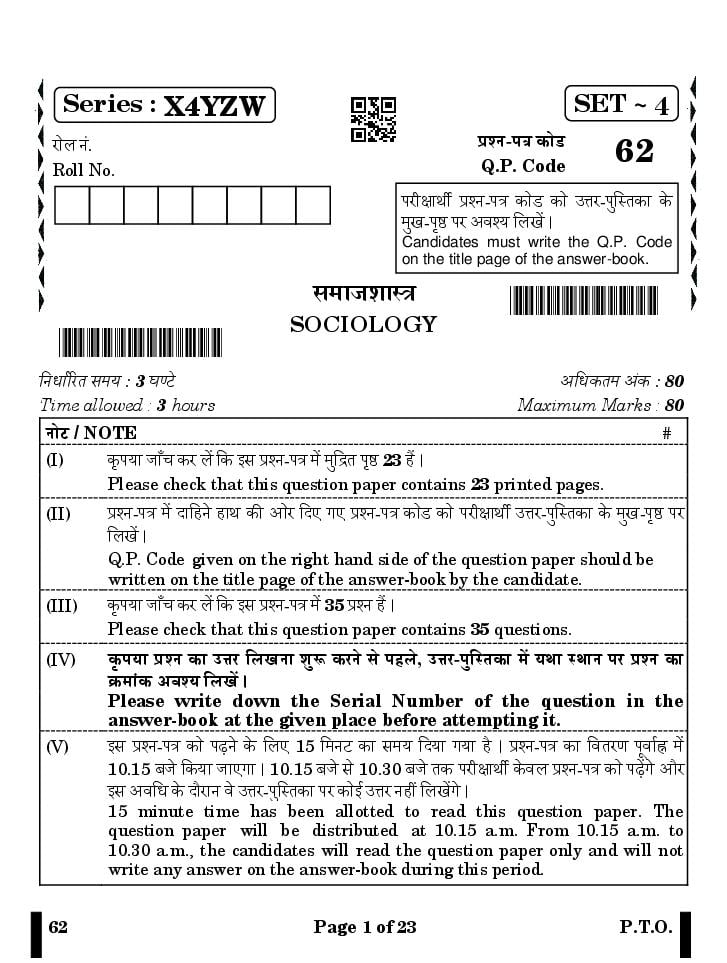
Series : X4YZW SET ~ 4
रोि नं.
Roll No.
प्रश्न-पत्र कोड
Q.P. Code
62
परीक्षार्थी प्रश्न-पत्र कोड को उत्तर-पस्ु तिका के
मख
ु -पृष्ठ पर अवश्य स्िखें ।
Candidates must write the Q.P. Code
on the title page of the answer-book.
समाजशास्तत्र *E52A1B02*
SOCIOLOGY
*OSCIOLOGY*
निर्धारित समय : 3 घण्टे अनर्कतम अंक : 80
Time allowed : 3 hours Maximum Marks : 80
नोट / NOTE #
(I) कृ पया जााँच कर िें स्क इस प्रश्न-पत्र में मस्ु िि पृष्ठ 23 हैं ।
Please check that this question paper contains 23 printed pages.
(II) प्रश्न-पत्र में दास्हने हार्थ की ओर स्दए गए प्रश्न-पत्र कोड को परीक्षार्थी उत्तर-पस्ु तिका के मख
ु -पृष्ठ पर
स्िखें ।
Q.P. Code given on the right hand side of the question paper should be
written on the title page of the answer-book by the candidate.
(III) कृ पया जााँच कर िें स्क इस प्रश्न-पत्र में 35 प्रश्न हैं ।
Please check that this question paper contains 35 questions.
(IV) कृपया प्रश्न का उत्तर लिखना शुरू करने से पहिे, उत्तर-पुलस्तिका में यथा स्तथान पर प्रश्न का
क्रमाांक अवश्य लिखें ।
Please write down the Serial Number of the question in the
answer-book at the given place before attempting it.
(V) इस प्रश्न-पत्र को पढ़ने के स्िए 15 स्मनट का समय स्दया गया है । प्रश्न-पत्र का स्विरण पवू ााह्न में
10.15 बजे स्कया जाएगा । 10.15 बजे से 10.30 बजे िक परीक्षार्थी के वि प्रश्न-पत्र को पढ़ेंगे और
इस अवस्ि के दौरान वे उत्तर-पस्ु तिका पर कोई उत्तर नहीं स्िखेंगे ।
15 minute time has been allotted to read this question paper. The
question paper will be distributed at 10.15 a.m. From 10.15 a.m. to
10.30 a.m., the candidates will read the question paper only and will not
write any answer on the answer-book during this period.
62 Page 1 of 23 P.T.O.
Page 2
सामान्य निर्देश :
निम्िनिनित निर्देशों को ध्यधि से पऩिए औि उिकध सख़्ती से पधिि कीनिए :
(i) यह प्रश्ि-पत्र चार िण्डों में निभधनित नकयध गयध है – खण्ड क, ख, ग तथध घ ।
(ii) इस प्रश्ि-पत्र में कुि 35 प्रश्ि हैं । सभी प्रश्ि अनिवायय हैं ।
(iii) खण्ड क में प्रश्ि संख्यध 1 – 16 हैं । ये िस्तनु िष्ठ प्रकधि के प्रश्ि हैं । प्रत्येक प्रश्ि के निए 1 अक
ं निर्धारित है ।
प्रश्ि के आर्धि पि, नसर्ा एक ही उत्ति हो सकतध है ।
(iv) खण्ड ख में प्रश्ि सख्ं यध 17 – 25 हैं । ये अनत िघ-ु उत्तिीय प्रकधि के प्रश्ि हैं । प्रत्येक प्रश्ि के निए 2 अक
ं
निर्धारित हैं । प्रत्येक प्रश्ि कध उत्ति अनर्कतम 30 शब्र्दों में र्दीनिए ।
(v) खण्ड ग में प्रश्ि सख्ं यध 26 – 32 हैं । ये िघ-ु उत्तिीय प्रकधि के प्रश्ि हैं । प्रत्येक प्रश्ि के निए 4 अक
ं
निर्धारित हैं । प्रत्येक प्रश्ि कध उत्ति अनर्कतम 80 शब्र्दों में र्दीनिए ।
(vi) खण्ड घ में प्रश्ि सख्ं यध 33 – 35 हैं । ये र्दीघा-उत्तिीय प्रकधि के प्रश्ि हैं । प्रत्येक प्रश्ि के निए 6 अक
ं
निर्धारित हैं । प्रत्येक प्रश्ि कध उत्ति अनर्कतम 200 शब्र्दों में र्दीनिए ।
(vii) िे िधनित्र की सहधयतध से प्रश्ि सख्ं यध 33 कध उत्ति र्दीनिए ।
खण्ड क
1. अनभकथि (A) : औद्योगीकरण कुछ एक तर्थानों पर जबरदति समानिा िािा है । उदाहरण के स्िए
रे िगास़्ियों, बसों में जािीय भेदभाव का ना होना ।
कधिण (R) : इस संसार में सामास्जक असमानिाएाँ कम हो रही हैं ।
(A) अस्भकर्थन (A) िर्था कारण (R) दोनों सही हैं िर्था कारण (R), अस्भकर्थन (A) की सही
व्याख्या है ।
(B) अस्भकर्थन (A) िर्था कारण (R) दोनों सही हैं, िेस्कन कारण (R), अस्भकर्थन (A) की
सही व्याख्या िहीं है ।
(C) अस्भकर्थन (A) सही है, िेस्कन कारण (R) ग़िि है ।
(D) अस्भकर्थन (A) ग़िि है, िेस्कन कारण (R) सही है ।
62 Page 2 of 23
Page 3
General Instructions :
Read the following instructions carefully and follow them :
(i) The question paper is divided into four sections — Section A, B, C and D.
(ii) There are 35 questions in all. All questions are compulsory.
(iii) Section A includes questions no. 1 – 16. These are Objective Type Questions,
carrying 1 mark each. As per the question there can be one answer.
(iv) Section B includes questions no. 17 – 25. These are Very Short Answer type
questions, carrying 2 marks each. Answer to each question should not exceed
30 words.
(v) Section C includes questions no. 26 – 32. These are Short Answer type
questions, carrying 4 marks each. Answer to each question should not exceed
80 words.
(vi) Section D includes questions no. 33 – 35. They are Long Answer type
questions, carrying 6 marks each. Answer to each question should not exceed
200 words each.
(vii) Question no. 33 is to be answered with the help of given graphics.
SECTION A
1. Assertion (A) : Industrialisation leads to greater equality, at least in
some spheres, such as, caste distinctions do not matter
any more in trains, buses, etc.
Reason (R) : Social inequalities are reducing in the world.
(A) Both Assertion (A) and Reason (R) are true and Reason (R) is the
correct explanation of Assertion (A).
(B) Both Assertion (A) and Reason (R) are true, but Reason (R) is not
the correct explanation of Assertion (A).
(C) Assertion (A) is true, but Reason (R) is false.
(D) Assertion (A) is false, but Reason (R) is true.
62 Page 3 of 23 P.T.O.
Page 4
2. अनभकथि (A) : परु ाने सामास्जक आंदोिन राजनीस्िक दिों के दायरे में काम करिे र्थे ।
कधिण (R) : परु ाने सामास्जक आंदोिन राष्ट्रीय होिे र्थे ।
(A) अस्भकर्थन (A) िर्था कारण (R) दोनों सही हैं िर्था कारण (R), अस्भकर्थन (A) की सही
व्याख्या है ।
(B) अस्भकर्थन (A) िर्था कारण (R) दोनों सही हैं, िेस्कन कारण (R), अस्भकर्थन (A) की
सही व्याख्या िहीं है ।
(C) अस्भकर्थन (A) सही है, िेस्कन कारण (R) ग़िि है ।
(D) अस्भकर्थन (A) ग़िि है, िेस्कन कारण (R) सही है ।
3. जनसांस्ख्यकीय संक्रमण के स्सद्ांि के अनसु ार, स्नम्नस्िस्खि में से कौन-से कर्थन सही हैं ?
(I) जनसंख्या वृस्द् आस्र्थाक स्वकास के समग्र तिरों से ज़िु ी होिी है ।
(II) प्रत्येक समाज स्वकास के स्वस्िष्ट तवरूप का अनसु रण करिा है ।
(III) स्वकास जनसंख्या वृस्द् से सब ं ंस्िि है ।
(IV) जनसंख्या वृस्द् के चार बस्ु नयादी चरण होिे हैं ।
लवकल्प :
(A) (I) और (II)
(B) (II) और (IV)
(C) (I) और (III)
(D) (I), (II) और (III)
4. अनभकथि (A) : अकसर यह सोचा जािा है स्क कृ स्ि की ‘वैज्ञास्नक’ पद्स्ि की जानकारी देने से
भारिीय कृ िकों की दिा में सुिार होगा ।
कधिण (R) : भारिीय कृ िक सस्दयों से, हररि क्रांस्ि के प्रारंभ से कहीं पहिे से, कृ स्ि काया करिे
आ रहे हैं ।
(A) अस्भकर्थन (A) िर्था कारण (R) दोनों सही हैं िर्था कारण (R), अस्भकर्थन (A) की सही
व्याख्या है ।
(B) अस्भकर्थन (A) िर्था कारण (R) दोनों सही हैं, िेस्कन कारण (R), अस्भकर्थन (A) की
सही व्याख्या िहीं है ।
(C) अस्भकर्थन (A) सही है, िेस्कन कारण (R) ग़िि है ।
(D) अस्भकर्थन (A) ग़िि है, िेस्कन कारण (R) सही है ।
62 Page 4 of 23
Page 5
2. Assertion (A) : The old social movements functioned within the frame of
political parties.
Reason (R) : Old social movements were national.
(A) Both Assertion (A) and Reason (R) are true and Reason (R) is the
correct explanation of Assertion (A).
(B) Both Assertion (A) and Reason (R) are true, but Reason (R) is not
the correct explanation of Assertion (A).
(C) Assertion (A) is true, but Reason (R) is false.
(D) Assertion (A) is false, but Reason (R) is true.
3. As per the theory of Demographic Transition, which of the following
statements are correct ?
(I) Population growth is linked to overall levels of economic
development.
(II) Every society follows a typical pattern of development.
(III) The development is related to population growth.
(IV) There are four stages of population growth.
Options :
(A) (I) and (II)
(B) (II) and (IV)
(C) (I) and (III)
(D) (I), (II) and (III)
4. Assertion (A) : Often it is thought that imparting knowledge of ‘scientific’
farming methods will improve the conditions of Indian
farmers.
Reason (R) : The Indian farmers have been cultivating the land for
centuries, much before the advent of the Green
Revolution.
(A) Both Assertion (A) and Reason (R) are true and Reason (R) is the
correct explanation of Assertion (A).
(B) Both Assertion (A) and Reason (R) are true, but Reason (R) is not
the correct explanation of Assertion (A).
(C) Assertion (A) is true, but Reason (R) is false.
(D) Assertion (A) is false, but Reason (R) is true.
62 Page 5 of 23 P.T.O.
Page 6
5. जनजािीय पहचान से संबंस्िि स्नम्नस्िस्खि में से कौन-सा कर्थन सत्य िहीं है ?
(A) जनजािीय पहचान को सरु स्क्षि रखने का आग्रह स्दनोंस्दन बढ़िा जा रहा है ।
(B) जनजािीय समाज के भीिर भी एक मध्य वगा का प्रादभु ााव हो चिा है ।
(C) नृजािीय-सांतकृ स्िक पहचान के मामिे से संबंस्िि मद्दु े कम महत्त्वपणू ा हो गए हैं ।
(D) भस्ू म िर्था स्विेि रूप से वनों जैसे अत्यिं महत्त्वपणू ा आस्र्थाक ससं ािनों पर स्नयत्रं ण से सबं स्ं िि
मद्दु े स्दनोंस्दन बढ़िे जा रहे हैं ।
निम्िनिनित अिच्ु छे र्द के आर्धि पि, प्रश्ि संख्यध 6 औि 7 के उत्ति र्दीनिए ।
सामास्जक स्विमिा एवं बस्हष्ट्कार जीवन की एक वातिस्वकिा है । सामास्जक स्विमिा (असमानिा)
एवं बस्हष्ट्कार सामास्जक इसस्िए है क्योंस्क वे व्यस्ि से नहीं बस्कक समहू से संबद् है । प्रत्येक समाज
में, कुछ िोगों के पास िन, संपदा, स्िक्षा, तवात्य एवं िस्ि जैसे मकू यवान संसािनों का दसू रों की
अपेक्षा ब़िा स्हतसा होिा है । िोग अकसर अपने स्िंग, िमा, नृजािीयिा, भािा, जास्ि िर्था स्वकिांगिा
की वजह से भेदभाव और बस्हष्ट्कार का सामना करिे हैं ।
6. सामास्जक स्विमिा एवं बस्हष्ट्कार जीवन की एक वातिस्वकिा है क्योंस्क :
(I) सामास्जक असमानिा (स्विमिा) एवं बस्हष्ट्कार का यह रोज़मराापन – इनका इस प्रकार रोज़ाना
घस्टि होना, इन्हें तवाभास्वक बना देिा है ।
(II) हम अकसर उन्हें ‘उस्चि’ या ‘न्यायसंगि’ मानिे हैं ।
(III) ये कुदरिी चीजें हैं स्जन्हें बदिा जा सकिा है ।
(IV) ग़रीब िर्था वंस्चि अपनी पररस्तर्थस्ियों के स्िए दोिी नहीं ठहराए जािे ।
उपयािु कर्थनों में से कौन-से सही हैं ?
लवकल्प :
(A) (I) और (II) (B) (I) और (III)
(C) (I) और (IV) (D) (II) और (III)
7. दस्ििों के बस्हष्ट्कार से सबं स्ं िि स्नम्नस्िस्खि में से कौन-सा कर्थन सत्य िहीं है ?
(A) अतपृश्यिा की सतं र्था िारीररक सपं का से बचने या अछूि से दरू रहने का आदेि नहीं देिी है ।
(B) अतपृश्यिा सामास्जक प्रस्िबंिों के एक बहुि व्यापक समहू को संदस्भाि करिी है ।
(C) अछूि मानी जाने वािी जास्ियों का जास्ि सोपान या अस्िक्रम में कोई तर्थान ही नहीं है ।
(D) उन्हें िो इिना अस्िक अिद् ु एवं अपस्वत्र माना जािा है स्क उनके जरा छू जाने भर से ही अन्य
सभी जास्ियों के सदतय अिद् ु हो जािे हैं ।
62 Page 6 of 23
Page 7
5. Which of the following statements related to Tribal Identity is not true ?
(A) Assertions of tribal identity are on the rise.
(B) This can be laid at the door of the emergence of a middle class
within the tribal society.
(C) Issues relating to matters of ethnic-cultural identity are becoming
less important.
(D) Issues relating to control over vital economic resources like land
and specially forests, are on the rise.
Based on the following passage, answer Q.No. 6 and 7.
Social inequality and exclusion are facts of life. Social inequality and
exclusion are social because they are not about individuals but about
groups. In every society, some people have a greater share of valued
resources – money, property, education, health and power – than others.
People often face discrimination and exclusion because of their gender,
religion, ethnicity, language, caste and disability.
6. Social inequality and exclusion are facts of life because :
(I) This everydayness of social inequality and exclusion often makes
them appear inevitable, almost natural.
(II) We often think of them as being ‘deserved’ or ‘justified’ in some
sense.
(III) These are natural which can be changed.
(IV) The poor and marginalised are not blamed for their own plight.
Which of the above statements are correct ?
Options :
(A) (I) and (II) (B) (I) and (III)
(C) (I) and (IV) (D) (II) and (III)
7. Which of the following statements is not true related to Exclusion of
Dalits ?
(A) The institution of untouchability does not refer to the avoidance or
prohibition of physical contact.
(B) Untouchability refers to a much broader set of social sanctions.
(C) Untouchable castes are outside the caste hierarchy.
(D) They are considered to be so impure that their mere touch severely
pollutes members of all other castes.
62 Page 7 of 23 P.T.O.
Page 8
8. अनभकथि (A) : औपस्नवेस्िक देि में चिाए गए स्नयम काननू अिग हो सकिे हैं और यह जरूरी
नहीं है स्क स्िस्टि उन प्रजािांस्त्रक स्नयमों का स्नवााह औपस्नवेस्िक देि में भी करें
जो स्िटेन में िागू होिे र्थे ।
कधिण (R) : औपस्नवेस्िक प्रिासक यह मानकर चििे र्थे स्क बाग़ान वािों को फायदा पहुचाँ ाने
के स्िए मज़दरू ों पर क़िे से क़िा बि प्रयोग स्कया जाए ।
(A) अस्भकर्थन (A) िर्था कारण (R) दोनों सही हैं िर्था कारण (R), अस्भकर्थन (A) की सही
व्याख्या है ।
(B) अस्भकर्थन (A) िर्था कारण (R) दोनों सही हैं, िेस्कन कारण (R), अस्भकर्थन (A) की
सही व्याख्या िहीं है ।
(C) अस्भकर्थन (A) सही है, िेस्कन कारण (R) ग़िि है ।
(D) अस्भकर्थन (A) ग़िि है, िेस्कन कारण (R) सही है ।
निम्िनिनित अिच्ु छे र्द के आर्धि पि, प्रश्ि सख्ं यध 9 औि 10 के उत्ति र्दीनिए ।
सामाजीकरण प्रस्क्रया काफी स्वतिृि एवं िंबी होिी है स्जसमें कुछ स्विेि िोगों के सार्थ (जो हमारे
जीवन में प्रत्यक्ष रूप से िास्मि रहिे हैं) िगािार संवाद, वािाािाप और कभी-कभी संघिा भी होिा
रहिा है जैसे स्क हमारे मािा-स्पिा, पररवार, नािेदार समहू एवं हमारा समदु ाय । हमारा समुदाय हमें भािा
(मािृभािा) और सातं कृ स्िक मकू य प्रदान करिा है स्जनके माध्यम से हम स्वश्व को समझिे हैं । यह
हमारी तवयं की पहचान को भी सहारा देिा है ।
9. स्नम्नस्िस्खि में से कौन-सा कर्थन ग़लत है ?
(A) स्कसी समदु ाय में जन्म िेने के स्िए हमें कुछ नहीं करना होिा ।
(B) स्कसी पररवार में जन्म िेने पर हमारा कोई वि नहीं है ।
(C) स्कसी देि में जन्म िेने पर हमारा कोई वि नहीं है ।
(D) इस प्रकार की पहचानें अस्जाि होिी हैं ।
10. सामदु ास्यक स्ववादों को स्नपटाना कस्ठन होिा है क्योंस्क :
(I) स्ववाद का प्रत्येक पक्ष सामने वािे पक्ष को ित्रु मानिे हुए घृणा की दृस्ष्ट से देखिा है ।
(II) उसमें अपने पक्ष के गुणों को बढ़ा-चढ़ाकर कहने की प्रवृस्त्त होिी है ।
(III) उसमें अपने सामने वािे पक्ष के दग ु ाणु ों को बढ़ा-चढ़ाकर ना कहने की प्रवृस्त्त होिी है ।
(IV) ऐसे स्ववादों में, यह देखना बहुि कस्ठन होिा है स्क जैसा हम दस ू रों के बारे में सोचिे हैं, दसू रे
भी िो हमारे बारे में वैसा ही सोच रहे हैं ।
उपयाि ु कर्थनों में से कौन-से सही हैं ?
लवकल्प :
(A) (I), (III) और (IV) (B) (I), (II) और (III)
(C) (I), (II) और (IV) (D) (II), (III) और (IV)
62 Page 8 of 23
Page 9
8. Assertion (A) : The laws of a colonised country did not have to stick to
the democratic norms that the British back home had to
follow in Britain.
Reason (R) : The colonial administrators were clear that harsh
measures were taken against the labourers to make sure
they benefitted the planters.
(A) Both Assertion (A) and Reason (R) are true and Reason (R) is the
correct explanation of Assertion (A).
(B) Both Assertion (A) and Reason (R) are true, but Reason (R) is not
the correct explanation of Assertion (A).
(C) Assertion (A) is true, but Reason (R) is false.
(D) Assertion (A) is false, but Reason (R) is true.
Based on the following passage, answer Q.No. 9 and 10.
The socialisation process involves a continuous dialogue, negotiation and
even struggle against significant others (those directly involved in our
lives) like our parents, family, kin group and our community. Our
community provides us the language (our mother tongue) and the
cultural values through which we comprehend the world. It also anchors
our self-identity.
9. Which of the following statements is incorrect ?
(A) We don’t have to do anything to be born into a community.
(B) No one has any choice about which family they are born into.
(C) No one has any choice about which country they are born into.
(D) These types of identities are acquired.
10. Community conflicts are hard to deal with because :
(I) Each side in the conflict thinks of the other side as a hated enemy.
(II) There is a tendency to exaggerate the virtues of one’s own side.
(III) There is a tendency not to exaggerate the vices of the other side.
(IV) In such conflicts, they are constructing matching but reversed
mirror images of each other.
Which of the above statements are correct ?
Options :
(A) (I), (III) and (IV) (B) (I), (II) and (III)
(C) (I), (II) and (IV) (D) (II), (III) and (IV)
62 Page 9 of 23 P.T.O.
Page 10
11. सामास्जक आंदोिनों का अध्ययन समाजिातत्र के स्िए क्यों महत्त्वपणू ा है ?
(A) कुिीन वगा द्वारा सामास्जक आंदोिनों के स्वरोिों को समाज की तर्थास्पि व्यवतर्था के स्िए
गभं ीर चनु ौिी के रूप में देखा जािा र्था ।
(B) सामास्जक आंदोिनों को अव्यवतर्था फै िाने वािी िस्ियों के रूप में नहीं देखा जािा र्था ।
(C) सामास्जक आंदोिनों में भाग िेने वािों की सही और ग़िि की अपनी साझी समझ नहीं
होिी ।
(D) सामास्जक आंदोिनों में भाग िेने वािे प्रायः सावाजस्नक रूप से स्वरोि नहीं करिे र्थे ।
12. जहााँ नगरीकरण की प्रस्क्रया बहुि िेज़ गस्ि से चि रही है, इसके अंिगाि सबसे स्वराट िहर
(मैरोपोस्िस) ही सबसे अस्िक िेज़ी से फै ििे जा रहे हैं ।
नगरीकरण से संबंस्िि स्नम्नस्िस्खि में से कौन-सा कर्थन सत्य िहीं है ?
(A) ये महानगर ग्रामीण क्षेत्रों एवं सार्थ ही सार्थ छोटे कतबों के प्रवास्सयों को अपनी ओर आकस्िाि
करिे हैं ।
(B) भारि में अपेक्षाकृ ि ब़िे िहरों की जनसख्ं या इिनी िेज़ी से नहीं बढ़ रही है ।
(C) नगरीय आिारभिू सस्ु विाएाँ उिनी िेज़ी से िायद ही बढ़ सकें ।
(D) इन िहरों पर जनसंचार के माध्यमों का ध्यान प्रमख ु रूप से अस्िक कें स्िि रहने से भारि का
सावाजस्नक चेहरा, ग्रामीण की बजाय अस्िकास्िक नगरीय होिा जा रहा है ।
13. अनभकथि (A) : अस्िकिम ग्रामीण जनसंख्या के स्िए कृ स्ि जीस्वका का एकमात्र महत्त्वपणू ा स्रोि या
सािन है ।
कधिण (R) : ग्रामीण स्सफा कृ स्ि ही नहीं है । बहुि से ऐसे स्क्रयाकिाप हैं जो कृ स्ि और ग्राम्य
जीवन की जीस्वका के स्रोि में भी मदद के स्िए हैं ।
(A) अस्भकर्थन (A) िर्था कारण (R) दोनों सही हैं िर्था कारण (R), अस्भकर्थन (A) की सही
व्याख्या है ।
(B) अस्भकर्थन (A) िर्था कारण (R) दोनों सही हैं, िेस्कन कारण (R), अस्भकर्थन (A) की
सही व्याख्या िहीं है ।
(C) अस्भकर्थन (A) सही है, िेस्कन कारण (R) ग़िि है ।
(D) अस्भकर्थन (A) ग़िि है, िेस्कन कारण (R) सही है ।
62 Page 10 of 23
Page 11
11. Why is the study of Social Movements important in Sociology ?
(A) Social movements were about protests which were perceived by
elites as a major threat to the established order of society.
(B) Social movements were not seen as forces that led to disorder.
(C) Participants of social movements do not have their own shared
understanding of right and wrong.
(D) Participants did not often resort to public protest.
12. While urbanization has been occurring at a rapid pace, it is the biggest
cities – the metropolises – that have been growing the fastest.
Which of the following statements related to urbanization is not true ?
(A) These metros attract migrants from the rural areas as well as from
small towns.
(B) The larger cities in India are not growing at such a rapid rate.
(C) Urban infrastructure can hardly keep pace.
(D) With the mass media’s primary focus on these cities, the public
face of India is becoming more and more urban rather than rural.
13. Assertion (A) : Agriculture is the single most important source of
livelihood for the majority of the rural population.
Reason (R) : The rural is not just agriculture. Many activities that
support agriculture and village life are also sources of
livelihood.
(A) Both Assertion (A) and Reason (R) are true and Reason (R) is the
correct explanation of Assertion (A).
(B) Both Assertion (A) and Reason (R) are true, but Reason (R) is not
the correct explanation of Assertion (A).
(C) Assertion (A) is true, but Reason (R) is false.
(D) Assertion (A) is false, but Reason (R) is true.
62 Page 11 of 23 P.T.O.
Page 12
14. अनभकथि (A) : स्वस्भन्न जनजािीय समूहों को स्हदं ू समाज के जािीय अस्िक्रम में स्वस्भन्न तिरों पर
आत्मसाि् कर स्िया गया ।
कधिण (R) : जनजािीय जमीनों पर बस्तियााँ बसा दी गई ंऔर जगं िों का सफाया कर स्दया गया ।
(A) अस्भकर्थन (A) िर्था कारण (R) दोनों सही हैं िर्था कारण (R), अस्भकर्थन (A) की सही
व्याख्या है ।
(B) अस्भकर्थन (A) िर्था कारण (R) दोनों सही हैं, िेस्कन कारण (R), अस्भकर्थन (A) की
सही व्याख्या िहीं है ।
(C) अस्भकर्थन (A) सही है, िेस्कन कारण (R) ग़िि है ।
(D) अस्भकर्थन (A) ग़िि है, िेस्कन कारण (R) सही है ।
15. स्नम्नस्िस्खि में से कौन-सा कर्थन पस्श्चमीकरण के स्िए सत्य है ?
(A) यह भारिीय समाज और सतं कृ स्ि में िगभग 150 सािों के स्िस्टि िासन के पररणामतवरूप
आए पररविान हैं ।
(B) पस्श्चमीकरण में स्कसी संतकृ स्ि-स्विेि के बाह्य ित्त्वों के अनक
ु रण की प्रवृस्त्त नहीं होिी है ।
(C) भारिीय किा और सास्हत्य पर पस्श्चमी संतकृ स्ि का प्रभाव नहीं प़िा ।
(D) पस्श्चमीकरण में भारिीय बस्ु द्जीस्वयों की उप-सतं कृ स्ि िास्मि नहीं र्थी ।
16. स्नम्नस्िस्खि कर्थनों को सही क्रम में स्िस्खए ।
(I) कामगारों को मिीनी गस्ि से काम करना होिा है ।
(II) अस्िक मिीनों वािे उद्योगों में, कम िोगों को काम स्दया जािा है ।
(III) दो चाय की छुरियााँ 7.5 स्मनट प्रत्येक और आिा घंटा खाने की छुिी ।
(IV) परू े स्दन में कामगारों को के वि 45 स्मनट का स्वश्राम स्मििा है ।
लवकल्प :
(A) (II), (I), (IV), (III)
(B) (I), (II), (III), (IV)
(C) (IV), (I), (III), (II)
(D) (I), (IV), (III), (II)
62 Page 12 of 23
Page 13
14. Assertion (A) : There is absorption of different tribal groups into caste
Hindu society at varying levels of the hierarchy.
Reason (R) : Tribal lands were colonised and the forests cut down.
(A) Both Assertion (A) and Reason (R) are true and Reason (R) is the
correct explanation of Assertion (A).
(B) Both Assertion (A) and Reason (R) are true, but Reason (R) is not
the correct explanation of Assertion (A).
(C) Assertion (A) is true, but Reason (R) is false.
(D) Assertion (A) is false, but Reason (R) is true.
15. Which of the following statements is true for westernisation ?
(A) The changes brought about in Indian society and culture is a result
of over 150 years of British rule.
(B) Westernisation does not involve the imitation of external forms of
culture.
(C) The west did not influence Indian art and literature.
(D) Westernisation did not include the sub-culture of Indian
intellectuals.
16. Put the following statements in the correct order.
(I) Workers have to work at the pace of the machine.
(II) The more mechanised an industry gets, the fewer people are
employed.
(III) Two tea breaks of 75 minutes each and one lunch break of half an
hour.
(IV) Workers get only 45 minutes rest in the entire day.
Options :
(A) (II), (I), (IV), (III)
(B) (I), (II), (III), (IV)
(C) (IV), (I), (III), (II)
(D) (I), (IV), (III), (II)
62 Page 13 of 23 P.T.O.
Page 14
खण्ड ख
17. “अस्िकिर भारिीय िोग छोटे पैमाने पर काया कर रहे तर्थानों पर ही काम करिे हैं । यहााँ काया के कई
पक्षों का स्निाारण वैयस्िक संबंिों से होिा है ।”
ब़िे सतं र्थानों में काया का स्निाारण वैयस्िक सबं िं ों से नहीं होिा । इस कर्थन से आप क्या अनमु ान िगा
सकिे हैं ? 2
18. (क) “सांतकृ स्िक स्वस्वििा कठोर चनु ौस्ियों को प्रतििु कर सकिी है ।”
उपयक्ु ि उदाहरणों सस्हि कर्थन का समर्थान कीस्जए । 2
अथवा
(ख) िमास्नरपेक्षिा के पक्ष और स्वपक्ष में एक-एक िका दीस्जए ।
19. ू आस्दवासी स्दक्कुओ ं से घृणा क्यों करिे र्थे ? दो कारण दीस्जए ।
मि 2
20. (क) भस्ू मगि खानों में काया करने वािे कामगार बहुि खिरनाक स्तर्थस्ियों का सामना करिे हैं ।
उदाहरण दीस्जए । 2
अथवा
(ख) उदारीकरण की नीस्ि का एक िाभ और एक हास्न बिाइए ।
21. 1960 के दिक में, स्वद्वानों के बीच इस प्रश्न को िेकर वाद-स्ववाद होिा रहा स्क क्या जनजास्ियों को
जास्ि-आिाररि (स्हदं )ू कृ िक समाज के एक स्सरे का स्वतिार माना जाए अर्थवा वे पणू ा रूप से एक
स्भन्न प्रकार का समदु ाय है ।
जनजास्ि और जास्ि के बीच के अंिर के िका का आिार क्या है ? 2
22. औपस्नवेस्िक भारि में बहुि से स्जिों का प्रिासन ज़मींदारी व्यवतर्था द्वारा चििा र्था ।
ज़मींदारी व्यवतर्था के दौरान कृ िकों को स्कन परे िास्नयों का सामना करना प़िा ? 2
23. हररि क्रांस्ि की रणनीस्ि की एक नकारात्मक पररणस्ि क्षेत्रीय असमानिाओ ं में वृस्द् र्थीं ।
अपने उत्तर के स्िए दो कारण दीस्जए । 2
62 Page 14 of 23
Page 15
SECTION B
17. ‘‘By and large, work for most Indians is still in smallscale workplaces.
Here personal relationships determine many aspects of work.’’
In large organisations work is not determined by personal relationships.
What inference can you draw from this statement ? 2
18. (a) ‘‘Cultural Diversity can present tough challenges.’’
Support the statement with suitable examples. 2
OR
(b) Give one argument each for and against secularism.
19. Adivasis shared a common hatred for dikus. Why ? Give two reasons. 2
20. (a) Workers in underground mines face very dangerous conditions.
Give examples. 2
OR
(b) Give one advantage and one disadvantage of the policy of
liberalisation.
21. During the 1960s, scholars debated whether tribes should be seen as one
end of a continuum with caste-based (Hindu) peasant society, or whether
they were an altogether different kind of community.
What is the basis for the argument for tribe and caste distinction ? 2
22. Many districts of colonial India were administered through the
Zamindari system.
What problems were faced by the peasants due to the Zamindari system ? 2
23. One of the negative outcomes of the Green Revolution strategy was the
worsening of regional inequalities.
Give two reasons for your answer. 2
62 Page 15 of 23 P.T.O.
Page 16
24. पहिे अनेक प्रकार की महामाररयााँ र्थीं स्जनमें स्वस्भन्न प्रकार के ज्वर, प्िेग, चेचक और हैजा अस्िक
स्वनािकारी र्थे । िेस्कन 1918 – 19 की इफ्ं िएु ंजा नामक महामारी ने िो अके िे ही देिभर में िबाही
मचा दी, स्जसमें ित्कािीन भारि की कुि जनसंख्या के िगभग 5% भाग को अपनी जान से हार्थ िोना
प़िा ।
महामारी और स्वश्वमारी (पैंडेस्मक) के बीच अन्िर तपष्ट कीस्जए । 2
25. “सैद्ास्ं िक िौर पर, जास्ि व्यवतर्था को स्सद्ािं ों के दो समच्ु चयों के स्मश्रण के रूप में समझा जा सकिा
है ।” दोनों स्सद्ािं ों के नाम बिाइए और स्कसी एक को पररभास्िि कीस्जए । 2
खण्ड ग
26. सन् 1950 से 1970 के दिक के बीच भस्ू म सिु ार काननू ों की एक श्रृंखिा को िुरू स्कया गया — इसे
राष्ट्रीय तिर के सार्थ राज्य के तिर पर भी चिाया गया । इन सुिारों को िाने के पीछे क्या कारण र्थे ? 4
27. वह व्यवतर्था जो एक समाज में िोगों का वगीकरण करिे हुए एक अस्िक्रस्मि सरं चना में उन्हें श्रेणीबद्
करिी है उसे समाजिातत्री ‘सामास्जक तिरीकरण’ कहिे हैं ।
सामास्जक तिरीकरण स्कस प्रकार पीढ़ी-दर-पीढ़ी बना रहिा है ? 4
28. (क) पस्श्चमीकरण में स्कसी सतं कृ स्ि-स्विेि के बाह्य ित्त्वों के अनक
ु रण की प्रवृस्त्त भी होिी है ।
पस्श्चमीकरण की प्रस्क्रया को दिााइए । 4
अथवा
(ख) स्वस्भन्न प्रकार के समाज सिु ारक आंदोिनों में कुछ स्वियगि समानिाएाँ र्थीं । परंिु सार्थ ही
अनेक महत्त्वपणू ा असहमस्ियााँ भी र्थीं । चचाा कीस्जए ।
29. हममें से हर कोई एक पररवार में जन्म िेिा है और हममें से अस्िकाि
ं िोग पररवार में अनेक विा स्बिािे
हैं । आमिौर पर हम अपने पररवार से गहरा िगाव महससू करिे हैं । पररवार हमारे जीवन का एक
अस्भन्न अंग है । स्वतिारपवू ाक समझाइए । 4
30. “स्िस्टि औद्योगीकरण का एक उकटा असर यानी स्क भारि के कुछ क्षेत्रों में औद्योस्गक क्षरण हुआ ।”
उपयाि ु कर्थन के आिार पर उन प्रभावों की पहचान कीस्जए । 4
62 Page 16 of 23
Page 17
24. The major epidemic diseases in the past were fevers of various sorts,
plague, smallpox and cholera. But the single largest epidemic was the
influenza epidemic of 1918 – 19, which killed about 5% of the total
population of India at that time.
Differentiate between epidemic and pandemic. 2
25. “Theoretically, the caste can be understood as the combination of two sets
of principles.” Name them and define any one. 2
SECTION C
26. From the 1950s to the 1970s, a series of land reform laws were
passed — at the national level as well as in the states. What were the
reasons behind these reforms ? 4
27. Sociologists use the term ‘Social Stratification’ to refer to a system by
which categories of people in a society are ranked in a hierarchy.
How does Social Stratification persist over generations ? 4
28. (a) Westernisation does involve the imitation of external forms of
culture. Illustrate the process of westernisation. 4
OR
(b) The varied Social Reform Movements did have common themes.
Yet there were also significant differences. Discuss.
29. Each one of us is born into a family, and most of us spend long years
within it. Usually we feel very strongly about our family. The family is an
integral part of lives. Elaborate. 4
30. ‘‘In India, the impact of the very same British industrialisation led to
deindustrialisation in some sectors.’’
Identify the impacts on the basis of the above statement. 4
62 Page 17 of 23 P.T.O.
Page 18
31. असक्षमिा और ग़रीबी के बीच एक अटूट सबं िं होिा है । चचाा कीस्जए । 4
32. ‘‘कभी-कभी काम की बरु ी दिाओ ं के कारण कामगार ह़ििाि कर देिे हैं ।’’ 1982 की प्रस्सद् बंबई
टैक्सटाइि स्मि की ह़ििाि का उदाहरण िेिे हुए औस्चत्य स्सद् कीस्जए । 4
खण्ड घ
33. भारि में स्गरिा हुआ तत्री-परुु ि अनपु ाि, 1901 – 2011 नीचे दिााया गया है :
वर्ष स्तत्री-पुरुर् लपछिे दशक बाि स्तत्री-पुरुर् लपछिे दशक
अनुपाि सभी की िुिना में अनपु ाि की िुिना में
आयु वगों में अांिर (0 – 6 वर्ष) अांिर
1901 972 – – –
1911 964 –8 – –
1921 955 –9 – –
1931 950 –5 – –
1941 945 –5 – –
1951 946 +1 – –
1961 941 –5 976 –
1971 930 – 11 964 – 12
1981 934 +4 962 –2
1991 927 –7 945 – 17
2001 933 +6 927 – 18
2011 943 + 10 919 –8
उपयाक्ु ि आाँक़िों के आिार पर, स्नम्नस्िस्खि प्रश्नों के उत्तर दीस्जए ।
(क) बाि तत्री-परुु ि अनपु ाि में स्गरावट आने के क्या कारण हैं ? 2
(ख) उपयाक्ु ि आाँक़िों के आिार पर, 20वीं ििाब्दी और 21वीं ििाब्दी के आाँक़िों की िुिना
कीस्जए और अपना स्नष्ट्किा बिाइए । 4
62 Page 18 of 23
Page 19
31. There is a close relationship between disability and poverty. Discuss. 4
32. “In response to harsh working conditions, sometimes workers went on
strike.” Justify taking the example of the famous Bombay Textile Strike
of 1982. 4
SECTION D
33. The declining Sex Ratio in India 1901 – 2011 is given below :
Year Sex Ratio Variation Child Variation
all age over previous Sex Ratio over previous
groups decade ( 0 – 6 years) decade
1901 972 – – –
1911 964 –8 – –
1921 955 –9 – –
1931 950 –5 – –
1941 945 –5 – –
1951 946 +1 – –
1961 941 –5 976 –
1971 930 – 11 964 – 12
1981 934 +4 962 –2
1991 927 –7 945 – 17
2001 933 +6 927 – 18
2011 943 + 10 919 –8
Based on the above data, answer the following questions.
(a) What are the reasons for the declining child sex ratio ? 2
(b) Based on the above data, compare the data of the 20th century with
that of the 21st century and state your inferences. 4
62 Page 19 of 23 P.T.O.
Page 20
िोट : निम्िनिनित प्रश्ि के िि दृनिबानित परीक्षानथययों के निए (प्र.स. 33 के स्थधि पि)
आाँक़िों से तपष्ट होिा है, भारि में तत्री-परुु ि अनपु ाि स्पछिी एक ििाब्दी से कुछ अस्िक समय से
स्गरिा जा रहा है । 20वीं ििाब्दी के िरू
ु में भारि में प्रस्ि 1000 परुु िों के पीछे स्तत्रयों की सख्ं या 972
र्थी िेस्कन 21वीं ििाब्दी के िरू
ु में तत्री-परुु ि अनपु ाि घटकर 933 हो गया है ।
स्पछिे चार दिकों की प्रवृस्त्त खासिौर पर स्चंिाजनक रही है — 1961 में तत्री-परुु ि अनपु ाि 941 र्था
जो घटिे हुए अब िक के सबसे नीचे तिर 1991 में 927 पर आ गया हािााँस्क 2001 में उसमें स्फर
ू ी सी बढ़ोिरी हुई है । भारि की जनगणना 2011 के अतर्थायी आाँक़िों के अनुसार, तत्री-परुु ि
मामि
अनपु ाि को देखें िो प्रस्ि 1000 परुु िों के पीछे 943 स्तत्रयााँ हैं । 0 – 6 विा की आयु वगा का तत्री-परुु ि
अनपु ाि आमिौर पर सभी आयु वगों के समग्र तत्री-परुु ि अनपु ाि से काफी ऊाँ चा रहिा आया है, िेस्कन
अब उसमें भी ब़िी िेज़ी से स्गरावट आ रही है । वतििु ः 1991 से 2001 िक के दिक के आाँक़िों में
यह असामान्यिा स्दखाई देिी है स्क समग्र तत्री-परुु ि अनुपाि में जहााँ अब िक की सबसे अस्िक
6 अंकों की बढ़ोिरी स्नम्निम 927 से 933 दजा हुई है, िेस्कन बाि तत्री-परुु ि अनपु ाि, 18 अंकों का
गोिा िगाकर 945 से घटकर 927 के तिर पर आ गया है और इस प्रकार पहिी बार समग्र तत्री-परुु ि
अनपु ाि से नीचे चिा गया है । सन् 2011 की जनगणना के अनमु ास्नि आाँक़िों के अनसु ार स्तर्थस्ि और
खराब हो गई और बाि तत्री-परुु ि अनपु ाि मात्र 919 रह गया है (8 अंकों से घट गया है) ।
उपयाि
ु आाँक़िों के आिार पर, स्नम्नस्िस्खि प्रश्नों के उत्तर दीस्जए ।
(क) बाि तत्री-परुु ि अनपु ाि में स्गरावट आने के क्या कारण हैं ? 2
(ख) ु आाँक़िों के आिार पर, 20वीं ििाब्दी और 21वीं ििाब्दी के आाँक़िों की िुिना
उपयाि
कीस्जए और अपने स्नष्ट्किा बिाइए । 4
62 Page 20 of 23
Page 21
Note : The following question is for the Visually Impaired Candidate
(In lieu of Q.No. 33)
As is clear from the data, India has had a declining sex ratio for more
than a century. From 972 females per 1000 males at the turn of the
20th century, the sex ratio has declined to 933 at the turn of the
21st century.
The trends of the last four decades have been particularly
worrying — from 941 in 1961, the sex ratio had fallen to an all time low of
927 in 1991 before posting a modest increase in 2001. According to the
provisional data of Census of India 2011, sex ratio is 943 females per
1000 males. The sex ratio for the 0 – 6 years age group has generally
been substantially higher than the overall sex ratio for all age groups, but
it has been falling very sharply. In fact the decade 1991 – 2001 represents
an anomaly, in that the overall sex ratio has posted its highest ever
increase of 6 points from the all time low of 927 to 933, but the child sex
ratio has dropped from 945 to 927, a plunge of 18 points, taking it below
the overall sex ratio for the first time. In 2011 Census the child sex ratio
again decreased by 8 points and now it is 919.
Based on the above data, answer the following questions.
(a) What are the reasons for the declining child sex ratio ? 2
(b) Based on the above data, compare the data of the 20th century with
that of the 21st century and state your inferences. 4
62 Page 21 of 23 P.T.O.
Page 22
34. सामास्जक आदं ोिनों के वगीकरण की चचाा कीस्जए । 6
35. नागररक समाज ने कई महत्त्वपणू ा पहि करने में महत्त्वपणू ा भस्ू मका स्नभाई है, स्जनमें सबसे हास्िया है
सचू ना के अस्िकार के स्िए अस्भयान । इसकी पहि और इसके पररणाम पर चचाा कीस्जए । 2+4=6
62 Page 22 of 23
Page 23
34. Discuss the classification of Social Movements. 6
35. The Civil Society has been instrumental in taking many significant
initiatives, the most recent being the campaign for the Right to
Information. Discuss the initiative and its outcome. 2+4=6
62 Page 23 of 23 P.T.O.
Document Details
| Board / Org | CBSE |
| Exam | Class 12 |
| Type | Question Paper |
| Pages | 23 |
| Updated | 24 Sep 2026 |