CBSE Class 12 Question Paper 2025 Sculpture
Finished viewing? Save it for later —
Download CBSE Class 12 Question Paper 2025 Sculpture (PDF · 12 pages)About CBSE Class 12 Question Paper 2025 Sculpture
CBSE Class 12 Question Paper 2025 Sculpture is available here for free download. Published by CBSE for Class 12, this question paper can be viewed online or downloaded as a PDF (12 pages). Candidates preparing for Class 12 can use CBSE Class 12 Question Paper 2025 Sculpture to understand the exam pattern, the type of questions asked, and the overall difficulty level.
Frequently Asked Questions
How can I download CBSE Class 12 Question Paper 2025 Sculpture?
Open this page and click the Download button to save CBSE Class 12 Question Paper 2025 Sculpture as a PDF. It is completely free on AglaSem Docs.
Is CBSE Class 12 Question Paper 2025 Sculpture free to download?
Yes. CBSE Class 12 Question Paper 2025 Sculpture can be viewed online and downloaded as a PDF free of cost on AglaSem Docs.
How many pages does CBSE Class 12 Question Paper 2025 Sculpture have?
CBSE Class 12 Question Paper 2025 Sculpture contains 12 pages, which you can read online or download together as a single PDF.
Where can I find more Class 12 study material?
You can find more Class 12 question papers, sample papers, syllabus, and answer keys on AglaSem Docs.
CBSE Class 12 Question Paper 2025 Sculpture – Text
Read the full text of this question paper below — useful to quickly search, copy and reference the content online without downloading the PDF.
📄 View text version (12 pages)
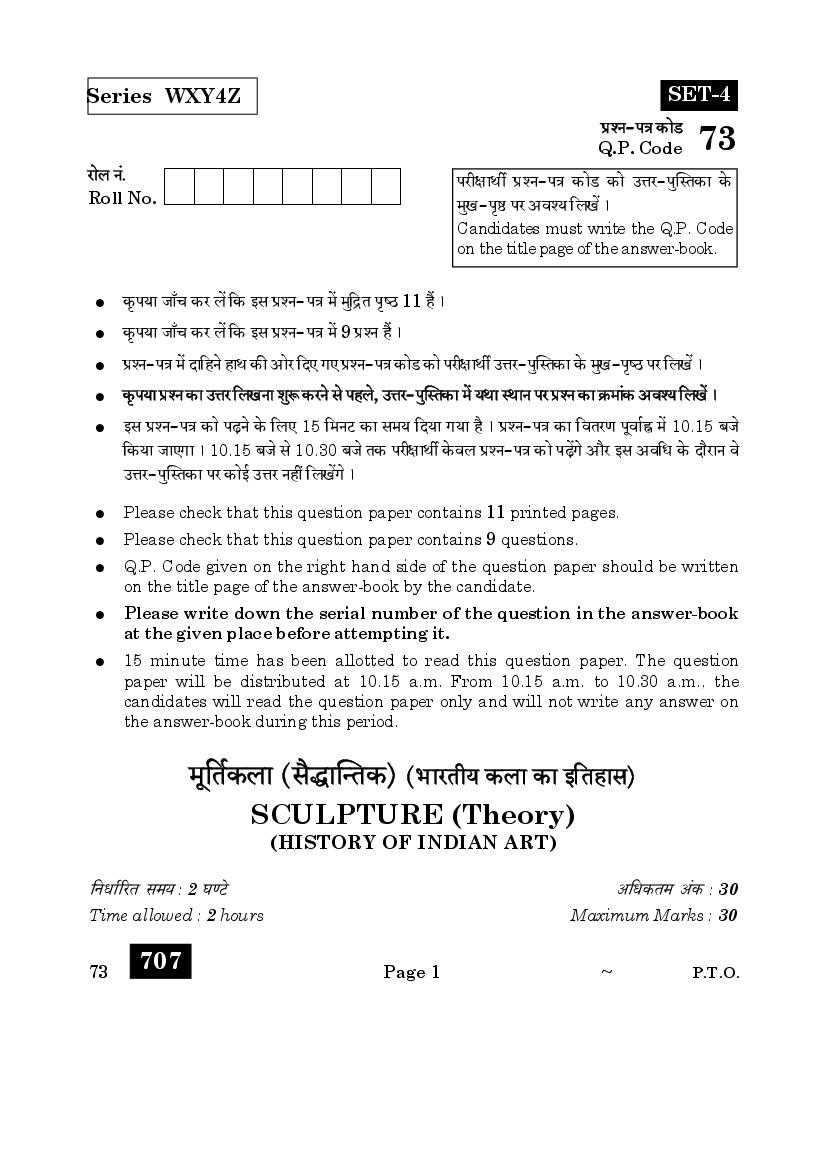
Page 1
-
Q.P. Code 73
. - -
Roll No. -
Candidates must write the Q.P. Code
on the title page of the answer-book.
- 11
- 9
- - - -
, -
- 15 - 10.15
10.15 10.30 -
-
Please check that this question paper contains 11 printed pages.
Please check that this question paper contains 9 questions.
Q.P. Code given on the right hand side of the question paper should be written
on the title page of the answer-book by the candidate.
Please write down the serial number of the question in the answer-book
at the given place before attempting it.
15 minute time has been allotted to read this question paper. The question
paper will be distributed at 10.15 a.m. From 10.15 a.m. to 10.30 a.m., the
candidates will read the question paper only and will not write any answer on
the answer-book during this period.
() ( )
SCULPTURE (Theory)
(HISTORY OF INDIAN ART)
{ZYm©[aV g‘¶ : 2 KÊQ>o A{YH$V‘ A§H$ : 30
Time allowed : 2 hours Maximum Marks : 30
73
707 Page 1 ~ P.T.O.
Page 2
–
( 1 )
–
( 2 )
–
( 6 )
–
( )
1.
(I) - ? 1
(A) (B)
(C) (D)
(II) (A) : (-)
(R) : 1
(A) (A) (R) (R), (A)
(B) (A) (R) , (R), (A)
(C) (A) , (R)
(D) (A) , (R)
(III) -
? 1
(A) - (B)
(C) -- (D)
73 Page 2 ~
Page 3
Section-A
Attempt all questions. (Each question will carry 1 mark)
Section-B
Attempt all questions. (Each question will carry 2 marks)
Section-C
Attempt any two questions. (Each question will carry 6 marks)
SECTION-A
(Multiple Choice Questions)
1. Select the right answer from the given options :
(I) Which medium was typically used in Rajasthani school of miniature
painting ? 1
(A) Acrylic (B) Oil painting
(C) Oil Pastels (D) Water colour
(II) Assertion (A) : In Nihal Chand’s painting Radha (Bani-Thani),
Radha is shown with beautiful accessorized hands and long
tapering fingers.
Reason (R) : In her right hand there are two flower buds and her
left hand is holding Orhni. 1
(A) Both (A) and (R) are true and (R) is the correct explanation of (A).
(B) Both (A) and (R) are true but (R) is not the correct explanation
of (A).
(C) (A) is true but (R) is false.
(D) (A) is false but (R) is true.
(III) In the Deccan miniature painting from your course, who is shown
seated along with Amir Khusro ? 1
(A) Ustad Faquir-Ulla Khan (B) Hazrat Nizamuddin Auliya
(C) Nizam-ul-Mulk (D) Raidas
73 Page 3 ~ P.T.O.
Page 4
“” ? 1
(A) (B)
(C) (D)
(V) “ ”
? 1
(A) (B)
(C) (D)
(VI) 1
(A) (B)
(C) (D)
(VII) ? 1
(A) . (B)
(C) (D)
(VIII) (A) :
(R) :
1
(A) (A) (R) (R), (A)
(B) (A) (R) , (R), (A)
(C) (A) , (R)
(D) (A) , (R)
73 Page 4 ~
Page 5
Meghdoot Chitravali ? 1
(A) Kalidas (B) Tulsidas
(C) Keshavdas (D) Jaidev
(V) In the painting “Maru Ragini” of Rajasthani school the main figures
are shown seated on : 1
(A) A Horse (B) An Elephant
(C) A Camel (D) A Bullock-cart
(VI) Identify the painting of Rajasthani school where the artist used
bright glowing colours with flat background. 1
(A) Krishna lifting mount Goverdhan
(B) Krishna with Gopies
(C) Marriage Procession of Dara Shikoh
(D) Chaugan Players
(VII) Which of the following is not a Print Maker ? 1
(A) K. Laxma Goud (B) Somnath Hore
(C) Amrita Shergil (D) Jyoti Bhatt
(VIII) Assertion (A) : Mughal Art style was a mixture of Indian traditional
art and Persian art.
Reason (R) : Features like painted border decorations and the use of
calligraphy in Arabic, were taken from Indian traditional style. 1
(A) Both (A) and (R) are true and (R) is the correct explanation of (A).
(B) Both (A) and (R) are true but (R) is not the correct explanation
of (A).
(C) (A) is true but (R) is false.
(D) (A) is false but (R) is true.
73 Page 5 ~ P.T.O.
Page 6
( )
100
2. (a)
24 2
(b)
3. ,
2
(a) ( )
(b) ( )
4.
: 2
(a)
(b)
73 Page 6 ~
Page 7
(Short Answer Type Questions)
Answer for these questions is expected in around 100 words.
2. (a) Name the colours and their symbolic meaning used in our National
Flag. Also write about the significance and meaning of Ashoka
Chakra and its 24 spokes. 2
OR
(b) From your syllabus name any four Indian artists who contributed to
the freedom struggle through their art.
3. Evaluate the aesthetic beauty of any one of the following paintings
depicting the connection between royal figures and animals, focusing on
the royal splendour. Include artist’s name in your answer.
(a) Marriage procession of Dara Shikoh (Mughal School) 2
OR
(b) ‘Chand Bibi playing Polo from Deccan school.
4. Identify and appreciate the dominant emotions in the paintings made by
the artist mentioned below. 2
Include the following points in your answer :
Name of this painting from your syllabus and its medium
Application of colours and elements contributing to convey these
feelings effectively.
(a) Raja Ravi Verma
OR
(b) Abnindranath Tagore
73 Page 7 ~ P.T.O.
Page 8
: 2
(a) “ ”
(b) ‘, ’
6. (a) ,
2
(b) “ ”
? ,
–
( )
200
7. ,
, -
(i) , 2
(ii) 2
(iii)
2
73 Page 8 ~
Page 9
art. In their painting Krishna is shown as a caring, approachable friend,
engaging with people warmly. Embodying divine support and affection. 2
Describe any one of the following paintings on the basis of aesthetic
beauty, also justify the above statement :
(a) ‘Krishna with Gopies’
OR
(b) ‘Nand, Yashoda and Krishna with Kinsmen going to Vrindavan’
6. (a) The disciple’s deep and sacred devotion to their mentor transcends
all worldly concerns showcasing a commitment that is pure. 2
Name and appreciate this painting from deccan school on the
basis of its composition in brief.
OR
(b) How does the painting “Falcon on a Bird Rest” from Jahangir’s
period reflect his love for nature and wildlife ? Discuss its aesthetic
qualities and the significance of the bird rest in enhancing the
overall depiction of the falcon and the background.
SECTION-C
(Long Answer Type Questions)
Attempt any two questions from the given options.
Answer for these questions is expected in around 200 words.
7. The following questions refer to a renowned painting from the Rajasthani
school that depicts a divine figure seated on a swing, surrounded by an
elaborate lush green setting.
(i) Identify and name the painting and mention the artist. 2
(ii) Describe the overall composition, focusing on the figures and
surrounding elements. 2
(iii) Write any four stylistic features of the Rajasthani school of
miniature paintings that can be seen in this particular artwork. 2
73 Page 9 ~ P.T.O.
Page 10
(i) , 3
(ii) , 3
9. ,
(i) , 2
(ii) -
? 2
(iii)
2
__________
73 Page 10 ~
Page 11
mountain to protect villagers. Identify the painting based on these clues
and answer :
(i) What is the name of this painting, its artist and the medium ? 3
(ii) Write about the compositional arrangement of this painting, focus on
the use of colour, detail of figures and nature representation. 3
9. Analyze the given picture of a prominent sculpture located at the Marina
Beach, Chennai. Based on your study of this sculpture.
(i) Mention the name of the sculpture and its sculptor. 2
(ii) Explain in detail the symbolic elements present in this sculpture.
What do individual figures and the object represent, how do they
contribute the composition and the values delivered by this artwork ? 2
(iii) Compare this sculpture with any other sculpture from your syllabus
in two points. 2
__________
73 Page 11 ~ P.T.O.
Page 12
Document Details
| Board / Org | CBSE |
| Exam | Class 12 |
| Type | Question Paper |
| Pages | 12 |
| Updated | 24 Sep 2026 |