APTET Question Paper with Answers 18 Jun 2018 Paper 2 Odiya (Shift 2)
Finished viewing? Save it for later —
Download APTET Question Paper with Answers 18 Jun 2018 Paper 2 Odiya (Shift 2) (PDF · 58 pages)About APTET Question Paper with Answers 18 Jun 2018 Paper 2 Odiya (Shift 2)
APTET Question Paper with Answers 18 Jun 2018 Paper 2 Odiya (Shift 2) is available here for free download. Published by Andhra Pradesh Exams for Andhra Pradesh Teacher Eligibility Test, this question paper can be viewed online or downloaded as a PDF (58 pages). Candidates preparing for Andhra Pradesh Teacher Eligibility Test can use APTET Question Paper with Answers 18 Jun 2018 Paper 2 Odiya (Shift 2) to understand the exam pattern, the type of questions asked, and the overall difficulty level.
Frequently Asked Questions
How can I download APTET Question Paper with Answers 18 Jun 2018 Paper 2 Odiya (Shift 2)?
Open this page and click the Download button to save APTET Question Paper with Answers 18 Jun 2018 Paper 2 Odiya (Shift 2) as a PDF. It is completely free on AglaSem Docs.
Is APTET Question Paper with Answers 18 Jun 2018 Paper 2 Odiya (Shift 2) free to download?
Yes. APTET Question Paper with Answers 18 Jun 2018 Paper 2 Odiya (Shift 2) can be viewed online and downloaded as a PDF free of cost on AglaSem Docs.
How many pages does APTET Question Paper with Answers 18 Jun 2018 Paper 2 Odiya (Shift 2) have?
APTET Question Paper with Answers 18 Jun 2018 Paper 2 Odiya (Shift 2) contains 58 pages, which you can read online or download together as a single PDF.
Where can I find more Andhra Pradesh Teacher Eligibility Test study material?
You can find more Andhra Pradesh Teacher Eligibility Test question papers, sample papers, syllabus, and answer keys on AglaSem Docs.
APTET Question Paper with Answers 18 Jun 2018 Paper 2 Odiya (Shift 2) – Text
Read the full text of this question paper below — useful to quickly search, copy and reference the content online without downloading the PDF.
📄 View text version (55 pages)
Page 1
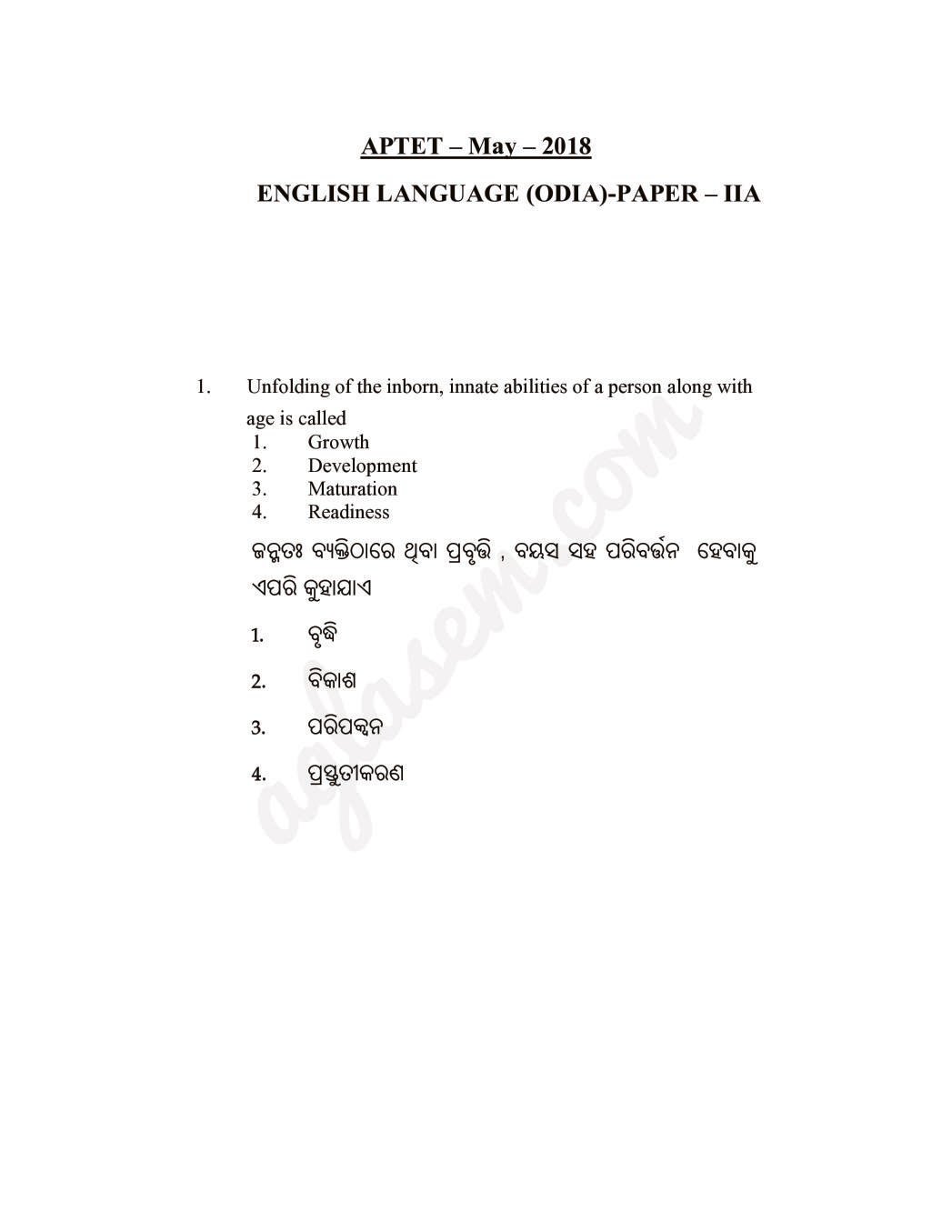
ENGLISH LANGUAGE (ODIA)-PAPER – IIA
1. Unfolding of the inborn, innate abilities of a person along with
age is called
1. Growth
2. Development
3. Maturation
4. Readiness
ଜନମତଃ ଫୟକ୍ତିଠାୄଯ ଥିଫା ପ୍ରଫୃ ତ୍ତି , ଫସ ସହ ଯିଫତ୍ତତନ ୄହଫାକୁ
ଏଯି କୁ ହାମାଏ
ଫୃ ଦ୍ଧି
ଫିକାଶ
ଯିକ୍ୱନ
ପ୍ରସ୍ତୁ ତୀକଯଣ
Page 2
1. Growth
2. Development
3. Heredity
4. Maturation
ନିଯଫଚ୍ଛିନ୍ନ ଓ କ୍ରଭ ଫଦ୍ଧିଷ୍ଣୁ ୄହଫା ଯିଫତ୍ତତନଟି
ଫୃ ଦ୍ଧି
ଫିକାଶ
ଫଂଶାନୁ କ୍ରଭ
ଯିକ୍ୱନ
3. Quantitative change is …
1. Growth
2. Development
3. Maturation
4. Heredity
ଯିଭାଣାତ୍ମକ ଯିଫତ୍ତତନଟି
ଫୃ ଦ୍ଧି
ଫିକାଶ
ଯିକ୍ୱନ
ଫଂଶାନୁ କ୍ରଭ
Page 3
1. Babyhood
2. Childhood
3. Adolescence
4. Old age
ଏହାକୁ ‘ ଅୄଫଗିକ ସ୍ଥିଯ ’ ଫସ୍ଥା ୄଫାରି ଷ୍ଟାନରୀ ହାଲ୍ ଚିହ୍ନଟ
କଯିଥିୄର -
ୄଶୈଶଫ ଫସ୍ଥା
ଫାରୟାଫସ୍ଥା
ୄକୈୄଶାଯାଫସ୍ଥା
ଫାଦ୍ଧତୟକୟ ଫସ୍ଥା
5. The psychologist who explained about incorporation,
accommodation and schemata
1. Vygotsky
2. Chomsky
3. Jean Piaget
4. Kohlberg
ସଂୄେଷଣ , ନୁ ଗୁଣନ , ସ୍କି ଭାଟା ସଂକତୄଯ ଫର୍ଣ୍ତନା କଯିଥିଫା
ଭୄନାଫିଜ୍ଞାନୀ
ୱାଆୄଗାଟସ୍କି
ଚାମସ୍କି
ଜନ ିଅୄଜ
ୄକାହଲ୍ଫର୍ଗତ
Page 4
physical punishment
1. Pre-conventional
2. Conventional
3. Post-conventional
4. Democratic morality
ିରାଭାୄନ ଏହି ସ୍ତଯୄଯ ୄନୈତକ
ି ତାକୁ ଶାଯୀଯିକ ଦଣ୍ଡ ୄଫାରି ବାଫନ୍ତି
ପ୍ରାକ୍ ପ୍ରଥାସମ୍ମତ
ପ୍ରଥାସମ୍ମତ
ଈତ୍ତଯ ପ୍ରଥାସମ୍ମତ
ଗଣତାନ୍ତ୍ରିକ ୄନୈତକ
ି ତା
7. Name the psychologist who proposed that children by birth
have the ability to grasp universal language principles
1. Piaget
2. Vygotsky
3. Chomsky
4. Skinner
ଶିଶୁଭାନଙ୍କ ଜନମଯୁ ହିଁ ସାଫତଜନୀନ ବାଷା ସିଦ୍ଧାନ୍ତ ଅହଯଣ କଯିଫାଯ
ସାଭଥତୟ ଯହିଥାଏ ୄଫାରି ଏହି ଭୄନାଫିଜ୍ଞାନୀ ଜଣାଆଥିୄର
ିଅୄଜ
ୱାଆୄଗାଟସ୍କି
ୄଚାମସ୍କି
ସ୍କି ନ୍ନର୍
Page 6
by ………
1. Binet
2. Simon
3. William Stern
4. Terman
‘ ଫୁ ଦ୍ଧି ରବଧାଙ୍କ ’ ନାଭକ ଧାଯଣାଯ ସଫତପ୍ରଥଭ ପ୍ରସ୍ତାଫକ
ଫିୄନ
ସାଆଭନ
ୱିରିମ ୄଷ୍ଟର୍ଣ୍ତ
ଟର୍ଭାନ
11. The ability of an individual to develop satisfactory
relationship with the environment is ….
1. Personality
2. Adjustment
3. Intelligence
4. Attitude
ଯିୄଫଶ ସହ ଅଶାନୁ ଯୂୄ ସମ୍ପକତ ସ୍ଥାନ କଯିଫା କ୍ଷଭତାକୁ ଏହା
କୁ ହାମାଏ
ଫୟକ୍ତିତ୍ୱ
ଈୄମାଜନ
ଫୁ ଦ୍ଧି
ଭୄନାଫୃ ତ୍ତି
Page 7
1. J.L. Moreno
2. Sheldon
3. Kreshmer
4. Erickson
ସାମାଜିକମିତ ି (ୄସାସିଓୄଭଟ୍ରି) କୁ ସଫତପ୍ରଥୄଭ ଫୟଫହାଯ କଯିଥିଫା
ଫୟକ୍ତି
J.L ୄଭାୄଯୄନା
ୄସଲ୍ଡ଼ନ
ୄକ୍ରସୄଭର୍
ଏଯିକ୍ସନ
13. The change in behaviour in an organism due to
experience and training is …..
1. Development
2. Maturation
3. Motivation
4. Learning
ନୁ ବୂତି ଏଫଂ ତାରିଭ ଦ୍ୱାଯା ଅଚଯଣୄଯ ଯିଫତ୍ତତନ ୄହଫା ପ୍ରକ୍ରିା
ଫିକାଶ
ଯିକ୍ୱନ
ବିୄପ୍ରଯଣ
ଶିକ୍ଷଣ
Page 8
1. Learning styles
2. Aspiration
3. Readiness
4. Achievement motivation
ଈନ୍ନତସ୍ତଯ ରକ୍ଷୟକୁ ହଞ୍ଚିଫା ନାଭକ ଈୄେଶୟଟି ଏଥିସହ ସମ୍ପକିତ
ଶିକ୍ଷଣ ୄଶୈୀ
ଅକାଂକ୍ଷା
ପ୍ରସ୍ତୁ ତକ
ି ଯଣ
କୃ ତତ୍ୱ
ି ବିୄପ୍ରଯଣା
15. Name the theorist who proposed when the number of Trials
increases the number of errors decrease and thus learning
happens -
1. Pavlov
2. Skinner
3. Thorndike
4. Kohler
ପ୍ରମତ୍ନ ସଂଖୟା ଫଢ଼ିଫାଦ୍ୱାଯା ତୃ ଟି ସଂଖୟା ହ୍ରାସ ାଆ ଶିକ୍ଷଣ ଘଟିଥାଏ
ୄଫାରି କହିଥିଫା ଭୄନାଫିଜ୍ଞାନୀ
ାଭୄରାଭ
ସ୍କି ନର୍
ଥର୍ଣ୍ତଣଡ଼ାଆକ୍
ୄକାହରର୍
Page 9
16. In Pavlov‟s experiment, the dog‟s salivation after
conditioning is called ____________
1. Conditioned response
2. Natural response
3. Higher order conditioning
4. Unconditioned response
ାଭୄରାଭଙ୍କ ଯୀକ୍ଷଣୄଯ ନୁ ଫନ୍ଧିତ ପ୍ରକ୍ରିା ସୃଷ୍ଟିୄହଫାୄଯ
କୁ କୁଯଯ ରା କ୍ଷଯଣ ୄହଫାକୁ ଏହା କୁ ହାମାଏ
ନୁ ଫନ୍ଧିତ ପ୍ରତିକ୍ରିା
ପ୍ରାକୃ ତକ
ି ପ୍ରତିକ୍ରିା
ଈନ୍ନତଭାନ ନୁ ଫନ୍ଧନ
ନନୁ ଫନ୍ଧିତ ପ୍ରତିକ୍ରିା
17. „Instrumental conditioning‟ is also called as …….
1. „S‟ type conditioning
2. Classical conditioning
3. Higher order conditioning
4. Operant conditioning
‘ ମାନ୍ତ୍ରିକ ନୁ ଫନ୍ଧନ ’ ଯ ନୟ ଏକ ନାଭ
„S‟ ପ୍ରକାଯ ନୁ ଫନ୍ଧନ
ଶାସ୍ତ୍ରୀ ନୁ ଫନ୍ଧନ
ଈନ୍ନତଭାନ ନୁ ଫନ୍ଧନ
କଯଣଫାଦୀ ନୁ ଫନ୍ଧନ
Page 10
18. Name the Psychologist who spoke about “Zone of Proximal
Development”
1. Hurlock
2. Bandura
3. Chomsky
4. Vygotsky
“Zone of Proximal Development” ଯ ପ୍ରସ୍ତାଫକ
ହରତକ୍
ଫାନ୍ଦୁ ଯା
ଚାମସ୍କି
ୱାଆୄଗାଟସ୍କି
19. A student is drawing a picture to satisfy himself. This is an
example of
1. Intrinsic motivation
2. Extrinsic motivation
3. Achievement motivation
4. Social motivation
ଜୄଣ ଶିକ୍ଷାଥତୀ ଚିତ୍ର ଟାଣି ନିଜକୁ ସଂତୃ ପ୍ତି ନୁ ବଫ କୄଯ ৷ ଏହା ନିଭନ
ପ୍ରକାଯଯ ଈଦାହଯଣ
ନ୍ତନିୄଫଶୀ ବିୄପ୍ରଯଣା
ଫହିନୄି ଫଶୀ ବିୄପ୍ରଯଣା
କୃ ତତ୍ୱ
ି ବିୄପ୍ରଯଣା
ସାଭାଜିକ ବିୄପ୍ରଯଣା
Page 11
20. The ability of an individual to store his experiences in the
brain and recall them into his consciousness whenever required is
1. Memory
2. Recognition
3. Retention
4. Learning
ଫୟକ୍ତି ନିଜଯ ବିଜ୍ଞତାଗୁଡ଼କ
ି ୁ ଭସ୍ତି ଷ୍କୄଯ ଗଚ୍ଛିତ କଯି , ଅଫଶୟକ ସ୍ଥୄ
ୁଣି ୄଚତନାୄଯ ଅଣିାଯିଫା କ୍ଷଭତା ହିଁ
ସ୍ମୃତି
ଚିହ୍ନଟିକଯଣ
ଧାଯଣା
ଶିକ୍ଷଣ
21. When a learnt material „A‟ interferes with present learning of
material „B‟, then the interference is called -
1. Retro active inhibition
2. Passive decay
3. Repression
4. Pro active inhibition
ୂଫତ ଶିକ୍ଷଣୀ ଂଶଗୁଡକ
ି (A) , ଫତ୍ତତଭାନ ଶିକ୍ଷଣୀ ଂଶଗୁଡ଼କ
ି ୁ
(B) ୁନଃ ସ୍ମଯଣ କଯିଫା ାଆଁ ଫାଧା ସୃଷ୍ଟିକଯିଫାକୁ ଏଯି କୁ ହାମାଏ
ପ୍ରତିଘାତ ଜନିତ ଫାଧା
ସ୍ମୃତକ୍ଷ
ି
ଫଦଭନ
ନୁ ଘାତ ଜନିତ ଫାଧା
Page 12
22. An individual who has learnt cycling, easily learns to ride a
motor cycle. It is
1. Positive transfer
2. Negative transfer
3. Bilateral transfer
4. Zero transfer
ସାଆୄକର ଚାନ ଶିଖିଫା ଫୟକ୍ତି ତି ସହଜୄଯ ୄଭାଟଯ ସାଆୄକଲ୍
ଚରାଆଫା ଶିଖିଥାଏ ৷ ଏହା ଏକ
ସକାଯାତ୍ମକ ସ୍ଥାନାନ୍ତଯଣ
ନକାଯାତ୍ମକ ସ୍ଥାନାନ୍ତଯଣ
ଦ୍ୱି-ାକ୍ଷିକ ସ୍ଥାନାନ୍ତଯଣ
ଶୂନ ସ୍ଥାନାନ୍ତଯଣ
23. The field of vision of blind persons is
1. below 20o
2. between 20o to 40o
3. between 40o to 60o
4. 60o to 90o
ଦୃ ଷ୍ଟିହୀନ ଫୟକ୍ତିଯ ଦୃ ଷ୍ଟିୄକାଣ
ଯୁ କମ
ଯୁଭଧ୍ୟୄଯ
ଯୁଭଧ୍ୟୄଯ
ଯୁଭଧ୍ୟୄଯ
Page 14
Page 16
1. Diagnostic evaluation
2. Qualitative evaluation
3. Quantitative evaluation
4. Formative evaluation
ନିଯଫଚ୍ଛିନ ସଂଫୟାକ ଭୂରୟାନ ଭଧ୍ୟଯୁ ୄଗାଟିଏ ସଂଗ୍ରହଣାତ୍ମକ
ଅକନୄହୄର , ନୟଟି
ନିଦାନାତ୍ମକ ଭୂରାନ
ଗୁଣାତ୍ମକ ଭୂରାନ
ଯିଭାଣାତ୍ମକ ଭୂରୟାନ
ଗଠନାତ୍ମକ ଭୂରାନ
Page 17
ଭଧୁସୂଦନ ଦାସ
ଭଧୁସଦ
ୂ ନ ଯାଓ
ଯକ୍ଷିତ ଦାସ
ୄଫୈଷ୍ଣଫ ାଣି
32. ଓଡ଼ିଅ ଜାତିାଆଁ ଜଗନ୍ନାଥ ଦାସଙ୍କ ୄେଷ୍ଠ ଫଦାନ -
ଭୃଗଣ
ୁ ି ସ୍ତୁ ତି
ତୁ ାବିଣା
ଥତୄକାଆରି
ବାଗଫତ
33. ଏହି ଭହାନ ଫୟକ୍ତି ୁଯୀ ଜିଲ୍ଲାଯ ସୁଅୄଣ୍ଡା ଗ୍ରାଭୄଯ ଜନମଗ୍ରହଣ
କଯିଥିୄର
ଅଚାମତୟ ହଯିହଯ
ନୀକଣ୍ଠ ଦାସ
ୄଗାଫନ୍ଧୁ ଦାସ
ହୄଯକୃ ଷ୍ଣ ଭହତାବ
Page 18
ୁ ା ’ ତ୍ରିକାଯ ସମ୍ପାଦକ
ୄଗାଦାଫଯୀଶ ଭିେ
ୄଗାଦାଫଯୀଶ ଭହାାତ୍ର
ୄଗୌଯୀଶଙ୍କଯ ଯା
ୟାଯୀୄଭାହନ ଅଚାମତୟ
35. ଫିଶଷ୍ଟ
ି ବାଷାତତ୍ତ୍ୱଫିତ୍ ଓ ଭ୍ରଭଣକାହାଣୀ ୄରଖକ ୄହଈଛନ୍ତି-
ୄଗାୄରାକ ଫିହାଯୀ ଧ
ୄଗାାା ଚନ୍ଦ୍ର ପ୍ରହଯାଜ
କୃ ଷ୍ଣଚନ୍ଦ୍ର ାଣିଗ୍ରାହୀ
ବୁଫୄନଶ୍ୱଯ ୄଫୄହଯା
36. ଯକ୍ଷିତ ଦାସଙ୍କ ‚ଜ‛ କଫିତାଟି ଏହି ୁସ୍ତକଯୁ ଗୃହୀତ -
ବକ୍ତିଟୀକା
ୄଭାକ୍ଷ ଈାଧି
ଭହୀଭଣ୍ଡ ଗୀତା
ଦାଯୁବ୍ରହ୍ମ ଗୀତା
37. ଏହି କଫିତାଟିୄଯ ଗାଅଁଯ ପ୍ରାକୃ ତକ
ି ୄସୌନ୍ଦମତୟ ଓ କଭତଭ ସଯ
ଗାଈଁରୀ ଜୀଫନଯ ନିଖଣ
ୁ ଚିତ୍ର ୄଦଖିଫାକୁ ଭିୄ -
କହିଫ ି କଥାଟି
ୄଛାଟ ୄଭାଯ ଗାଅଁଟି
ୄଛାଟଯୁ ଫଡ଼
ୄଦଖିନାହିଁ ୄକୄତଦିନୁ ଖଣ୍ଡଗିଯି
Page 19
ଦଣ୍ଡ ୄବାଗିଫାକୁ ୄଡ଼ , ଏହି ଗଳ୍ପୄଯ ତାହା କୁ ହାମାଆଛି -
ନନାଙ୍କ ଫସ୍ତାନି
ଫାଆଭହାନ୍ତିଙ୍କ ାଞ୍ଜି
ଫାଆନାନୀଙ୍କ ଫିଜୁି
ଭାଡ଼ହାଣ୍ଡି କଥା
39. ‚ବୃତୟ‛ ଶବ୍ଦଟିଯ ଥତ -
ବକ୍ତ
ଚାକଯ
ଫଣିକ
ବାୁ
40. ‘ ଗଗନ ’ଯ ପ୍ରତିଶବ୍ଦ -
ୄଭଘ
ଫିଜୁି
ଅକାଶ
ଫନ
41. ‘ ଘନ ’ ଶବ୍ଦଟିଯ ଦୁ ଆଟି ବିନ୍ନାଥତ -
ଫହ , ୄଭଘ
ଅକାଶ , ଧନ
ବ୍ରହ୍ମା , ବିାଷ
କଙ୍କ , କଢ଼ି
Page 20
ି ଖ
ି , ଫନ – ଏଥିଯୁ ବିନ୍ନ ଜାତୀ ଶବ୍ଦଟିକୁ
ଚିହ୍ନଟ କଯ -
ଫନ
ଫଷତା
ଗିଯଶ
ି ଖ
ି
ଫିଜୁି
43. ‘ ଫିତ୍ତି ’ ଶବ୍ଦଟିଯ ଫିଯୀତାଥତ ୄଫାଧକ ଶବ୍ଦ -
ଅତ୍ତି
ସମ୍ପତ୍ତି
ଦମ୍ପତି
ନୃ ତି
44. ନାଅଁ , ନାଅ – ଏହି ସୄଭାଚ୍ଚାଯିତ ଶବ୍ଦ ଦୁ ଆଟିଯ ଥତ ମାଥାକ୍ରୄଭ -
ଡଙ୍ଗା , ନାଭ
ତଯଣୀ , ୄନୌକା
ୄଫାଆତ , ଯିଚ
ନାଭ , ଡଙ୍ଗା
45. ନିୄଭନାକ୍ତ ଭଧ୍ୟଯୁ ଶୁଦ୍ଧ ଶବ୍ଦଟି -
ସନୟାସୀ
ସନ୍ନୟାସି
ସନ୍ନୟାସୀ
ସନୟାଶୀ
Page 21
ୄସଭାନଙ୍କଯ
ୄସଭାନଙ୍କୁ
ତାଙ୍କଯ
ଏହାଙ୍କୁ
47. ‘ ଫୃ ଦ୍ଧ ’ଯ ସ୍ତ୍ରୀରିଙ୍ଗ ଫାଚକ ଶବ୍ଦଟି -
ଫୃ ଦ୍ଧି
ଫୁ ଦ୍ଧି
ଫୃ ଦ୍ଧଣୀ
ଫୃ ଦ୍ଧା
48. ଏହା ଏକ ‘ତତ୍ସଭ’ ଶବ୍ଦ -
ଶିଅ
ନଯ
ସୁନ୍ଦଯ
ଭାଟି
49. ନିୄଭନାକ୍ତ ଭଧ୍ୟଯୁ ଫିୄଶଷୟ ଦଟି
ଫଣ୍ଟନୀ
ୄକ୍ରାଧ
ବାୁ
ଚାିତ
Page 22
ୄପ୍ରଯିତ
ୄସଫା
ଜୀଫନ
ସଭୂହ
51. ‘ୄସ୍ୱଚ୍ଛା ’ ଶବ୍ଦଟିଯ ସନ୍ଧିଫୄି ଚ୍ଛଦ କୄର ଏହା ୄହଫ -
ସ + ଆଛା
ୄସ + ଆଛା
ସ୍ୱ + ଆଛା
ସୁ + ଆଛା
52. ‘ ଗୃହାଗତ ’ ଦଟିଯ ଠିକ୍ ଫିଗ୍ରହ ଫାକୟ -
ଗୃହଯ ଅଗତ
ଗୃହକୁ ଅଗତ
ଗୃହକୁ ଅଗତ ୄମ
ଗୃହ ଓ ଅଗତ
53. ‘ ନୀକଣ୍ଠ ’ – ଏହି ସଭାସଯ ନ୍ତବତୁକ୍ତ -
ଦ୍ୱନ୍ଦ୍ୱ
ଦ୍ୱିଗୁ
ତତ୍ୁଯୁଷ
ଫହୁ ବ୍ରୀହି
Page 23
ଦାଣ୍ଡିଫୃତ
ନଟଫାଣୀ
ଫଙ୍ଗାେୀ
ଶଙ୍କଯା ବଯଣ
55. ବିନ୍ନାଥତୄଫାଧକ ଏକ ପ୍ରକାଯ ଶବ୍ଦଯ ଫାଯଭିାଯ ଅଫୃ ତ୍ତକ
ି ୁ ଏହି ଙ୍କାଯ
କୁ ହାମାଏ -
ମଭକ
ୄେଷ
ଈଭା
ନୁ ପ୍ରାସ
56. ସୁଅ ୄରାକ କଷ୍ଟ ାଏ ৷ ଏହା ଏକ -
ଜଟି ଫାକୟ
ୄମୌଗିକ ଫାକୟ
ସଯ ଫାକୟ
ଭିେ ଫାକୟ
Page 24
କଯ ৷
ୟାଯୀୄଭାହନଙ୍କ ଜୀଫନଥିରା ଏକ ତସ୍ୱୀଯ ଜୀଫନ ৷ ୄସହି
ଫୟକ୍ତି ଜୀଫନୄଯ ସିଦ୍ଧି ରାବ କୄଯ , ମିଏ କଭତକୁ ତସୟା ବାଫୄଯ
ଗ୍ରହଣ କଯି ୄନଆଥାଏ ৷ ୟାଯୀୄଭାହନ ୄସହିଯି ଥିୄର ଜୄଣ
କଭତସଦ୍ଧ
ି ଫୟକ୍ତି ৷ୄସୄତୄଫୄ କଟକଯ ‘ ଈତ୍କ ଦୀିକା ’ ଓ
ଫାୄରଶ୍ୱଯଯୁ ‘ ସଭିାଦ ଫାହିନୀ ’ ନାଭୄଯ ୄକଫ ଦୁ ଆଟି ଭାତ୍ର
ସଭିାଦତ୍ର ପ୍ରକାଶ ାଈଥିରା ৷ ୄସ ନୁ ବଫ କୄର ୄମ ଏହା
ମୄଥଷ୍ଟ ନୁ ୄହଁ ৷ ଏଥିାଆଁ ୄସ ନିଜ ୄଚଷ୍ଟାୄଯ 1871 ଭସିହାୄଯ
‘ ଈତ୍କ – ୁତ୍ର ’ ନାଭୄଯ କଟକଯୁ ଏକ ତ୍ରିକା ପ୍ରକାଶ କୄର ৷
57. ଈୄଯାକ୍ତ ନୁ ୄଚ୍ଛଦୄଯ ଅୄରାଚନା କଯାମାଆଥିଫା ଭହାନ ଫୟକ୍ତି
ୄହଈଛନ୍ତି -
ୄଭାହନ ଦାସ
ୟାଯୀୄଭାହନ
ଇଶ୍ୱଯ ଚନ୍ଦ୍ର ଫିଦୟାସାଗଯ
ଦାନନ୍ଦ ସଯସ୍ୱତୀ
58. ଭସିହାୄଯ ଏହି ତ୍ରିକା ପ୍ରକାଶ ାଆଥିରା -
ଈତ୍କ ଦୀିକା
ସଭିାଦ ଫାହିନୀ
ଈତ୍କ ଦତଣ
ଈତ୍କ – ୁତ୍ର
Page 25
ି ୁ ଚିହ୍ନଟ
କଯ ৷
‚ ଈତ୍କଯ ପ୍ରି ୁତ୍ର ୄହ ଭଧୁସୂଦନ ,
ଭଯତକୁ ୄତଜିଗର ଭଯ ବୁଫନ !
ୄଯାଗ ମନ୍ତ୍ରଣାୄଯ ରୄଫ ନୄହାଆ କାତଯ ,
ସାଧୁଥିୄର ଈତ୍କଯ ହିତ ନିଯନ୍ତଯ ৷‛
59. ଈକ୍ତ ଦୟାଂଶୄଯ ଏହି ଭହାନ ୁଯୁଷଙ୍କ ଫିୄାଗ କଥା କୁ ହାମାଆଛି -
ୄଗାଫନ୍ଧୁ
ଭଧୁସୂଦନ
ପକୀଯ ୄଭାହନ ୄସନାତି
ନୀକଣ୍ଠ
60. ‘ ହିତ ’ ଶବ୍ଦଟିଯ ଥତ -
ବିାଷ
ଶୁୄବଚ୍ଛା
ଭଙ୍ଗ
ଅଶୀଫତାଦ
Page 26
Choose the meaning of the word, „passage‟;
1. A lengthy text
2. A long narrow way
3. A paragraph with sentences
4. A journey
62. Choose the word that refers to „a number of players‟.
1. Play
2. Class
3. Team
4. Bench
63. Choose the word with a „suffix‟.
1. Child
2. Childhood
3. Discourage
4. Illegal
Page 27
1. Whispering
2. Scater
3. addresing
4. Gaint
65. Choose the word that can be used as a noun and a verb.
1. Truth
2. Great
3. Mind
4. Faith
66. His disability came as rare occurrence.
Choose the antonym of the word „rare‟.
1. Common
2. Special
3. Particular
4. Desired
Page 28
Identify the meaning of „came across‟.
1. Talked to someone.
2. Helped by chance.
3. Met by chance.
4. Met purposefully.
68. It may be true.
This sentence means;
1. It is possibly true.
2. It is certainly true.
3. It is undoubtedly true.
4. It is not true.
69. Yesterday I saw ………….. one eyed man.
Choose the article that fits the blank.
1. a
2. an
3. the
4. No article is needed.
Page 29
70. The passengers started to shout ……….. the driver.
Choose the correct preposition that fits in the blank.
1. on
2. by
3. at
4. with
71. Mohan who is my English teacher always buys new books.
This sentence has;
1. A defining relative clause.
2. A non-defining relative clause.
3. A noun clause.
4. A conditional clause.
72. I did everything I could do.
In the above sentence „could‟
1. indicates politeness.
2. indicates submissiveness.
3. is the past tense of „can‟.
4. is the present tense.
Page 30
73. They live in England.
Choose the correct question tag for this sentence.
1. didn‟t they ?
2. doesn‟t they ?
3. do they ?
4. don‟t they ?
74. It is quite near
This sentence ends with;
1. a full stop
2. a question mark
3. a comma
4. an exclamatory mark.
75. “What‟s your name, boy ?” said the gentleman.
Choose the reported speech of this sentence.
1. The boy said that he was a gentleman.
2. The boy asked the gentleman what was your name.
3. The gentleman said that what is your name.
4. The gentleman asked the boy what his name was.
Page 31
Choose the correct form of verb that fits the blank.
1. will
2. are
3. is
4. have
77. It was raining when we ……………. the station.
Choose the correct tense form that fits the blank.
1. reach
2. reached
3. reaches
4. had reached
78. Let me tell you the story.
The part of speech of the word „me‟ is;
1. a noun
2. a pronoun
3. a preposition
4. a conjunction
Page 32
79. Choose the linker that can indicate results.
1. Equally
2. To sum up
3. Therefore
4. Furthermore
80. Choose the subordinate conjunction from the following.
1. neither … nor
2. since
3. yet
4. and
81. Choose the grammatically correct sentence.
1. Neela has eaten the mango yesterday.
2. Neela ate the mango yesterday.
3. Neela has been eating the mango yesterday.
4. Neela had eaten the mango yesterday.
Page 33
82. Choose the correctly punctuated sentence from the following.
1. she said I am hungry.
2. She said, I am hungry.
3. She said „I am hungry‟.
4. She said, “I am hungry.”
83. Choose the sentence in passive voice.
1. Trespassers will be prosecuted.
2. What are you doing here ?
3. My own garden is my own garden.
4. We can play on the road.
84. Chitra is …………. singers in Tollywood.
Choose the correct expression that fits grammatically.
1. one of the greater
2. one of the greatest
3. greater than
4. as great as
Page 34
85. The expression used at the end of a letter addressed to a
friend is;
1. Lovingly your
2. Yours lovingly
3. Your‟s lovingly
4. Your lovingly
86. Choose the list with correct alphabetical order.
1. tool, tooth, too, to
2. tooth, too, to, tool
3. to, too, tool, tooth
4. too, to, tool, tooth
87. He looked at me frantically.
Choose the synonym of the word, „frantically‟.
1. Skillfully
2. Anxiously
3. Steadily
4. Softly
Page 35
88. This girl strongly believes ………… God.
Choose the correct preposition that fits the blank.
1. on
2. in
3. into
4. over
89. Read the following passage and choose the correct
answer to the question.
One day a guru foresaw in a flash of vision what he would be
in his next life, so he called his favourite disciple and asked
him what he would do for his guru in return for all he had
received. The disciple said he would do whatever his guru
asked him to do.
The guru was able;
1. to create a disciple
2. to foresee his next life
3. to see his favourite disciple in a dream
4. to foresee what his disciple would be in his next life
Page 36
90. Read the following passage and choose the correct
answer to the question.
One day a guru foresaw in a flash of vision what he would be
in his next life, so he called his favourite disciple and asked
him what he would do for his guru in return for all he had
received. The disciple said he would do whatever his guru
asked him to do.
Choose the true statement from the following.
1. The guru would become a disciple in his next life.
2. The disciple would become a guru in his next life.
3. The guru gave a great gift before dying.
4. The disciple was an obedient person.
Page 37
Choose the synonym of the word, „ushered.‟
1. Controlled
2. Escorted
3. Continued
4. Retorted
92. There are many delightful things in the park.
Choose the opposite word of „delightful.‟
1. Adequate
2. Meaningful
3. Unpleasant
4. Appropriate
93. Choose the word with correct spelling.
1. Simultanious
2. Presense
3. Moustache
4. Persistance
Page 38
94. Hemant is not sure about the existence of God. He is ;
1. a mercenary
2. an agnostic
3. an honorary
4. a theist
95. I can get along with all my classmates.
Choose the meaning of the phrasal verb, „get along‟.
1. Have competition
2. Have friendly relationship
3. Have rivalry
4. Have no competition
96. I will never set foot in your house.
Choose the meaning of the expression, „set foot‟.
1. Sit
2. Work
3. Spend
4. Enter
97. Choose the incorrect expression with respect to the
collocation of words.
1. Thatched roof
2. Unsafe roof
3. Young roof
4. Slippery roof
Page 39
98. Today, Madhu has a viva voce exam in his English subject.
Choose the meaning of „viva voce‟ in the above sentence.
1. A meeting
2. A spoken exam
3. A talk with a classmate
4. A competition in essay writing
99. I like reading ………. poetry.
Choose the article that fits the blank.
1. a
2. an
3. the
4. No article is needed
100. We should abstain ……. evil and do good.
Choose the correct preposition that fits the blank
1. from
2. with
3. to
4. an
Page 40
Choose the word that fits the blank.
1. whose
2. who
3. whom
4. which
102. „You are bigger than …….. animal in the forest,‟ said the fox
to the elephant.
Choose the correct expression that fits the blank.
1. most other
2. many other
3. any other
4. one another
103. May I go out now?
This sentence indicates.
1. granting permission
2. giving permission
3. taking permission
4. sanctioning permission
Page 41
Choose the correct question tag for this sentence.
1. didn‟t she ?
2. did she ?
3. doesn‟t she ?
4. isn‟t it ?
105. “I‟ll tell you the whole story,” said the man.
The reported speech of this sentence is;
1. The man asked to tell him the whole story.
2. The man said that he would tell them the whole story.
3. The man will tell the whole story to the boy.
4. The man said if he would tell them the whole story.
106. Choose the sentence in passive voice.
1. I have to distribute food.
2. She had food to distribute.
3. Food was distributed free of charge.
4. He has fought as good fight.
107. Look ! The crow……… on the tree.
Choose the correct tense form of the verb that fits the blank.
1. sat
2. was sitting
3. is sitting
4. sitting
Page 42
108. Sudha Murthy ………… an interview in Pune several years
ago.
The verb that fits the blank is;
1. attended
2. attends
3. will attend
4. does attend
109. The police ………….. caught the criminal.
Choose the correct verb that fits the blank.
1. have
2. has
3. are
4. is
110. Choose the expression with the correct order of adjectives.
1. Beautiful a red umbrella.
2. A red umbrella beautiful.
3. A beautiful red umbrella.
4. A umbrella beautiful red.
Page 43
111. Seeing the snake, she fainted.
This is ;
1. a simple sentence
2. a compound sentence
3. a complex sentence
4. a compound complex sentence
112. Your love for her will save her.
Choose the part of speech of the word, „love‟.
1. An adverb of time
2. An adverb of manner
3. An abstract noun
4. A proper noun
113. Choose the grammatically correct sentence.
1. When you saw the movie?
2. When did you saw the movie?
3. When do you saw the movie?
4. When did you see the movie?
Page 44
punctuation.
1. Who did Gopi marry, she said.
2. Who did Gopi marry, “She said.”
3. “Who did Gopi marry,” she said.
4. “Who did Gopi marry?” she said.
115. A news report begins with;
1. a heading
2. a signature
3. a date
4. an image
116. Choose the list of words with correct alphabetical order.
1. cannon, canopy, can, cot
2. cap, capital, canvas, canteen
3. block, bloat, ball, bull
4. bag, baggy, ball, bull
Page 45
117. Choose the phonetic symbol of „es‟ in the word „roses‟.
1. /ez/
2. /iz/
3. /s/
4. /is/
118. Choose the odd word with respect to pronunciation.
1. Change
2. Chance
3. Cheap
4. Character
119. Choose the word with two syllables.
1. quite
2. monsoon
3. remarkable
4. relative
Page 46
120. Melic or lyric song was sung;
1. by a single voice
2. by collectively by many people
3. by only musicians
4. by a male voice and a female voice
121. „The masque‟ is a dramatic entertainment in which plot,
character, an even to a great extent dialogue, are subordinated
on the one hand to spectacular illustration, and on the other to
musical accompaniment.
This is said by;
1. Henry- VIII
2. Kyd
3. Saintsbury
4. Charley
122. F. Marion Crawford described „the Novel‟ as;
1. a pocket theatre
2. a feast of feelings
3. a narration with colour
4. a narration with entertainment
Page 47
123. The following is a literary epic;
1. War and Peace
2. Paradise Lost
3. Beowulf
4. Divine Comedy
124. „Point of view‟ signifies;
1. The number of characters in a novel.
2. The number of lines in a poem.
3. The way a story gets told.
4. The likes and dislikes of the audience
Page 48
125. Read the following lines of poetry and choose the correct
answer to the question given after.
OUR three red champak trees
had done it again,
meaning they have done it before.
The champak trees:
1. prevented people entering the house.
2. bloomed and released the fragrance of pollen.
3. stopped the fog entering the house.
4. spread their branches widely.
126. Read the following lines of poetry and choose the correct
answer to the question given after.
Took the face-cloth from the face;
Yet she neither moved nor wept
These lines say that;
1. The woman refuses to grieve.
2. The women removed cloth from her face.
3. The women gave her face cloth to somebody.
4. The women took the face-cloth to wipe her tears.
Page 49
127. Read the following and choose the correct answer to the
question given after.
He said it expanded his lungs (How to Live to Be 200)
In the above line, the word, „it‟ refers to;
1. taking a cold plunge every morning.
2. lying on stomach.
3. standing and breathing at an open window.
4. lifting iron bars.
128. Read the following and choose the correct answer to the
question given after.
It is by no means uncommon to find men whose knowledge is
wide but whose feelings are narrow. Such men lack what I
call wisdom. (Knowledge and Wisdom)
This passage says that;
1. all people in the word have wisdom
2. only people with no knowledge have wisdom
3. people with narrow feelings have lack of wisdom
4. wisdom is not needed for anybody.
Page 50
129. „Ecology‟ is a poem which could be read as;
1. one single line
2. a poem of fourteen lines
3. one single sentence
4. only five sentences
130. In the poem, „The Word from a Railway Carriage‟, the poet
doesn‟t see this from the railway carriage.
1. the beauty of the area
2. the beauty of the train
3. a child climbing up steeply ground
4. a homeless person
131. In the essay, “How to Live to Be 200” the writer tries;
1. to highlight the importance of exercises
2. to correct the follies and thoughts of people having
health mania
3. to say that he wants to live upto 200 years
4. to highlight the nature of disease.
Page 51
132. According to Russell, „wisdom‟;
1. can be taught as a goal of education
2. cannot be cultivated
3. develops our ego
4. stops us from thinking
133. The animal that voluntarily left the farm was; (Animal Farm)
1. Mollie
2. Boxer
3. Squealer
4. Napoleon
134. The title that Napoleon eventfully assume for himself was;
(Animal Farm)
1. King of the animals
2. Lord of Manor Farm
3. President of the Republic
4. God of beasts
Page 52
the silver casket was; (The Merchant of Venice)
1. The Jew of Malta
2. The Prince of Arragon
3. The Duke of Venice
4. Bassanio
136. After accepting the court‟s sentence, Shylock said; (The
Merchant of Venice)
1. Antonio cheated me.
2. These are most unlawful laws.
3. Forgive my sins.
4. I am not well.
137. In „Under the Banyan Tree‟, Nambi was;
1. a temple priest
2. a village farmer
3. a tailor in a village
4. a short story writer
Page 53
138. Nambi would light a lamp under the tree; (Under the Banyan
Tree)
1. to collect money from the villagers
2. to give a signal to villagers to assemble and hear his
story
3. to give flowers to the villagers
4. to check the health of the villagers
139. Choose the correct statement regarding a language.
1. Language is systematic
2. Language cannot exhibit duality of structure
3. Language is static
4. Language is unextendible
140. Acquisition is not usually associated with.
1. first language
2. mother tongue
3. language at home
4. third language
Page 54
141. Who remarked English as a „window on the world‟:
1. G-B. Shaw
2. M.K. Gandhi
3. Jawaharlal Nehru
4. Rabindranadh Tagore
142. Choose the wrong statement regarding the English language.
1. It is the major language of media and broad cost
2. Education from pre-primary to the highest level is
available in English
3. It is a library language
4. It is the first language in India.
143. “Language Acquisition Device is an inborn trait.” This is
believed by:
1. Cognitivists
2. Psycho-linguists
3. Behaviourists
4. Realists
Page 55
This feature of language is:
1. Systematicity
2. Arbitrariness
3. Extendibility
4. Creativity
145. The following is not the sub skill of speaking.
1. Articulation of sounds in isolation.
2. Articulation of sounds in connected speech.
3. Articulating stress patterns within words.
4. Decoding sounds.
146. Understanding the summary of a book by reading the preface
involves:
1. extensive reading
2. intensive reading
3. skimming
4. scanning
Page 56
147. The following establishes a relation between theory and
practice of language teaching.
1. A method
2. A technique
3. An approach
4. A strategy
148. The method that can be used to teach classical languages in
India is;
1. Direct method
2. Grammar Translation method
3. Dr. West‟s method
4. Bilingual method
149. Translation from one language to the other language is
completely avoided in.
1. Bilingual method
2. Direct method
3. Situational method
4. Structural method
Page 57
150. Learning can happen best when it is shared with others. This
is the belief of;
1. Spiral Approach
2. Cyclic Approach
3. Collaborative Approach
4. Eclectic Approach
Page 58
Paper-II(A) - English Language(Odia) - Set-O 18.06.2018 Afternoon Session
Q.Nos CDP Q.Nos Odia Q.Nos English Q.Nos English Q.Nos Egnlish
1 3 31 2 61 2 91 2 121 3
2 2 32 4 62 3 92 3 122 1
3 1 33 3 63 2 93 3 123 2
4 3 34 2 64 1 94 2 124 3
5 3 35 1 65 3 95 2 125 2
6 1 36 3 66 1 96 4 126 1
7 3 37 2 67 3 97 3 127 3
8 1 38 4 68 1 98 2 128 3
9 2 39 2 69 1 99 4 129 3
10 3 40 3 70 3 100 1 130 2
11 2 41 1 71 1 101 2 131 2
12 1 42 3 72 3 102 3 132 1
13 4 43 2 73 4 103 3 133 1
14 4 44 4 74 1 104 2 134 3
15 3 45 3 75 4 105 2 135 2
16 1 46 2 76 3 106 3 136 4
17 4 47 4 77 2 107 3 137 1
18 4 48 3 78 2 108 1 138 2
19 1 49 2 79 3 109 1 139 1
20 1 50 1 80 2 110 3 140 4
21 4 51 3 81 2 111 1 141 3
22 1 52 2 82 4 112 3 142 4
23 1 53 4 83 1 113 4 143 2
24 3 54 3 84 2 114 4 144 2
25 3 55 1 85 2 115 1 145 4
26 1 56 3 86 3 116 4 146 3
27 2 57 2 87 2 117 2 147 3
28 4 58 4 88 2 118 4 148 2
29 3 59 2 89 2 119 2 149 2
30 4 60 3 90 4 120 1 150 3
Document Details
| Board / Org | Andhra Pradesh Exams |
| Exam | Andhra Pradesh Teacher Eligibility Test |
| Type | Question Paper |
| Pages | 58 |
| Updated | 30 Apr 2026 |