NIOS Class 12 Question Paper 2021 (Jan Feb) Sociology
Finished viewing? Save it for later —
Download NIOS Class 12 Question Paper 2021 (Jan Feb) Sociology (PDF · 10 pages)About NIOS Class 12 Question Paper 2021 (Jan Feb) Sociology
NIOS Class 12 Question Paper 2021 (Jan Feb) Sociology is available here for free download. Published by NIOS for National Institute of Open Schooling Class 12, this question paper can be viewed online or downloaded as a PDF (10 pages). Candidates preparing for National Institute of Open Schooling Class 12 can use NIOS Class 12 Question Paper 2021 (Jan Feb) Sociology to understand the exam pattern, the type of questions asked, and the overall difficulty level.
Frequently Asked Questions
How can I download NIOS Class 12 Question Paper 2021 (Jan Feb) Sociology?
Open this page and click the Download button to save NIOS Class 12 Question Paper 2021 (Jan Feb) Sociology as a PDF. It is completely free on AglaSem Docs.
Is NIOS Class 12 Question Paper 2021 (Jan Feb) Sociology free to download?
Yes. NIOS Class 12 Question Paper 2021 (Jan Feb) Sociology can be viewed online and downloaded as a PDF free of cost on AglaSem Docs.
How many pages does NIOS Class 12 Question Paper 2021 (Jan Feb) Sociology have?
NIOS Class 12 Question Paper 2021 (Jan Feb) Sociology contains 10 pages, which you can read online or download together as a single PDF.
Where can I find more National Institute of Open Schooling Class 12 study material?
You can find more National Institute of Open Schooling Class 12 question papers, sample papers, syllabus, and answer keys on AglaSem Docs.
NIOS Class 12 Question Paper 2021 (Jan Feb) Sociology – Text
Read the full text of this question paper below — useful to quickly search, copy and reference the content online without downloading the PDF.
📄 View text version (10 pages)
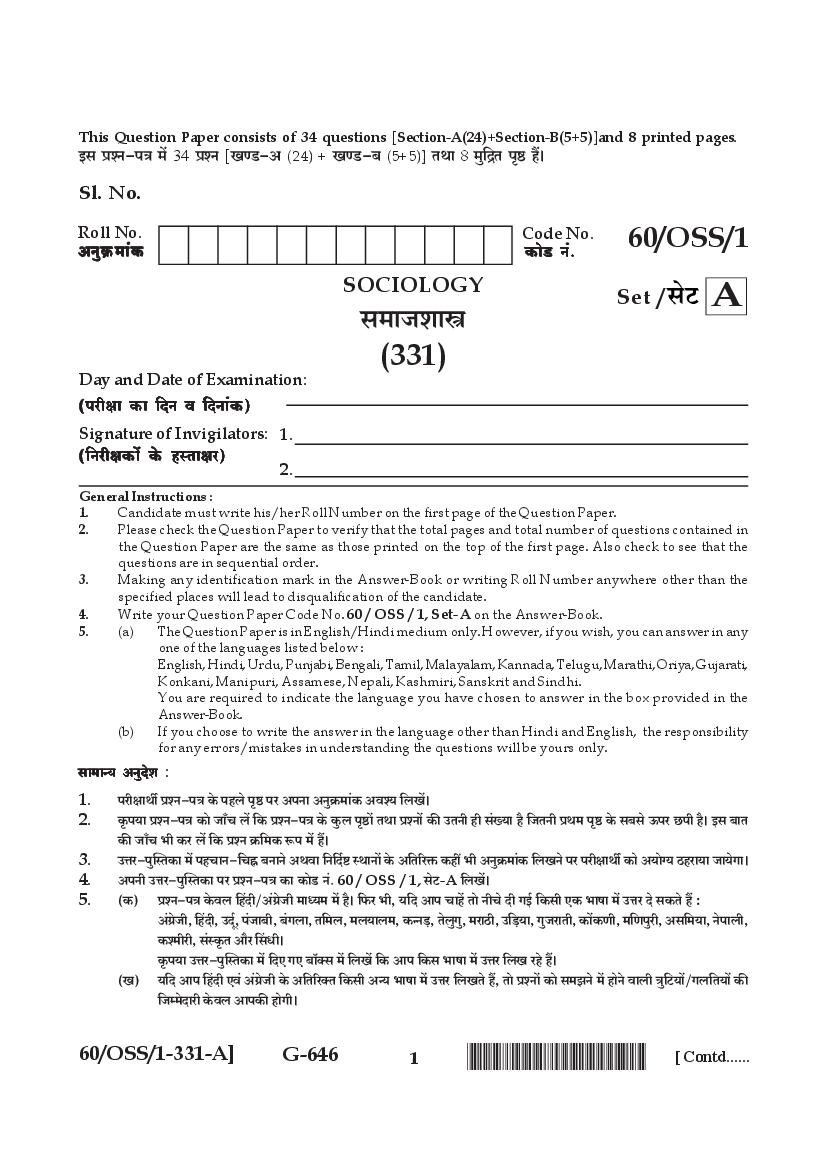
Page 1
Bg àíZ-nÌ _| 34 àíZ [IÊS>-A (24) + IÊS>-~ (5+5)] VWm 8 ‘w{ÐV n¥ð> h¢&
Sl. No.
Roll No.
AZw H « $ _m§ H $
Code No.
H$moS> Z§. 60/OSS/1
SOCIOLOGY
Set / go Q > A
g‘mOemó
(331)
Day and Date of Examination:
(narjm H$m {XZ d {XZm§ H $)
Signature of Invigilators: 1.
({ZarjH$m| Ho $ hñVmja)
2.
General Instructions :
1. Candidate must write his/her Roll Number on the first page of the Question Paper.
2. Please check the Question Paper to verify that the total pages and total number of questions contained in
the Question Paper are the same as those printed on the top of the first page. Also check to see that the
questions are in sequential order.
3. Making any identification mark in the Answer-Book or writing Roll Number anywhere other than the
specified places will lead to disqualification of the candidate.
4. Write your Question Paper Code No. 60 / OSS / 1, Set-A on the Answer-Book.
5. (a) The Question Paper is in English/Hindi medium only. However, if you wish, you can answer in any
one of the languages listed below :
English, Hindi, Urdu, Punjabi, Bengali, Tamil, Malayalam, Kannada, Telugu, Marathi, Oriya, Gujarati,
Konkani, Manipuri, Assamese, Nepali, Kashmiri, Sanskrit and Sindhi.
You are required to indicate the language you have chosen to answer in the box provided in the
Answer-Book.
(b) If you choose to write the answer in the language other than Hindi and English, the responsibility
for any errors/mistakes in understanding the questions will be yours only.
gm_mÝ` AZwXoe :
1. narjmWu àíZ-nÌ Ho$ nhbo n¥ð> na AnZm AZwH«$‘m§H$ Adí¶ {bI|&
2. H¥$n¶m àíZ-nÌ H$mo Om±M b| {H$ àíZ-nÌ Ho$ Hw$b n¥ð>m| VWm àíZm| H$s CVZr hr g§»¶m h¡ {OVZr àW‘ n¥ð> Ho$ g~go D$na N>nr h¡& Bg ~mV
H$s Om±M ^r H$a b| {H$ àíZ H«${‘H$ ê$n ‘| h¢&
3. CÎma-nwpñVH$m ‘| nhMmZ-{M• ~ZmZo AWdm {Z{X©ï> ñWmZm| Ho$ A{V[aº$ H$ht ^r AZwH«$‘m§H$ {bIZo na narjmWu H$mo A¶mo½¶ R>ham¶m Om¶oJm&
4. AnZr CÎma-nwpñVH$m na àíZ-nÌ H$m H$moS> Z§. 60 / OSS / 1, goQ>-A {bI|&
5. (H$) àíZ-nÌ Ho$db qhXr/A§J«oOr ‘mܶ‘ ‘| h¡& {’$a ^r, ¶{X Amn Mmh| Vmo ZrMo Xr JB© {H$gr EH$ ^mfm ‘| CÎma Xo gH$Vo h¢ :
A§J«oOr, qhXr, CXÿ©, n§Om~r, ~§Jbm, V{‘b, ‘b¶mb‘, H$ÝZ‹S>, VobwJw, ‘amR>r, C{‹S>¶m, JwOamVr, H$m|H$Ur, ‘{Unwar, Ag{‘¶m, Zonmbr,
H$í‘rar, g§ñH¥$V Am¡a qgYr&
H¥$n¶m CÎma-nwpñVH$m ‘| {XE JE ~m°³g ‘| {bI| {H$ Amn {H$g ^mfm ‘| CÎma {bI aho h¢&
(I) ¶{X Amn qhXr Ed§ A§J«oOr Ho$ A{V[a³V {H$gr Aݶ ^mfm ‘| CÎma {bIVo h¢, Vmo àíZm| H$mo g‘PZo ‘| hmoZo dmbr Ìw{Q>¶m|/Jb{V¶m| H$s
{Oå‘oXmar Ho$db AmnH$s hmoJr&
60/OSS/1-331-A] G-646 1 [ Contd......
Page 2
g‘mOemó
(331)
Time : 3 Hours] [Maximum Marks : 100
g_` : 3 KÊQ>o] [nyUmªH$ : 100
Note : (i) This question paper consists of two sections, viz., 'A' and 'B'.
(ii) All questions from section 'A' are to be attempted.
(iii) Section 'B' has two options. Candidates are required to attempt questions
from one option only.
{ZX}e : (i) Bg àíZ-nÌ ‘| Xmo IÊS> h¢-IÊS> "A' VWm IÊS> "~'&
(ii) IÊS> "A' ‘| {XE JE g^r àíZ A{Zdm¶© h¢&
(iii) IÊS> "~' ‘| Xmo {dH$ën h¢& narjm{W©¶m| H$mo Ho$db EH$ {dH$ën Ho$ hr àíZm| Ho$ CÎma XoZo h¢&
SECTION - A
IÊS> - A
1. Which community did W.H.R. Rivers study? [1]
S>ãë¶y. EM. Ama. [adg© Zo {H$g g‘wXm¶ H$m Aܶ¶Z {H$¶m?
60/OSS/1-331-A] G-646 2 [ Contd......
Page 3
KQ>Zm {deof Ho$ JhZ Aܶ¶Z go Amn ³¶m g‘PVo h¢?
3. Who is the founder of Zoroastrianism? [1]
nmagr Y‘© Ho$ g§ñWmnH$ H$m¡Z h¢?
4. Distinguish between society and community. [2]
g‘mO VWm g‘wXm¶ Ho$ ‘ܶ {d^oX H$s{OE&
5. Differentiate between Norm and Value. [2]
à{V‘mZ VWm ‘yë¶ Ho$ ‘ܶ {d^oX H$s{OE&
6. Mention any two characteristics of Social System. [2]
gm‘m{OH$ ì¶dñWm H$s {H$Ýht Xmo {dímofVmAm| H$m C„oI H$s{OE&
7. Describe briefly the concept of melting pot. [2]
‘opëQ>¨J nmoQ> H$s AdYmaUm H$m g§jon ‘| dU©Z H$s{OE&
60/OSS/1-331-A] G-646 3 [ Contd......
Page 4
^maV Ho$ ‘ܶ joÌ ‘| nmE OmZo dmbo {H$Ýht Xmo Am{Xdmgr g‘wXm¶m| Ho$ Zm‘ {b{IE&
9. List any two reasons for the decline of Buddhism from India. [2]
^maV go ~m¡Õ Y‘© Ho$ nVZ Ho$ {H$Ýht Xmo H$maUm| H$mo gyMr~Õ H$s{OE&
10. Enumerate the major contributions of August Comte. [4]
Am°JñV H$m°åQ>o H$s à‘wI XoZ H$s n[aJUZm H$s{OE&
11. Discuss the relationship between Sociology and Psychology. [4]
g‘mOemó VWm ‘Zmo{dkmZ Ho$ ‘ܶ g§~§Y na MMm© H$s{OE&
12. Describe the importance of Norms. [4]
à{V‘mZm| Ho$ ‘hËd H$m dU©Z H$s{OE&
13. List out the characteristics of Association. [4]
g§K Ho$ bjUm| H$mo gyMr~Õ H$s{OE&
60/OSS/1-331-A] G-646 4 [ Contd......
Page 5
gh¶moJ VWm g§Kf© Ho$ ‘ܶ g§~§Y gm‘m{OH$ gVVVm Ho$ ê$n na MMm© H$s{OE&
15. How caste is different from class? Explain. [4]
Om{V {H$g àH$ma dJ© go {^Þ h¡? ì¶m»¶m H$s{OE&
16. Highlight the role of elections in Social change. [4]
gm‘m{OH$ n[adV©Z ‘| MwZmd H$s ^y{‘H$m gwñnï> H$s{OE&
17. Explain the significance of kinship. [4]
ZmVoXmar Ho$ ‘hËd H$s ì¶m»¶m H$s{OE&
18. Explain the effects of environment on human society. [4]
‘mZd g‘mO na n¶m©daU Ho$ à^md H$s ì¶m»¶m H$s{OE&
19. Enumerate the preachings of Saint Kabir. [4]
g§V H$~ra H$s {ejmAm| H$s n[aJUZm H$s{OE&
60/OSS/1-331-A] G-646 5 [ Contd......
Page 6
gm‘m{OH$aU Ho$ H$maH$m| na EH$ {Z~§Y {b{IE&
21. Describe the role of law as formal means of social control. [6]
gm‘m{OH$ {Z¶§ÌU Ho$ Am¡nMm[aH$ gmYZm| Ho$ ê$n ‘| H$mZyZ H$s ^y{‘H$m H$m dU©Z H$s{OE&
22. Describe the main teachings of Jainism. [6]
O¡Z Y‘© H$s à‘wI {ejmAm| H$m dU©Z H$s{OE&
23. Discuss the features of the caste system. [6]
Om{V ì¶dñWm Ho$ bjUm| na MMm© H$s{OE&
24. Write an essay on the nature and extent of Diversity in India. [6]
^maV ‘| {d{dYVm Ho$ àgma H$s àH¥${V na EH$ {Z~§Y {b{IE&
60/OSS/1-331-A] G-646 6 [ Contd......
Page 7
IÊS> - ~
OPTION - I
{dH$ën>> - I
{dH$ën
(Status of Women)
(‘{hbmAm| H$s àpñW{V)
25. When was the Widow Remarriage Act passed? [1]
{dYdm nwZ{d©dmh H$mZyZ H$~ nmg hþAm?
26. Define Feminism. [2]
‘{hbmdmX H$s n[a^mfm Xr{OE&
27. Mention any two reasons for the existence of Female infanticide in India. [2]
^maV ‘| ~m{bH$m {eew h˶m Ho$ àMbZ na {H$Ýht Xmo H$maUm| H$m C„oI H$s{OE&
28. List out the different types of behaviour as cases of sexual harassment at work
place. [4]
H$m¶©ñWb na hmoZo dmbo ¶m¡Z CËnrS>Z go gå~pÝYV {d{^Þ àH$ma Ho$ ì¶dhmam| H$s gyMr ~ZmE§&
29. Comment who is an Empowered women. [6]
geº$ ‘{hbm H$m¡Z h¡ na {Q>ßnUr H$s{OE&
60/OSS/1-331-A] G-646 7 [ Contd......
Page 8
{dH$ën>> - II
{dH$ën
(Culture)
(g§ ñ H¥ $ {V)
25. Where is the Sun temple located in India? [1]
^maV ‘| gy¶© ‘§{Xa H$hm± h¡?
26. Name any two prominent Academics established by government of India for the
development of Art and culture. [2]
^maV gaH$ma Ûmam H$bm VWm g§ñH¥${V Ho$ {dH$mg Ho$ {bE ñWm{nV {H$Ýht Xmo AH$mX{‘H$ g§ñWmAm| Ho$ Zm‘
{b{IE&
27. Define the term cultural lag with examples. [2]
gm§ñH¥${VH$ {dbå~Zm nX H$s n[a^mfm CXmhaUm| g{hV H$s{OE&
28. Write a brief note on the role of mass media in diffusion of culture. [4]
g§ñH¥${V Ho$ àgma ‘| OZg§Mma ‘mܶ‘m| H$s ^y{‘H$m na EH$ g§{já ZmoQ> {b{IE&
29. Describe the contribution of Indian Scientists. [6]
^maVr¶ {dkmZH$m| H$s XoZ H$m dU©Z H$s{OE&
60/OSS/1-331-A] G-646 8
Page 9
1. Where did A. R. Radcliffe Brown did his field work? [1]
E. Ama. aoS>p³b’$ ~«mD$Z Zo {H$g joÌ ‘| AnZm H$m¶© {H$¶m?
4. Describe the contribution of Emile Durkheim. [2]
E‘mBb XþIu‘ H$s XoZ H$m dU©Z H$s{OE&
10. List out the characteristics of Role. [4]
^w{‘H$m H$s {deofVmAm| H$s gwMr ~ZmE§&
11. Differentiate between Matrilineal and Patrilineal Descent rule. [4]
‘mV¥ d§eH«$‘ VWm {nV¥ d§eH«$‘ Ho$ ‘ܶ {d^oX H$s{OE&
20. Discuss the views of Max Weber on Social Stratification. [6]
gm‘m{OH$ ñVarH$aU na ‘°³g do~a Ho$ {dMmam| na MMm© H$s{OE&
SECTION - B
IÊS> - ~
OPTION - I
{dH$ën>> - I
{dH$ën
(Status of Women)
(‘{hbmAm| H$s àpñW{V)
25. Name two women intellectuals of Rigvedic period. [1]
F$½d¡{XH$ H$mb H$s {H$Ýht Xmo {dXþfr ‘{hbmAm§o Ho$ Zm‘ {b{IE&
27. What rule did Yagnavalkya laid down for the parents. [2]
¶mkd볶 Zo ‘mVm-{nVm Ho$ {bE H$m¡Z go {Z¶‘ ~ZmE?
OPTION - II
{dH$ën>> - II
{dH$ën
(Culture)
(g§ ñ H¥ $ {V)
25. Who is referred to as Father of India's nuclear science? [1]
^maV Ho$ Zm{^H$s¶ {dkmZ Ho$ OZH$ {H$go ‘mZm OmVm h¡?
28. Differentiate between Mass Communication and Mass Media. [4]
OZg§Mma VWm OZg§Mma ‘mܶ‘m| Ho$ ‘ܶ {d^oX H$s{OE&
60/OSS/1-331-A] G-646 9
Page 10
1. Who developed Vedanta Philosophy? [1]
doXmÝV Xe©Z {H$gZo {dH${gV {H$¶m?
4. Define Linguism. [2]
^mfmdmX H$s n[a^mfm Xr{OE&
10. Describe briefly urban social problems in India. [4]
^maV ‘| ZJar¶ g‘m{OH$ g‘ñ¶mAm| H$m g§jon ‘| dU©Z H$s{OE&
11. Discuss the features of a dominant caste. [4]
à^d Om{V Ho$ bjUm| na MMm© H$s{OE&
20. Hindu Marriage is seen as a sacrament. Comment. [6]
{hÝXÿ {ddmh EH$ Ym{‘©H$ g§ñH$ma Ho$ ê$n ‘| XoIm OmVm h¡& {Q>ßnUr H$s{OE&
SECTION - B
IÊS> - ~
OPTION - I
{dH$ën>> - I
{dH$ën
(Status of Women)
(‘{hbmAm| H$s àpñW{V)
28. Briefly describe the status of women during Medieval Period. [4]
‘ܶmH$mb Ho$ Xm¡amZ ‘{hbmAm| H$s àpñW{V H$m g§jon ‘| dU©Z H$s{OE&
OPTION - II
{dH$ën>> - II
{dH$ën
(Culture)
(g§ ñ H¥ $ {V)
27. Define Enculturation. [2]
g§ñH$marH$aU H$s nar^mfm Xr{OE&
60/OSS/1-331-A] G-646 10
Document Details
| Board / Org | NIOS |
| Exam | National Institute of Open Schooling Class 12 |
| Type | Question Paper |
| Pages | 10 |
| Updated | 22 Jul 2026 |