CBSE Class 12 Question Paper 2022 History (Solved)
Finished viewing? Save it for later —
Download CBSE Class 12 Question Paper 2022 History (Solved) (PDF · 16 pages)About CBSE Class 12 Question Paper 2022 History (Solved)
CBSE Class 12 Question Paper 2022 History (Solved) is available here for free download. Published by CBSE for Class 12, this question paper can be viewed online or downloaded as a PDF (16 pages). Candidates preparing for Class 12 can use CBSE Class 12 Question Paper 2022 History (Solved) to understand the exam pattern, the type of questions asked, and the overall difficulty level.
Frequently Asked Questions
How can I download CBSE Class 12 Question Paper 2022 History (Solved)?
Open this page and click the Download button to save CBSE Class 12 Question Paper 2022 History (Solved) as a PDF. It is completely free on AglaSem Docs.
Is CBSE Class 12 Question Paper 2022 History (Solved) free to download?
Yes. CBSE Class 12 Question Paper 2022 History (Solved) can be viewed online and downloaded as a PDF free of cost on AglaSem Docs.
How many pages does CBSE Class 12 Question Paper 2022 History (Solved) have?
CBSE Class 12 Question Paper 2022 History (Solved) contains 16 pages, which you can read online or download together as a single PDF.
Where can I find more Class 12 study material?
You can find more Class 12 question papers, sample papers, syllabus, and answer keys on AglaSem Docs.
CBSE Class 12 Question Paper 2022 History (Solved) – Text
Read the full text of this question paper below — useful to quickly search, copy and reference the content online without downloading the PDF.
📄 View text version (16 pages)
Page 1
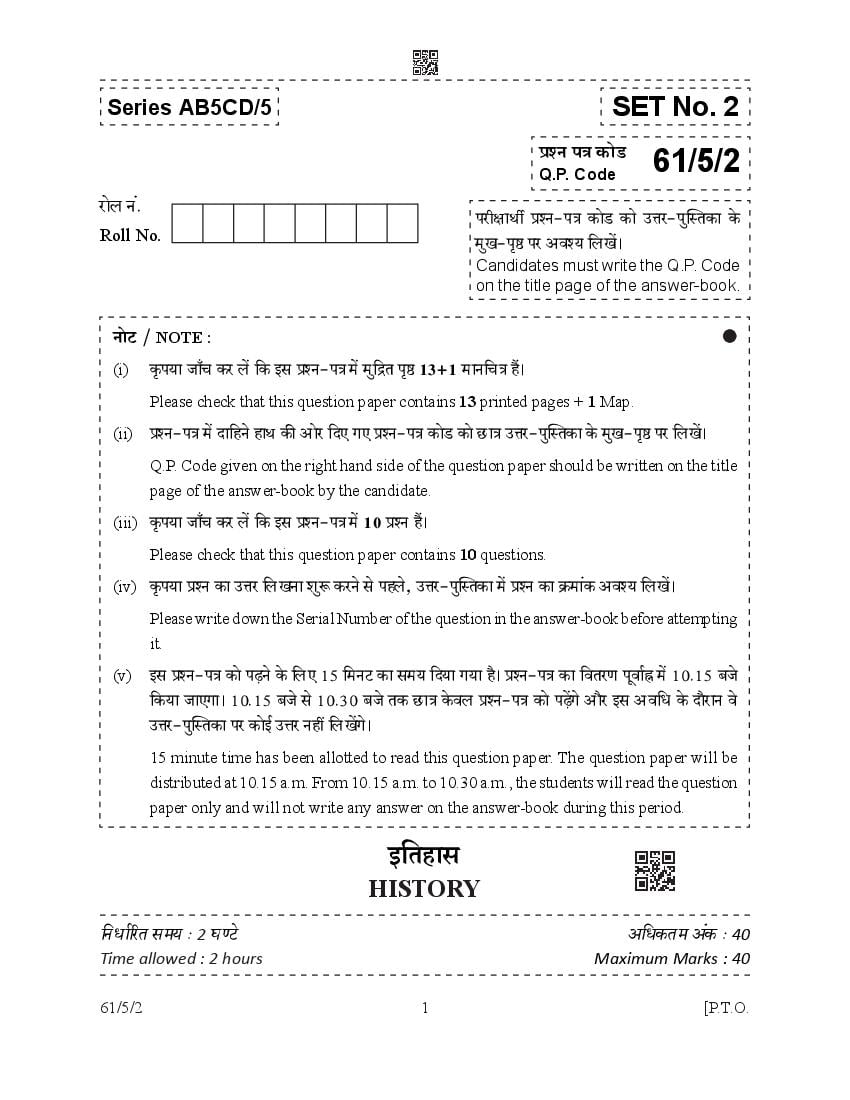
àíZ nÌ H$moS>
Q.P. Code
61/5/2
amob> Z§.
narjmWu àíZ-nÌ H$moS> H$mo CÎma-nwpñVH$m Ho$
Roll No. _wI-n¥ð> na Adí` {bI|&
Candidates must write the Q.P. Code
on the title page of the answer-book.
ZmoQ> / NOTE :
(i) H¥$n`m Om±M H$a b| {H$ Bg àíZ-nÌ _| _w{ÐV n¥ð> 13+1 _mZ{MÌ h¢&
Please check that this question paper contains 13 printed pages + 1 Map.
(ii) àíZ-nÌ _| Xm{hZo hmW H$s Amoa {XE JE àíZ-nÌ H$moS> H$mo N>mÌ CÎma-nwpñVH$m Ho$ _wI-n¥ð> na {bI|&
Q.P. Code given on the right hand side of the question paper should be written on the title
page of the answer-book by the candidate.
(iii) H¥$n`m Om±M H$a b| {H$ Bg àíZ-nÌ _| 10 àíZ h¢&
Please check that this question paper contains 10 questions.
(iv) H¥$n`m àíZ H$m CÎma {bIZm ewê$ H$aZo go nhbo, CÎma-nwpñVH$m _| àíZ H$m H«$_m§H$ Adí` {bI|&
Please write down the Serial Number of the question in the answer-book before attempting
it.
(v) Bg àíZ-nÌ H$mo n‹T>Zo Ho$ {bE 15 {_ZQ> H$m g_` {X`m J`m h¡& àíZ-nÌ H$m {dVaU nydm©• _| 10.15 ~Oo
{H$`m OmEJm& 10.15 ~Oo go 10.30 ~Oo VH$ N>mÌ Ho$db àíZ-nÌ H$mo n‹T>J| o Am¡a Bg Ad{Y Ho$ Xm¡amZ do
CÎma-nwpñVH$m na H$moB© CÎma Zht {bI|J&o
15 minute time has been allotted to read this question paper. The question paper will be
distributed at 10.15 a.m. From 10.15 a.m. to 10.30 a.m., the students will read the question
paper only and will not write any answer on the answer-book during this period.
B{Vhmg
HISTORY
{ZYm©[aV g_` … 2 KÊQ>o A{YH$V_ A§H$ … 40
Time allowed : 2 hours Maximum Marks : 40
61/5/2 1 [P.T.O.
Page 2
{ZåZ{b{IV {ZX}em| H$mo Ü`mZ go n‹T>| Am¡a CZH$m g»Vr go nmbZ H$a| …
1. Bg àíZ-nÌ _| Hw$b 10 àíZ h¢& àË`oH$ àíZ Ho$ gm_Zo àíZ Ho$ A§H$ {XE JE h¢&
2. g^r àíZ A{Zdm`© h¢&
3. `h àíZ-nÌ Mma IÊS>m| _| {d^m{OV {H$`m J`m h¡, IÊS>-H$, I, J VWm K&
4. IÊS> H$ … àíZ g§»`m 1 go 4 VH$ bKw-CÎmar` àH$ma Ho$ àíZ h¢ {Og_| àË`oH$ àíZ 3 A§H$m| H$m
h¡& BZ àíZm| Ho$ CÎma 80 eãXm| go A{YH$ Zht {XE OmZo Mm{hE&
5. IÊS> I … àíZ g§»`m 5 go 7 VH$ XrK©-CÎmar` àH$ma Ho$ àíZ h¢ {Og_| àË`oH$ àíZ 6 A§H$m| H$m
h¡& BZ àíZm| Ho$ CÎma 150 go 200 eãXm| go A{YH$ Zht {XE OmZo Mm{hE&
6. IÊS> J … àíZ g§»`m 8 VWm 9 òmoV AmYm[aV àíZ h¢, àË`oH$ n«íZ 4 A§H$m| H$m h¡&
7. IÊS> K … àíZ g§»`m 10 _mZ{MÌ AmYm[aV 2 A§H$m| H$m àíZ h¡&
8. àíZ-nÌ _| H$moB© g_J« {dH$ën Zht h¡& hmbm§{H$, Hw$N> àíZm| _| Am§V[aH$ {dH$ën H$m M`Z àXmZ
{H$`m J`m h¡& Bg àH$ma Ho$ àíZm| _| go Ho$db EH$ hr àíZ H$m CÎma {b{IE&
61/5/2 2
Page 3
Please read the following instructions carefully and strictly follow them :
1. This question paper contains 10 questions. Marks have been indicated
against each question.
2. All questions are compulsory.
3. This question paper is divided into FOUR sections, Section-A, B, C
and D.
4. Section A : Question numbers 1 to 4 are Short-answer type questions of 3
marks each. Answer to each question should not exceed 80 words.
5. Section B : Question numbers 5 to 7 are Long-answer type questions
carrying 6 marks each. Answer to each question should not exceed 150 to
200 words.
6. Section C : Question numbers 8 and 9 are source based questions carrying
4 marks each.
7. Section D : Question number 10 is Map based question carrying 2 marks.
8. There is no overall choice in the question paper. However, an internal
choice has been provided in some questions. Only one of the choices in
such questions have to be attempted.
61/5/2 3 [P.T.O.
Page 4
(bKw-CÎmar` àH$ma Ho$ àíZ) 3×4=12
1. (H$) ""Jm±dm| _| O_tXmam| H$s VwbZm _| OmoVXma A{YH$ à^mdembr Wo&'' BñV_amar-~§Xmo~ñV 3
Ho$ g§X^© _| Bg H$WZ H$s naI H$s{OE&
AWdm
(I) amO_hb H$s nhm{‹S>`m| _| nhm‹S>r bmoJm| H$m OrdZ {H$g àH$ma dZm| go K{Zð> ê$n go OwS‹ >m 3
Wm ? naI H$s{OE&
2. g§{dYmZ g^m _| àmê$n g{_{V Ûmam g§KdmX na ~ZmB© JB© VrZ gy{M`m| H$m dU©Z H$s{OE& 3
3. 1857 H$m {dÐmoh AÝ` {H$gr ñWmZ H$s VwbZm _| AdY _| {~«{Q>e emgZ Ho$ à{VamoY H$s 3
bmoH${à` A{^ì`{º$ Š`m| ~Zm ? ñnîQ> H$s{OE&
4. ""Jm§YrOr Zo ^maV H$s ñdV§ÌVm Ho$ ~mX {d{^Þ joÌm| _| em§{V bmZo H$m à`mg {H$g àH$ma {H$`m ? 3
ñnï> H$s{OE&
61/5/2 4
Page 5
(Short-Answer Type Questions) 3×4=12
1. (a) "The jotedars were more effective than that of zamindars in the 3
villages." Examine the statement in the context of Permanent
Settlement.
OR
(b) Examine how the lives of Paharias in the hills of Raj Mahal, were 3
intimately connected to the forests.
2. Describe the three lists of Federalism provided by the Drafting Committee 3
in the Constituent Assembly.
3. Explain why the Revolt of 1857 became an expression of popular resistance 3
in Awadh than any where else to the British rule.
4. How did Gandhiji try to bring peace in various areas after the independence 3
of India ? Explain.
61/5/2 5 [P.T.O.
Page 6
(XrK©-CÎmar` àH$ma Ho$ àíZ) 6×3=18
5. ""{gnm{h`m| Am¡a J«m_rU OJV Ho$ ~rM _m¡OXy g§~Y§ m| Zo 1857 Ho$ {dÐmoh na Jham Aga S>mbm&'' 6
H$WZ H$mo Cn`wº$ CXmhaUm| g{hV ñnï> H$s{OE&
6. (H$) ""_wJb B{Vd¥{Îm`m| _| {MÌH$mar amÁ` Am¡a amOm H$s e{º$ Ho$ g§àfo U H$m geº$ _mÜ`_ 6
_mZr OmVr Wr&'' H$WZ H$s nw{ï> VH$m] Ho$ gmW H$s{OE&
AWdm
(I) ""_wJb emhr n[adma H$s Hw$N> {ó`m| Zo _wJb gm_«mÁ` _| _hÎdnyU© ^y{_H$m {Z^mB©&'' 6
H$WZ H$mo Ý`m`g§JV R>hamB`o&
7. (H$) CZ n[apñW{V`m| H$m dU©Z H$s{OE {OZHo$ H$maU Jm§YrOr Zo Agh`moJ Am§XmobZ H$s 3+3=6
ewéAmV H$s& Bg Am§XmobZ Ho$ _hÎd H$s ì`m»`m H$s{OE&
AWdm
(I) EH$ g_mO gwYmaH$ Am¡a EH$ amOZr{VH$ ZoVm Ho$ ê$n _| Jm§YrOr H$s ^y{_H$m H$m dU©Z 2+4=6
H$s{OE&
61/5/2 6
Page 7
(Long-Answer Type Questions) 6×3=18
5. "The link between sepoys and the rural peasant folk had important 6
implications in the course of the Revolt of 1857." Elucidate the statement
with suitable examples.
6. (a) "The paintings in the Mughal Chronicles possess special powers to 6
communicate ideas about the power of king and kingdom." Give
arguments to support the statement.
OR
(b) "Few women of the imperial household played a significant role in 6
the Mughal empire." Justify the statement.
7. (a) Describe the circumstances that led to the initiation of Non- 3+3=6
Cooperation Movement by Gandhiji. Explain the significance of this
movement ?
OR
(b) Describe the role of Gandhiji as a social reformer and as a Political 2+4=6
leader.
61/5/2 7 [P.T.O.
Page 8
(Ho$g AmYm[aV àíZ) 4×2=8
8. {XE JE òmoV H$mo Ü`mZnydH© $ n{‹T>E Am¡a ZrMo {XE àíZm| Ho$ CÎma Xr{OE … 4
""h_ {g\©$ ZH$b H$aZo dmbo Zht h¢''
13 {Xgå~a, 1946 H$mo AnZo à{gÕ ^mfU _| Odmha bmb Zohê$ Zo `h H$hm Wm …
h_Zo EH$ ñdV§Ì g§à^w JUamÁ` H$s ñWmnZm H$m Ñ‹T> Am¡a n{dÌ g§H$ën {b`m h¡& ^maV H$m g§à^w
hmoZm {Z`V h¡& BgH$m ñdV§Ì hmoZm Am¡a JUamÁ` hmoZm ^r ñdm^m{dH$ h¡...& Hw$N> {_Ìm| Zo gdmb
CR>m`m h¡ … ""AmnZo `hm± "bmoH$Vm§{ÌH$' eãX Š`m| Zht aIm ?'' _¢Zo CÝh| H$hm h¡ {H$ {Zñg§Xho `h
gmoMm Om gH$Vm h¡ {H$ H$moB© JUamÁ` bmoH$Vm§{ÌH$ Z hmo na§Vw h_mam nyam B{Vhmg Bg VÏ` H$m
gmjr h¡ {H$ h_ bmoH$Vm§{ÌH$ g§ñWmZm| Ho$ hr njYa h¢& ñdm^m{dH$ h¡ {H$ h_mam bú` bmoH$V§Ì h¡&
bmoH$V§Ì go H$_ Hw$N> ^r Zht& `h bmoH$V§Ì H¡$gm hmoJm, CgH$s eŠb-gyaV H¡$gr hmoJr, `h EH$
AbJ _gbm h¡& AmO Ho$ bmoH$V§Ìm| Zo Xþ{Z`m H$s àJ{V _| O~aXñV ^y{_H$m {Z^m`r h¡ Am¡a
CZ_| go ~hþV gmao `yamon VWm AÝ` ñWmZmo§ Ho$ Xoe h¢& naÝVw `h g§Xho OZH$ hmo gH$Vm h¡ {H$ AJa
CÝh| nyar Vah bmoH$Vm§{ÌH$ ~Zo ahZm h¡ Vmo Z OmZo H$~ CZ bmoH$V§Ìm| H$mo AnZr eŠb-gyaV WmoS‹ >r
~hwV ~XbZr n‹S>Vr& _¢ Amem H$aVm hÿ± {H$ {H$gr H${WV bmoH$Vm§{ÌH$ Xoe H$s EH$ Img bmoH$Vm§{ÌH$
àUmbr `m {H$gr g§ñWmZ {deof H$s h_ {g\©$ ZH$b H$aZo dmbo Zht h¢& hmo gH$Vm h¡ {H$ h_ Cggo
~ohVa Hw$N> aM X|& ~hahmb, {H$gr ^r gyaV _|, h_ `hm± O¡gr Mmho gaH$ma ~ZmE±, dh h_mao
bmoJm| Ho$ ñd^md Ho$ AZwê$n Am¡a CZH$mo ñdrH$m`© O µ ê$a hmoZr Mm{hE& h_ bmoH$V§Ì Ho$ hH$ _| h¢&
`h Bg gXZ H$mo V` H$aZm h¡ {H$ Bg bmoH$V§Ì, nyUV© _ bmoH$V§Ì H$m ñdê$n H¡$gm hmoJm& gXZ Bg
~mV H$mo XoI gH$Vm h¡ `Ú{n Bg àñVmd _| h_Zo ""bmoH$Vm§{ÌH$'' eãX H$m BñVo_mb Zht {H$`m
h¡ Š`m|{H$ h_| bJm {H$ `h Vmo ñdm^m{dH$ hr h¡ {H$ ""JUamÁ`'' eãX _| `h eãX nhbo hr
{Z{hV hmoVm h¡& Bg{bE h_ AZmdí`H$ Am¡a AZwn`moJr eãXm| H$m à`moJ Zht H$aZm MmhVo Wo&
h_Zo eãXm| Ho$ Cn`moJ _mÌ go H$ht Áµ `mXm Ü`mZ {X`m h¡& h_Zo Bg àñVmd _| bmoH$V§Ì H$s
A§Vd©ñVw àñVwV H$s h¡& ~pëH$ bmoH$V§Ì H$s hr Zht, Am{W©H$ bmoH$V§Ì H$s A§Vd©ñVw àñVwV H$s h¡&
(i) g§à^wVm eãX H$mo n[a^m{fV H$s{OE& 1
(ii) g§{dYmZ g^m Ûmam {H$Z Xoem| Ho$ g§{dYmZm| H$mo g§X{^©V {H$`m J`m ? 1
(iii) Bg òmoV _| bmoH$V§Ì H$s ì`m»`m {H$g àH$ma H$s JB© h¡ ? 2
61/5/2 8
Page 9
(Case Based Questions)
4×2=8
8. Read the source given below carefully and answer the questions that follow :
4
"We are not going just to copy"
This is what Jawahar Lal Nehru said in his famous speech of 13 December,
1946 :
We say that it is our firm and solemn resolve to have an independent sovereign
republic. India is bound to be sovereign, it is bound to be independent and it
is bound to be a republic... Now, some friends have raised the question:
“Why have you not put in the word ‘democratic’ here ?” Well, I told them
that it is conceivable, of course, that a republic may not be democratic but
the whole of our past is witness to this fact that we stand for democratic
institutions. Obviously we are aiming at democracy and nothing less than a
democracy. What form of democracy, what shape it might take is another
matter. The democracies of the present day, many of them in Europe and
elsewhere, have played a great part in the world’s progress. Yet it may be
doubtful if those democracies may not have to change their shape somewhat
before long if they have to remain completely democratic. We are not going
just to copy, I hope, a certain democratic procedure or an institution of a so-
called democratic country. We may improve upon it. In any event whatever
system of government we may establish here must fit in with the temper of
our people and be acceptable to them. We stand for democracy. It will be for
this House to determine what shape to give to that democracy, the fullest
democracy.
(i) Define the term sovereignty. 1
(ii) Which constitutions of the countries were referred by the Constitution 1
Assembly ?
(iii) How is democracy explained in this source ? 2
61/5/2 9 [P.T.O.
Page 10
Xa~ma-E-AH$~ar
A~wb \$µÁb AH$~a Ho$ Xa~ma H$m ~‹S>m gOrd {ddaU XoVo hþE H$hVm h¡ …
O~ ^r _hm_{h_ (AH$~a) Xa~ma bJmVo h¢ Vmo EH$ {demb T>mb
o nrQ>m OmVm h¡ Am¡a gmW-gmW
A„mh H$m JwUJmZ hmoVm h¡& Bg Vah g^r dJm] Ho$ bmoJm| H$mo gyMZm {_b OmVr h¡& _hm_{h_ Ho$
nwÌ, nm¡Ì, Xa~mar Am¡a do g^r {OÝh| Xa~ma _| àdoe H$s AZw_{V Wr, hm{µOa hmoVo h¢ Am¡a H$mo{Z©e
H$a AnZo ñWmZ na I‹S>o ahVo h¢& »`m{Vàmá {dÛ‚mZ VWm {d{eï> H$m¡ebm| _| {ZnwU ì`{º$ AmXa
ì`º$ H$aVo h¢; VWm Ý`m` A{YH$mar >AnZr [anmoQ>© àñVwV H$aVo h¢& _hm_{h_ AnZr gm_mÝ`
A§VÑ©{ï> Ho$ AmYma na AmXoe XoVo h¢ Am¡a g^r _m_bm| H$mo g§VmofOZH$ T>J§ go {ZnQ>mVo h¢& Bg nyao
g_` Ho$ Xm¡amZ {d{^Þ Xoem| go AmE Vbdm[a`o d nhbdmZ AnZo H$mo V¡`ma aIVo h¢ Am¡a _{hbm
VWm nwéf Jm`H$ AnZr ~mar H$s àVrjm _| ahVo h¢& MVwa ~mµOrJa Am¡a _µOm{H$`m H$bm~mµO ^r
AnZo H$m¡eb Am¡a XjVm H$m àXe©Z H$aZo H$mo CËgwH$ h¢&
(i) bmoJm| H$mo Xa~ma Ho$ AmMaU H$s OmZH$mar {H$g àH$ma Xr OmVr Wr ? 1
(ii) Xa~ma _| gm_m{OH$ {Z`§ÌU H$mo {H$g àH$ma {ZYm©[aV {H$`m J`m ? 1
(iii) AH$~a Zo Xa~ma _| Anrbm| `m _m_bm| H$m {ZnQ>mam {H$g àH$ma {H$`m ? 2
61/5/2 10
Page 11
Darbar-i Akbari
Abu'l Fazl gives a vivid account of Akbar's darbar :
Whenever His Majesty (Akbar) holds court (darbar) a large drum is beaten,
the sounds of which are accompanied by Divine praise. In this manner,
people of all classes receive notice. His Majesty's sons and grandchildren,
the grandees of the Court, and all other men who have admittance, attend to
make the kornish, and remain standing in their proper places. Learned men
of renown and skillful mechanics pay their respects; and the officers of
justice present their reports. His Majesty, with his usual insights, gives orders,
and settles everything in a satisfactory manner. During the whole time, skillful
gladiators and wrestlers from all countries hold themselves in readiness,
and singers, male and female, are in waiting. Clever jugglers and funny
tumblers also are anxious to exhibit their dexterity and agility.
(i) How were the people informed about the conduct of the court ? 1
(ii) How was the social control exercised in the court ? 1
(iii) How did Akbar dispose of the appeals or cases in the court ? 2
61/5/2 11 [P.T.O.
Page 12
(_mZ{MÌ AmYm[aV àíZ) 1+1=2
10. (H$) ^maV Ho$ {XE JE amOZr{VH$ aoIm _mZ{MÌ na {ZåZ{b{IV _| go {H$gr EH$ H$mo
Cn`wº$ {M• go A§{H$V H$s{OE …
(i) dh ñWmZ Ohm± O{b`m±dmbm ~mJ hË`mH$m§S> H$s KQ>Zm KQ>r& 1
AWdm
(ii) dh ñWmZ Ohm± Jm±YrOr Zo Z_H$ H$mZyZ H$mo VmoS‹ >m& 1
(I) ^maV Ho$ {XE JE Bgr _mZ{MÌ na _wJb gm_«mÁ` Ho$ amOYmZr ZJa H$mo 'A' Ho$ ê$n _| 1
A§{H$V {H$`m J`m h¡& Bgo nhMm{ZE Am¡a CgHo$ nmg Xr JB© aoIm na CgH$m Zm_
{b{IE&
ZmoQ> … {ZåZ{b{IV àíZ Ñ{ï>~m{YV narjm{W©`m| Ho$ {bE àíZ g§»`m 10 Ho$ ñWmZ
na h¡&
(H$) (i) Cg ñWmZ H$m C„oI H$s{OE Ohm± na O{b`m±dmbm ~mJ hË`mH$m§S> H$s KQ>Zm 1
KQ>r&
AWdm
(ii) Cg ñWmZ H$m Zm_ {b{IE Ohm± na Jm±YrOr Zo Z_H$ H$mZyZ H$mo VmoS‹ >m Wm& 1
(I) _wJb gm_«mÁ` Ho$ {H$gr EH$ amOYmZr ZJa H$m Zm_ {b{IE& 1
61/5/2 12
Page 13
(Map Based Question) 1+1=2
10. (a) On the given political outline map of India mark and label any one
of the follow with appropriate symbols :
(i) The place where Jallianwala Bagh Massacre happened. 1
OR
(ii) The place where Salt Law was broken by Gandhiji. 1
(b) On the same map, a capital of the Mughal Empire is marked as 'A'. 1
Identify it and name it on the line drawn near it.
Note : The following questions are for the visually impaired candidates
only in lieu of Q.No. 10.
(a) (i) Mention the place where Jallianwala Bagh Massacre took place. 1
OR
(ii) Name the place where Gandhiji broke the Salt Law. 1
(b) Name any one capital of the Mughal Empire. 1
61/5/2 13 [P.T.O.
Page 14
Page 15
MAP for Q.No. 10.
INDIA
Political
Cut here `hm± go H$mQ>|
km Scale 1:15000,000 km
100 500 100 200 300 400 500
61/5/2 15 [P.T.O.
Page 16
Document Details
| Board / Org | CBSE |
| Exam | Class 12 |
| Type | Question Paper |
| Pages | 16 |
| Updated | 30 Apr 2026 |