APTET Question Paper with Answers 15 Jun 2018 Paper 2 Maths and Science (Shift 2)
Finished viewing? Save it for later —
Download APTET Question Paper with Answers 15 Jun 2018 Paper 2 Maths and Science (Shift 2) (PDF · 64 pages)About APTET Question Paper with Answers 15 Jun 2018 Paper 2 Maths and Science (Shift 2)
APTET Question Paper with Answers 15 Jun 2018 Paper 2 Maths and Science (Shift 2) is available here for free download. Published by Andhra Pradesh Exams for Andhra Pradesh Teacher Eligibility Test, this question paper can be viewed online or downloaded as a PDF (64 pages). Candidates preparing for Andhra Pradesh Teacher Eligibility Test can use APTET Question Paper with Answers 15 Jun 2018 Paper 2 Maths and Science (Shift 2) to understand the exam pattern, the type of questions asked, and the overall difficulty level.
Frequently Asked Questions
How can I download APTET Question Paper with Answers 15 Jun 2018 Paper 2 Maths and Science (Shift 2)?
Open this page and click the Download button to save APTET Question Paper with Answers 15 Jun 2018 Paper 2 Maths and Science (Shift 2) as a PDF. It is completely free on AglaSem Docs.
Is APTET Question Paper with Answers 15 Jun 2018 Paper 2 Maths and Science (Shift 2) free to download?
Yes. APTET Question Paper with Answers 15 Jun 2018 Paper 2 Maths and Science (Shift 2) can be viewed online and downloaded as a PDF free of cost on AglaSem Docs.
How many pages does APTET Question Paper with Answers 15 Jun 2018 Paper 2 Maths and Science (Shift 2) have?
APTET Question Paper with Answers 15 Jun 2018 Paper 2 Maths and Science (Shift 2) contains 64 pages, which you can read online or download together as a single PDF.
Where can I find more Andhra Pradesh Teacher Eligibility Test study material?
You can find more Andhra Pradesh Teacher Eligibility Test question papers, sample papers, syllabus, and answer keys on AglaSem Docs.
APTET Question Paper with Answers 15 Jun 2018 Paper 2 Maths and Science (Shift 2) – Text
Read the full text of this question paper below — useful to quickly search, copy and reference the content online without downloading the PDF.
📄 View text version (55 pages)
Page 1
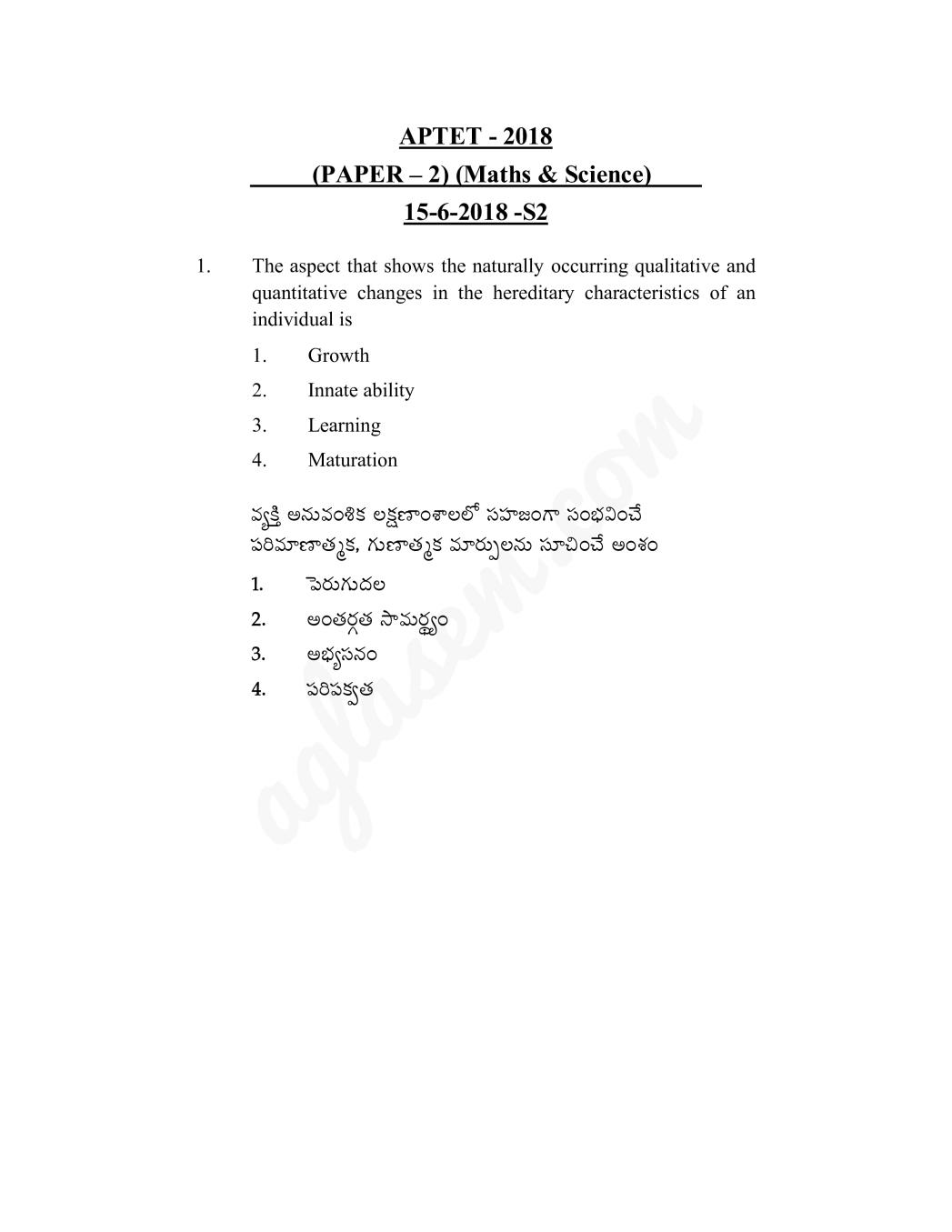
(PAPER – 2) (Maths & Science)
15-6-2018 -S2
1. The aspect that shows the naturally occurring qualitative and
quantitative changes in the hereditary characteristics of an
individual is
1. Growth
2. Innate ability
3. Learning
4. Maturation
Page 2
1. Language development depends on intellectual
development
2. Children have an innate universal grammar
3. Language development depends on the reinforcements
received by the child
4. Children acquire language by observing parents and
others
3. Ravi is able to recite Mathematical tables and poems that he
had learnt in his childhood without mistakes. His memory is
1. Immediate Memory
2. Long term Memory
3. Logical Memory
4. Active Memory
Page 3
performance in the class. This type of reinforcement schedule
is called as
1. Fixed interval
2. Fixed ratio
3. Variable ratio
4. Continuous
5. Find out the wrong statement with regard to learning
1. Learning leads to changes in behaviour
2. Learning is purposeful and goal oriented
3. Learning starts with birth and proceeds up to death
4. Behavioural changes occur through learning are
temporary
Page 4
achieve that greatness. This is called
1. Achievement Motivation
2. Intrinsic Motivation
3. Aspirational Motivation
4. Extrinsic Motivation
7. When a previously learnt task affects the retention of the task
being currently acquired is called as
1. Retro active inhibition
2. Pro active inhibition
3. Retroactive effect
4. Proactive effect
Page 5
1. To assess the teaching learning process.
2. To measure the scholastic progress of the student.
3. To measure the achievements of teacher and students
in teaching learning process.
4. To assess the processing of co-curricular activities in a
school.
NCF
9. Teacher acquainting the students who have passed 10th class
regarding the availability of courses according to their
interests and abilities – is known as
1. Vocational Guidance
2. Personal Guidance
3. Educational Guidance
4. Group Guidance
Page 6
1. Environmental factors only
2. Hereditary factors only
3. Hereditary and Economic factors
4. Hereditary and Environmental factors
11. Psychological aspect that affects learning is
1. Level of aspiration
2. Gender difference
3. Maturation
4. Physical health
Page 7
1. Bruner – Theory of instruction
2. Vygotsky – Instrumental learning
3. Carl Rogers – Experiential learning
4. Maslow – Hierarchy of needs
13. The leadership style of a teacher who motivates the children
by giving importance to their ideas and feelings and allowing
them to participate in the school programmes along with him
is,
1. Permissive leadership
2. Authoritarian leadership
3. Participatory leadership
4. Laissezfaire leadership
Page 8
has switched off the gas stove or not, whether he has locked
the house or not. This disorder is
1. Psycho neurosis
2. Neurasthenia
3. Common anxiety
4. Obsessive compulsive neurosis
15. Suresh is unable to read and cannot understand what others
read. His learning disability is
1. Dysgraphia
2. Dyslexia
3. Dyscalculia
4. Dysphasia
Page 9
1. Imitation
2. Naturalization
3. Evaluation
4. Manipulation
17. Development is high in Infancy and low in Childhood and it
becomes high again when the child reaches Adolescence. The
developmental principle involved here is
1. Development is not uniform in all stages
2. There are individual differences in development
3. Development is continuous
4. Development is a process of interaction
Page 10
1. Social development
2. Emotional development
3. Moral development
4. Mental development
19. Minimum number of instructional hours specified for classes
6th to 8th in an academic year according to RTE Act - 2009
1. 1000
2. 800
3. 1200
4. 900
Page 11
themselves by putting problems and questions before them to
provoke thoughts and allow brainstorming is,
1. Problem solving learning
2. Social learning
3. Inquiry based learning
4. Instrumental learning
21. The method in which information is obtained from the same
person selected for study is,
1. Longitudinal method
2. Experimental method
3. Observation method
4. Introspection method
Page 12
1. Ability to change his behaviour towards the
achievement of goal
2. Abstract thinking ability
3. Ability to adapt to physical and social environment
4. Person’s innate ability to develop interpersonal
relations
23. Shyam doesn’t like to participate in family gathering but at
the same time he doesn’t want to disappoint his mother. The
conflict here is
1. Avoidance - Avoidance
2. Approach - Approach
3. Approach - Avoidance
4. Dual approach - Avoidance
Page 13
1. Skin colour
2. Health
3. Blood pressure
4. Hair colour
25. According to Kohlberg the reason for moral behaviour of the
child during the stage of conventional morality
1. To avoid punishment from the parents
2. Gaining acceptance and getting rewards from others
3. Gaining acceptance and avoiding censure by others
4. By self accepted principles
Page 14
performing art are called
1. Bodily Kinaesthetic learners
2. Visual learners
3. Auditory learners
4. Oral learners
27. According to Piaget changes occur in Schemata due to
1. Assimilation and Accommodation
2. Accommodation and Equilibration
3. Adaptation and Equilibration
4. Adaptation and Organisation
Page 15
car, the transfer of learning here is
1. Positive transfer
2. Zero transfer
3. Bilateral transfer
4. Negative transfer
29. Physical factor that affects the development of a person is
1. Environment he grows
2. His relatives
3. Media
4. Religious rituals
Page 16
task until the child can do it on his own is termed as
1. Co-operative learning
2. Zone of proximal development
3. Collaborative learning
4. Scaffolding
Page 26
‘Flabby’ in the above sentence means;
1. lacking vitality
2. sad or gloomy
3. depressed
4. persuasive and convincing
62. He became the pioneer of India’s software industry.
The word, ‘pioneer’ in the above sentence means;
1. a person who is the first to develop a particular area of
knowledge.
2. a person who lost his life for knowledge.
3. a person who got a job in software industry.
4. a person who bought software from a company.
63. Choose the word that does not have a suffix.
1. conduct
2. official
3. proposal
4. identification
Page 27
1. Vorocious
2. Varocious
3. Voracious
4. Varacious
65. Words having the same spelling but different meaning are
called;
1. homophones
2. homonyms
3. hypernyms
4. hyponyms
66. Light changes its nature when passed through a transparent
medium.
Choose the antonym of the word ‘transparent’.
1. positive
2. bright
3. opaque
4. unnatural
67. Choose the phrasal verb that means ‘ manage to understand.’
1. Bring down
2. Make out
3. Bring out
4. Broke down
Page 28
The purpose of using ‘can’ in this sentence is to express;
1. position
2. ability
3. permission
4. possibility
69. Choose the correct sentence with respect to the use of articles.
1. Tables are made of wood.
2. The tables are the made of wood.
3. The tables are made of the wood.
4. Tables are made of the wood.
70. He deals …………… many business people.
Choose the correct preposition that fits the blank.
1. in
2. on
3. with
4. over
Page 29
This sentence has;
1. a defining relative clause
2. a non defining relative clause
3. a noun clause
4. a conditional clause
72. Choose the informal expression among the following.
1. Tell me where the market is.
2. Please show me the market.
3. Will you please help me in finding the market?
4. Can you please help me in finding the market ?
73. He comes every Friday.
Choose the correct question tag for this sentence.
1. isn’t he ?
2. does he ?
3. doesn’t he ?
4. is he ?
Page 30
1. I know who you are
2. How good you are
3. Who are you
4. How are you
75. “Shyam has eaten my chocolate,” says Arun.
Choose the reported speech of the sentence above.
1. Shyam says that Arun has eaten my chocolate.
2. Shyam told Arun that he has eaten my chocolate.
3. Arun told Shyam that he has eaten my chocolate.
4. Arun says that Shyam has eaten his chocolate.
76. Plenty of water ……… available here round the year.
Choose the correct verb form to fill in the blank.
1. is
2. are
3. were
4. have
Page 31
Choose the correct tense form that fits the blank.
1. has chased
2. is chased
3. was chased
4. had chased
78. Choose the verb form from the following.
1. organise
2. tidy
3. six
4. corn
79. Choose the linker that can be used to indicate contrast.
1. Yet
2. Hence
3. All the same
4. Likewise
80. He was tired. He lay down on the sofa.
The two sentences can be combined as:
1. Neither he was tired nor he lay down on the sofa.
2. Being tired, he lay down on the sofa.
3. He lay down on the road so that he was tired.
4. Although he was tired, he lay down on the sofa.
Page 32
following.
1. Vikram prefers coffee for tea.
2. Vikram prefers coffee with tea.
3. Vikram prefers coffee to tea.
4. Vikram prefers coffee by tea.
82. Has a snake ever coiled itself round any part of your body
This sentence ends with;
1. a full stop
2. a question mark
3. a comma
4. an exclamatory mark
83. Choose the word that should begin with a capital letter.
1. american
2. poetry
3. news
4. week
84. He has taught us grammar.
The passive voice of this sentence is;
1. Grammar has taught us by him.
2. Grammar was taught to us by him.
3. Grammar has been taught to us by him.
4. We have taught grammar by him.
Page 33
Choose the expression that fits the blank.
1. the longest
2. longer than
3. long
4. so long as
86. You address the receiver of a personal letter as;
1. Hello Sir
2. Dear Mr.
3. My dear
4. Dear Sir
87. Choose the list of words in the correct alphabetical order.
1. do, does, did, done
2. do, did, done, does
3. did, do, does, done
4. did, does, done, do
88. Tourists from various parts of the state travel through
Kurnool.
Choose the synonym of the word ‘various’.
1. some
2. all
3. many
4. any
Page 34
answer to the question.
Shivaji once attacked the city of Surat, which was under the
Mughals then. The Englishmen who lived in Surat ran away
for safety. Though they escaped, their belongings were taken
away by the soldiers of Shivaji to Raigarh, the capital of
Shivaji’s kingdom.
The Englishmen ran away because.
1. They wanted to save their belongings.
2. They wanted to attack Raigarh.
3. They wanted to save their lives.
4. They wanted to meet Shivaji.
90. Read the following passage and choose the correct
answer to the question.
Shivaji once attacked the city of Surat, which was under the
Mughals then. The Englishmen who lived in Surat ran away
for safety. Though they escaped, their belongings were taken
away by the soldiers of Shivaji to Raigarh, the capital of
Shivaji’s kingdom.
Choose the true statement from the following.
1. Shivaji belonged to Surat.
2. Shivaji attacked Raigarh.
3. The Englishmen attacked Shivaji.
4. Raigarh was the capital of Shivaji’s kingdom.
Page 35
1. 5
2. 3
3
3.
2
2
4.
3
92. Sum of two rational numbers is 8 . If one of the rational
17
numbers is then the other is
9
17
8
9
8
1. 9
9
1
2. 6
9
8
3. 9
9
1
4. 6
9
Page 36
A, B n(A) = 5, n(B) = 3
n(A B)
1. 8
2. 5
3. 3
4. 0
94. Number of two digit numbers divisible by 8 is
1. 9
2. 10
3. 11
4. 12
95. If the two zeroes of 7x2 – 15x – K are reciprocal to each other
then the value of ‘K’ is
7x2 – 15x – K
‘K’
1. 7
2. –7
15
3.
7
1
4.
7
Page 37
1. 44
2. 34
3. 28
4. 24
97. First and last terms of an Arithmetic Progression are
10 and 50. Sum of the terms of this Arithmetic Progression is
480 then the number of terms in this Arithmetic Progression
is
1. 8
2. 10
3. 16
4. 20
5 2 1
98. If x = then the value of x is
5 2 x
5 2 1
x = x
5 2 x
1. 18
2. 14
3. 8 5
4. 2 5
Page 38
20 cm. long and at the same time the length of the shadow
cast by another pole of 10 mts. 50 cm. high is (in mts.)
1. 18.375
2. 8.64
3. 8.1
4. 6
100. A shop keeper buys 80 articles for Rs.2400 and sells them for
a profit of 16% then the selling price of one article is (in Rs.)
1. 30.60
2. 34.80
3. 35.40
4. 46.20
101. Five coins are tossed at a time and then the number of
possible outcomes is
1. 64
2. 32
3. 16
4. 8
Page 39
‘A’ P(A)
1. P(A) < 0
2. P(A) > 1
3. 0 P(A) 1
4. –1 P(A) 1
103. The time in seconds taken by 150 athletes to run a 110 mts.
running race are tabulated below :
Class
13.8-14 14 -14.2 14.2-14.4 14.4-14.6 14.6-14.8 14.8-15
Frequency
2 4 5 71 48 20
The number of athletes who completed the race in less than
14.6 seconds is
1. 11
2. 71
3. 82
4. 130
Page 40
14, 6, 12, 17, 21, 10, 4, 3
1. 11
2. 17
3. 18
4. 21
20
105. If Sin = then the value of sec + tan is
29
20
Sin = sec + tan
29
21
1.
49
49
2.
21
41
3.
29
29
4.
41
Page 41
observe its top at the angles of elevation as 30o and 60o
respectively, then the distance between the two men is (in
mts.)
30o 60o
1. 20 3
2. 40
3. 40 3
4. 60 3
107. The points D, E and F are the mid points of the sides of
ABC. If the perimeter of ABC is 16cm, then the perimeter
of DEF is (in cm)
D, E F ABC
ABC DEF
1. 32
2. 8
3. 4
4. 2
Page 42
C is
ABCD A C = 20o C
1. 120o
2. 80o
3. 70o
4. 40o
109. The angle which makes a linear pair with an angle of 61o is
61o
1. 29o
2. 61o
3. 119o
4. 122o
110. Two sides of a triangle are of lengths 5 cm. and 1.5 cm. then
the length of the third side of the triangle cannot be
1. 3.4 cm
2. 3.6 cm
3. 3.8 cm
4. 4.1 cm
Page 43
vertices of a
1. Trapezium
2. Rhombus
3. Rectangle
4. Square
A(7, 3), B(6, 1), C(8, 2) D(9, 4)
1.
2.
3.
4.
112. The point (4, 3) is in the quadrant
(4, 3)
1. I
2. II
3. III
4. IV
113. The difference of circumference and radius of a circle is
111 mts. then the diameter of a circle is (in mts.)
1. 10.5
2. 21
3. 42
4. 84
Page 44
out from a cube of edge 4.2 cm. is (cm3)
1. 9.7
2. 19.4
3. 58.2
4. 77.6
Page 45
1. Pythagoras
2. Euclid
3. Bhaskaracharya
4. Eudoxus
1.
2.
3.
4.
116. The highest objective in cognitive domain is
1. Evaluation
2. Characterisation
3. Synthesis
4. Naturalisation
1.
2.
3.
4.
Page 46
school” – defined by
1. Parker
2. Stevenson
3. Kilpatrick
4. Ballard
1.
2.
3.
4.
118. This provides the lowest amount of learning as per Edgar
Dale’s Cone of Experience
1. Field Trips
2. Visual Symbols
3. Verbal Symbols
4. Direct Purposeful Experience
1.
2.
3.
4.
Page 47
Talent
1. Good memory
2. Mathematical Aptitude
3. Unpleasant Home Environment
4. Teacher’s encouragement
1.
2.
3.
4.
120. The Academic Standard to be tested through the following
test item
“The monthly salary of Sudhakar is Rs.12,500/-. He spent
Rs. 9,300/- for his household expenditure. Find the
remaining amount.”
1. Connection
2. Communication
3. Representation – Visualisation
4. Reasoning – Proof
1.
2.
3.
4.
Page 48
with
1. Scale
2. Tape
3. Graph Paper
4. Measuring Cylinder
122. The change that takes place in a dry cell of torch
1. Chemical energy is converted into electrical energy
2. Electrical energy is converted into chemical energy
3. Chemical energy is converted into mechanical energy
4. Mechanical energy is converted into chemical energy
Page 49
1. Frequency
2. Intensity
3. Amplitude
4. Density
124. The law which states that “when mass is constant,
acceleration of body increases with increase in resultant
force”
1. Newton’s first law of motion
2. Newton’s second law of motion
3. Newton’s third law of motion
4. Law of conservation of energy
Page 50
1. Erg
2. Joule
3. Newton
4. Dyne
M.K.S.
126. The heat energy required to change 2 gms. of water to
water vapour at constant temperature is (in calories)
1. 80
2. 540
3. 1080
4. 160
Page 51
1. Acetic acid
2. Carbonic acid
3. Sulphuric acid
4. Citric acid
128. The metals that exist in their free state are
1. Copper and Iron
2. Silver and Aluminium
3. Gold and Iron
4. Silver and Gold
Page 52
evaporation
1. Increases
2. Decreases
3. Doesn’t change
4. Becomes half
130. Identify the chemical change among the following
1. Evaporation of spirit
2. Rusting of Iron
3. Sublimation of iodine
4. Melting of wax
Page 53
1. Water
2. Green leaves
3. Carbondioxide
4. Sand
132. The fibre used in making swim suits and parachutes is
1. Cotton
2. Wool
3. Rayon
4. Nylon
Page 54
1. Pond surface
2. Above the pond surface
3. Pond margin
4. Bottom of the pond
134. Total number of calf bones and bones of lower arm in a
human are
1. 4
2. 2
3. 6
4. 8
Page 55
1. Special roots developed by parasitic plants
2. Modified leaves of insectivorous plants
3. A kind of sea weeds
4. Umbrella shaped plants
1.
2.
3.
4.
136. Number of parts that the Stamen and the Pistil in Datura
flower has
1. Stamen - 3, Pistil - 4
2. Stamen - 4, Pistil - 2
3. Stamen - 2, Pistil - 3
4. Stamen - 5, Pistil - 1
Page 56
1. Tuberculosis
2. Polio
3. Plague
4. Smallpox
138. The excess of Carbon monoxide in the air leads
1. to formation of Carboxyhemoglobin in humans
2. to blacken lead paintings
3. to reduce transpiration in plants
4. to acid rain
1.
2.
3.
4.
Page 57
classification of life forms is
1. Monera
2. Plante
3. Fungi
4. Animalia
140. Choose the correct pair
1. Skeletal muscle - Non striated muscles
2. Smooth muscles - Non striated muscles
3. Cardiac muscles - Voluntary muscles
4. Voluntary muscles - Non striated muscles
Page 58
hatching’. This type of behaviour is called
1. Instinct
2. Imprinting
3. Conditioning
4. Imitation
142. Heart receives blood from
1. Superior and inferior vena cavae and pulmonary vein
2. Aorta and pulmonary vein
3. Pulmonary vein and pulmonary artery
4. Pulmonary artery and aorta
Page 59
tissue make up
1. Umbilical cord
2. Placenta
3. Allantois
4. Amnion
144. The hormone that suppress hunger when you feel your
stomach is full is
1. Ghrelin
2. Leptin
3. Adrenalin
4. Somatotrophin
Page 60
values takes place in the child in the following objective of
Affective domain is
1. Receiving
2. Valuing
3. Responding
4. Organization
Page 61
curriculum construction
1. Social discrimination
2. Nationalism
3. Removal of superstitions
4. Equality of sex
147. The best method to teach ‘Periodic table of elements’ is
1. Laboratory Method
2. Heuristic Method
3. Lecture Method
4. Project Method
Page 62
in the classroom should be (in cms)
1. 1 to 3
2. 2 to 4
3. 3 to 4
4. 5 to 10
149. Quotations are not required to purchase the materials that are
to be entered in the following register
1. Consumable stock register
2. Temporary stock register
3. Non breakable stock register
4. Breakable stock register
Page 63
easy
1. Essay type of questions
2. Classification questions
3. Short answer questions
4. Multiple choice questions
Page 64
Paper-II(A) - Telugu Medium - Set-K (M&S) 15.06.2018 After Session
Q.Nos CDP Q.Nos Telugu Q.Nos English Q.Nos Maths Q.Nos Science
1 4 31 1 61 1 91 4 121 3
2 2 32 1 62 1 92 4 122 1
3 2 33 1 63 1 93 1 123 1
4 1 34 2 64 3 94 3 124 2
5 4 35 3 65 2 95 2 125 2
6 1 36 2 66 3 96 4 126 3
7 2 37 4 67 2 97 3 127 2
8 3 38 1 68 4 98 1 128 4
9 3 39 1 69 1 99 4 129 1
10 4 40 1 70 3 100 2 130 2
11 1 41 1 71 2 101 2 131 3
12 2 42 3 72 1 102 3 132 4
13 3 43 4 73 3 103 3 133 3
14 4 44 1 74 1 104 3 134 4
15 2 45 4 75 4 105 2 135 1
16 3 46 2 76 1 106 3 136 3
17 1 47 3 77 3 107 2 137 2
18 4 48 3 78 1 108 2 138 1
19 1 49 2 79 1 109 3 139 3
20 3 50 2 80 2 110 1 140 2
21 4 51 3 81 3 111 2 141 2
22 2 52 2 82 2 112 4 142 1
23 1 53 3 83 1 113 3 143 2
24 3 54 2 84 3 114 2 144 2
25 3 55 4 85 4 115 2 145 2
26 1 56 1 86 3 116 1 146 4
27 4 57 1 87 3 117 4 147 3
28 2 58 3 88 3 118 3 148 4
29 1 59 2 89 3 119 3 149 2
30 4 60 1 90 4 120 1 150 1
Document Details
| Board / Org | Andhra Pradesh Exams |
| Exam | Andhra Pradesh Teacher Eligibility Test |
| Type | Question Paper |
| Pages | 64 |
| Updated | 09 Jun 2026 |