APTET Question Paper with Answers 13 Jun 2018 Paper 1 (Shift 1)
Finished viewing? Save it for later —
Download APTET Question Paper with Answers 13 Jun 2018 Paper 1 (Shift 1) (PDF · 62 pages)About APTET Question Paper with Answers 13 Jun 2018 Paper 1 (Shift 1)
APTET Question Paper with Answers 13 Jun 2018 Paper 1 (Shift 1) is available here for free download. Published by Andhra Pradesh Exams for Andhra Pradesh Teacher Eligibility Test, this question paper can be viewed online or downloaded as a PDF (62 pages). Candidates preparing for Andhra Pradesh Teacher Eligibility Test can use APTET Question Paper with Answers 13 Jun 2018 Paper 1 (Shift 1) to understand the exam pattern, the type of questions asked, and the overall difficulty level.
Frequently Asked Questions
How can I download APTET Question Paper with Answers 13 Jun 2018 Paper 1 (Shift 1)?
Open this page and click the Download button to save APTET Question Paper with Answers 13 Jun 2018 Paper 1 (Shift 1) as a PDF. It is completely free on AglaSem Docs.
Is APTET Question Paper with Answers 13 Jun 2018 Paper 1 (Shift 1) free to download?
Yes. APTET Question Paper with Answers 13 Jun 2018 Paper 1 (Shift 1) can be viewed online and downloaded as a PDF free of cost on AglaSem Docs.
How many pages does APTET Question Paper with Answers 13 Jun 2018 Paper 1 (Shift 1) have?
APTET Question Paper with Answers 13 Jun 2018 Paper 1 (Shift 1) contains 62 pages, which you can read online or download together as a single PDF.
Where can I find more Andhra Pradesh Teacher Eligibility Test study material?
You can find more Andhra Pradesh Teacher Eligibility Test question papers, sample papers, syllabus, and answer keys on AglaSem Docs.
APTET Question Paper with Answers 13 Jun 2018 Paper 1 (Shift 1) – Text
Read the full text of this question paper below — useful to quickly search, copy and reference the content online without downloading the PDF.
📄 View text version (62 pages)
Page 1
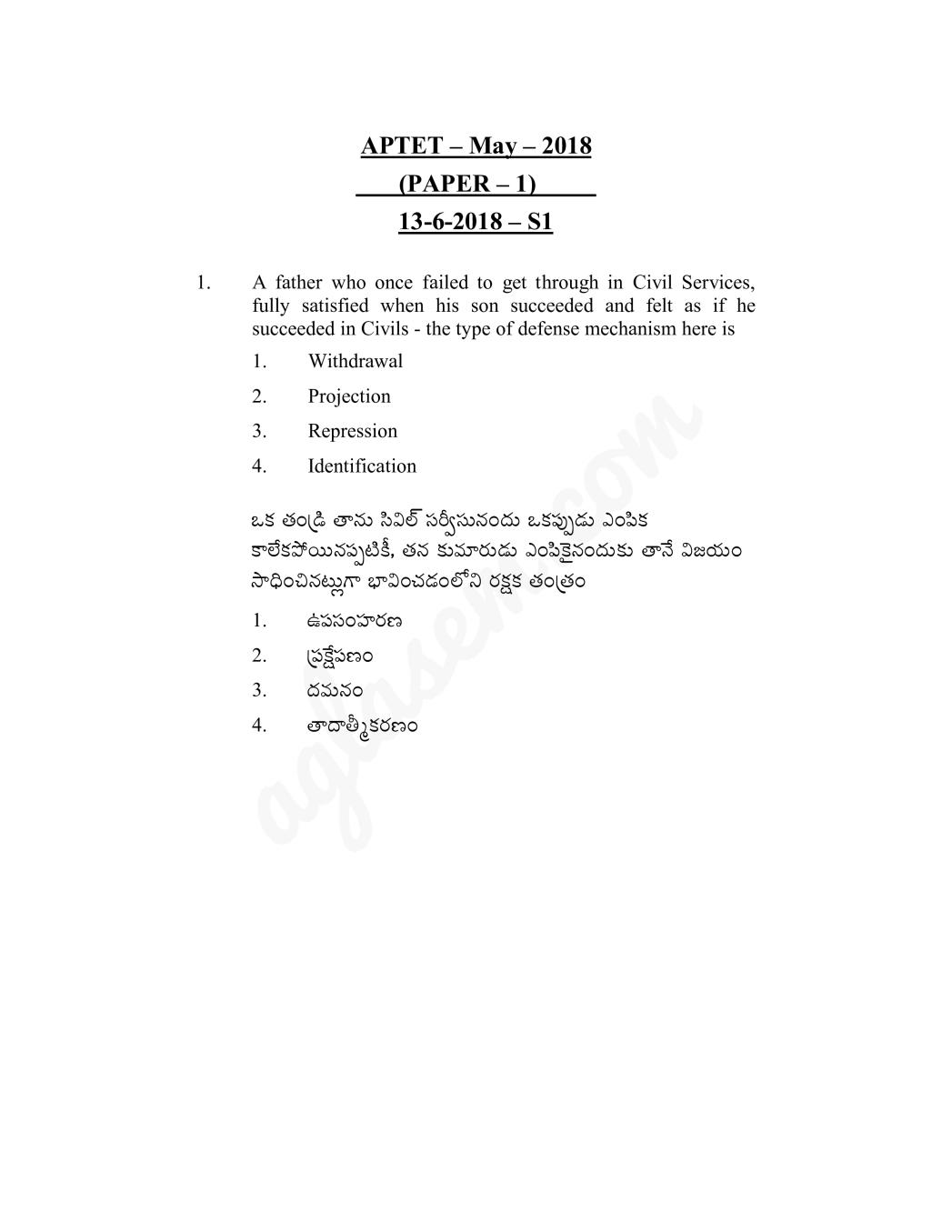
(PAPER – 1)
13-6-2018 – S1
1. A father who once failed to get through in Civil Services,
fully satisfied when his son succeeded and felt as if he
succeeded in Civils - the type of defense mechanism here is
1. Withdrawal
2. Projection
3. Repression
4. Identification
1.
2.
3.
4.
Page 2
bank clerk at the same time. She likes both the professions.
The conflict in this situation is
1. Approach - Avoidance
2. Approach - Approach
3. Avoidance - Avoidance
4. Double approach - Avoidance
3. Children from this home environment show feelings of
security, self reliance behaviour
1. Over caring, pampering parents
2. Submissive parents
3. Parents play with children
4. Authoritarian parents
1.
2.
3.
4.
Page 3
to this level of Kohlberg’s moral development
1. Conventional moral level
2. Post conventional level
3. Pre conventional level
4. Natural moral level
5. The following is more objective in nature
1. Experimental method
2. Case study method
3. Introspection method
4. Observation method
Page 4
of development
1. Development is continuous
2. Development is unpredictable
3. Development has individual differences
4. Development is cumulative
1.
2.
3.
4.
7. Tachistoscope is used to measure
1. Intelligence
2. Narratives
3. Memory/Span of attention
4. Aptitude
Page 5
this dimension of emotional intelligence
1. Self motivation
2. Self management
3. Maintenance of relations
4. Self contact
9. The following categories of intelligence are ‘picture smart’
1. Intra personal intelligence
2. Spatial intelligence
3. Bodily kinesthetic intelligence
4. Interpersonal intelligence
Page 6
following
1. Interest
2. Intelligence quotient
3. Attitude
4. Emotional intelligence
11. In an experiment the variable that plays the role of ‘effect’ is
1. Dependent variable
2. Independent variable
3. Intervening variable
4. No variable
Page 7
containing animal pictures are used is,
1. Thematic apperception test
2. Rorschach inkblot test
3. Children’s apperception test
4. Sentence completion test
13. The ringing of bell in classical conditioning is
1. Unconditioned stimulus
2. Unconditioned response
3. Conditioned stimulus
4. Conditioned response
Page 8
1. Students’ maturity is not important for teaching
2. Instruction should be based on principle of known to
unknown
3. Students’ maturity is important for teaching
4. Intrinsic motivation is important for reinforcing
learning
15. One of the following statements is not true with regard to the
factors influencing learning
1. Motivation is the key to learning
2. Individual’s health is not a factor for learning
3. Memory enhances learning
4. There is a positive relation between maturity and
learning
Page 9
proposed by
1. Bandura
2. Bruner
3. Piaget
4. Vygotsky
(ZPD)
17. ‘Intuitive thought period’ is a sub stage in Piaget’s cognitive
developmental stages
1. Pre-operational stage
2. Sensory motor stage
3. Concrete operational stage
4. Formal operational stage
Page 10
1. Organizing discussions and seminars
2. Promoting good relations among peers
3. Learning in stress environment
4. Judicious use of rewards and punishment
19. If the psychology lesson of 1st period inhibits the
understanding of methodology subject in the 2nd period, then
this inhibition is called,
1. Proactive inhibition
2. Retroactive inhibition
3. Repression
4. No inhibition
Page 11
attempt, but he has taken only 2 trails in re-learning. The
saving score is
1. 200
2. 50
3. 100
4. 25
21. A student who has learnt cycling tries to learn picture
drawing – the kind of transfer of learning in this situation is
1. Positive transfer
2. Negative transfer
3. Zero transfer
4. Bilateral transfer
Page 12
to get a good gift as his father gifted his brother a computer
when he scored 10/10. This reinforcement is,
1. Indirect
2. Direct
3. Self
4. Zero
23. As per RTE Act 2009 teaching hours for 1 to 5 classes in an
academic year
1. 880
2. 850
3. 820
4. 800
Page 13
examination reforms
1. Encouraging open book examinations
2. Importance to written tests
3. Introducing unlimited time for examinations
4. Importance to evaluation of group work
NCF - 2005
25. As per PWD Act this range of hearing is considered as
hearing impairment
1. More than 30 db HL
2. More than 40 db HL
3. More than 50 db HL
4. More than 60 db HL
PWD Act
30 db HL
40 db HL
0 db HL
0 db HL
Page 14
1. Directive counselling
2. Non directive counselling
3. Ecleictic counselling
4. Informal counselling
27. The objective of continuous comprehensive evaluation is
1. Encouraging rote memory methods
2. Providing continuous feedback on student’s
performance
3. Moulding teaching learning process as teacher
centered
4. Limiting teaching to develop cognitive skills only
Page 15
primary class students.
1. Reading the chapter from the text book in the
classroom
2. Exhibiting charts showing houses
3. Arranging field trip to the nearby habitation
4. Arranging a speech by a local mason
29. This is not suggested by RTE Act - 2009
1. No school is expected to collect capitation fees
2. Admission tests should not be conducted for admission
into general schools
3. Special trainings are to be conducted for out of school
children
4. Recognition from specified authority is not mandatory
for schools maintaining good standards
Page 16
1. When there is no competition among groups
2. When getting membership is easy
3. When the objective of the group not attained
4. When there is an effective leadership
Page 17
32.
33.
Page 18
35.
36.
Page 19
38.
39.
40.
Page 20
42.
43.
44.
Page 21
46.
47.
48.
Page 22
50.
51.
Page 23
53.
54.
Page 24
56.
57.
58.
Page 25
60.
Page 26
Choose the meaning of the word “appetite”.
1. ready to work
2. the desire to eat
3. complain about something
4. ability to say amusing things
62. Tall buildings, cell towers and factory chimneys began to
vanish gradually
Choose the synonym of the word “Vanish”
1. live
2. move
3. fall
4. disappear
63. I’ve grown old and feeble.
Choose the antonym of the word “feeble”.
1. happy
2. strong
3. active
4. serious
Page 27
1. harmoneous
2. harmonious
3. harmonies
4. harmonus
65. I will knock down the wall, and my garden shall be the
children’s play ground forever and ever.
Choose the meaning of the phrase “knock down”
1. demolish
2. construct
3. purchase
4. paint
66. Choose the suffix that suits the word, “power” to form an
adjective.
1. fully
2. ness
3. ful
4. ly
67. She did not go to school as she was ill.
This sentence is:
1. a simple sentence
2. a compound sentence
3. a complex sentence
4. an interrogative sentence
Page 28
following.
1. Kishore is not understanding the lesson.
2. Kishore does not understand the lesson.
3. Kishore was not understanding the lesson.
4. Kishore is not understand the lesson.
69. Raman ______ to the Royal society of London in 1924.
Choose correct form of verb that fits the blank.
1. elected
2. was elected
3. elects
4. has elected
70. Why are there lights even in the middle of the night?
Choose the part of speech of the word ‘Why’.
1. a conjunction
2. a pronoun
3. an adjective
4. an adverb
71. People who live in glass houses must not throw stones.
This sentence has
1. a defining relative clause
2. a non-defining relative clause
3. a noun clause
4. a conditional clause
Page 29
Choose the correct form of the verb that fits the blank.
1. was seeing
2. have seen
3. has seen
4. did not saw
73. Tejaswini lent me ______ interesting book.
Choose the article that fits the blank.
1. a
2. an
3. the
4. No article is needed.
74. I am not responsible _____ this issue.
Choose the correct preposition that fits the blank.
1. with
2. to
3. for
4. by
75. Pavan is not so intelligent as Sekhar.
Choose the comparative degree of this sentence.
1. Pavan is the most intelligent student.
2. Very few students are as intelligent as Pavan.
3. Sekhar is more intelligent than Pavan.
4. No other student is so intelligent as Pavan.
Page 30
Choose the sentence that can be used to express the above
sentence politely.
1. Why do you change this damaged magnifying glass at
once ?
2. You should change this damaged magnifying glass at
once.
3. You must change this damaged magnifying glass at
once.
4. Could you please change this damaged magnifying
glass at once ?
77. I have met you before,
Choose the correct question tag of this sentence.
1. didn’t I?
2. isn’t it?
3. haven’t I?
4. hasn’t I?
78. The teacher said, “What can be the origin of the word?”
Choose the correct reported speech of the sentence
1. The teacher asked what the origin of the word could
be.
2. The teacher told what could be the origin of the word.
3. The teacher said what the origin of the word could be.
4. The teacher said what could be the origin of the word.
Page 31
Choose the passive voice of the sentence.
1. The class was divided into groups by the teacher.
2. The class has been divided into groups by the teacher.
3. Teacher was divided into groups by the class.
4. Teacher has divided into groups by the class.
80. Choose the word that can not begin with a capital letter.
1. Africa
2. Arun
3. Smugglers
4. Friday
81. The following is to be said in the opening part of a formal
letter.
1. Ask how good the weather is in the recipient’s city.
2. Ask the recipient if he is hale and hearty.
3. Talk about how good the weather is in your city.
4. Inform the recipient why you are writing the letter.
82. Choose the list of words in the correct alphabetical order.
1. beneficial, beneficiary, benefit, beneficent
2. beneficent, beneficial, beneficiary, benefit
3. beneficiary, benefit, beneficial, beneficiary
4. benefit, beneficent, beneficiary, beneficial
Page 32
question given after.
The benefit of the study of history covers the broad range of
human experience. War and peace, which are a part of
history, are certainly covered as national and international
affairs. Human nature is an important part of history:
emotions like passion, greed and insecurity have influenced
the shaping of world affairs.
The following influences the world affairs.
1. Human emotions
2. The study of history
3. The historians
4. The human experience
84. Read the passage and choose the correct answer to the
question given after
Psychology is the study of human behavior of how people
behave and why they behave in just the way they do. Its chief
purpose is to know more about human nature and human
activity.
The study of psychology helps us to understand:
1. human body
2. human evolution
3. human nature
4. human culture
Page 33
1. It standardises the instruction
2. It provides a variety of learning resources
3. It presents effective language models.
4. It consists of only seventy five pages.
86. The approach that came into practice as an alternative to
direct method was:
1. The sentence approach
2. The word approach
3. The Structural-Oral-Situational approach
4. Communicative approach
87. Choose the text which is rhythmic and musical.
1. An essay
2. A short story
3. An article
4. A poem
88. A lesson plan helps a teacher to:
1. anticipate the problems before they happen during the
class.
2. reduce the teaching hours
3. decrease the topics in a lesson
4. reduce the chalkboard work
Page 34
1. at the end of every week
2. at the end of every month
3. in the beginning of the academic year
4. at the end of the course
90. Listening to poetry is:
1. Listening for enjoyment
2. Listening to evaluate
3. Listening to solve problems
4. Listening to communicate
Page 35
91. Multiplicative inverse of is
19
13
19
19
1.
13
13
2.
19
19
3.
13
4. 1
92. One of the following is Commutative property
1. a(b + c) = ab + ac
2. a + (b + c) = (a + b) + c
3. a (b + c) = (a b) + (a c)
4. a b = b a
93. Number of cubic numbers in between 1 to 100
1. 9
2. 10
3. 3
4. 13
Page 36
–5, 2
1. –7
2. –8
3. –9
4. 0
95. Square root of 4 3 5 5 3 4 is
4 3 5 5 3 4
1. 60
2. 50
3. 120
4. 30
3
96. Equivalent fraction of is
5
3
5
65
1.
100
66
2.
110
56
3.
100
66
4.
120
Page 37
97. At Veerendra’s birthday party, part of the cake was
12
distributed, remaining part of the cake is
7
12
6
1.
12
5
2.
12
4
3.
12
1
4.
12
98. Express 8229 grams in kilograms
1. 8.229
2. 0.8229
3. 82.29
4. 822.9
99. The value of 2.2 0.2 0.001 is
2.2 0.2 0.001
1. 4.2
2. 0.00044
3. 4.004
4. 4.404
Page 38
100. 2.104 is written in the form of is
q
p
2.104
q
264
1.
125
232
2.
125
263
3.
125
265
4.
125
101. The ratio 45 : 108 in simplest form
45 : 108
1. 7 : 13
2. 5 : 12
3. 12 : 5
4. 13 : 7
Page 39
102. A class has 32 students. If part of them are boys then
4
the number of boys are
3
4
1. 24
2. 14
3. 04
4. 08
103. If the cost of 12 pencils is ` 24 then cost of 10 pencils is
(in Rupees)
`
1. 20
2. 18
3. 16
4. 10
104. The compound ratio of a : b and c : d is
a:b c:d
1. ab : cd
2. bc : ad
3. ac : bd
4. ad : bc
Page 40
R
105. In A = P 1 , R stands for
100
1. Principal
2. Time
3. Compound interest
4. Rate of interest
n
R
P 1 R
100
1.
2.
3.
4.
106. Arithmetic mean of the first five prime numbers is
1. 5.6
2. 4.5
3. 3.6
4. 2.5
Page 41
1. Circles
2. Rectangles
3. Triangles
4. Squares
1.
2.
3.
4.
108. If the mode of 8, 15, 7, 7, 9, 2, 9 and x is 9 then ‘x’ is
8, 15, 7, 7, 9, 2, 9 x
‘x’
1. 7
2. 8
3. 15
4. 9
Page 42
a week is
`
1. ` 250
2. ` 350
3. ` 400
4. ` 450
110. Number of symmetric lines for a square
1. 2
2. 3
3. 4
4. 1
2 4 2 5 5
111. Degree of the polynomial x y x 2 xy 5 is
7 3
2 4 2 5 5
x y x 2 xy 5
7 3
1. 6
2. 5
3. 4
4. 2
Page 43
112. If 45 = 1 then 3x is equal to
x 5
45 =1 3x
1. 15
2. –15
3. 20
4. –18
113. Angle between 90o and 180o is called
1. Right angle
2. Straight angle
3. Reflex angle
4. Obtuse angle
90o 180o
1.
2.
3.
4.
114. In ABC, A = 30o, B = 60o then C is equal to
ABC A = 30o, B = 60o C
1. 30o
2. 90o
3. 60o
4. 45o
Page 44
1. Imitation
2. Articulation
3. Naturalisation
4. Manipulation
1.
2.
3.
4.
116. “Pupil draws diagrams for equal fractions”. This
specification comes under this objective
1. Knowledge
2. Application
3. Understanding
4. Skill
1.
2.
3.
4.
Page 45
Materials supplied in “Maths Kit” is
OBB
1. 4
2. 5
3. 6
4. 7
118. One of the following is a scholastic test
1. Intelligence test
2. Personality test
3. Teacher made test
4. Aptitude test
1.
2.
3.
4.
Page 46
1. Concrete to abstract
2. Hypothesis to conclusion
3. Example to principle
4. Specific to general
1.
2.
3.
4.
120. Portfolio is considered as one of the item for assessing the
following tool in formative assessment
1. Pupil participation - Reflection
2. Written works
3. Slip test
4. Project work
1.
2.
3.
4.
Page 47
1. Neptune
2. Pluto
3. Uranus
4. Saturn
122. The change from milk to curd is a
1. Slow and temporary change
2. Fast and temporary change
3. Slow and permanent change
4. Fast and permanent change
Page 48
objects / substances
1. Laboratory thermometer
2. Thermister thermometer
3. Clinical thermometer
4. Six’s maximum – minimum thermometer
124. The filament coil of electric heater is made up of
1. Iron
2. Nichrome
3. Tungsten
4. Manganin
Page 49
1. Newton
2. Newton - meter
3. Newton / meter
4. Newton / meter2
S.I.
126. The friction which comes into play when the surfaces of two
objects are in contact and are at rest relative to each other is
1. Static friction
2. Sliding friction
3. Rolling friction
4. Fluid friction
Page 50
127. The disease that spreads through open defecation
1. Malaria
2. Elephantiasis
3. Cholera
4. Dengue
128. The CPR that should be done to the heart attack patients per
minute is
1. 3 times
2. 6 times
3. 2 times
4. 10 times
CPR
Page 51
1. Lotus
2. Neem
3. Aloevera
4. Tamarind
130. Find out the mismatch
1. Hinge Joint - Elbow
2. Pivotal Joint - Neck
3. Ball and Socket Joint - Knee
4. Fixed Joint - Skull
Page 52
1. Mountains
2. Deserts
3. Forests
4. Rivers
132. The enrichment of water by nutrients leading to excessive
algal growth and depletion of oxygen in the pond is known as
1. Eutrophication
2. Bioremediation
3. Biomagnification
4. Bioluminiscence
Page 53
1. The basic needs should be provided to people
2. Poverty should be decreased
3. Participation of the people is compulsory
4. The nation must be industrialized
134. The person responsible for income and expenditure of the
Gram Panchayat is
1. Upa Sarpanch
2. Sarpanch
3. Village Secretary
4. Village Assistant
Page 54
1. Akbar
2. Guru Gobind
3. Guru Nanak
4. Guru Arjun
136. The Kandariya Mahadeva temple dedicated to Shiva was
constructed by
1. Cholas
2. Pallavas
3. Chahamanas
4. Chandelas
Page 55
1. Sardar Patel
2. Dr. B. R. Ambedkar
3. K. M. Munshi
4. K. R. Narayanan
138. The mineral that is used as a non-conductor of electricity in
electronic industry
1. Ceramic
2. Manganese
3. Mica
4. Limestone
Page 56
anicut was completed in the year
1. 1845
2. 1849
3. 1850
4. 1852
140. ‘Dandi’, where the Salt Satyagraha was started is located in
this State
1. Rajasthan
2. Gujarath
3. Kerala
4. Uttar Pradesh
Page 57
1. Punjab style of sculpture
2. Gandhara style of sculpture
3. Rajasthan style of sculpture
4. Amaravathi style of sculpture
142. The construction of Qutubminar was started by
1. Qutubuddin Aibak
2. Iltutmish
3. Allauddin Khilji
4. Mohammad bin Tuglak
Page 58
1. North India
2. South India
3. North Eastern States
4. Central India
144. This Country is greater in area when compared to India
1. Australia
2. Germany
3. Argentina
4. Mongolia
Page 59
1. Concepts
2. Laws
3. Processes
4. Theories
146. Cognitive domain is related to
1. Head
2. Heart
3. Body
4. Consciousness
Page 60
learn all the topics in all the classes is
1. Topical approach
2. Logical approach
3. Concentric approach
4. Psychological approach
148. One best example for direct experience is
1. Model of kidney
2. Observation of exhibition
3. Defining a law
4. Dissecting cockroach
Page 61
school’ – This was defined by
1. Kilpatrick
2. Stevenson
3. Ballard
4. Parker
150. The style of writing and imaginative capacity of students can
be measured through this type of questions
1. Multiple choice type
2. Completion type
3. Essay type
4. Matching type
Page 62
Paper-I - Telugu Medium - Set-G 13.06.2018 Morning Session
Q. Nos. CDP Q. Nos. Telugu Q. Nos. English Q. Nos. Maths Q. Nos. EVS
1 4 31 3 61 2 91 3 121 2
2 2 32 4 62 4 92 4 122 3
3 3 33 1 63 2 93 3 123 1
4 3 34 2 64 2 94 3 124 2
5 1 35 3 65 1 95 1 125 4
6 2 36 1 66 3 96 2 126 1
7 3 37 3 67 3 97 2 127 3
8 Add Score 38 4 68 2 98 1 128 1
9 2 39 2 69 2 99 2 129 3
10 4 40 4 70 4 100 3 130 3
11 1 41 2 71 1 101 2 131 3
12 3 42 1 72 2 102 1 132 1
13 3 43 1 73 2 103 1 133 3
14 3 44 2 74 3 104 3 134 2
15 2 45 2 75 3 105 4 135 3
16 4 46 3 76 4 106 1 136 4
17 1 47 2 77 3 107 2 137 2
18 3 48 3 78 1 108 4 138 1 or 3
19 1 49 4 79 1 109 2 139 2
20 2 50 3 80 3 110 3 140 2
21 3 51 2 81 4 111 1 141 3
22 1 52 1 82 2 112 2 142 1
23 4 53 4 83 1 113 4 143 4
24 2 54 1 84 3 114 2 144 1
25 4 55 1 85 4 115 4 145 3
26 1 56 2 86 3 116 4 146 1
27 2 57 3 87 4 117 4 147 3
28 3 58 1 88 1 118 3 148 4
29 4 59 3 89 4 119 2 149 3
30 4 60 2 90 1 120 2 150 3
Document Details
| Board / Org | Andhra Pradesh Exams |
| Exam | Andhra Pradesh Teacher Eligibility Test |
| Type | Question Paper |
| Pages | 62 |
| Updated | 09 Jun 2026 |