NBSE Class 9 Syllabus 2023
Finished viewing? Save it for later —
Download NBSE Class 9 Syllabus 2023 (PDF · 5 pages)About NBSE Class 9 Syllabus 2023
NBSE Class 9 Syllabus 2023 is available here for free download. Published by Nagaland Board for Class 9, this syllabus can be viewed online or downloaded as a PDF (5 pages). Candidates preparing for Class 9 can use NBSE Class 9 Syllabus 2023 to understand the exam pattern, the type of questions asked, and the overall difficulty level.
Frequently Asked Questions
How can I download NBSE Class 9 Syllabus 2023?
Open this page and click the Download button to save NBSE Class 9 Syllabus 2023 as a PDF. It is completely free on AglaSem Docs.
Is NBSE Class 9 Syllabus 2023 free to download?
Yes. NBSE Class 9 Syllabus 2023 can be viewed online and downloaded as a PDF free of cost on AglaSem Docs.
How many pages does NBSE Class 9 Syllabus 2023 have?
NBSE Class 9 Syllabus 2023 contains 5 pages, which you can read online or download together as a single PDF.
Where can I find more Class 9 study material?
You can find more Class 9 question papers, sample papers, syllabus, and answer keys on AglaSem Docs.
NBSE Class 9 Syllabus 2023 – Text
Read the full text of this syllabus below — useful to quickly search, copy and reference the content online without downloading the PDF.
📄 View text version (5 pages)
Page 1
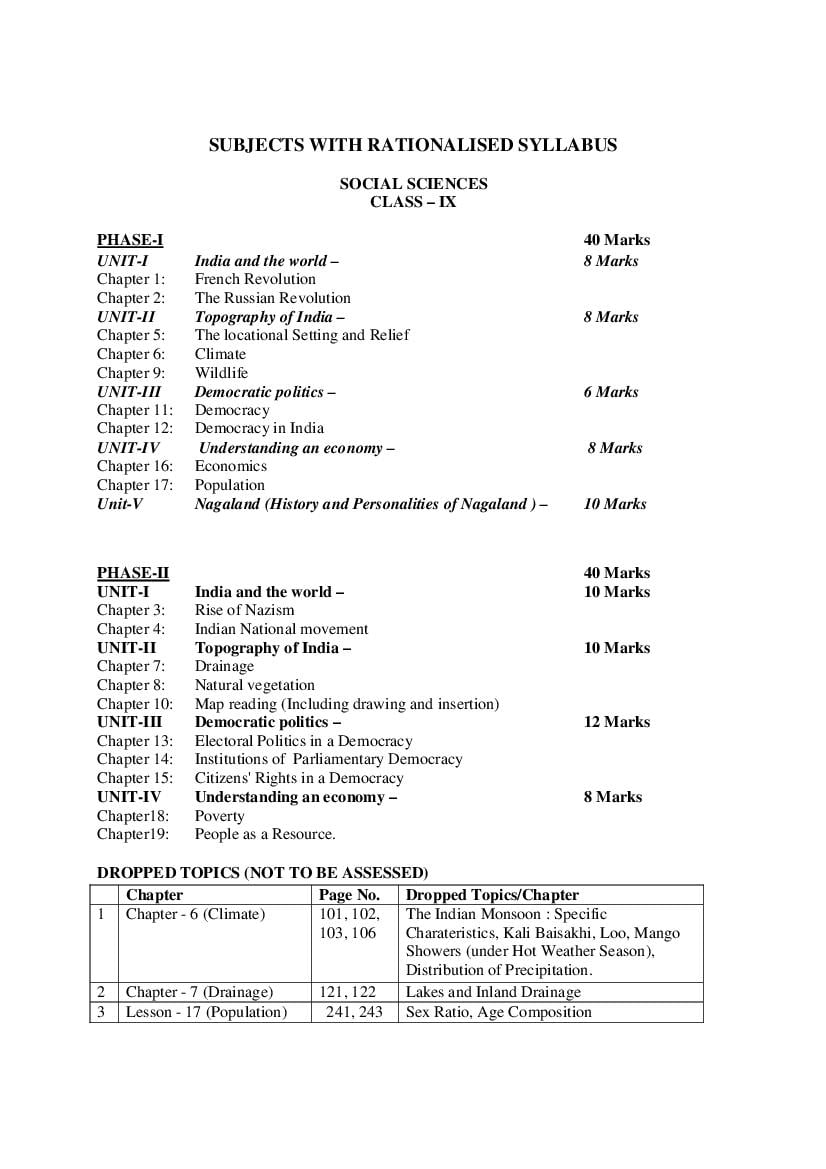
SOCIAL SCIENCES
CLASS – IX
PHASE-I 40 Marks
UNIT-I India and the world – 8 Marks
Chapter 1: French Revolution
Chapter 2: The Russian Revolution
UNIT-II Topography of India – 8 Marks
Chapter 5: The locational Setting and Relief
Chapter 6: Climate
Chapter 9: Wildlife
UNIT-III Democratic politics – 6 Marks
Chapter 11: Democracy
Chapter 12: Democracy in India
UNIT-IV Understanding an economy – 8 Marks
Chapter 16: Economics
Chapter 17: Population
Unit-V Nagaland (History and Personalities of Nagaland ) – 10 Marks
PHASE-II 40 Marks
UNIT-I India and the world – 10 Marks
Chapter 3: Rise of Nazism
Chapter 4: Indian National movement
UNIT-II Topography of India – 10 Marks
Chapter 7: Drainage
Chapter 8: Natural vegetation
Chapter 10: Map reading (Including drawing and insertion)
UNIT-III Democratic politics – 12 Marks
Chapter 13: Electoral Politics in a Democracy
Chapter 14: Institutions of Parliamentary Democracy
Chapter 15: Citizens' Rights in a Democracy
UNIT-IV Understanding an economy – 8 Marks
Chapter18: Poverty
Chapter19: People as a Resource.
Chapter Page No. Dropped Topics/Chapter
1 Chapter - 6 (Climate) 101, 102, The Indian Monsoon : Specific
103, 106 Charateristics, Kali Baisakhi, Loo, Mango
Showers (under Hot Weather Season),
Distribution of Precipitation.
2 Chapter - 7 (Drainage) 121, 122 Lakes and Inland Drainage
3 Lesson - 17 (Population) 241, 243 Sex Ratio, Age Composition
Page 2
CLASS-IX
PHASE I 40 marks
Unit No. Chapter No. Name of the Chapter Marks
I 1 Number Systems 9
2 Polynomials 15
II 4 Linear Equations in two variables 3
III 3 Coordinate Geometry 4
V 12 Heron’s formula 9
PHASE II 40 marks
Unit No. Chapter No. Name of the Chapter Marks
5 Introduction to Euclid’s Geometry 1
6 Lines and Angles 4
IV
7 Triangles
8 Quadrilaterals 12
10 Circles 7
V 13 Surface Areas and Volumes 11
VI 14 Statistics 5
Chapter Page No. Dropped Topics/Chapters
Chapter 1: 9 Exercise 1.2, questions B. 3, 4 & 5
Number Systems 1.4 Representing real numbers on the number line
16-19 Exercise 1.4
26 Exercise 1.5, questions B.4 & 5
Chapter 2: Polynomials 43 Ex 2.3
Chapter 3: 67-71 3.3 Plotting a point in the plane if its coordinates are
Coordinate Geometry given
Exercise 3.3
Chapter 4: Linear Equations in 77-83 4.4 Graph of linear equations in two variables
two Variables Exercise 4.3
83-85 4.5 Equations of lines parallel x-axis and y-axis
Exercise 4.4
Chapter 5: 94-96 5.3 Equivalent versions of Euclid’s fifth postulate
Introduction-Euclidean Exercise 5.2
Geometry
Chapter 6: 114-119 6.7 Angle sum property of a triangle
Lines and Angles Exercise 6.3
Page 3
Triangles Exercise 7.4
Chapter 8: 147-150 8.1 Introduction
Quadrilaterals 8.2 Angle sum property of a quadrilateral
8.3 Types of quadrilaterals
156-159 8.5 Another condition for a Quadrilateral-be a
parallelogram
Exercise 8.1, questions 1 & 11
Chapter 9: 164-180 Full chapter
Areas of Parallelogram and
Triangles
Chapter 10: 10.1 Introduction
Circles 181-184 10.2 Circles and its related terms: Review
Exercise 10.1
187-189 10.5 Circle through three points
Exercise 10.3
Chapter 11: 203-210 Full chapter
Construction
Chapter 12: 211-213 12.1 Introduction
Heron’s Formula 12.3 Application of Heron’s formula in finding areas
218-223 of quadrilaterals
Exercise 12.2
Chapter 13: 13.1 Introduction
Surface Area and Volume 224-229 13.2 Surface area of a cuboid and cube
Exercise 13.1
229-233 13.3 Surface area of right circular cylinder
Exercise 13.2
242-245 13.6 Volume of cuboid
Exercise 13.5
245-247 13.7 Volume of cylinder
Exercise 13.6
Chapter 14: 255-264 14.1 Introduction
Statistics 14.2 Collection of data
Exercise 14.1
14.3 Presentation of data
Exercise 14.2
278-288 14.5 Measure of central tendency
Exercise 14.4
14.6 Summary
Chapter 15: 289-303 Full chapter
Probability
Page 4
Construction 11.2 Division of a line segment
Exercise 11.1, question 1
230-232 11.3 Construction of tangents to a circle
Exercise 11.2
11.4 Summary
Chapter 12: 12.1 Introduction
Areas Related to 233-236 12.2 Perimeter and area of a circle – A review
Circles Exercise 12.1
242-249 12.4 Areas of combinations of plane figures
Exercise 12.3
Chapter 13: 260-264 13.4 Conversion of solid from one shape to another
Surface Areas and Exercise 13.3
Volumes 264-271 13.5 Frustum of a cone
Exercise 13.4
Chapter 14: 303-307 14.5Graphical representation of cumulative frequency
Statistics distribution - Exercise 14.4
Chapter 15: 309 15.1 Introduction
Probability 325-326 Exercise 15.2
SCIENCE
CLASS IX
PHASE I 40 marks
Unit I: 1. Matter in Our Surroundings 4 marks
3. Atoms and Molecules 7 marks
Unit II: 5. The Fundamental Unit of life 7marks
7. Diversity in Living Organisms 6 marks
Unit III: 8. Motion 5 marks
11. Work and Energy 5 marks
Unit IV: 13. Why do we Fall ill 6 marks
PHASE II 40 marks
Unit I: 2. Is Matter Around Us Pure? 5 marks
4. Structure of the Atom 7 marks
Unit II: 6. Tissues 7 marks
Unit III: 9. Force and Laws of Motion 6 marks
10. Gravitation 4 marks
12. Sound 5 marks
Unit V: 15. Improvement in Food Resources 6 marks
Page 5
Chapter 2: Is Matter Around us Pure 2.3.1 How can we obtain coloured component
(dye) from blue/black ink?
2.3.2 How can we separate cream from milk?
2.3.3 How can we separate a mixture of two
immiscible liquids?
2.3.4 How can we separate a mixture of salt
and ammonium chloride?
2.3.5 Is the dye in black ink a single colour?
2.3.6 How can we separate a mixture of two
miscible liquids?
2.3.7 How can we obtain different gases from
air?
2.3.8 How can we obtain pure copper sulphate
from an impure sample?
Chapter 3: Atoms and Molecules 3.5 Molecular Mass and Mole Concept
3.5.1 Molecular Mass
3.5.2 Formula Unit Mass
3.5.3 Mole Concept
Chapter 7: Diversity in Living Organisms 7.1 What is the basis of Classification?
Chapter 8: Motion 8.5.1 Equation for velocity-time relation
8.5.2 Equation for position-time relation
8.5.3 Equation for position-velocity relation
Chapter 9: Force and Laws of Motion 9.6 Conservation of Momentum
Activity- 9.5 & 9.6
Examples- 9.6, 9.7, 9.8
Chapter 11: Work and Energy 11.3.1 Commercial Unit of Energy
Chapter 12: Sound 12.6 Structure of Human Ear
Chapter 13: Why do we Fall Ill 13.1.2 Personal and Community Issues both
matter for health
13.1.3 Distinctions between ‘Healthy’ and
‘Disease-free’
13.3.3 Organ-specific and Tissue-specific
manifestations
13.3.5 Principles of prevention
Chapter 14: Natural Resources Full chapter will not be assessed in the final
examination.
Teachers to assign students to read this chapter
and assess through ctivities/assignments/write-
ups/projects, etc and give marks for Internal
Assessment
Chapter 15: Improvement in 15.1.1 Crop variety improvement
Food Resources
Note: Information in boxes in all the chapters will not be assessed in the final examination.