HBSE Class 12 Sample Paper 2027 Mathematics Stepwise Marking Scheme
Finished viewing? Save it for later —
Download HBSE Class 12 Sample Paper 2027 Mathematics Stepwise Marking Scheme (PDF · 13 pages)About HBSE Class 12 Sample Paper 2027 Mathematics Stepwise Marking Scheme
HBSE Class 12 Sample Paper 2027 Mathematics Stepwise Marking Scheme is available here for free download. Published by Haryana Board for Class 12, this answer key can be viewed online or downloaded as a PDF (13 pages). Candidates preparing for Class 12 can use HBSE Class 12 Sample Paper 2027 Mathematics Stepwise Marking Scheme to understand the exam pattern, the type of questions asked, and the overall difficulty level.
Frequently Asked Questions
How can I download HBSE Class 12 Sample Paper 2027 Mathematics Stepwise Marking Scheme?
Open this page and click the Download button to save HBSE Class 12 Sample Paper 2027 Mathematics Stepwise Marking Scheme as a PDF. It is completely free on AglaSem Docs.
Is HBSE Class 12 Sample Paper 2027 Mathematics Stepwise Marking Scheme free to download?
Yes. HBSE Class 12 Sample Paper 2027 Mathematics Stepwise Marking Scheme can be viewed online and downloaded as a PDF free of cost on AglaSem Docs.
How many pages does HBSE Class 12 Sample Paper 2027 Mathematics Stepwise Marking Scheme have?
HBSE Class 12 Sample Paper 2027 Mathematics Stepwise Marking Scheme contains 13 pages, which you can read online or download together as a single PDF.
Where can I find more Class 12 study material?
You can find more Class 12 question papers, sample papers, syllabus, and answer keys on AglaSem Docs.
HBSE Class 12 Sample Paper 2027 Mathematics Stepwise Marking Scheme – Text
Read the full text of this answer key below — useful to quickly search, copy and reference the content online without downloading the PDF.
📄 View text version (14 pages)
Page 1
HBSE Class 12 Sample
Paper 2027
Mathematics Stepwise
Marking Scheme
EXAM YEAR TYPE SUBJECT
Haryana Class 12 2027 Answer Key Maths
Notes · Sample Papers · Previous Year Papers · Mock Tests
Page 2
.co s e m
s em l a
a ag
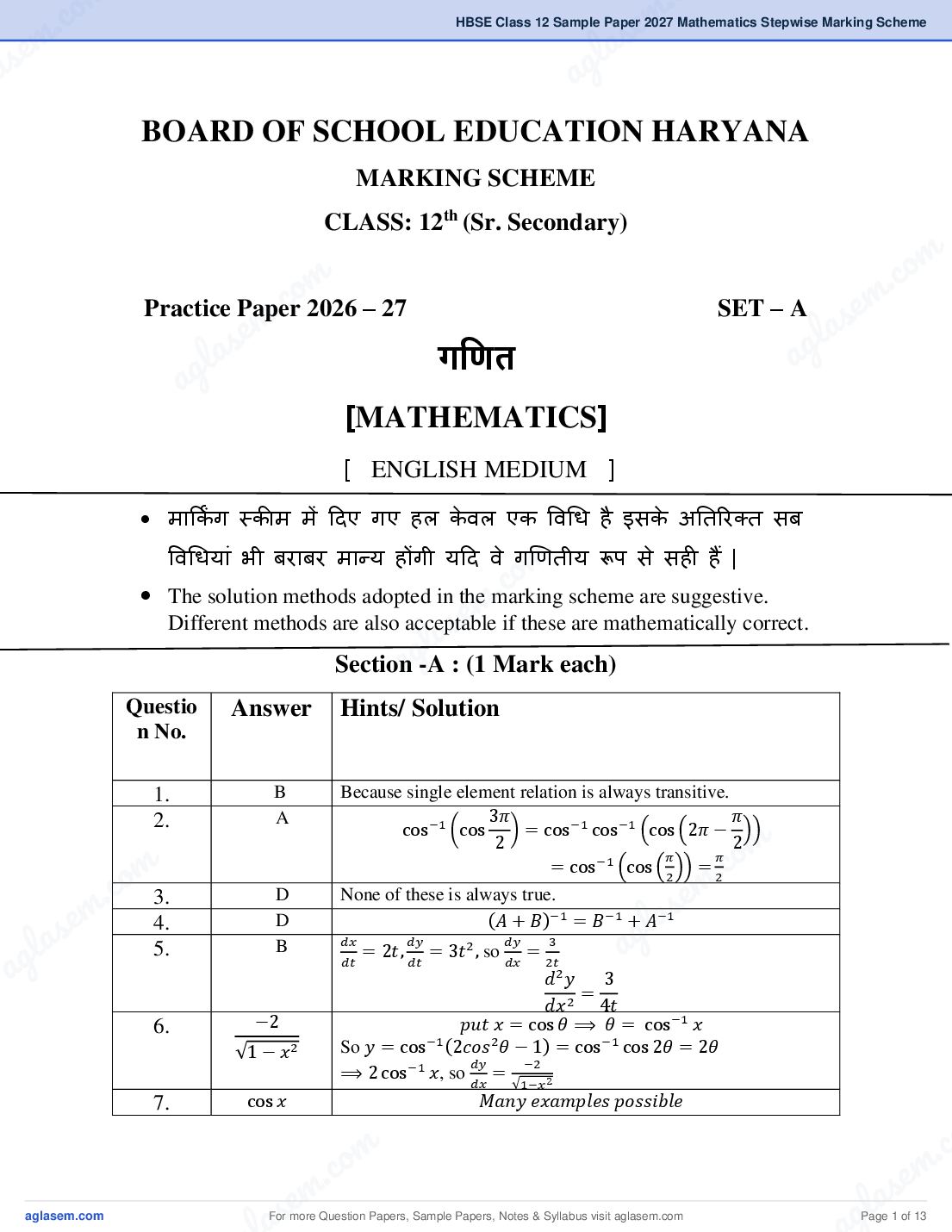
BOARD OF SCHOOL EDUCATION HARYANA
MARKING SCHEME
CLASS: 12th (Sr. Secondary)
m
om . co
.c 2026 – 27 SET – A em
Practice Paper
em l as
l as गणित ag
ag
[MATHEMATICS]
[ ENGLISH MEDIUM ]
• मार्किंग स्कीम में दिए गए हल केवल एक ववधि है इसके अतिरिक्ि सब
ववधियाां भी बिाबि मान्य होंगी यदि वे गणििीय रूप से सही हैं |
m
. c o
• The solution methods adopted in the marking
m scheme are suggestive.
e if these are mathematically correct.
as
Different methods are also acceptable
l
g
Sectiona -A : (1 Mark each)
Questio Answer Hints/ Solution
n No.
1. B Because single element relation is always transitive.
2. A 3𝜋 𝜋
cos−1 (cos ) = cos −1 cos −1 (cos (2𝜋 − ))
2 2 m
m .co
−1 𝜋 𝜋
= cos (cos ( )) =
c. o 3. 2
s em
2
em
D None of these is always true.
s (𝐴 + 𝐵)−1 = 𝐵 −1 + 𝐴−1 l a
ag
4. D
g la 5. B 𝑑𝑥
= 2𝑡,
𝑑𝑦
= 3𝑡 2 , so
𝑑𝑦
=
3
a 𝑑𝑡 𝑑𝑡
𝑑 𝑦
𝑑𝑥
=
3
2𝑡
2
𝑑𝑥 2 4𝑡
6. −2 𝑝𝑢𝑡 𝑥 = cos 𝜃 ⟹ 𝜃 = cos−1 𝑥
√1 − 𝑥 2 So 𝑦 = cos −1 (2𝑐𝑜𝑠 2 𝜃 − 1) = cos −1 cos 2𝜃 = 2𝜃
𝑑𝑦 −2
⟹ 2 cos −1 𝑥, so = √1−𝑥2
𝑑𝑥
7. cos 𝑥 𝑀𝑎𝑛𝑦 𝑒𝑥𝑎𝑚𝑝𝑙𝑒𝑠 𝑝𝑜𝑠𝑠𝑖𝑏𝑙𝑒
m . c
c. o s e m
s em
For more Question Papers, Sample Papers, Notes & Syllabus visit
gl a
Page 1 of 13
Page 3
𝑑𝑦 𝑥(2 − 𝑥)
= 𝑥𝑒 −𝑥 (−𝑥 + 2) = > 0 𝑖𝑛 (0,2)
𝑑𝑥 𝑒𝑥
9. Critical point 𝐴𝑡 𝑐𝑟𝑖𝑡𝑖𝑐𝑎𝑙 𝑝𝑜𝑛𝑖𝑡 𝑡ℎ𝑒 𝑔𝑖𝑣𝑒𝑛 𝑐𝑜𝑛𝑑𝑖𝑡𝑖𝑜𝑛 ℎ𝑜𝑙𝑑𝑠.
10. A
2𝑐𝑜𝑠 2 𝑥 − 1 − 2𝑐𝑜𝑠 2 𝜃 + 1 𝑐𝑜𝑠 2 𝑥 − 𝑐𝑜𝑠 2 𝜃
𝐼=∫ 𝑑𝑥 = 2 ∫ 𝑑𝑥
cos 𝑥 − cos 𝜃 cos 𝑥 − cos 𝜃
= 2 ∫(cos 𝑥 + cos 𝜃) 𝑑𝑥
= 2(sin 𝑥 + 𝑥 cos 𝜃) + 𝑐
Note: 𝑡𝑟𝑒𝑎𝑡 cos 𝜃 𝑎𝑠 𝑐𝑜𝑛𝑠𝑡𝑎𝑛𝑡.
11. A Degree = no. of arbitrary constants = 1
12. D For orthogonal vectors 𝑎⃗. 𝑏⃗⃗ = 0.
So (2𝑖̂ + 𝜆𝑗̂ + 𝑘̂). (𝑖̂ + 2𝑗̂ + 3𝑘̂) = 0
−5
2 + 2𝜆 + 3 = 0 ⇒ 𝜆 =
2
13. 𝑎⃗. 𝑏̂ 𝑎⃗. 𝑏⃗⃗ 1
(
) 𝑜𝑟 (𝑎⃗. 𝑏⃗⃗)
⃗
⃗
|𝑏| ⃗⃗⃗⃗⃗⃗
|𝑏⃗⃗|
14. D Required Distance = √(𝛼 − 0)2 + (𝛽 − 𝛽)2 + (𝛾 − 0)2 =
√𝛼 2 + 𝛾 2 𝑠𝑖𝑛𝑐𝑒 𝑎𝑛𝑦 𝑝𝑜𝑖𝑛𝑡 𝑜𝑛 𝑦 − 𝑎𝑥𝑖𝑠 𝑖𝑠 (0, 𝛽, 0)
15. B 𝑜𝑏𝑗𝑒𝑐𝑡𝑖𝑣𝑒 𝑓𝑢𝑛𝑐𝑡𝑖𝑜𝑛 𝑖𝑠 𝑎 𝑓𝑢𝑛𝑐𝑡𝑖𝑜𝑛 𝑡𝑜 𝑏𝑒 𝑜𝑝𝑡𝑖𝑚𝑖𝑠𝑒𝑑.
16. C
Z is maximum at (0,4) where Z = 16
For more Question Papers, Sample Papers, Notes & Syllabus visit Page 2 of 13
Page 4
.co s e m
s em l a
a ag
17. A Given, 𝑃 (𝐴) = 0.8, 𝑃 (𝐵) = 0.5 𝑎𝑛𝑑 𝑃 (𝐵|𝐴) = 0.4
By conditional probability, we have;
𝑃 (𝐵|𝐴) = 𝑃(𝐴 ∩ 𝐵)/𝑃(𝐴)
m
om
⇒ 𝑃 (𝐴 ∩ 𝐵) = 𝑃(𝐵|𝐴). 𝑃(𝐴) = 0.4 𝑥 0.8 = 0.32
. co
. c em
em l as
18.
l as
𝑃(𝐴 ∩ 𝐵)
= 𝑃(𝐴). 𝑃(𝐵)
𝐵𝑦 𝑑𝑒𝑓𝑖𝑛𝑖𝑡𝑖𝑜𝑛 𝑜𝑓 𝑖𝑛𝑑𝑒𝑝𝑒𝑛𝑑𝑒𝑛𝑡 𝑒𝑣𝑒𝑛𝑡𝑠.
ag
19. ag D A is false but R is true here.
20. D A is false 𝑆𝑖𝑛𝑐𝑒 𝜆 = −1 ℎ𝑒𝑟𝑒 𝑓𝑜𝑟 𝑡ℎ𝑒 𝑔𝑖𝑣𝑒𝑛 𝑐𝑜𝑛𝑑𝑖𝑡𝑖𝑜𝑛. but R
is true here.
खंड – ब
SECTION – B
om
(2×5=10)
. c
21. Check for one to one function:
e m
l as
𝑓(1) = 𝑓(2) = 𝑓(3) = 1, 𝑠𝑜 𝑓 𝑖𝑠 𝑛𝑜𝑡 𝑜𝑛𝑒 − 𝑜𝑛𝑒. 1
a
Check for Onto Function: g 1
Here range of 𝑓 = {−1,0,1} but domain of 𝑓 ≠ 𝑅
So f is not onto.
22(a). Since the corresponding elements of equal matrices are identical,
we get:
2𝑥 + 𝑦 = 7
𝑥 − 2𝑦 = −4 1
m
m On solving we get 𝑥 = 2, 𝑦 = 3 c. o 1
m .co s e m
s e 1
1 0 1
g la
la
OR
g
Area of triangle= |6 0 1|
2
4 3 1 a 1
a 22(b).
On solving:
15
= 𝑠𝑞𝑢𝑎𝑟𝑒 𝑢𝑛𝑖𝑡𝑠 1
2
2
23 𝑦 = 2𝑐𝑜𝑠 𝑥
2
log 𝑦 = 𝑙𝑜𝑔 2𝑐𝑜𝑠 𝑥 = 𝑐𝑜𝑠 2 𝑥. log 2 0.5
m . c
c. o s e m
s em
For more Question Papers, Sample Papers, Notes & Syllabus visit
gl a
Page 3 of 13
Page 5
So, = log 2 . (2 cos 𝑥)(− sin 𝑥)
𝑦 𝑑𝑥
𝑑𝑦 2
= −2𝑐𝑜𝑠 𝑥 . log 2 (sin 2𝑥) 0.5
𝑑𝑥
24(a) 2𝑥 − 1 2𝑥 + 3 − 3 − 1 0.5
𝐼=∫ 𝑑𝑥 = ∫ 𝑑𝑥
2𝑥 + 3 2𝑥 + 3
1 0.5
= ∫ 1𝑑𝑥 − 4 ∫ 𝑑𝑥
2𝑥 + 3
= 𝑥 − 2𝑙𝑜𝑔(2𝑥 + 3) + 𝐶 0.5
𝑥 − 𝑙𝑜𝑔(2𝑥 + 3)2 + 𝐶 0.5
1
24(b) 𝑥
𝐼=∫ 𝑑𝑥
√1 + 𝑥 2
0 0.5
𝑝𝑢𝑡 1 + 𝑥 2 = 𝑡 2 , 2𝑥 𝑑𝑥 = 2𝑡 𝑑𝑡 ⟹ 𝑥 𝑑𝑥 = 𝑡 𝑑𝑡
When 𝑥 = 0, 𝑡 = 1 ; 𝑖𝑓 𝑥 = 1 , 𝑡 = √2 0.5
√2 𝑡 𝑑𝑡
𝐼=∫ = [𝑡]1√2 = √2 − 1 1
1 𝑡
25. 𝐺𝑖𝑣𝑒𝑛 𝑡ℎ𝑎𝑡 𝐴 𝑎𝑛𝑑 𝐵 𝑎𝑟𝑒 𝑖𝑛𝑑𝑒𝑝𝑒𝑛𝑑𝑒𝑛𝑡
So 𝑃(𝐴 ∩ 𝐵) = 𝑃(𝐴). 𝑃(𝐵) 0.5
Now
𝑃(𝑝𝑟𝑜𝑏𝑙𝑒𝑚 𝑖𝑠 𝑠𝑜𝑙𝑣𝑒𝑑)
= 𝑃𝑟𝑜𝑏𝑙𝑒𝑚 𝑖𝑠 𝑠𝑜𝑙𝑣𝑒𝑑 𝑏𝑦 𝐴 𝑜𝑟 𝑝𝑟𝑜𝑏𝑙𝑒𝑚 𝑖𝑠 𝑠𝑜𝑙𝑣𝑒𝑑 𝑏𝑦 𝐵 0.5
𝑜𝑟 𝑝𝑟𝑜𝑏𝑙𝑒𝑚 𝑖𝑠 𝑠𝑜𝑙𝑣𝑒𝑑 𝑏𝑦 𝑏𝑜𝑡ℎ
𝑃(𝐴 ∪ 𝐵) = 𝑃(𝐴) + 𝑃(𝐵) − 𝑃(𝐴 ∩ 𝐵) 0.5
𝑃(𝐴 ∪ 𝐵) = 𝑃(𝐴) + 𝑃(𝐵) − 𝑃(𝐴). 𝑃(𝐵)
1 1 1 1
𝑃(𝐴 ∪ 𝐵) = + − .
2 3 2 3
3+2−1 2
𝑃(𝐴 ∪ 𝐵) = = 0.5
6 3
खंड – स
SECTION – C (3×6=18)
26. put 𝑥 = cos 2𝜃
√1+𝑥−√1−𝑥
tan−1 ( )=
√1+𝑥+√1−𝑥
−1 √1+cos 2𝜃−√1−cos 2𝜃
0.5
= tan ( )
√1+cos 2𝜃+√1−cos 2𝜃
For more Question Papers, Sample Papers, Notes & Syllabus visit Page 4 of 13
Page 6
.co s e m
s em l a
a ag
√2𝑐𝑜𝑠 2 𝜃 − √2𝑠𝑖𝑛2 𝜃 0.5
= tan−1 ( )
√2𝑐𝑜𝑠 2 𝜃 + √2𝑠𝑖𝑛2 𝜃
cos 𝜃 − sin 𝜃 1
= tan−1 ( )
cos 𝜃 + sin 𝜃
1 − tan 𝜃 𝜋
= tan−1 ( ) = tan−1 (tan ( − 𝜃))
1 + tan 𝜃 4
m
co
𝜋 1 1
om .
= − cos −1 𝑥
. c 4 2
em
27(a). At 𝑥 = 0
e m 3𝑥 + 4 tan 𝑥 0
l as
l as lim 𝑓(𝑥) = lim
𝑥→0 𝑥→0 𝑥
= 𝑓𝑜𝑟𝑚
0
ag
ag So we cannot say it continuous at 𝑥 = 0
For 𝑓 to be continuous we should have
lim 𝑓(𝑥) = 𝑓(0) 1
𝑥→0
Applying L’Hospital Rule:
3 + 4 𝑠𝑒𝑐 2 𝑥
lim 𝑓(𝑥) = lim = 3+4= 7 1
𝑥→0 𝑥→0 1
So 𝑎𝑡 𝑥 = 0 for being continuous function should be redefined
as:
3𝑥 + 4 tan 𝑥
m
.co
; 𝑥≠0
𝑓(𝑥) = { 𝑥
em ;
1
7
Then lim 𝑓(𝑥) = 𝑓(0) = 7 l as 𝑥=0
g
So 𝑓 is continuous at 𝑥 =a 0
𝑥→0
OR
OR Here
27(b).
𝑓(𝑥) = 4𝑥 3 − 6𝑥 2 − 72𝑥 + 30
So
𝑓 ′ (𝑥) = 12𝑥 2 − 12𝑥 − 72
= 12(𝑥 2 − 𝑥 − 6)
o m
0.5
m . c
c. o
= 12(𝑥 − 3) + (𝑥 + 2)
𝑓 ′ (𝑥)
= 0 gives e m
em
Put
𝑥 = 3, 𝑥 = −2
las 0.5
l as ag
ag -∞ -2 3 ∞ 0.5
INTERVAL SIGN OF Nature of 𝑓(𝑥)
𝑓 ′ (𝑥)
(−∞, −2) >0 𝑓 𝑖𝑠 𝑠𝑡𝑟𝑖𝑐𝑡𝑙𝑦 𝑖𝑛𝑐𝑟𝑒𝑎𝑠𝑖𝑛𝑔 0.5
(−2,3) <0 𝑓 𝑖𝑠 𝑠𝑡𝑟𝑖𝑐𝑡𝑙𝑦 𝑑𝑒𝑐𝑟𝑒𝑎𝑠𝑖𝑛𝑔 0.5
(3, ∞) >0 𝑓 𝑖𝑠 𝑠𝑡𝑟𝑖𝑐𝑡𝑙𝑦 𝑖𝑛𝑐𝑟𝑒𝑎𝑠𝑖𝑛𝑔 0.5
m . c
c. o s e m
s em
For more Question Papers, Sample Papers, Notes & Syllabus visit
gl a
Page 5 of 13
Page 7
𝑥 sin 𝜋𝑥 ; −1 ≤ 𝑥 ≤ 1
𝑓(𝑥) = |𝑥 𝑠𝑖𝑛 𝜋𝑥| = { 3
−𝑥 sin 𝜋𝑥 ; 1 ≤ 𝑥 ≤
2
Now : 1
3 3
1
2 2
∫ |𝑥 sin 𝜋𝑥|𝑑𝑥 = ∫ 𝑥 sin 𝜋𝑥 𝑑𝑥 + ∫ −𝑥 sin 𝜋𝑥 𝑑𝑥
−1 −1 1
3
1
2
= ∫ 𝑥 sin 𝜋𝑥 𝑑𝑥 − ∫ 𝑥 sin 𝜋𝑥 𝑑𝑥
−1 1 1
3
−𝑥 cos 𝜋𝑥 sin 𝜋𝑥 1 −𝑥 cos 𝜋𝑥 sin 𝜋𝑥 2
=[ + 2
] −[ + ]
𝜋 𝜋 −1 𝜋 𝜋2 1
2 1 1 3 1 1
= − [− 2 − ] = + 2
𝜋 𝜋 𝜋 𝜋 𝜋
29. 𝑑𝑉 𝑑𝑥 1.5
𝑉 = 𝑥3 ⟹
= 3𝑥 2 = 3𝑥 2 . 2 = 6𝑥 2
𝑑𝑡 𝑑𝑡
𝑑𝑉
Put 𝑥 = 12 𝑐𝑚 ⟹ = (6 × 144) 𝑐𝑚3 /𝑠 = 864 𝑐𝑚3 /𝑠
𝑑𝑡
1.5
30(a). 𝑎⃗ + 𝑏⃗⃗ = (𝑖̂ + 𝑗̂ + 𝑘̂) + (𝑖̂ + 2𝑗̂ + 3𝑘̂) = 2𝑖̂ + 3𝑗̂ + 4𝑘̂
𝑎⃗ − 𝑏⃗⃗ = (𝑖̂ + 𝑗̂ + 𝑘̂) − (𝑖̂ + 2𝑗̂ + 3𝑘̂) = −𝑗̂ − 2𝑘̂ 1
Now
𝑖̂ 𝑗̂ 𝑘̂
⃗⃗ ⃗
⃗
𝑐⃗ = (𝑎⃗ + 𝑏) × (𝑎⃗ − 𝑏) = |2 3 4|
0 −1 −2
𝑐⃗ = −2𝑖̂ + 4𝑗̂ ± 2𝑘̂
|𝑐⃗| = 2√6
1
𝑐⃗ −1 2 1
⟹ 𝑐̂ = = 𝑖̂ + 𝑗̂ − 𝑘̂
|𝑐⃗| √6 √6 √6
Then 𝑐̂ will be perpendicular to (𝑎⃗ + 𝑏⃗⃗) 𝑎𝑛𝑑 (𝑎⃗ − 𝑏⃗⃗)
𝑠𝑖𝑛𝑐𝑒 1
𝑎⃗ × 𝑏⃗⃗ 𝑖𝑠 𝑎𝑙𝑤𝑎𝑦𝑠 𝑝𝑒𝑟𝑝𝑒𝑛𝑑𝑖𝑐𝑢𝑙𝑎𝑟 𝑡𝑜 𝑏𝑜𝑡ℎ 𝑎⃗ 𝑎𝑛𝑑 𝑏⃗⃗.
OR
𝜋 1 𝜋
30(b) Here 𝑚 = 𝑐𝑜𝑠 = , 𝑛 = 𝑐𝑜𝑠 =0
4 √2 2 1
𝑙 2 + 𝑚 2 + 𝑛2 = 1 1
1
𝑙=±
√2
𝑟⃗ = 𝑙𝑖̂ + 𝑚𝑗̂ + 𝑛𝑘̂ 1
For more Question Papers, Sample Papers, Notes & Syllabus visit Page 6 of 13
Page 8
.co s e m
s em l a
a ag
𝑟⃗ = ±3𝑖̂ + 3𝑗̂
31. Here 𝑛(𝑠) = 6 × 6 × 6 = 216
Let 𝐸1 = 𝑡ℎ𝑒 𝑒𝑣𝑒𝑛𝑡 𝑡ℎ𝑎𝑡 𝑠𝑢𝑚 𝑜𝑓𝑛𝑢𝑚𝑏𝑒𝑟𝑠 𝑜𝑛 𝑡ℎ𝑒 𝑑𝑖𝑐 𝑤𝑎𝑠 6
(1,1,4), (1,2,3), (1,3,2), (1,4,1), (2,1,3), (2,2,2), (2,3,1)
𝐸1 = { } 1
(3,1,2), (3,2,1), (4,1,1)
m
co
Let 𝐸2 = 𝑡ℎ𝑒 𝑒𝑣𝑒𝑛𝑡 𝑡ℎ𝑎𝑡 𝑡ℎ𝑟𝑒𝑒 𝑡𝑤𝑜′ 𝑠 𝑜𝑐𝑐𝑢𝑟𝑠
. c om 𝐸2 = {(2,2,2)}
So 𝑛(𝐸1 = 10 𝑎𝑛𝑑 𝑛(𝐸2 ) = 1, 𝑛(𝐸1 ∩ 𝐸2 ) = 1
) 1
em .
em as
1 gl
𝐸1 𝑃(𝐸1 ∩ 𝐸2 ) 1
l as 𝑃( ) =
𝐸2 𝑃(𝐸1 )
=
10 a
ag
खंड – द
SECTION – D (5×4=20)
32(a). The given system of equations can be written as:
𝐴𝑋 = 𝐵, 𝑤ℎ𝑒𝑟𝑒
3 2 −2 𝑥 3
m 0.5
c. o
𝐴 = [1 2 3] , 𝑋 = [ 𝑦 ] , 𝐵 = [6 ]
2 −1 1 𝑧 2
|𝐴| = 35 ≠ 0
e m 0.5
⟹ 𝐴−1 𝑒𝑥𝑖𝑠𝑡𝑠
l as
ag
Co-factors of A are :
𝐴11 = 5 , 𝐴12 = 5 , 𝐴13 = −5
0.5
𝐴21 = 0 , 𝐴22 = 7 , 𝐴23 = 7 0.5
𝐴31 = 10 , 𝐴32 = −11 , 𝐴33 = 4 0.5
5 0 10
⟹ 𝑎𝑑𝑗𝐴 = [ 5 7 −11]
om
0.5
−5 7 4
m . c
c. o ⟹ 𝐴−1 =
𝑎𝑑𝑗 𝐴 1 5 0 10
s e m
em
= [ 5 7 −11]
la
|𝐴| 35 0.5
l as −5 7 4
ag
ag ⟹ 𝑋 = 𝐴−1 𝐵 =
1 5 0 10 3
35
[ 5 7 −11] [6] 0.5
−5 7 4 2
𝑎𝑑𝑗 𝐴 1 15 + 20
⟹ 𝐴−1 = = [ 15 + 42 − 22 ]
|𝐴| 35 0.5
−15 + 42 + 8
m . c
c. o s e m
s em
For more Question Papers, Sample Papers, Notes & Syllabus visit
gl a
Page 7 of 13
Page 9
−1
⟹𝑋=𝐴 𝐵= [35] = [1]
35
35 1
⟹ 𝑥 = 1, 𝑦 = 1, 𝑧 = 1 0.5
OR
2 2 −4 1 −1 0
OR Given that 𝐴 = [−4 2 −4] , 𝐵 = [2 3 4]
32(b). 2 −1 5 0 1 2
So
6 0 0
𝐵𝐴 = [0 6 0] = 6𝐼 1
0 0 6
So
1 1 2 2 −4 1 −1 0 −1
𝐵 −1 = 𝐴 = [−4 2 −4] = [2 3 4] 1
6 6
2 −1 5 0 1 2
Also
𝑦 + 2𝑧 = 7
𝑥−𝑦 =3
2𝑥 + 3𝑦 + 4𝑧 = 17
𝑥 1 −1 0 −1 3 6 + 34 − 28 12
1 1
So [𝑦] = [2 3 4] [17] = 6 [−12 + 34 − 28] = [−6] 1+1
6
𝑧 0 1 2 7 6 − 17 + 35 24
⟹ 𝑥 = 2, 𝑦 = −1, 𝑧 = 4 1
Given ellipse is :
33(a). 𝑥2 𝑦2
+ =1
52 42
𝑥2 4 2
⟹ 𝑦 = 4√1 − = √5 − 𝑥 2
52 5
(in figure ) : 𝑎 = ±5 , 𝑏 = ±4 1
1
𝑎
Required Area =𝐴 = 4. ∫0 𝑦. 𝑑𝑥
1
For more Question Papers, Sample Papers, Notes & Syllabus visit Page 8 of 13
Page 10
.co s e m
s em l a
a ag
5 5
4 16
𝐴 = 4 ∫ √52 − 𝑥 2 𝑑𝑥 = ∫ √52 − 𝑥 2 𝑑𝑥
5 5
0 0 1
16 𝑥 25 −1 𝑥 5
⟹𝐴= [ √25 − 𝑥 + sin
2 ]
5 2 2 50 1
16 25 𝜋
m
co
𝐴= [ × ] = 20𝜋 𝑠𝑞𝑢𝑎𝑟𝑒 𝑢𝑛𝑖𝑡𝑠.
5 2 2
. c om em .
e m (OR)
l as
33(b). las
OR
ag
ag
1
m
m .co
s e
l a
ag𝑥 − 𝑎𝑥𝑖𝑠 𝑎𝑡 𝑥 = −
The line 𝑦 = 3𝑥 + 2 meets
2
3 1
2
and its graph lies below 𝑥 − 𝑎𝑥𝑖𝑠 𝑓𝑜𝑟 𝑥 ∈ (−1, − )
3
2
𝑎𝑛𝑑 𝑎𝑏𝑜𝑣𝑒 𝑥 − 𝑎𝑥𝑖𝑠 𝑓𝑜𝑟𝑥 ∈ (− , 1)
3
Required area =
Area of the region ACBA+ Area of the region ADEA
2 1
− 1
3
= |∫ (3𝑥 + 2)𝑑𝑥| + ∫ (3𝑥 + 2)𝑑𝑥
m
c. o 1
2
m −1 −
.co
3
−
2
1
e m
e m =[
3𝑥 2 3
+ 2𝑥] + [
3𝑥 2
+ 2𝑥]
las
las 2 −1
2 −
2
3
ag 1
ag 1 25 13
= +
6 6
=
3
Here :
34(a)
𝑎1 = −𝑖̂ − 𝑗̂ − 𝑘̂ ,
⃗⃗⃗⃗⃗ 𝑏1 = 7𝑖̂ − 6𝑗̂ + 𝑘̂
⃗⃗⃗⃗ 0.5
𝑎2 = 3𝑖̂ + 5𝑗̂ + 7𝑘̂ ,
⃗⃗⃗⃗⃗ ⃗⃗⃗⃗⃗
𝑏2 = 𝑖̂ − 2𝑗̂ + 𝑘̂
1
⃗⃗⃗⃗⃗
𝑎2 − 𝑎 ⃗⃗⃗⃗⃗1 = 4𝑖̂ + 6𝑗̂ + 8𝑘̂
m . c
c. o s e m
s em
For more Question Papers, Sample Papers, Notes & Syllabus visit
gl a
Page 9 of 13
Page 11
𝑏1 × 𝑏2 = |7 −6 1| = −4𝑖̂ − 6𝑗̂ − 8𝑘̂
⃗⃗⃗⃗ ⃗⃗⃗⃗⃗
1 −2 1
⃗⃗⃗⃗1 × 𝑏
(𝑏 ⃗⃗⃗⃗⃗2 ). (𝑎
⃗⃗⃗⃗⃗2 − 𝑎
⃗⃗⃗⃗⃗)
1
0.5
𝑆. 𝐷. = | |
|𝑏⃗⃗⃗⃗1 × ⃗⃗⃗⃗⃗
𝑏2 |
(−4𝑖̂ − 6𝑗̂ − 8𝑘̂). (4𝑖̂ + 6𝑗̂ + 8𝑘̂ ) 1
(𝑆. 𝐷. ) = | |
|√16 + 36 + 64|
116 1
𝑆. 𝐷. = | | = √116 = 2√29 𝑢𝑛𝑖𝑡𝑠
|√116|
OR
OR Rewrite the eqn of given line
𝑥 𝑦−1 𝑧−2
34(b). = = = 𝑘 (𝑠𝑎𝑦)
1 2 3
Then arbitrary D(x,y,z) point on the line is
1
𝑥 = 𝑘 , 𝑦 = 2𝑘 + 1 , 𝑧 = 3𝑘 + 2
Let this point D is the foot of perpendicular on the line.
Now position vector from given point P (1,6,3) to Point D is
given by: 0.5
𝑃𝐷 = (𝑘 − 1 )𝑖̂ + (2𝑘 − 5)𝑗̂ + (3𝑘 − 1) 𝑘̂
⃗⃗⃗⃗⃗⃗
Now
Direction vector of line 𝑏⃗⃗ = 1𝑖̂ + 2𝑗̂ + 3𝑘̂
0.5
Here 𝑏⃗⃗ ⊥ ⃗⃗⃗⃗⃗⃗
𝑃𝐷 ⟹ 𝑏⃗⃗. 𝑃𝐷
⃗⃗⃗⃗⃗⃗ = 0
⟹ 𝑘 − 1 + 4𝑘 − 10 + 9𝑘 − 3 = 0
⟹ 14𝑘 − 14 = 0 0.5
⟹𝑘=1
So foot of perpendicular is:
D = (1 , 3, 5 )
Let 𝐸(𝑎 , 𝑏 , 𝑐 ) be the image of P(1,6,3) then D(1,3,5) will be 1
mid point of PE.
So by mid point formula :
𝑎+1 𝑏+6 𝑐+3
=1, = 3, =5
2 2 2
⟹ 𝑎 = 1, 𝑏 = 0, 𝑐 = 7 1
So image of P = E (1,0,7)
For more Question Papers, Sample Papers, Notes & Syllabus visit Page 10 of 13
Page 12
.co s e m
s em l a
a ag
Also the distance PE = √(1 − 1)2 + (6 − 0)2 + (3 − 7)2 = 0.5
√0 + 36 + 16
= √52 𝑢𝑛𝑖𝑡𝑠
35(a). Objective function : 𝑍 = −𝑥 + 2𝑦
Given constraints are:
m
𝑥 ≥ 3, 𝑥 + 𝑦 ≥ 5, 𝑥 + 2𝑦 ≥ 6, 𝑦 ≥ 0
om . co
c
Consider the system of lines according to given constraints:
. em
em l as
l as 𝑥=3 x 3 3
ag
ag y 0 1 0.5
x 5 0
𝑥+𝑦 =5 0.5
y 0 5
𝑥 + 2𝑦 = 6 x 6 0
0.5
y 0 3
m
m .co
s e
l a
ag
1
m
m .co
m .co s e m
s e 𝑍 = −𝑥 + 2𝑦 g
la
g la Corner Point
a
a (6,0)
(Value of Z)
-6 0.5
(4,1) -2 0.5
(3,2) 1 0.5
m . c
c. o s e m
s em
For more Question Papers, Sample Papers, Notes & Syllabus visit
gl a
Page 11 of 13
Page 13
inequality 𝑍 >1 from which we find that resulting region has
points in common with U.F.R.
So Z has no maximum value
OR OR
35(b).
Let 𝐸1 = 𝑡ℎ𝑒 𝑐ℎ𝑜𝑠𝑒𝑛 𝑝𝑒𝑟𝑠𝑜𝑛 ℎ𝑎𝑣𝑒 𝑏𝑙𝑜𝑜𝑑 𝑔𝑟𝑜𝑢𝑝 𝑂
𝐸2 = 𝑡ℎ𝑒 𝑐ℎ𝑜𝑠𝑒𝑛 𝑝𝑒𝑟𝑠𝑜𝑛 ℎ𝑎𝑣𝑒 𝑏𝑙𝑜𝑜𝑑 𝑔𝑟𝑜𝑢𝑝
𝑜𝑡ℎ𝑒𝑟 𝑡ℎ𝑎𝑛 𝑂
𝐴 = 𝑡ℎ𝑒 𝑐ℎ𝑜𝑠𝑒𝑛 𝑝𝑒𝑟𝑠𝑜𝑛 𝑖𝑠 𝑙𝑒𝑓𝑡 ℎ𝑎𝑛𝑑𝑒𝑑
30
Now 𝑃(𝐸1 ) = 30% =
100 1
70
𝑃(𝐸2 ) = 70% =
100
𝐴
Now 𝑃( ) =
𝐸1
𝑃(𝐿𝑒𝑓𝑡 ℎ𝑎𝑛𝑑𝑒𝑑 𝑝𝑒𝑟𝑠𝑜𝑛 𝑤𝑖𝑡ℎ 𝑏𝑙𝑜𝑜𝑑 𝑔𝑟𝑜𝑢𝑝 𝑂) = 6% = 6/100
Now 𝑃(𝐴/𝐸2 ) = 1
𝑃(𝐿𝑒𝑓𝑡 ℎ𝑎𝑛𝑑𝑒𝑑 𝑝𝑒𝑟𝑠𝑜𝑛 𝑤𝑖𝑡ℎ 𝑏𝑙𝑜𝑜𝑑 𝑔𝑟𝑜𝑢𝑝 𝑜𝑡ℎ𝑒𝑟 𝑡ℎ𝑎𝑛 𝑂 =
10% = 10/100
Using Bayes Theorem:
𝐴
𝐸1 𝑃(𝐸1 ). 𝑃 ( )
𝐸1 1
𝑃( ) =
𝐴 𝐴 𝐴
𝑃(𝐸1 ). 𝑃 ( ) + 𝑃(𝐸2 ). 𝑃 ( )
𝐸1 𝐸2
0.3 × 0.06 1
=
0.3 × 0.06 + 0.7 × 0.1
0.0180 180 9 1
= = =
0.0880 880 44
खंड – ल
SECTION – E (4×3=12)
Here:
36. 15000 30000 36000
(a). 𝐴 + 𝐵 = [ ] 1
70000 40000 20000
5000 10000 24000
(b). 𝐴 − 𝐵 = [ ]
30000 20000 0
(c). 2% 𝑜𝑓 𝐵 = 0.02 × 𝐵 1
For more Question Papers, Sample Papers, Notes & Syllabus visit Page 12 of 13
Page 14
.co s e m
s em l a
a ag
𝐴= 2
𝐵𝑎𝑠𝑚𝑎𝑡𝑖 𝑃𝑒𝑟𝑚𝑎𝑙 𝑁𝑎𝑢𝑟𝑎
[ 100 200 120 ] 𝑅𝑎𝑚𝑘𝑖𝑠ℎ𝑎𝑛
400 200 200 𝐺𝑢𝑟𝑐ℎ𝑎𝑟𝑎𝑛 𝑠𝑖𝑛𝑔ℎ
37.
If AR= 𝑥 𝑚 ⟹ 𝐵𝑅 = (20 − 𝑥) 𝑚
(a) 1
m
om
𝑆(𝑥) = 𝑅𝑃2 +𝑅𝑄2 = 2𝑥 2 − 40𝑥 + 1140 . co
(b)
. c
Here co-eff. Of 𝑥 = −40
1
em
e m l as
as
lUsing second derivative test : ag
(c) ag 1
𝑜𝑛 𝑝𝑢𝑡𝑡𝑖𝑛𝑔 𝑆 ′ (𝑥) = 0 ⟹ 4𝑥 − 40 = 0
1
⟹ 𝑥 = 10
𝑆 ′′ (𝑥) = 4 = +𝑣𝑒 ⟹ 𝑥 = 10 𝑖𝑠 𝑎 𝑝𝑜𝑖𝑛𝑡 𝑜𝑓 𝑚𝑖𝑛𝑖𝑚𝑎.
𝐴𝑅 = 10 𝑚, 𝐵𝑅 = 10 𝑚
Given differential equation is :
38.
𝑑𝑦 1 + 𝑦 2
=
𝑑𝑥 1 + 𝑥 2
m
c. o
(a) here degree =1,order = 1 1
e m
Suitable method : separating thesvariables
(b)
g la 1
(c) General Solution: a
Separating the variables we get:
𝑑𝑦 𝑑𝑥
= 1
1 + 𝑦2 1 + 𝑥2
Integrating both sides
𝑑𝑦 𝑑𝑥
∫ 2
=∫
1+𝑦 1 + 𝑥2
tan−1 𝑦 = tan−1 𝑥 + 𝑐
o m 1
m
Which is the required general solution where c is the constant of
. c
c. o m
integration.
s e
s em g la
l a a
ag
m . c
c. o s e m
s em
For more Question Papers, Sample Papers, Notes & Syllabus visit
gl a
Page 13 of 13
Document Details
| Board / Org | Haryana Board |
| Exam | Class 12 |
| Type | Answer Key |
| Pages | 13 |
| Updated | 03 Nov 2026 |