Karnataka SSLC Question Paper April 2019 Elements of Electronics Engineering
Finished viewing? Save it for later —
Download Karnataka SSLC Question Paper April 2019 Elements of Electronics Engineering (PDF · 4 pages)About Karnataka SSLC Question Paper April 2019 Elements of Electronics Engineering
Karnataka SSLC Question Paper April 2019 Elements of Electronics Engineering is available here for free download. Published by Karnataka Board for Class 10, this question paper can be viewed online or downloaded as a PDF (4 pages). Candidates preparing for Class 10 can use Karnataka SSLC Question Paper April 2019 Elements of Electronics Engineering to understand the exam pattern, the type of questions asked, and the overall difficulty level.
Frequently Asked Questions
How can I download Karnataka SSLC Question Paper April 2019 Elements of Electronics Engineering?
Open this page and click the Download button to save Karnataka SSLC Question Paper April 2019 Elements of Electronics Engineering as a PDF. It is completely free on AglaSem Docs.
Is Karnataka SSLC Question Paper April 2019 Elements of Electronics Engineering free to download?
Yes. Karnataka SSLC Question Paper April 2019 Elements of Electronics Engineering can be viewed online and downloaded as a PDF free of cost on AglaSem Docs.
How many pages does Karnataka SSLC Question Paper April 2019 Elements of Electronics Engineering have?
Karnataka SSLC Question Paper April 2019 Elements of Electronics Engineering contains 4 pages, which you can read online or download together as a single PDF.
Where can I find more Class 10 study material?
You can find more Class 10 question papers, sample papers, syllabus, and answer keys on AglaSem Docs.
Karnataka SSLC Question Paper April 2019 Elements of Electronics Engineering – Text
Read the full text of this question paper below — useful to quickly search, copy and reference the content online without downloading the PDF.
📄 View text version (4 pages)
Page 1
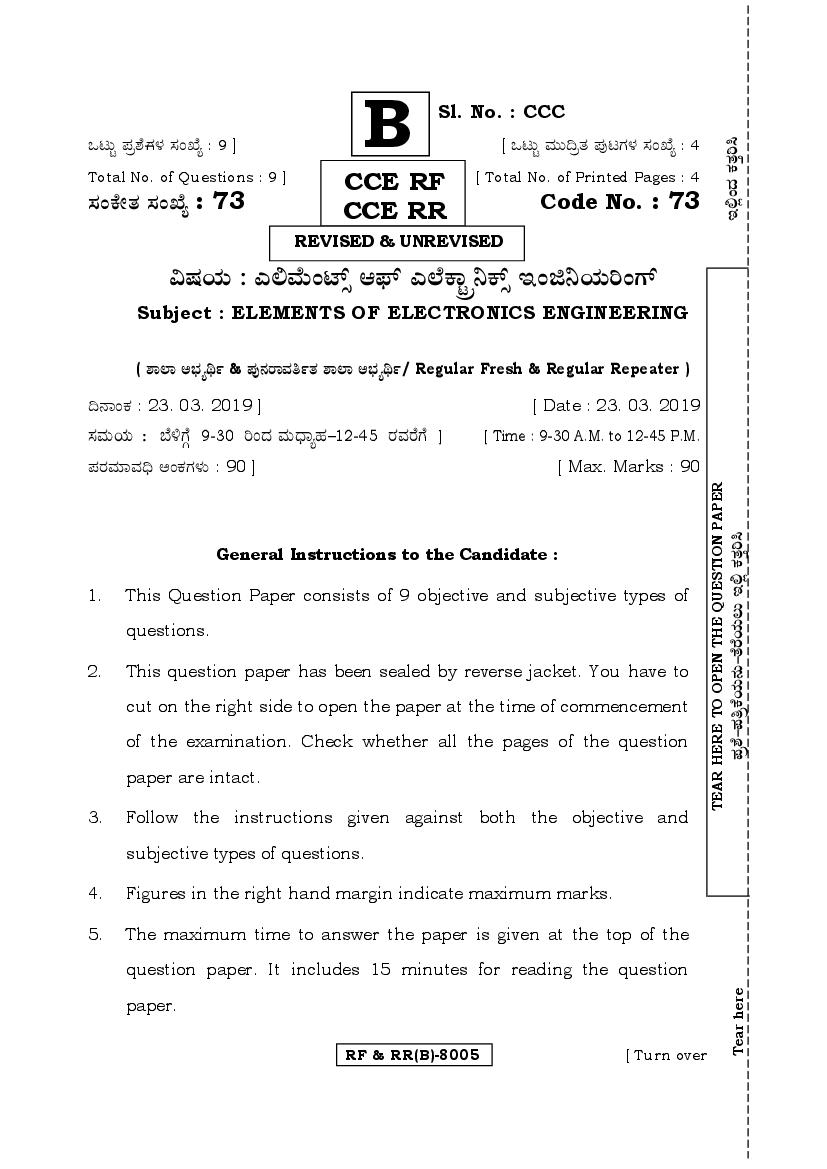
[ Jlflo »⁄flfl¶√}⁄ Æ⁄‚¥lV⁄◊⁄ —⁄MSÊ¿ : 4
BΔ«M•⁄ O⁄}⁄°¬“
Total No. of Questions : 9 ]
CCE RF [ Total No. of Printed Pages : 4
—⁄MOÊfi}⁄ —⁄MSÊ¿ : 73 CCE RR Code No. : 73
REVISED & UNREVISED
…Œ⁄æ⁄fl : GΔ»ÊflMmÈ” A±È G≈ÊO¤oÒ¨OÈ” BMf¨æ⁄fl¬MVÈ
Subject : ELEMENTS OF ELECTRONICS ENGINEERING
( À¤≈¤ @∫⁄¥¿£% & Æ⁄‚¥´⁄¡¤»⁄~%}⁄ À¤≈¤ @∫⁄¥¿£%/ Regular Fresh & Regular Repeater )
¶´¤MO⁄ : 23. 03. 2019 ] [ Date : 23. 03. 2019
—⁄»⁄flæ⁄fl : ∑ÊÿVÊX 9-30 ¬M•⁄ »⁄fl®¤¿‘⁄-12-45 ¡⁄»⁄¡ÊVÊ ] [ Time : 9-30 A.M. to 12-45 P.M.
Æ⁄¡⁄»⁄·¤»⁄© @MO⁄V⁄◊⁄fl : 90 ] [ Max. Marks : 90
TEAR HERE TO OPEN THE QUESTION PAPER
Æ⁄√ÀÊ-Æ⁄~√OÊæ⁄fl´⁄fl-}Ê¡Êæ⁄flƒfl BΔ« O⁄}⁄°¬“
General Instructions to the Candidate :
1. This Question Paper consists of 9 objective and subjective types of
questions.
2. This question paper has been sealed by reverse jacket. You have to
cut on the right side to open the paper at the time of commencement
of the examination. Check whether all the pages of the question
paper are intact.
3. Follow the instructions given against both the objective and
subjective types of questions.
4. Figures in the right hand margin indicate maximum marks.
5. The maximum time to answer the paper is given at the top of the
question paper. It includes 15 minutes for reading the question
Tear here
paper.
RF & RR(B)-8005 [ Turn over
Page 2
Note : Answer all the questions.
1. Fill in the blanks with the appropriate figure/word(s) by selecting from the
choices given in the brackets : 10 × 1 = 10
i) IC consumes ................... power.
(a) more (b) less (c) none of these.
ii) Normally ICs are made of .................. .
(a) Aluminium (b) Copper (c) Silicon.
iii) ICs are generally in the form of ................... .
(a) Flat pack (b) Triangle (c) Sphere.
iv) IC 741 is an example of .................... .
(a) MOSFET (b) Op-Amp (c) FET.
v) Op-Amp has ................ impedance.
(a) low (b) medium (c) high.
vi) Octal number system has ................... logic symbols.
(a) 8 (b) 4 (c) 6.
vii) If the inputs of NAND gate IC are 1 & 1 then its output is ............... .
(a) 1 (b) 0 (c) 2.
viii) Binary number 0111 represents .................. .
(a) 9 (b) 8 (c) 7.
ix) .................. is used to store binary word temporary.
(a) Buffer register (b) SISO register (c) SIPO register.
x) .................. is used to count number of clock pulses arrived at its
input.
(a) Inverter (b) Counter (c) Converter.
2. a) List any two active components. 2
b) Explain monolithic IC. 3
c) Draw a neat sketch to show the construction of monolithic IC. 5
3. a) Define the term SSI. 2
b) Describe how registors are fabricated in IC. 3
c) Draw a neat sketch of CRT. 5
4. a) List types of ICs based on manufacturing process. 2
b) Describe how hybrid ICs are differ from monolithic IC. 3
c) Why ICs need less power to operate and more reliable than discrete
components ? 5
5. a) What is meant by an Op-Amp ? 2
b) Explain Inverting amplifier. 3
c) Draw the block diagram of an Op-Amp and explain input stage. 5
Page 3
6. a) Name the IC which inverts input data. 2
b) Describe about universal logic gates. 3
c) Determine the values of
i) 6 – 4 by using binary subtraction method
ii) 24 + 8 by using binary addition method. 5
7. a) How many digits are used in octal number system ? 2
b) Why binary number system is most popular ? 3
c) Convert octal numbers (512)8 and (1035)8 into decimal numbers. 5
8. a) Define the term flip-flop. 2
b) Explain JK flip-flop. 3
c) Draw a neat diagram of RS flip-flop using NAND gates and explain. 5
9. a) What do you mean by microprocessor ? 2
b) Explain 8085 microprocessor. 3
c) Explain Up and Down counter. 5
RF & RR(B)-8005 [ Turn over
Page 4
Document Details
| Board / Org | Karnataka Board |
| Exam | Class 10 |
| Type | Question Paper |
| Pages | 4 |
| Updated | 30 Apr 2026 |