NBSE Class 9 Question Paper 2019 Music
Finished viewing? Save it for later —
Download NBSE Class 9 Question Paper 2019 Music (PDF · 5 pages)About NBSE Class 9 Question Paper 2019 Music
NBSE Class 9 Question Paper 2019 Music is available here for free download. Published by Nagaland Board for Class 9, this question paper can be viewed online or downloaded as a PDF (5 pages). Candidates preparing for Class 9 can use NBSE Class 9 Question Paper 2019 Music to understand the exam pattern, the type of questions asked, and the overall difficulty level.
Frequently Asked Questions
How can I download NBSE Class 9 Question Paper 2019 Music?
Open this page and click the Download button to save NBSE Class 9 Question Paper 2019 Music as a PDF. It is completely free on AglaSem Docs.
Is NBSE Class 9 Question Paper 2019 Music free to download?
Yes. NBSE Class 9 Question Paper 2019 Music can be viewed online and downloaded as a PDF free of cost on AglaSem Docs.
How many pages does NBSE Class 9 Question Paper 2019 Music have?
NBSE Class 9 Question Paper 2019 Music contains 5 pages, which you can read online or download together as a single PDF.
Where can I find more Class 9 study material?
You can find more Class 9 question papers, sample papers, syllabus, and answer keys on AglaSem Docs.
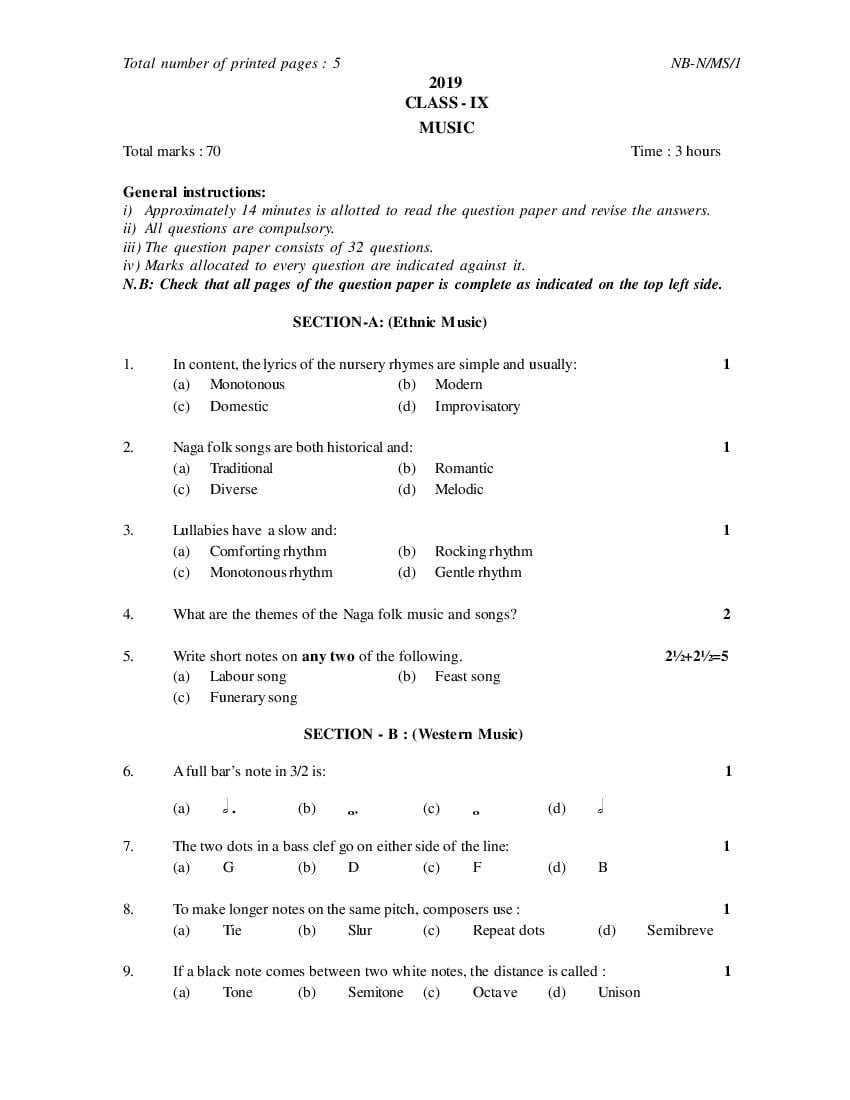
NBSE Class 9 Question Paper 2019 Music – Text
Read the full text of this question paper below — useful to quickly search, copy and reference the content online without downloading the PDF.
📄 View text version (5 pages)
Page 1
2019
CLASS - IX
MUSIC
Total marks : 70 Time : 3 hours
General instructions:
i) Approximately 14 minutes is allotted to read the question paper and revise the answers.
ii) All questions are compulsory.
iii) The question paper consists of 32 questions.
iv) Marks allocated to every question are indicated against it.
N.B: Check that all pages of the question paper is complete as indicated on the top left side.
SECTION-A: (Ethnic Music)
1. In content, the lyrics of the nursery rhymes are simple and usually: 1
(a) Monotonous (b) Modern
(c) Domestic (d) Improvisatory
2. Naga folk songs are both historical and: 1
(a) Traditional (b) Romantic
(c) Diverse (d) Melodic
3. Lullabies have a slow and: 1
(a) Comforting rhythm (b) Rocking rhythm
(c) Monotonous rhythm (d) Gentle rhythm
4. What are the themes of the Naga folk music and songs? 2
5. Write short notes on any two of the following. 2½+2½=5
(a) Labour song (b) Feast song
(c) Funerary song
SECTION - B : (Western Music)
6. A full bar’s note in 3/2 is: 1
(a) . (b) (c) (d)
7. The two dots in a bass clef go on either side of the line: 1
(a) G (b) D (c) F (d) B
8. To make longer notes on the same pitch, composers use : 1
(a) Tie (b) Slur (c) Repeat dots (d) Semibreve
9. If a black note comes between two white notes, the distance is called : 1
(a) Tone (b) Semitone (c) Octave (d) Unison
Page 2
10. Between the 1st and 2nd degree of the scale in every major and minor key, there is
always an interval of a : 1
(a) Major 2nd (b) Minor 2nd
(c) Major 3rd (d) Minor 3rd
11. The scale in which the 7th degree is raised is a : 1
(a) Natural minor scale (b) Major scale
(c) Harmonic minor scale (d) Pentatonic scale
12.
.
Which sign is sometimes used to show the end of a phrase ? 1
(a) (b) -
(c) (d) <
13. Fill the bracket with correctly grouped rests to complete the bar. 1+1=2
(a) 4
4
. { }
(b)
3 . { }
’. What is its function ?
4
14. Name the sign ‘ 1+1= 2
15. Write the key signature of the given keys. 1+1= 2
(a) G major in the treble staff
(b) Dm in the bass staff
16. Make a sequence of one measure to the given notation as directed. 1+1= 2
(a) One note higher
(b) One note lower
17. Add bar lines to agree with the time signature. 1+1= 2
(a)
(b)
18. Give the meanings of the following words :- 2
(a) Ritenuto (b) Andante
(c) Molto (d) Tenuto
Page 3
19. Identify the following scales : 2
(a)
(b)
20. Write the key signature, the tonic triad and its first inversion for the given keys
in the treble staff. 1+1=2
(a) Key of G major
(b) Key of F major
21. Write the following arpeggios using semibreves, in the treble staff going up and
then down. 1+1=2
(a) Am arpeggio
(b) Em arpeggio
22. Neatly write two more repeats of the given pattern (OSTINATO) 2
23 Answer the following rhythms: 1+1=2
(a)
(b)
24. Add the total number of crotchet beats in the given values and rests. 1+1+1=3
(a)
(b)
(c)
25. The following notes are tied unnecessarily. Write the music correctly. 1½+1½=3
(a)
(b)
Page 4
26. Transpose the tunes as directed. 1½+1½=3
(a) Down an octave
(b) Up an octave
27. Write a tune using the first five degrees of the D minor scale, in any register, on the
treble staff, to the given rhythm. Use key signature and finish on the tonic. 3
28. Work out the key of the following music. 1+1+1=3
(a)
(b)
(c)
29. Write the correct interval above each note. ½x6=3
30. Using crotchets, write a broken chord using D minor tonic triad, going down.
Use pattern of three notes each time. Finish on the first D below the stave. 3
(a)
Page 5
31. Write the following scales as directed. 1x5=5
(a) C major scale, going down and then up, using single quaver (Bass staff)
(b) E natural minor scale, going up and then down, in crotchets, without key
signature. (Treble Staff)
(c) F major scale, without key signature, going down and then up, using crotchets.
(Bass Staff)
(d) D minor scale (harmonic), going up and then down, using crotchets with key
signature. (Bass Staff)
(e) G major scale, with key signature, going up and then down, using single quaver.
(Treble Staff)
32. Look at the following music and answer the questions below: 1x5=5
(a) What is the name of the dot below the note . ? What does it mean?
(b) What is the name of the shortest rest in this composition ?
(c) How many quavers is the last note worth ?
(d) In how many bars does the rhythm ‘
’ occur ?
(e) How many counts will the rest ______ in the second last bar get ?
******************************