NBSE Class 9 Question Paper 2019 Science
Finished viewing? Save it for later —
Download NBSE Class 9 Question Paper 2019 Science (PDF · 3 pages)About NBSE Class 9 Question Paper 2019 Science
NBSE Class 9 Question Paper 2019 Science is available here for free download. Published by Nagaland Board for Class 9, this question paper can be viewed online or downloaded as a PDF (3 pages). Candidates preparing for Class 9 can use NBSE Class 9 Question Paper 2019 Science to understand the exam pattern, the type of questions asked, and the overall difficulty level.
Frequently Asked Questions
How can I download NBSE Class 9 Question Paper 2019 Science?
Open this page and click the Download button to save NBSE Class 9 Question Paper 2019 Science as a PDF. It is completely free on AglaSem Docs.
Is NBSE Class 9 Question Paper 2019 Science free to download?
Yes. NBSE Class 9 Question Paper 2019 Science can be viewed online and downloaded as a PDF free of cost on AglaSem Docs.
How many pages does NBSE Class 9 Question Paper 2019 Science have?
NBSE Class 9 Question Paper 2019 Science contains 3 pages, which you can read online or download together as a single PDF.
Where can I find more Class 9 study material?
You can find more Class 9 question papers, sample papers, syllabus, and answer keys on AglaSem Docs.
NBSE Class 9 Question Paper 2019 Science – Text
Read the full text of this question paper below — useful to quickly search, copy and reference the content online without downloading the PDF.
📄 View text version (3 pages)
Page 1
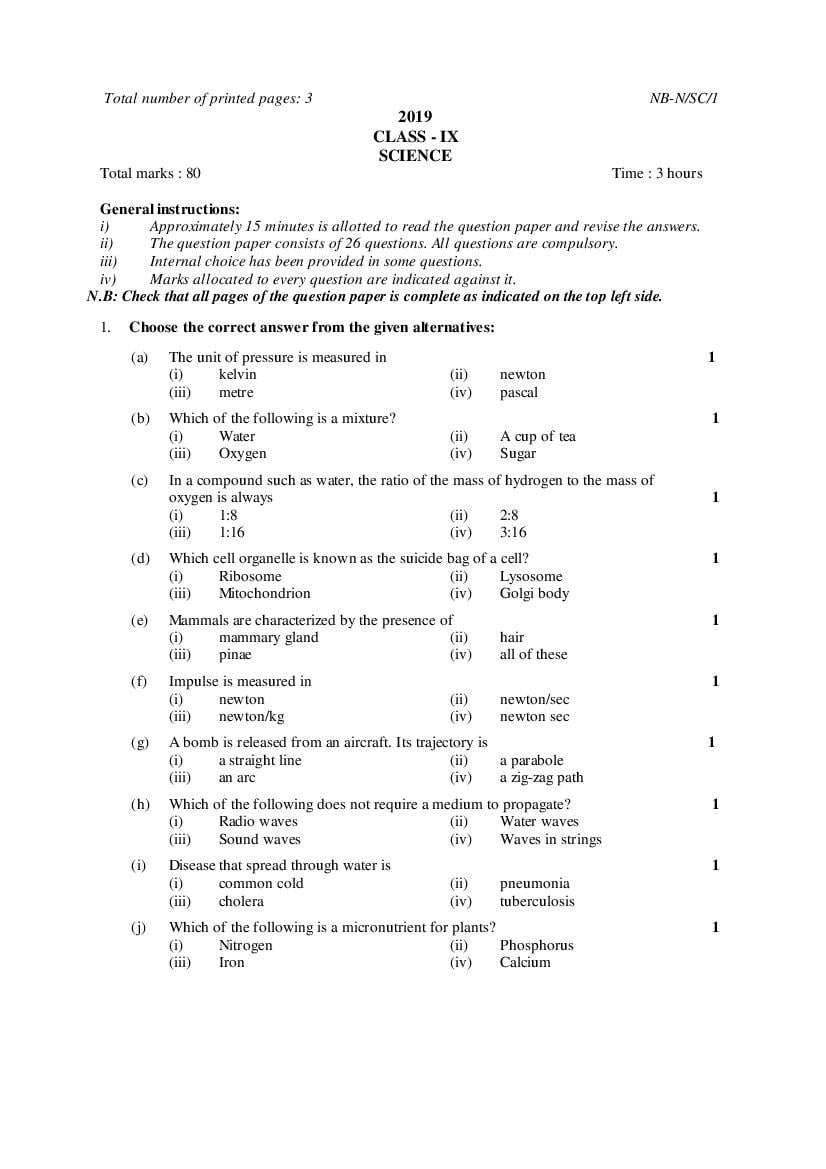
2019
CLASS - IX
SCIENCE
Total marks : 80 Time : 3 hours
General instructions:
i) Approximately 15 minutes is allotted to read the question paper and revise the answers.
ii) The question paper consists of 26 questions. All questions are compulsory.
iii) Internal choice has been provided in some questions.
iv) Marks allocated to every question are indicated against it.
N.B: Check that all pages of the question paper is complete as indicated on the top left side.
1. Choose the correct answer from the given alternatives:
(a) The unit of pressure is measured in 1
(i) kelvin (ii) newton
(iii) metre (iv) pascal
(b) Which of the following is a mixture? 1
(i) Water (ii) A cup of tea
(iii) Oxygen (iv) Sugar
(c) In a compound such as water, the ratio of the mass of hydrogen to the mass of
oxygen is always 1
(i) 1:8 (ii) 2:8
(iii) 1:16 (iv) 3:16
(d) Which cell organelle is known as the suicide bag of a cell? 1
(i) Ribosome (ii) Lysosome
(iii) Mitochondrion (iv) Golgi body
(e) Mammals are characterized by the presence of 1
(i) mammary gland (ii) hair
(iii) pinae (iv) all of these
(f) Impulse is measured in 1
(i) newton (ii) newton/sec
(iii) newton/kg (iv) newton sec
(g) A bomb is released from an aircraft. Its trajectory is 1
(i) a straight line (ii) a parabole
(iii) an arc (iv) a zig-zag path
(h) Which of the following does not require a medium to propagate? 1
(i) Radio waves (ii) Water waves
(iii) Sound waves (iv) Waves in strings
(i) Disease that spread through water is 1
(i) common cold (ii) pneumonia
(iii) cholera (iv) tuberculosis
(j) Which of the following is a micronutrient for plants? 1
(i) Nitrogen (ii) Phosphorus
(iii) Iron (iv) Calcium
Page 2
Answer the following questions in one word or one sentence:
2. What are alloys? 1
3. Name the tissue which makes up the husk of coconut. 1
4. Define work. 1
5. What is soil pollution? 1
6. What is meant by the term ‘disease’? 1
Answer the following questions in about 20-30 words:
7. Write the atomic numbers of the following elements:
(i) Oxygen (ii) Sodium 1+1=2
8. Give two roles of epidermis in plants. 2
9. An electric bulb of 60W is used for 6 hours per day. Calculate the units of energy
consumed in one day by the bulb. 2
10. State any two conditions essential for good health. 2
11. Write two factors which are responsible for loss of grain during storage. 2
Answer the following questions in about 40-60 words:
12. Write any three factors affecting evaporation. 3
13. a. What is suspension? Give two properties of suspension.
Or 1+2=3
b. Define crystallization. Write two applications of crystallization.
14. State any three points of Dalton’s Atomic Theory. 3
15. Diagrammatically show the three types of muscle fibres of human beings. 3
16. a. Write any three differences between amphibians and reptiles.
Or 3
b.Write any three differences between monocot and dicot plants.
17. Distinguish between speed and velocity. What does the odometer of an automobile
measure? 2+1=3
18. a. An object is thrown vertically upwards and rise to a height of 10m. Calculate:
(i) the velocity with which the object was thrown upwards.
(ii) the time taken by the object to reach the highest point.
Or 1½+1½=3
b. A car falls off a ledge and drops to the ground in 0.5 seconds. Find:
(i) what is its speed on striking the ground?
(ii) how high is the ledge from the ground? (Given, g=10ms−1)
Page 3
19. Define energy. Define the two forms of mechanical energy. 1+2=3
20. a. What are wavelength, frequency and amplitude of a sound wave? 3
Or
b. What is ultrasound? Write two applications of ultrasound. (1+2=3)
21. Mention any three benefits of cattle farming. 3
Answer the following questions in about 70-100 words:
22. Write three features of Rutherford’s model of an atom and its two limitations. 3+2=5
23. a. Draw the structure of a plant cell and label the following parts:
(i) cell wall (ii) mitochondrion (iii) nucleus
(iv) chloroplast (v) lysosome (vi) ribosome
Or 2+3=5
b. Draw the structure of an animal cell and label the following parts:
(i) plasma membrane (ii) cytoplasm (iii) nucleus
(iv) lysosome (v) mitochondrion (vi) golgi apparatus
24. a. State Newton’s First Law of Motion. Give reasons why :
(i) A passenger in a moving car slips to one side of the seat when the car takes a sharp
turn.
(ii) Athletes are made to fall either on a cushioned bed or a sand bed in a high jump
athletic event.
Or 1+2+2= 5
b. State Newton’s Third Law of Motion. Give reasons why:
(i) The passengers of a moving bus fall in the forward direction when the bus brakes to a
stop and fall backwards when it accelerates from rest.
(ii) It is difficult for a fireman to hold a hose, which ejects large amounts of water at high
velocity.
25. a. Explain any two modes of spread of communicable diseases and give one way to prevent each.
2½+2½=5
Or
b. Write any two most common communicable diseases among school children. Suggest any two
preventive measures for each. (1+2+2=5)
26. a. With the help of a diagrammatic representation, explain the Nitrogen cycle in nature.
Or 2+3=5
b. With the help of a diagrammatic representation, explain the Carbon cycle in nature.
**************************