ICSE Class 10 Syllabus 2022 Environmental Applications
Finished viewing? Save it for later —
Download ICSE Class 10 Syllabus 2022 Environmental Applications (PDF · 7 pages)About ICSE Class 10 Syllabus 2022 Environmental Applications
ICSE Class 10 Syllabus 2022 Environmental Applications is available here for free download. Published by CISCE for Class 10, this syllabus can be viewed online or downloaded as a PDF (7 pages). Candidates preparing for Class 10 can use ICSE Class 10 Syllabus 2022 Environmental Applications to understand the exam pattern, the type of questions asked, and the overall difficulty level.
Frequently Asked Questions
How can I download ICSE Class 10 Syllabus 2022 Environmental Applications?
Open this page and click the Download button to save ICSE Class 10 Syllabus 2022 Environmental Applications as a PDF. It is completely free on AglaSem Docs.
Is ICSE Class 10 Syllabus 2022 Environmental Applications free to download?
Yes. ICSE Class 10 Syllabus 2022 Environmental Applications can be viewed online and downloaded as a PDF free of cost on AglaSem Docs.
How many pages does ICSE Class 10 Syllabus 2022 Environmental Applications have?
ICSE Class 10 Syllabus 2022 Environmental Applications contains 7 pages, which you can read online or download together as a single PDF.
Where can I find more Class 10 study material?
You can find more Class 10 question papers, sample papers, syllabus, and answer keys on AglaSem Docs.
ICSE Class 10 Syllabus 2022 Environmental Applications – Text
Read the full text of this syllabus below — useful to quickly search, copy and reference the content online without downloading the PDF.
📄 View text version (7 pages)
Page 1
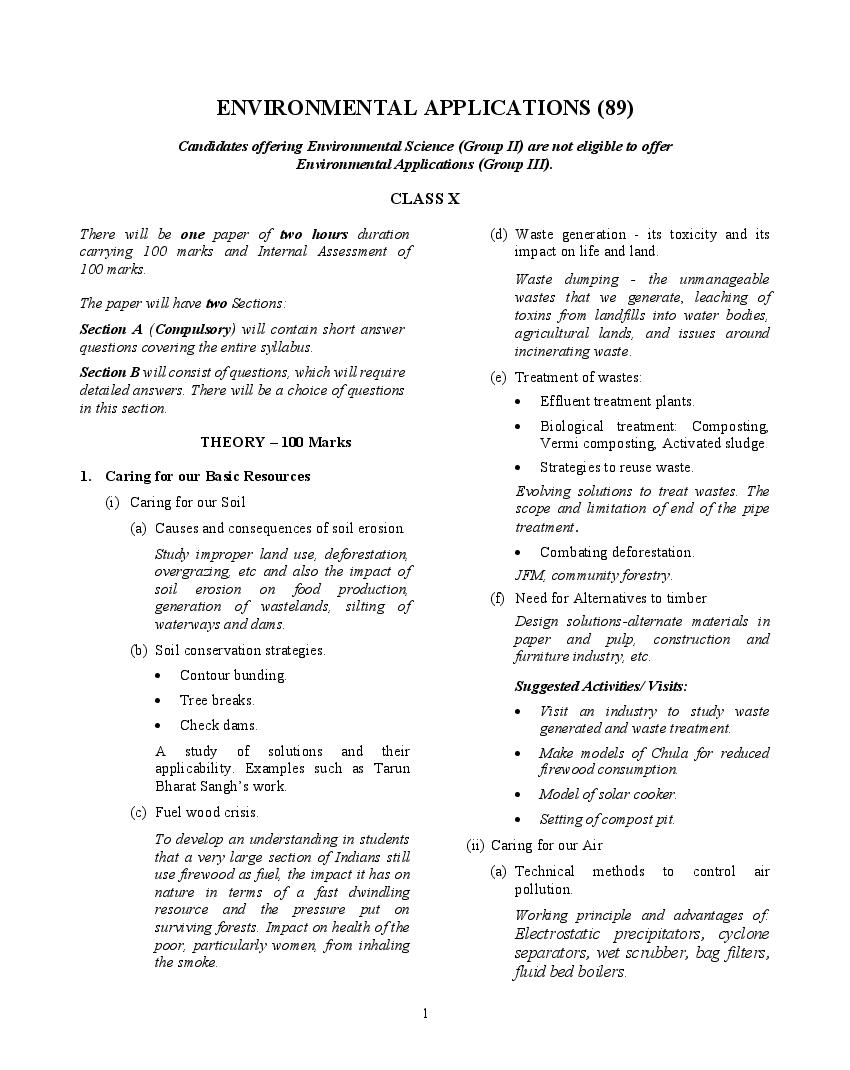
Candidates offering Environmental Science (Group II) are not eligible to offer
Environmental Applications (Group III).
CLASS X
There will be one paper of two hours duration (d) Waste generation - its toxicity and its
carrying 100 marks and Internal Assessment of impact on life and land.
100 marks.
Waste dumping - the unmanageable
The paper will have two Sections: wastes that we generate, leaching of
toxins from landfills into water bodies,
Section A (Compulsory) will contain short answer agricultural lands, and issues around
questions covering the entire syllabus. incinerating waste.
Section B will consist of questions, which will require (e) Treatment of wastes:
detailed answers. There will be a choice of questions
in this section. • Effluent treatment plants.
• Biological treatment: Composting,
THEORY – 100 Marks Vermi composting, Activated sludge.
• Strategies to reuse waste.
1. Caring for our Basic Resources
Evolving solutions to treat wastes. The
(i) Caring for our Soil scope and limitation of end of the pipe
(a) Causes and consequences of soil erosion. treatment.
Study improper land use, deforestation, • Combating deforestation.
overgrazing, etc and also the impact of JFM, community forestry.
soil erosion on food production,
(f) Need for Alternatives to timber
generation of wastelands, silting of
waterways and dams. Design solutions-alternate materials in
paper and pulp, construction and
(b) Soil conservation strategies. furniture industry, etc.
• Contour bunding.
Suggested Activities/ Visits:
• Tree breaks.
• Visit an industry to study waste
• Check dams. generated and waste treatment.
A study of solutions and their • Make models of Chula for reduced
applicability. Examples such as Tarun firewood consumption.
Bharat Sangh’s work.
• Model of solar cooker.
(c) Fuel wood crisis. • Setting of compost pit.
To develop an understanding in students (ii) Caring for our Air
that a very large section of Indians still
use firewood as fuel, the impact it has on (a) Technical methods to control air
nature in terms of a fast dwindling pollution.
resource and the pressure put on Working principle and advantages of:
surviving forests. Impact on health of the Electrostatic precipitators, cyclone
poor, particularly women, from inhaling
separators, wet scrubber, bag filters,
the smoke.
fluid bed boilers.
1
Page 2
• Economic of wetlands. Ramsar convention.
Penalties and subsidies, Bubble (b) Rainwater harvesting.
theory - definition only.
• Roof water harvesting through
• Technical percolation pits, etc.
Hybrid vehicles, alternate fuels, • Water harvesting in rural areas
alternate energy vehicles. through check dams, bunds etc.
• Traffic management.
The need for the above and the scope.
Synchronised signals, use of lanes,
one-way roads, etc. (c) Small dams versus large dams.
Study of Curitiba in Brazil (Bus An analysis - can many small dams
System). replace a large dam? Do large rivers
(c) Legislation as a means to reduce air require large dams only? (Will not be
pollution. tested, for understanding and knowledge
only.)
The role of law in controlling and
reducing pollution with examples like the Issues around large dams.
Taj Mahal trapezium, Delhi city, etc. Scope and limitation of small dams.
Note: Role of Pollution Control Board Other possibilities like Micro hydel, Mini
(PCB) and Central Pollution Control hydel, run off the river.
Board (CPCB) will not be tested. (d) Water recycling.
(d) Remote sensing satellites and their The scope of water recycling and importance.
applications.
(e) Alternatives to existing sewage treatment like
Why is it such a good tool? What can it be dry compost toilets. (Working and
used for? significance).
(e) International norms on air pollution. Use of decomposed night soil as a fertiliser.
What are EURO norms? How are they Suggested Activities / Visits
drawn? Limitations with the • Carry out rainwater harvesting in the
implementing. neighbourhood.
Example: Euro 1, Euro 2. • Visit a catchment area of the city.
Suggested Activities/ Visits: • Visit to a nearby dam.
• Visit to a pollution control board. 2. Resource use
• Interaction with an NGO working in
the field of environment. (i) Impact of globalisation on environment.
(iii) Caring for our Water Globalisation – definition.
(a) Techniques of watershed management Understanding the basic intention of
Watershed-definition and its globalisation; the possibility and challenge of
significance, Conserving water bodies; a global economy (will not be tested, for
Study of indigenous examples like the Eri understanding and knowledge only). Impact
system of Tamil Nadu or Rajasthan’s of globalisation on developing countries -
traditional systems (Johad and Kund): increased disparities, national debt and
their structure and significance. Newly recession; brain drain; impact on human
evolving modern techniques of water resources and natural resources.
2
Page 3
(NGOs) in sustaining environment.
Environment Impact Assessments (EIA), their
Study the work of NGOs - issue based, role including impacts while planning and the
women’s collectives and child welfare method to develop least cost options.
organisations. Scope of grassroot upward planning rather
Choose an international, national and a local than trickle down planning. (In context with
NGO working in different areas (will not be EIA).
tested, for understanding and knowledge (iv) Natural resource accounting.
only).
What is natural resource accounting?
(iii) Evolving a sustainable growth paradigm e.g.,
Gandhi-Large-scale development versus Suggested Activities / Visits
Village community based self-sufficient • Visit a modern power plant.
growth.
• Visit a village with traditional occupation
What does sustainability mean? like weaving, pottery, etc.
How to integrate the principle of
• Visit a Bio-gas plant.
sustainability in development?
Gandhi’s model of decentralised governance 4. Initiatives I can take
like Panchayati raj-definition and functions.
(i) In my local environment.
A study of a few working examples like Khadi,
Dastkar, Auroville, and Gandhi gram. (ii) In my future career choice.
(iv) North - South divide. (iii) In supporting initiative in my State or
Country.
Patterns of resource use in the North and the
South and the impact they have on the By the end of Class X, the student must have a
environment of both the regions. (Will not be working understanding of the broad impact
tested, for understanding and knowledge that his /her personal decisions can have on
only.) the environment and on society. The
implications of such an understanding are
Suggested Activities / Visits that:
• Visit to a Khadi production centre or • the student is responsible for choices
other such units. made.
3. Appropriate Eco-friendly Technologies • he/she is capable of mobilising responses
to things that happen into meaningful and
(i) Scope and limitation of indigenous
productive action.
technology and modern technology.
Study an industry like fishing and/or weaving • in whatever career context the student
- where both technologies are practised. (Will may function in later life, there is scope
not be tested, for understanding and for applying environmental sensitivity.
knowledge only.) • there is a clear connectedness to people
(ii) Need for developing intermediate and and a capacity to interpret processes and
appropriate technology. decisions in society and governance and
its impact on people.
Definition of Intermediate and Appropriate
technology. To be studied through the analysis This can be brought about by discussions in
of the power sector - the limitation of all class or facilitated through any other
conventional sources and the scope of empowering process.
alternate energy sources.
3
Page 4
• Chernobyl tragedy.
Students are recommended to complete two case
(iii) Caring for our Water
studies and one project from the list given below.
Suggested list of Projects/ Case studies for topics from Project
the syllabus. • Is water being wasted through the modern
1. Caring for our Basic Resources sewage disposal system in cities?
(i) Caring for our soil Case Studies
Projects • Water shortage in Kerala and Chirapunji.
• Rajasthan's water conservation systems.
• How can a society produce less waste?
• Salt water intrusion.
• Examine the problem of plastic.
• Ground water depletion.
• Setting up a safe plastic disposal system
in a city. • Contamination of surface water.
• What are toxic wastes? • Laws relating to rain water harvesting in
cities.
• Should oceans act as waste dumps?
• The politics of water sharing like the
Case Studies
Cauvery issue.
• Tarun Bharat Sangh's work in Alwar. • Narmada issue.
• Case study of Anna Hazare's work in • The Tehri dam issue.
Ralegoan Siddhi.
• The three gorges project in China.
• Auroville's afforestation effort.
2. Resource Use
• Environmental effects of mining, brick
industry. Projects
• Use of resources in a city. Compare with • Assess the impact of any movement related to
the resources used in a rural community. displacements or violations.
• India’s growing population problem - a • Look at Governmental and Non-
critical analysis. Governmental supports to promote local
(ii) Caring for our Air initiative in the area of sustainable growth.
Projects Case Studies
• Monitor pollution in busy traffic places. • Reports by NGOs on Globalisation
impacts.
• Role of vehicles in causing respiratory
health problems. • Captive minds captive lives – Vandana
Shiva.
• Is better public transport an answer to
reducing air pollution in cities? • The unseen worker – National
Foundation of India.
Case Studies
• Excerpts from E.F. Schumacher’s work
• Generating power through burning “small is Beautiful”.
garbage - is it a good way of dealing with
• Voluntary action and Gandhian approach
garbage?
– D.K. Oza.
• Medical waste disposal through
• J.C. Kumarappa’s writing.
incineration - is there an option?
• Gandhi’s writings.
• Can pollution be reduced by better city
planning [one way lanes, synchronized
signals etc].
4
Page 5
Projects include appropriate choice and use of secondary
data.
• Can Non-conventional sources meet the
growing demand for power? 5. Collating data and generating solutions
Case Studies This phase after the gathering of the data is one of
stock taking i.e. putting together of information.
• Dr. A.K.N. Reddy’s work in creating a The data is then analysed and the solutions
network of villages in Tumkur district based generated. The initial project report is put
on appropriate technologies. together.
• MNES publications. Criteria of evaluation for this stage will therefore
include sifting and organisation of relevant data,
Guidelines for evaluating Project Work complexity of analysis in terms of number and
relevance of parameter chosen and feasibility and
The project has to be evaluated for the efficacy of the
following steps: innovation of solutions generated.
6. Project Report
1. Coming up with a clear question or problem
statement, which will be the basis of the student’s The research the student does is submitted as a
project research. This is critical because without project report comprising of the following:
a clear question the research tends to be broad and i. Statement of the topic, issue or problem being
unfocussed, with the student tending to gather studied / researched.
whatever information is available rather what they ii. Statement of the action plan.
need to have. iii. Presentation of data using different methods
Criteria of evaluation for this stage will therefore such as bar charts/ pie diagram etc. A clear
include definition in terms of the focus and clarity distinction has to be made between primary
of the question. and secondary data.
2. Formulating an action plan, which states the steps iv. Analysis of data.
to be taken to move the question forward. v. Solutions offered.
Criteria of evaluation for this stage will include vi. Personal learning for the student.
how pragmatically the plan takes the question
forward. vii. Bibliography and acknowledging resource
persons.
3. Gathering primary data
Criteria of evaluation for this stage will therefore
50% - 70% of information gathered needs to be include readability, precision, neatness and
primary data i.e., data gathered by the student by indexing.
going into the field.
Therefore, the evaluation is on-line and does not
This may involve evolving a questionnaire for base itself entirely on the project report.
social issues and formats for ecology related
projects. Sample size and type have to be adequate 7. VIVA-VOCE (Optional)
and scrutinized carefully. A viva may be conducted with the subject teacher
Criteria of evaluation for this stage will therefore and an External Examiner who could be another
be based on quantum of fieldwork and efficacy of teacher from the school itself or an experienced
sampling. person from the environmental field, preferably a
4. Secondary data researcher.
Secondary data from books, Internet and other The purpose of the viva is to give the student an
publications is used only as a basis to substantiate, opportunity to converse with an expert in the field
analyse and to construct an argument. regarding his / her project. This would help to
deepen the learning for the students and help them
understand the lacunae in their thinking and
process.
5
Page 6
Case studies unlike projects are not based on primary The assignments/project work is to be evaluated by the
data but entirely on secondary data mostly about a subject teacher and by an External Examiner. The
particular event or case. External Examiner may be a teacher nominated by the
The student presents it as a report about 1500 words Head of the school, who could be from the faculty, but
long. It may be evaluated for: not teaching the subject in the section/class.
• Comprehensiveness; The Internal Examiner and the External Examiner will
assess the assignments independently.
• Accuracy;
• Range of sources; Award of Marks (100 Marks)
• Inferences drawn; Subject Teacher (Internal Examiner) 50 marks
• Connections made; External Examiner 50 marks
• Perspective gained, etc. The total marks obtained out of 100 are to be sent to
the Council by the Head of the school.
Marks may be awarded on the following break up: The Head of the school will be responsible for the
Project - 30 online entry of marks on the Council’s CAREERS
Case studies - 20 portal by the due date.
Total - 50
6
Page 7
Criteria Preparation Investigation/Gathering Data Analysis/Inference Solutions Alternatives/ Presentation
Innovations
Grade I Follows instructions with Is able to ask correct questions. Analyses systematically. Can Innovative ideas Accurate. Feasible, neat,
(4 marks) understanding; modifies if Knows whom to ask, when and how. see sequences or correlation. presented. Alternatives well labelled diagrams.
needed. Background Can deal with more than one variable. Can segregate fact from opinion. suggested. Index and references
information correct. Level given.
of awareness high.
Grade II Follows instructions step- Is able to ask questions and identify Makes observations correctly. Alternatives presented. Accurate. Neat, well
(3 marks) by-step. Awareness is whom to ask, when and how. Can Analysis fair. Innovative but not labelled diagrams. Index
good. Background handle two variables only. practical. and references given.
information correct.
Grade III Follows simple instructions Needs help with the investigations. Observation - help needed. Obvious solutions A bit disorganised, but
(2 marks) only. Awareness basic. Has suggestions but cannot decide. Needs guidance to see presented. Not neat and accurate. Either
Background information correlations or sequence. innovative. index or references
sketchy. missing.
Grade IV Follows some instructions Needs to be told what questions to be Detailed instructions required to Thinks of solutions under Poorly organised. Some
(1 mark) but confused. Has to be asked, whom to ask or where to gather draw inferences. Charts have to guidance. points missing. Index and
made aware. Background the data from. be made. references missing.
information incorrect in
places.
Grade V Confused about Gets stuck at every step. Even with help, analysis is not Solutions not Overall impression very
(0 mark) instructions. Has to be Questionnaire has to be formulated. clear. Takes teacher’s word for forthcoming. poor. Not very accurate.
made aware. Needs help it.
with background
information.
7
Document Details
| Board / Org | CISCE |
| Exam | Class 10 |
| Type | Syllabus |
| Pages | 7 |
| Language | english |
| Updated | 22 Jul 2026 |