ICSE Class 10 Syllabus 2022 Home Science
Finished viewing? Save it for later —
Download ICSE Class 10 Syllabus 2022 Home Science (PDF · 4 pages)About ICSE Class 10 Syllabus 2022 Home Science
ICSE Class 10 Syllabus 2022 Home Science is available here for free download. Published by CISCE for Class 10, this syllabus can be viewed online or downloaded as a PDF (4 pages). Candidates preparing for Class 10 can use ICSE Class 10 Syllabus 2022 Home Science to understand the exam pattern, the type of questions asked, and the overall difficulty level.
Frequently Asked Questions
How can I download ICSE Class 10 Syllabus 2022 Home Science?
Open this page and click the Download button to save ICSE Class 10 Syllabus 2022 Home Science as a PDF. It is completely free on AglaSem Docs.
Is ICSE Class 10 Syllabus 2022 Home Science free to download?
Yes. ICSE Class 10 Syllabus 2022 Home Science can be viewed online and downloaded as a PDF free of cost on AglaSem Docs.
How many pages does ICSE Class 10 Syllabus 2022 Home Science have?
ICSE Class 10 Syllabus 2022 Home Science contains 4 pages, which you can read online or download together as a single PDF.
Where can I find more Class 10 study material?
You can find more Class 10 question papers, sample papers, syllabus, and answer keys on AglaSem Docs.
ICSE Class 10 Syllabus 2022 Home Science – Text
Read the full text of this syllabus below — useful to quickly search, copy and reference the content online without downloading the PDF.
📄 View text version (4 pages)
Page 1
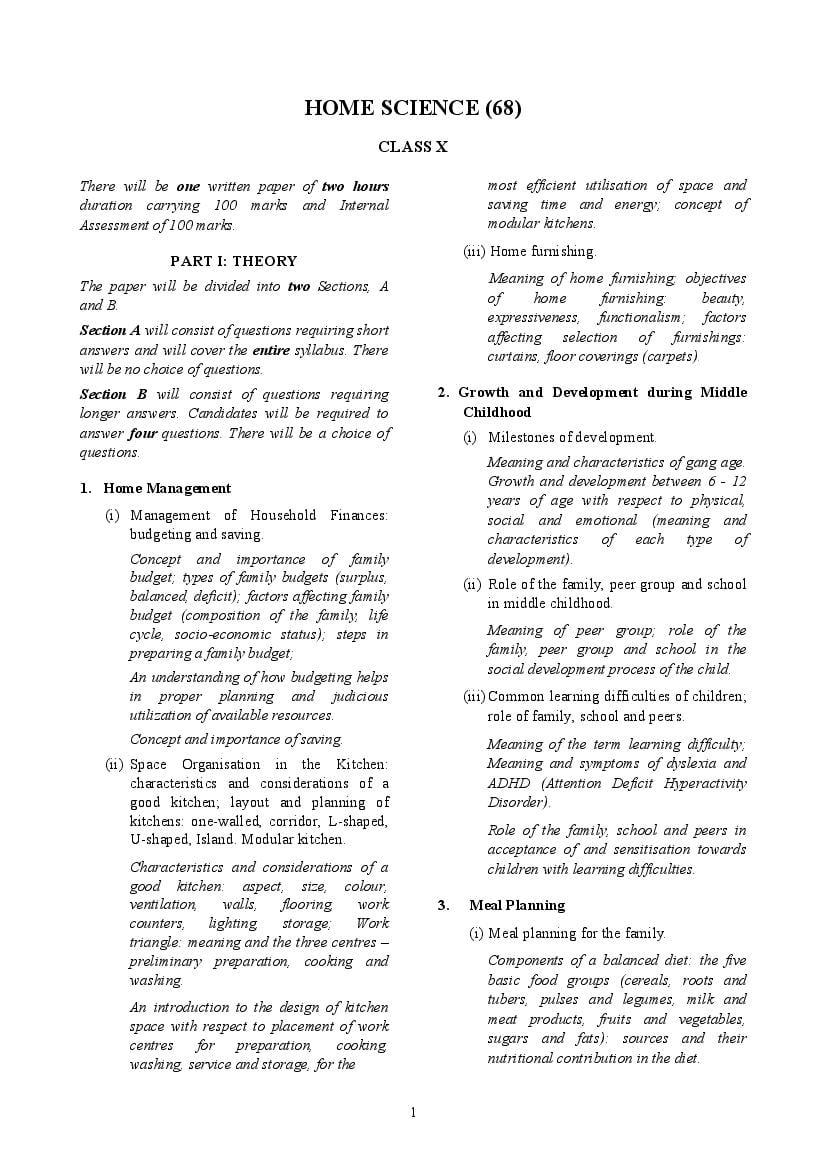
CLASS X
There will be one written paper of two hours most efficient utilisation of space and
duration carrying 100 marks and Internal saving time and energy; concept of
Assessment of 100 marks. modular kitchens.
(iii) Home furnishing.
PART I: THEORY
The paper will be divided into two Sections, A Meaning of home furnishing; objectives
and B. of home furnishing: beauty,
expressiveness, functionalism; factors
Section A will consist of questions requiring short affecting selection of furnishings:
answers and will cover the entire syllabus. There curtains, floor coverings (carpets).
will be no choice of questions.
Section B will consist of questions requiring 2. Growth and Development during Middle
longer answers. Candidates will be required to Childhood
answer four questions. There will be a choice of (i) Milestones of development.
questions.
Meaning and characteristics of gang age.
1. Home Management Growth and development between 6 - 12
years of age with respect to physical,
(i) Management of Household Finances: social and emotional (meaning and
budgeting and saving. characteristics of each type of
Concept and importance of family development).
budget; types of family budgets (surplus, (ii) Role of the family, peer group and school
balanced, deficit); factors affecting family in middle childhood.
budget (composition of the family, life
cycle, socio-economic status); steps in Meaning of peer group; role of the
preparing a family budget; family, peer group and school in the
social development process of the child.
An understanding of how budgeting helps
in proper planning and judicious (iii) Common learning difficulties of children;
utilization of available resources. role of family, school and peers.
Concept and importance of saving. Meaning of the term learning difficulty;
(ii) Space Organisation in the Kitchen: Meaning and symptoms of dyslexia and
characteristics and considerations of a ADHD (Attention Deficit Hyperactivity
good kitchen; layout and planning of Disorder).
kitchens: one-walled, corridor, L-shaped,
Role of the family, school and peers in
U-shaped, Island. Modular kitchen.
acceptance of and sensitisation towards
Characteristics and considerations of a children with learning difficulties.
good kitchen: aspect, size, colour,
ventilation, walls, flooring, work 3. Meal Planning
counters, lighting, storage; Work
(i) Meal planning for the family.
triangle: meaning and the three centres –
preliminary preparation, cooking and Components of a balanced diet: the five
washing. basic food groups (cereals, roots and
tubers, pulses and legumes, milk and
An introduction to the design of kitchen
space with respect to placement of work meat products, fruits and vegetables,
centres for preparation, cooking, sugars and fats): sources and their
washing, service and storage, for the nutritional contribution in the diet.
1
Page 2
principles, importance and factors communication aids for addressing
affecting meal planning. various social concerns.
(ii) Hygienic handling and storage of food - PART II
household methods of preservation of
INTERNAL ASSESSMENT: 100 MARKS
food.
Definition of the term food hygiene; To be assessed internally by the school.
Hygienic handling of food during PRACTICAL WORK
purchase, storage, preparation and
Candidates will be required to practice one or
serving. Importance of personal hygiene
while handling food. Sanitation and more aspects of Home Management, Human
safety in kitchen. Development, Foods and Nutrition, Textiles and
Communication & Extension, covered in the
Meaning and examples of perishable, syllabus. They may also undertake practical work
semi-perishable and non-perishable food on any of the topics suggested below. The teacher
items: Storage of perishable, semi- is free to assess the practical work either on the
perishable and non-perishable food items basis of continuous assessment or on the basis of
commonly available at home; use of periodical tests.
convenience foods- advantages and
disadvantages. The minimum number of assignments for each
Definition of food preservation; academic year:
household methods of food preservation: Class X - Four practical oriented assignments as
sun drying, freezing, pickling, use of salt, prescribed by the teacher.
sugar, spices, oil and chemical
preservatives. SUGGESTED ASSIGNMENTS
Foods and Nutrition
4. Selection and care of Textiles and Clothing
• Identification of pulses, cereals and spices.
Laundering of Clothes
• Identification of serving and cooking
Household methods of laundering of cotton, equipment.
silk, wool and synthetics (step wise), use of
detergents, soaps, starch, blue and optical • Preparation of nutritious snacks using
brighteners. different methods of cooking.
• Demonstration of various cuts of vegetables
5. Communication & Extension and fruits such as slice, chop, dice, mince,
(i) Understanding terminology related to juliennes to make easy salads.
development, some developmental • Preparation of food using simple cooking
schemes and programmes in India. techniques such as boiling, frying, steaming,
Meaning of the following terms: grilling, baking, stewing.
Gender discrimination, women’s • Visiting a food processing unit and
empowerment, child labour, human preparation of a report on the same
trafficking, child abuse, female
• Identification and collection of samples of ten
infanticide/foeticide, carbon footprint,
endangered species. herbs/ spices/condiments available in the
kitchen for treating common ailments.
A brief understanding, significance and Preparation of a report on the same.
target group of each of the following:
• Listing foods eaten on any one day and
− Ayushman Bharat or Pradhan Mantri classifying them into food groups. Analysing
Jan Arogya Yojana; them on the basis of nutrient content and
− Ujjwala Yojna; appearance.
− Pradhanmantri Jan Dhan Yojna. • Food preservation: making chutneys, pickles
and jam.
(ii) Communication aids.
• Demonstration of various innovative table
Meaning and uses of communication aids;
layouts, napkin folding and creative
Poster, brochure, pamphlets, puppet
decorations.
2
Page 3
• Collecting ten play materials and evaluating • Designing a leaflet or a pamphlet to create
them in terms of their merits and demerits. awareness regarding consumer
rights/responsibilities.
• Observing a group of junior/middle school
children during the lunch break and recording • Collecting information about global
observations with respect to the language environmental issues and problems and
used, choice of friends, games played, etc. communicating the information through
appropriate modes of communication such as
• Visiting a day-care centre and observing the posters, charts, collages, cartoons, handouts,
activities of the children. Making a record of letters, street plays, etc. to all concerned.
the observations.
• Identifying low cost, environmentally friendly
• Visiting a special school and recording alternatives in order to deal with the scarcity
observations made on any one child with of resources such as fuels in the locality.
special needs.
FINAL TEST
Textiles and Clothing
In addition to the course work, the candidate will
• Collecting samples of fabrics and comparing be tested in one or more aspects of Home Science
them on the basis of cost, durability, by the External Examiner.
appearance and suitability.
• Identification of fibres-cotton, wool, silk and EVALUATION
synthetics by the burning test.
The assignments/project works are to be
• Planning the interiors of a home through evaluated by the subject teacher and by an
choice of colours and furnishing materials of External Examiner. The External Examiner may
the bedroom, living room and dining room. be a teacher nominated by the Head of the school,
• Care of Clothing; Laundering of cotton, silk who could be from the faculty, but not teaching
and wool. the subject in the section/class. For example, a
teacher of Home Science of Class XI may be
Resource Management deputed to be an External Examiner for Class X,
• Planning a system for recycling of waste Home Science projects.
produced by the school/home. The Internal Examiner and the External Examiner
• Preparation of compost pits. will assess the assignments independently.
• Gardening: planting of herbs and medicinal Award of Marks (100 Marks)
plants and taking care of them.
• Preparing a layout of the plan of the Home Subject Teacher (Internal Examiner) 50 marks
Science laboratory with complete detailing of External Examiner 50 marks
work centres, storage areas and placement of
heavy and light equipment. The total marks obtained out of 100 are to be sent
• Cleaning of glass panes, grills, sink (steel and to the Council by the Head of the school.
ceramic), counter tops (marble, granite and The Head of the school will be responsible for the
sand stones) and wooden shelves and online entry of marks on the Council’s CAREERS
electrical appliances like refrigerator, oven portal by the due date.
and cooking stove (any five to be done.)
• Preparing a family budget based on the
information received from parents.
3
Page 4
Criteria Planning Efficiency Working to time plan Manipulation Quality produced Appearance/Arrangement Marks
Grade I Follows the question set Is successful in handling Excellent display of With a special insight into A fine aesthetic sense and artistic 4 marks for
and systematically parts of the question set manipulative skills - can the question, the quality ability conveyed in the complete each
organises the work and fits them within deal with a laboratory developed is of a high arrangement. criterion
process. required time. situation efficiently. standard.
Grade II Follows the question set Is successful in handling Good control of The insight into the The display of colour and equipment 3 marks for
except that the step by parts of the question, but manipulative skills. Has requirements of the question used gives an impression of sound each
step work shows slow the smooth work appears been able to deal with each has been achieved and the organisation. criterion
operational skill. to slow down. situation with ease. quality is good.
Grade III Follows the question. Is successful in handling Has been successful with The quality has been The arrangement appears complete but 2 marks for
Order of work process the question, however the the manipulative skills in produced in part but the some special details missing. each
shows lack of co- time link seems to break in parts, then gradually slows overall lacks some criterion
ordination. some area. down. achievement.
Grade IV Follows a part of the Is able to work only a part Begins with a control of the Only few areas of quality Part of the arrangement is represented 1 mark for
question, work of the question within the skills and is unable to are visible, which affect the but the total appearance lacks finish each
sequence appears time stated and then seems sustain the effort. total result produced. and composition. criterion
disorganised. confused.
Grade V Has not been able to Time and work sequence is Is unable to control and No standard of quality has There has been no achievement in 0 marks for
interpret the question most disorganised. manipulate the required been achieved due to poor either the appearance or arrangement. each
into proper laboratory skills. understanding. criterion
organisation.
4
Document Details
| Board / Org | CISCE |
| Exam | Class 10 |
| Type | Syllabus |
| Pages | 4 |
| Language | english |
| Updated | 22 Jul 2026 |