CBSE Class 12 Knowledge Traditions and Practices of India Question Paper 2020
Finished viewing? Save it for later —
Download CBSE Class 12 Knowledge Traditions and Practices of India Question Paper 2020 (PDF · 15 pages)About CBSE Class 12 Knowledge Traditions and Practices of India Question Paper 2020
CBSE Class 12 Knowledge Traditions and Practices of India Question Paper 2020 is available here for free download. Published by CBSE for Class 12, this question paper can be viewed online or downloaded as a PDF (15 pages). Candidates preparing for Class 12 can use CBSE Class 12 Knowledge Traditions and Practices of India Question Paper 2020 to understand the exam pattern, the type of questions asked, and the overall difficulty level.
Frequently Asked Questions
How can I download CBSE Class 12 Knowledge Traditions and Practices of India Question Paper 2020?
Open this page and click the Download button to save CBSE Class 12 Knowledge Traditions and Practices of India Question Paper 2020 as a PDF. It is completely free on AglaSem Docs.
Is CBSE Class 12 Knowledge Traditions and Practices of India Question Paper 2020 free to download?
Yes. CBSE Class 12 Knowledge Traditions and Practices of India Question Paper 2020 can be viewed online and downloaded as a PDF free of cost on AglaSem Docs.
How many pages does CBSE Class 12 Knowledge Traditions and Practices of India Question Paper 2020 have?
CBSE Class 12 Knowledge Traditions and Practices of India Question Paper 2020 contains 15 pages, which you can read online or download together as a single PDF.
Where can I find more Class 12 study material?
You can find more Class 12 question papers, sample papers, syllabus, and answer keys on AglaSem Docs.
CBSE Class 12 Knowledge Traditions and Practices of India Question Paper 2020 – Text
Read the full text of this question paper below — useful to quickly search, copy and reference the content online without downloading the PDF.
📄 View text version (15 pages)
Page 1
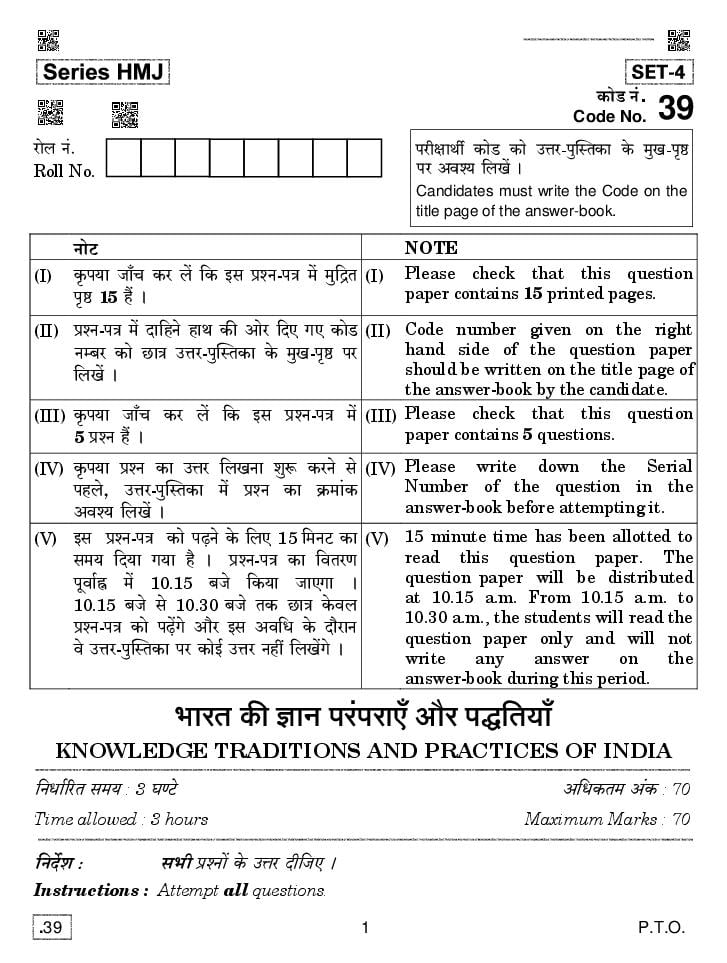
Code No. 39
amob Z§. narjmWu H$moS >H$mo CÎma-nwpñVH$m Ho$ _wI-n¥ð
Roll No. >na Adí` {bIo§ &
Candidates must write the Code on the
title page of the answer-book.
ZmoQ> NOTE
(I) H¥$n`m Om±M H$a b| {H$ Bg àíZ-nÌ _o§ _w{ÐV (I) Please check that this question
n¥ð> 15 h¢ & paper contains 15 printed pages.
(II) àíZ-nÌ _| Xm{hZo hmW H$s Amoa {XE JE H$moS (II) Code number given on the right
>Zå~a H$mo N>mÌ CÎma-nwpñVH$m Ho$ _wI-n¥ð> na hand side of the question paper
{bI| & should be written on the title page of
the answer-book by the candidate.
(III) H¥$n`m Om±M H$a b| {H$ Bg àíZ-nÌ _| (III) Please check that this question
>5 àíZ h¢ & paper contains 5 questions.
(IV) H¥$n`m àíZ H$m CÎma {bIZm ewê$ H$aZo go (IV) Please write down the Serial
nhbo, CÎma-nwpñVH$m _| àíZ H$m H«$_m§H$ Number of the question in the
Adí` {bI| & answer-book before attempting it.
(V) Bg àíZ-nÌ H$mo n‹T>Zo Ho$ {bE 15 {_ZQ >H$m (V) 15 minute time has been allotted to
g_` {X`m J`m h¡ & àíZ-nÌ H$m {dVaU read this question paper. The
nydm©• _| 10.15 ~Oo {H$`m OmEJm & question paper will be distributed
10.15 ~Oo go 10.30 ~Oo VH$ N>mÌ Ho$db at 10.15 a.m. From 10.15 a.m. to
10.30 a.m., the students will read the
àíZ-nÌ H$mo n‹T>|Jo Am¡a Bg Ad{Y Ho$ Xm¡amZ question paper only and will not
do CÎma-nwpñVH$m na H$moB© CÎma Zht {bI|Jo & write any answer on the
answer-book during this period.
^maV H$s kmZ na§namE± Am¡a nÕ{V`m±
KNOWLEDGE TRADITIONS AND PRACTICES OF INDIA
{ZYm©[aV g_` : 3 KÊQ>o A{YH$V_ A§H$ : 70
Time allowed : 3 hours Maximum Marks : 70
{ZX}e : g^r àíZm| Ho$ CÎma Xr{OE &
Instructions : Attempt all questions.
.39 1 P.T.O.
Page 2
(nR>Z H$m¡eb) 20 A§H$
1. (H$) {ZåZ{b{IV AZwÀN>oX H$mo n{‹T>E Am¡a {XE JE n«íZm| Ho$ CÎma Xr{OE : 10
H¥${f H$m`© Ho$ {bE àm`: qgMmB© H$s Hw$N> VH$ZrH$ H$s Amdí`H$Vm hmoVr h¡ & Zham|, N>moQ>o
M¡Zbm| (Ob_mJm]) `m J«m_m| Ho$ Vmbm~mo§ O¡go gamodam| H$m YÝ`dmX {H$ nyU©V: `m A§eV:
qg{MV H¥${f H$s OmVr ahr & `o gamoda Ob g§ajU Ho$ H$m_ ^r AmVo Wo {Oggo ewîH$
_m¡g_m| `m b§~r Ad{Y dmbo gyIo H$m gm_Zm {H$`m Om gHo$ & Bgr àH$ma {H$gmZ `h ^r
OmZVo Wo {H$ µ\$gb nH$Vo g_` ñdñW ~rO H$s nhMmZ H¡$go H$s OmVr h¡ & AÀN>o ~rO
H$m _hÎd Bggo ñnï> g_Pm Om gH$Vm h¡ {H$ Zr{VH$ma _Zw Zo ~rOm| _| {_bmdQ> H$aZo
dmbo Ho$ {bE H$R>moa X§S> H$s g§ñVw{V H$s h¡ & N>moQ>r Š`m[a`m| _o| YmZ H$mo ~moH$a N>moQ>o nm¡Ym|
H$mo ~‹S>o IoVm| _| amonZo H$s H$bm ^r ZdrZ Zht h¡ & nhbr eVmãXr _| `h H¥$îUm Am¡a
JmoXmdar Z{X`m| Ho$ S>oëQ>mAm| _| nyU© H$s JB© Wr &
d¡{XH$ g_` go hr newAm| Ho$ ñdm{_Ëd H$m AW© g§n{Îm Wm & G$½doX newYZ Am¡ a CgHo$
à~ÝYZ Ho$ g§X^m] go ^am h¡ & MaVo hþE new, ñdÀN> Obme`m| go CZHo$ {bE nmZr H$s
ì`dñWm, hao Mmao Am¡a new ~m‹S>m| Ho$ g§X^© nmE Om gH$Vo h¢ & ~mX _| newAm| Ho$ N>ßna
~ZmE OmZo bJo Am¡a CZH$s ñdÀN>Vm na ~b {X`m J`m & Jm`m| H$mo n{dÌ _mZm J`m
O~{H$ ~m¡Õ Am¡a O¡Z Y_© Zo new hË`m {ZfoY H$mo àmoËgm{hV {H$`m & AW©emñÌ _| AÝ`
nXm{YH$m[a`m| Ho$ gmW ‘new AYrjH$’ nX H$m C„oI h¡ Omo Xoe _| newYZ H$m n`©dojU
H$aVm, CZH$s JUZm H$a CZH$s C{MV XoI^mb gw{ZpíMV H$aVm Wm & newYZ H$m dJuH$aU
Bg àH$ma {H$`m J`m — gYo hþE nmbVy, hb ItMZo dmbo ~¡b, hb MbmZo `mo½` ~ZmZo
Ho$ {bE à{e{jV {H$E OmZo dmbo gm±S>, g§dY©Z ~¡b, _m§g Ho$ {bE nmbm OmZo dmbm
newYZ, XþYmê$ Jm`, ~m±P new (Jm` `m ^¢g), VWm Xmo _hrZo VH$ H$s C_« Ho$ ~N>‹S>o &
AW©emñÌ {dñV¥V MMm© H$aVm h¡ {H$ {H$gr gm±S>, Jm` `m ^¢g Ho$ {bE {H$VZm Mmam {X`m
OmZm Mm{hE & Jm±dm| Ho$ Amgnmg MamJmh Ho$ aIaImd H$mo àmoËgm{hV {H$`m J`m &
H¥${f bmoH${à` g§ñH¥${V H$m A{^Þ A§J Wr Am¡a Bggo new _obm|, _do{e`m| Ho$ _obm|,
CËgdm| VWm Ym{_©H$ AZwð>mZm| _| d¥{Õ hþB© & Eogo CËgdm| Zo Z Ho$db ñWmZr` bmoJm| H$mo
gwJ{R>V aIZo _| ghm`Vm H$s ~pëH$ amï´>r` EH$Vm H$mo ^r ~‹T>mdm {X`m &
Cn`w©º$ AdVaU Ho$ gå~ÝY _| {ZåZ{b{IV àíZmo| Ho$ CÎma Xr{OE :
(i) qgMmB© H$s VH$ZrH$m| Am¡a Ob g§ajU H$s H$bm na {dMma H$s{OE & Š`m AmO
H$s H¥${f àUm{b`m| _| BZH$s H$moB© àmg§{JH$Vm h¡ ? 4
(ii) àmMrZH$mb _| newYZ Ho$ _hÎd Am¡a CgHo$ à~§YZ H$mo ñnï> H$s{OE & 4
(iii) _obmo| Am¡a new _obm| H$mo Am`mo{OV H$aZo Ho$ Š`m bm^ h¢ ? 2
.39 2
Page 3
(Reading Skills) 20 Marks
1. (a) Read the passage given below and answer the questions that follow : 10
Agricultural practices often involve some technique of irrigation.
Wholly or partly irrigated crops were raised thanks to canals, smaller
channels or reservoirs such as village tanks. Reservoirs also served the
purpose of water harvesting to cope with the dry seasons or prolonged
droughts. Similarly farmers knew how to select healthy seed from a
ripening crop. The importance of good seed was so clearly recognized
that the law-giver Manu recommended severe punishment for the
adulteration of seed. The art of sowing rice seed in small areas, i.e., in
nurseries, and transplanting the seedlings is not a recent practice. It
was first perfected in the deltas of Godavari and Krishna rivers in the
1st century CE.
Since Vedic times, owning cattle meant possessing wealth. The
Rgveda
. is replete with references to cattle and their management.
References can be found to grazing of livestock, provision of water from
clean ponds and succulent green fodder, and livestock barns. Later,
cattle sheds were constructed and cleanliness of the shed was
emphasized. Cows came to be regarded as sacred, while Buddhism and
Jainism promoted non-killing of all animals. Among other officers, the
Arthaśāstra notes the ‘Superintendent of cattle’, who supervised
livestock in the country, kept a census of livestock and ensured their
proper rearing. Livestock was classified as tame steers, draft oxen,
bulls to be trained to yoke, stud bulls, livestock reared for meat,
buffaloes and draft buffaloes, female calves, heifers, pregnant cows,
milking cows, barren livestock (either cows or buffaloes), and calves up
to two months old. The Arthaśāstra gives an elaborate description of
the rations that a bull, cow or buffalo should be supplied with.
Maintenance of pastures around villages was encouraged.
Agriculture was an integral part of popular culture and gave rise to
annual fairs, cattle melas, festivals and rituals, all of which were
occasions for celebration. Such festivals not only helped to bond local
communities together, but have promoted national integration.
Answer the following questions in relation to the above passage :
(i) Consider the importance of irrigational techniques and the art of
saving the water. Do they have any relevance in today’s
agricultural systems ? 4
(ii) Highlight the significance of cattle and their management in
ancient times. 4
(iii) What were the benefits of holding fairs and cattle melas ? 2
.39 3 P.T.O.
Page 4
^maVr` g_mO g~go àmMrZ g_mOm| _o§ h¡ Omo {Za§Va ApñVËd _| ahm Am¡a _moQ>o Vm¡a na
Cgr àmMrZ gm_m{OH$ àUmbr _| {Og_| ‘amÁ`’ Ho$ AZoH$ Am`m_ aho — O¡go àOm Ho$
Am¡a emgH$m| Ho$ H$V©ì`/A{YH$ma, emgH$ Ho$ {Z`_ Am¡a emgH$ VWm em{gVm| Ho$ emgZ
Ho$ {Z`_ & Bgr àH$ma g_mO Ho$ ^r AnZo KQ>H$ h¢ — {d{^Þ Om{V`m± `m g_wXm`m| Am¡a
àH$m`m©Ë_H$ BH$mB`m± {OÝh| h_ dU© `m Om{V H$hVo h¢ &
^maVr` g_mO Bg Ñ{ï> go gXm AZoH$ËddmXr ahm h¡ {H$ Bg ^y{_ na AZm{X H$mb go
AZoH$ Om{V`m± AWdm Z¥OmVr` g_wXm` aho h¢ {OZHo$ Y_© Am¡a {dídmg {^Þ h¢, {^Þ
^mfmE± ~mobVo h¢, {d{^Þ doe^yfm nhZVo h¢, {^Þ àH$ma Ho$ ImÚ ImVo h¢, {d{^Þ
ì`dgm` H$aVo h¢, gm_m{OH$ à{V_mZ, [admµO Am¡a nÕ{V`m± {^Þ h¢ & qH$Vw AZoH$Vm
µO_rZr ñVa na H$^r ^r g_mO Ho$ gwg§JV {dH$mg _| éH$mdQ> Zht ~Zr & {dídmg
àUm{b`m| _|, B©ída go S>aZo dmbo ñd^md Am¡a A{V{W gËH$ma dmbo {ddmX _|, d¥Õm| Ho$
à{V gå_mZ, kmZ Am¡a Ë`mJ _|, ^mfm, doe VWm ImZ-nmZ _| EH$ A{Ib ^maVr`
g_mZVm h¡ {Oggo ^maVr` g_mO H$mo ^maVr`Vm H$s nhMmZ {_bVr h¡ &
{ZåZ{b{IV àíZmo| Ho$ CÎma Cn`w©º$ AdVaU Ho$ gå~ÝY _| Xr{OE :
(i) ^maVr` g_mO Ho$ {deof bjUm| H$s MMm© H$s{OE & 4
(ii) AZoH$Ëddm{XVm Š`m h¡ ? BgZo ^maVr` g_mO Ho$ VmZo-~mZo H$mo H$^r ^r ~m{YV
Š`m| Zht {H$`m ? 4
(iii) {H$gr amÁ` _§o {Z`_ {d{Z`_m| H$s Amdí`H$Vm Š`m| n‹S>Vr h¡ ? 2
IÊS> I
({díbofUmË_H$ H$m¡eb) 25 A§H$
2. {ZåZ{b{IV AdVaU H$mo n{‹T>E Am¡a CgHo$ ZrMo {XE JE àíZm| Ho$ CÎma Xr{OE : 10
(H$) ^maV _| Z¥Ë` H$m XrK© B{Vhmg h¡ & Z¥Ë` go g§~§{YV ~hþV gr gm_J«r B©.ny. Xÿgar gXr go
boH$a 21dt eVmãXr B©ñdr VH$ H$s CnbãY h¡ & Z¥Ë` na àmá hmoZo dmbm àW_ J«§W ^aV
_w{Z H$m ZmQ>çemñÌ (bJ^J Xÿgar gXr B©.ny.) h¡ Omo AmO ^r CnbãY h¡ & Bg_§| Z¥Ë` Ho$
~mao _| ñnï> Am¡a {dñV¥V {ddaU h¡ & Z¥Ë` `m Vmo _mJu hmoVm h¡ `m Xogr Omo g^r
H$bmAm| na bmJy hmoVo h¢ & _mJu _mZH$, Am¡nMm[aH$ na§nam h¡ Am¡a Xogr bmoH$ VWm
n[adV©Zerb na§nam &
.39 4
Page 5
follow : 10
Indian society is among the oldest societies in continuous existence
with broadly the same ancient social system in which a ‘state’, rājya,
has several dimensions — the duties/rights of the ruled and the rulers,
the rules of governance and the rules that govern the rulers and the
ruled. In the same way, a ‘society’, samāja, has its components, the
different jātis or communities, and functional units that we may call
. or castes.
varnas
The Indian society has always been pluralistic in that this land has
been since time immemorial inhabited by many jātīs or ethnic
communities professing different religions and faiths, speaking
different languages, wearing different dresses, eating different foods,
following different occupations, different social norms, customs and
practices. But this plurality has never hindered a harmonious social
life at the grassroots. In belief system, in being god-fearing and
hospitable, respect for age, knowledge and renunciation, restraint in
public conduct in matters of language, dress and eating/drinking, there
is a pan-Indian commonality that has evolved over time to make the
Indian society a recognizable Indian system.
Answer the following questions in relation to the above passage :
(i) Discuss the special features of Indian society. 4
(ii) What is plurality ? Why did it never hinder the Indian social
fibre ? 4
(iii) Why are rules and regulations needed in a state ? 2
SECTION B
(Analytical Skills) 25 Marks
2. Read the passages given below and answer the questions that follow : 10
(a) Dance has a long history in India. A large amount of material related
to dance, dating from as early as the 2nd century BCE up to the
21st century CE, is available. The first still available classical manual
on dance is Bharata Muni’s NāÊ yaśāstra (about 2nd century BCE). It
gives a clear and detailed account of dance. Dance is either mārgī or
deśī, the two categories that apply to all arts. Mārgī is the standard,
formal traditional; deśī is folk, variable traditions.
.39 5 P.T.O.
Page 6
H$s aMZm H$aVo h¢ & ZmQ>ç H$m g§~§Y ZmQ>H$ go h¡ Omo _§M àXe©Z H$m EH$ ZmQ>H$s` VÎd
h¡ & ^aV Zo ZmQ>ç H$s n[a^mfm XoVo hþE H$hm h¡, ‘`h Bg {díd Ho$ XodVmAm|, amjgm|,
amOmAm| Am¡a J¥hñWm| Ho$ H$m`© H$m AZwH$aU h¡ &’ Z¥Ë` eara H$m b`mË_H$ g§MmbZ h¡
{Oggo ag Am¡a ^md Ow‹S>o hmoVo h¢ & Z¥Îm H$m Ame` h¡ eara H$s b`mË_H$ J{V Am¡a nX
g§MmbZ &
^maVr` emñÌr` Z¥Ë` ê$nm| H$m nmofU _§{Xam| Ho$ n{dÌ n[aga _| EH$ CÔoí` Ho$ gmW {H$`m
J`m Wm & H$bm H$mo bmoJm| VH$ bo OmZo Am¡a OZVm H$mo EH$ g§Xoe XoZo Ho$ {dMma Ho$ gmW
_§{Xa Z¥Ë` {H$`m J`m Wm & _§{Xa Ho$ AZwð>mZm| _| XodVmAm| H$mo àgÞ H$aZo Ho$ {bE Zída
_{hbmAm| H$s ^m¡{VH$ CnpñW{V H$s Amdí`H$Vm Wr & Xodm| H$mo àgÞ H$aZo Ho$ CÔoí` go
à`wº$ Z¥Ë` H$m Abm¡{H$H$ Ñí` Yrao-Yrao _Ü` H$mb Ho$ _§{Xam| _| EH$ {Z`{_V godm _|
~Xb J`m & g§^dV… `h emñÌr` ^maVr` Z¥Ë`m| Ho$ g~go àmapå^H$ H$bmH$mam|,
XodXm{g`m| H$s CËn{Îm Ho$ nrN>o H$m H$maU Wm & CZgo Ano{jV Wm {H$ do Z¥Ë` ê$nm| H$mo
g_{n©V ê$n go AmJo ~‹T>mE± Am¡a CZ_| CËH¥$ï> àXe©Z H$a| & do _§{Xa n[aga _| hr ahVo Wo
Am¡a ZmMVo Wo, Am¡a CZH$s d¥{Îm H$mo ~‹S>r Ym{_©H$ à{Vð>m {_bVr Wr &
(I) {MÌH$bm (n|qQ>J) {Ogo àmMrZH$mb _| dU©Z H$hm OmVm Wm, ^maV _| eVmpãX`m| go
{d{^Þ g§ñH¥${V`m| Am¡a na§namAm| Ho$ _ob go {dH${gV hþB© h¡ & ^maV H$s g~go àmMrZ
{MÌH$bmE± àmJ¡{Vhm{gH$ H$mb Ho$ {ebm-{MÌ h¢ Omo gmao ^maV _| {deofH$a _Ü` àXoe H$m
nwamnmfmU H$mbrZ ^r_~oQ>H$m Zm_H$ {ebm Aml` ñWbm| _| h¢ & `o bJ^J 10,000 df©
nwamZo {ebm{MÌ h¢ {OZ_| àmMrZ _mZd H$s {XbMñnr Ho$ {df` àX{e©V h¢ — ^moOZ,
H${R>Z n[adoe _o| ApñVËd Am¡a newAm| H$mo de _| H$aZo Ho$ g§Kfm] H$m {MÌU & àm`:
I{ZOm| go àmá a§J Cn`moJ _| bmE JE h¢ Am¡a Jhar Jw\$mAm| _| hmoZo go `m ^rVar Xrdmam|
go {Kao hmoZo Ho$ H$maU gwa{jV h¢ &
^maV Ho$ àmMrZ gm{hpË`H$ J«§W O¡go am_m`U Am¡a _hm^maV _| {MÌH$bm dr{WH$m| `m
{MÌembmAm| H$m C„oI h¡ & H$bm Am¡a {eën emñÌ Ho$ J«§Wm| _| ^r {^{Îm{MÌm| VWm
bKw{MÌm| Ho$ gmW-gmW H$mð> VWm dñÌm| na ~ZmE {MÌm| H$m C„oI {_bVm h¡ & g~go
{dñV¥V J§«W h¡ — {dîUwY_m}Îma nwamU {Og_| Z¥Ë`, g§JrV Am¡a Ñí` H$bmAm| H$s nañna
{Z^©aVm H$m C„oI h¡ &
^maVr` gm{hË` Eogo C„oIm| go n[anyU© h¡ {OZ_| g§^«m§V bmoJm| Ho$ _hbm| H$m dU©Z h¡ Omo
{MÌH$bmAm| go g{‚mV hmoVo Wo & {H$ÝVw AO§Vm H$s Jw\$mE± g~go _hÎdnyU© h¢ &
.39 6
Page 7
together with other elements make up the classical dance. NāÊ ya
corresponds to drama; it is the dramatic element of a stage
performance. Bharata defines nāÊ ya as ‘a mimicry of the exploits of
gods, demons, kings, as well as of householders of this world’. N¨ tya is
the rhythmic movement of the body in dance combined with emotion or
rasa and bhāva. N¨ tta stands for rhythmic movements and steps.
Indian classical dance forms were nurtured with a purpose in the
sacred premises of temples. Temple dancing was imbued with the idea
of taking art to the people and conveying a message to the masses. The
temple rituals necessitated the physical presence of mortal women to
propitiate the gods. The allegorical view of dance, used for the purpose
of the pleasing the devas, was gradually transformed into a regular
service in the temples of the medieval times. This was possibly the
reason behind the origin of devadāsīs, the earliest performers of the
classical Indian dances. They were supposed to pursue the dance forms
devotedly and excel in them. They lived and danced only in the temple
premises, their vocation enjoying great religious prestige.
(b) Painting, citrakala in Hindi and anciently called varnana, evolved in
India through a fusion of various cultures and traditions over
centuries. The earliest paintings in India are rock paintings of
pre-historic times, found all over India, especially in places like the
Palaeolithic Bhimbetka rock shelters in Madhya Pradesh whose almost
10,000-year old rock paintings display the concerns of early man —
food, survival in a difficult environment and struggle in subduing
animals. The colours used are mostly of mineral origin and have
survived because the paintings were deep inside the caves or on inner
walls.
Early literary compositions of India such as Ramayana and
Mahabharata, make many references to art galleries or citrasalas. The
silpa sastra texts of art and architecture deal with the art of mural and
miniature painting and also paintings executed on wood and cloth. The
most comprehensive text is the Vishnudharmottara Purana which
deals with the interdependence of dance, music and visual arts.
India’s literature is replete with texts that describe places of the
aristocratic class embellished with paintings but the paintings of the
caves of Ajanta are the most significant.
.39 7 P.T.O.
Page 8
(i) AdVaU Ho$ g§X^© _| VwbZm H$aVo hþE ñnï> H$s{OE {H$ Z¥Ë`m| Ho$ ñdê$n Am¡a OZ
g_yh H$mo g§Xoe XoZo H$s {d{Y`m| _| Š`m A§Va Am`m h¡ & 6
(ii) àmMrZ {MÌH$bmAm| _| B{Vhmg na ~b {X`m J`m h¡ O~{H$ Xÿgar Amoa AmYw{ZH$
H$bm n[adV©Zerb g_` Am¡a {d{dY Ñ{ï>`m| na Ü`mZ Ho$pÝÐV H$aVr h¡ & XmoZm| _|
VwbZm H$s{OE Am¡a AnZo Hw$N> {dMmam| H$mo AmYw{ZH$ {MÌH$bm/H$bm go ^r g§~Õ
H$s{OE & 4
3. {ZåZ{b{IV Xmo àíZm| _| go {H$gr EH$ H$m CÎma bJ^J 300 – 400 eãXm| _| Xr{OE : 151=15
(i) {eënH$bm na _m°S>çyb _| C„oI h¡ {H$ ‘‘^maV Ho$ {d{^Þ ^mJm| _| nËWa H$mQ>H$a ~ZmB©
JB© Jw\$mAm| _| CZ {ebmAm| H$s {deofVm Ho$ AZwgma A§Va Am`m h¡ {OÝh| H$mQ>H$a do ~ZmB©
JB© h¢ &’’ Jw\$m _§{Xam| _| {ebmE± H$mQ>H$a {Z{_©V {d{^Þ {Z_m©Um| H$m {dñV¥V dU©Z
H$s{OE &
(ii) {ejm na {XE JE _m°S>çyb H$m g§X^© J«hU H$aVo hþE {b{IE {H$ àmMrZH$mb _| ^maV _|
àM{bV {ejm Ho$ ~mao _| AmnH$s gm_mÝ` YmaUm Š`m ~ZVr h¡ ? AmO Ho$ g§X^© _| `h
{H$VZr àmg§{JH$ h¡ ?
IÊS> J
(qMVZ H$m¡eb) 25 A§H$
4. {ZåZ{b{IV N>h àíZm| ‘| go {H$Ýht nm±M àíZm| Ho$ CÎma 30 – 40 eãXm| _§o Xr{OE : 3×5=15
(i) _mZd H$s BÀN>mAm| H$s ny{V© Ho$ {bE Amdí`H$ OrdZ Ho$ Mma nwéfmW© (bjU) Š`m h¢ ?
(ii) ^m§J‹S>m bmoH$ Z¥Ë` H$s àmg§{JH$Vm H$m dU©Z H$s{OE &
(iii) Am{Ve~mµOr na EH$ g§{já {Q>ßnUr {b{IE &
(iv) na_ CÔoí` [_moj ] àmá H$aZo Ho$ {bE _Zwî` H$mo Š`m H$aZm hmoVm h¡ ?
(v) ‘Am{X_-~mJdmZr’ (A~moar-hm°Q>uH$ëMa) go Amn Š`m g_PVo h¢ ?
(vi) _pñOX H$s à_wI {deofVmAm| H$s ê$naoIm ~VmBE &
.39 8
Page 9
(i) With reference to the passage, compare and contrast how
differently the dance forms and their manner of conveying
message to the masses has changed. 6
(ii) The emphasis of ancient paintings is on history and on the other
hand, modern day art focuses on changing times and different
perceptions. Compare and contrast the two and relate some of
your views to the present day paintings/art. 4
3. Answer (in 300 – 400 words) any one of the following two questions : 15×1=15
(i) The module on Architecture states that ‘‘The rock-cut caves of different
parts of India developed variations depending upon the nature of the
rock into which they were carved.’’ Elaborate on the various rock-cut
structures constructed in cave temples.
(ii) Referring to the module on Education, what general impression do
you get about the education system that prevailed in India in the
ancient times ? How far is it relevant in the present context ?
SECTION C
(Thinking Skills) 25 Marks
4. Answer briefly (in 30 – 40 words) any five out of six short answer
questions : 3×5=15
(i) What are the four ends of life (purusharthas) required for fulfilling
human desires ?
(ii) Describe the relevance of Bhangra folk dance.
(iii) Write a short note on pyrotechnique.
(iv) What does one need to do to attain the supreme goal [moksa] ?
(v) What do you understand by ‘abori-horticulture’ ?
(vi) Outline the salient features of a mosque.
.39 9 P.T.O.
Page 10
MwZH$a {b{IE & 1×10=10
(i) _Zwñ_¥{V _| ImZo `mo½` Xmo _N>{b`m| H$m C„oI {H$`m J`m h¡ & do h¢ __________ &
(H$) amohÿ Am¡a H$Q>bm
(I) nmWoZ Am¡a {hëgm
(J) H$Q>bm Am¡a {hëgm
(K) amohÿ Am¡a nmWoZ
(ii) àmMrZH$mb _|, gmXraÅ>_ Ho$ ê$n _o| ^aVZmQ>ç_² àñVwV {H$`m OmVm Wm _§{Xa H$s
_________ Ho$ Ûmam &
(H$) XodXm{g`m|
(I) _{hbmAm|
(J) amOH$s` Z¥Ë`m§JZmAm|
(K) go{dH$mAm|
(iii) nm±Mdt eVmãXr H$s àma§{^H$ qhXÿ Jw\$mE± h¢
(H$) AO§Vm, _hmamï´>
(I) CX`{J[a, _Ü` àXoe
(J) ~¡amQ>, amOñWmZ
(K) _m_„nwa_², V{_b ZmSw>
(iv) amOm ^m½`MÝÐ Ho$ emgZH$mb _| OÝ_m à{gÓ amgbrbm Z¥Ë` {H$g amÁ` H$m h¡ ?
(H$) JwOamV
(I) H$Zm©Q>H$
(J) n§Om~
(K) _{Unwa
.39 10
Page 11
question : 1×10=10
(i) Manusmriti names two fishes as suitable for food. They are _________ .
(a) Rohu and Katla
(b) Pathen and Hilsa
(c) Katla and Hilsa
(d) Rohu and Pathen
(ii) In ancient times, the Bharatanatyam was performed as Sadirattam
by temple __________ .
(a) Devadasis
(b) Women
(c) Royal dancers
(d) Servants
(iii) The earliest Hindu caves belonging to 5th century can be seen at
__________ .
(a) Ajanta, Maharashtra
(b) Udayagiri, Madhya Pradesh
(c) Bairath, Rajasthan
(d) Mamallapuram, Tamil Nadu
(iv) The famous Rasalila dances that originated during the reign of King
Bhagyachandra are from __________ .
(a) Gujarat
(b) Karnataka
(c) Punjab
(d) Manipur
.39 11 P.T.O.
Page 12
(H$) Üd{Z{dkmZ Am¡a ì`mH$aU
(I) emñÌ Am¡a H$mì`
(J) doX Am¡a H$mì`
(K) doX Am¡a doXm§J
(vi) g§ñH¥$V eãXg§J«h _________ ~mah àH$ma H$s ^y{_ H$m dU©Z H$aVm h¡ &
(H$) _w„¡
(I) _Zwñ_¥{V
(J) A_aH$mof
(K) nZH$sH$bm
(vii) amJ_mbm {MÌm| go H$m¡Z-gr {MÌ e¡br g§~§{YV h¡ ?
(H$) _Yw~Zr
(I) bKw ({_ZrEMa)
(J) nQ>{MÌ
(K) H$b_H$mar
(viii) eãXmW© Ho$ AÜ``Z H$m {dkmZ h¡ ___________ &
(H$) H$mí`n
(I) ì`mH$aU
(J) {Zéº$
(K) YmVw
.39 12
Page 13
(a) Phonetics and Grammar
(b) Shastras and Kavya
(c) Vedas and Kavya
(d) Vedas and Vedangas
(vi) The __________, a Sanskrit thesaurus describes twelve types of lands.
(a) Mullai
(b) Manusmriti
(c) Amarakosa
(d) Pankikala
(vii) Which painting style is associated with Ragamala paintings ?
(a) Madhubani
(b) Miniature
(c) Pattachitra
(d) Kalamkari
(viii) ____________ is the science of the study of the meaning of words.
(a) Kasyapa
(b) Vyakarana
(c) Nirukta
(d) Dhatu
.39 13 P.T.O.
Page 14
(H$) ^r_ Am¡a lrH¥$îU
(I) Xþ`m}YZ Am¡a lrH¥$îU
(J) Xþ`m}YZ Am¡a ~bam_
(K) lrH¥$îU Am¡a ~bam_
(x) nQ>mobr _________ H$s _{hbm Z¥Ë`m§JZmAm| H$m {deof dñÌ h¡ &
(H$) AmÝY« àXoe
(I) npíM_ ~§Jmb
(J) ZmJmb¢S>
(K) _{Unwa
.39 14
Page 15
art of wrestling ?
(a) Bhima and Sri Krishna
(b) Duryodhana and Sri Krishna
(c) Duryodhana and Balarama
(d) Sri Krishna and Balarama
(x) Patoli is the typical costume of the female dancers of ____________ .
(a) Andhra Pradesh
(b) West Bengal
(c) Nagaland
(d) Manipur
.39 15 P.T.O.
Document Details
| Board / Org | CBSE |
| Exam | Class 12 |
| Type | Question Paper |
| Pages | 15 |
| Updated | 09 Jun 2026 |