Karnataka SSLC Question Paper 2021 Science for Tamil Medium
Finished viewing? Save it for later —
Download Karnataka SSLC Question Paper 2021 Science for Tamil Medium (PDF · 24 pages)About Karnataka SSLC Question Paper 2021 Science for Tamil Medium
Karnataka SSLC Question Paper 2021 Science for Tamil Medium is available here for free download. Published by Karnataka Board for Class 10, this question paper can be viewed online or downloaded as a PDF (24 pages). Candidates preparing for Class 10 can use Karnataka SSLC Question Paper 2021 Science for Tamil Medium to understand the exam pattern, the type of questions asked, and the overall difficulty level.
Frequently Asked Questions
How can I download Karnataka SSLC Question Paper 2021 Science for Tamil Medium?
Open this page and click the Download button to save Karnataka SSLC Question Paper 2021 Science for Tamil Medium as a PDF. It is completely free on AglaSem Docs.
Is Karnataka SSLC Question Paper 2021 Science for Tamil Medium free to download?
Yes. Karnataka SSLC Question Paper 2021 Science for Tamil Medium can be viewed online and downloaded as a PDF free of cost on AglaSem Docs.
How many pages does Karnataka SSLC Question Paper 2021 Science for Tamil Medium have?
Karnataka SSLC Question Paper 2021 Science for Tamil Medium contains 24 pages, which you can read online or download together as a single PDF.
Where can I find more Class 10 study material?
You can find more Class 10 question papers, sample papers, syllabus, and answer keys on AglaSem Docs.
Karnataka SSLC Question Paper 2021 Science for Tamil Medium – Text
Read the full text of this question paper below — useful to quickly search, copy and reference the content online without downloading the PDF.
📄 View text version (24 pages)
Page 1
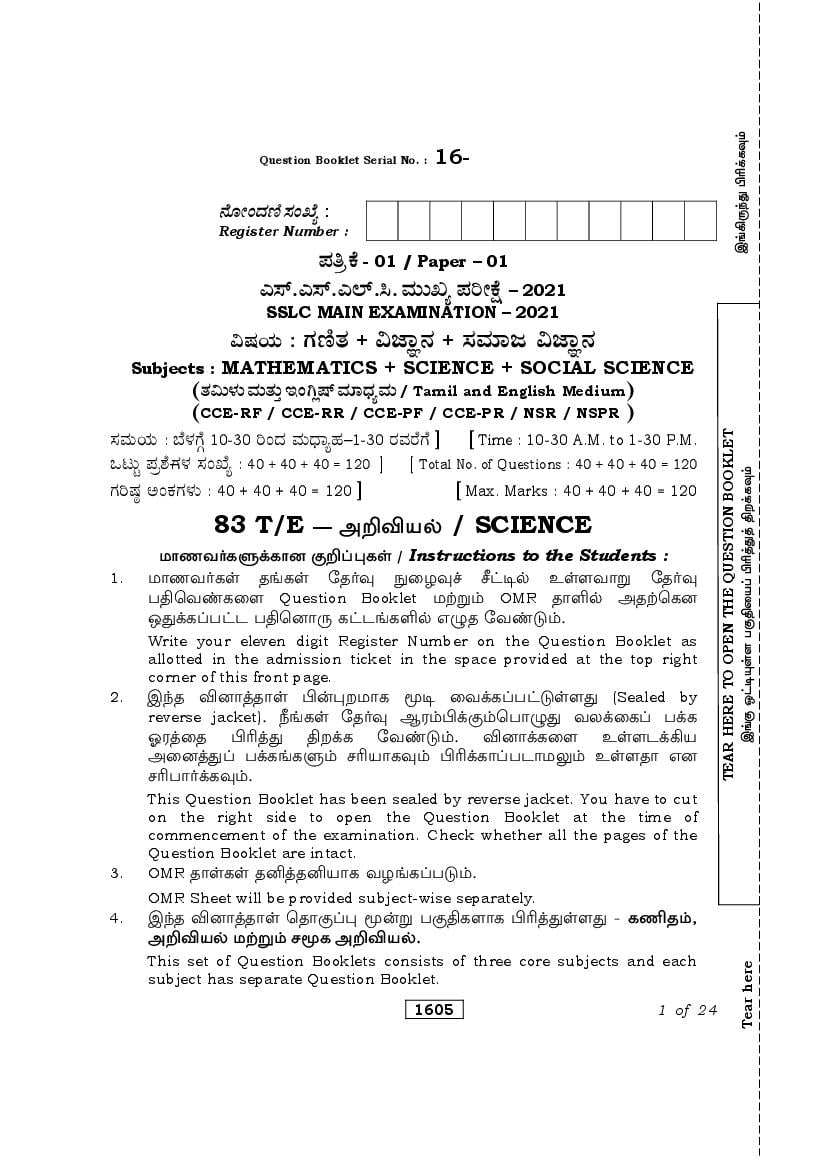
Question Booklet Serial No. : 16-
®æãàí¨Ü~ ÓÜíTæ :
Register Number :
±Ü£ÅPæ - 01 / Paper – 01
GÓ….GÓ….GÇ….Ô. ÊÜááS ±ÜÄàûæ – 2021
SSLC MAIN EXAMINATION – 2021
…Œ⁄æ⁄fl : V⁄{}⁄ + …e¤k´⁄ + —⁄»⁄·¤d …e¤k´⁄
Subjects : MATHEMATICS + SCIENCE + SOCIAL SCIENCE
(ñÜËáÙÜá ÊÜáñÜᤠCíXÉÐ… ÊÜÞ«ÜÂÊÜá / Tamil and English Medium)
(CCE-RF / CCE-RR / CCE-PF / CCE-PR / NSR / NSPR )
TEAR HERE TO OPEN THE QUESTION BOOKLET
—⁄»⁄flæ⁄fl : ∑Ê◊⁄VÊX 10-30 ¬M•⁄ »⁄fl®¤¿‘⁄-1-30 ¡⁄»⁄¡ÊVÊ ] [ Time : 10-30 A.M. to 1-30 P.M.
Jlflo Æ⁄√ÀÊ-V⁄◊⁄ —⁄MSÊ¿ : 40 + 40 + 40 = 120 ] [ Total No. of Questions : 40 + 40 + 40 = 120
Ceœ Jh•Ÿs[ Tœß˚Vl ©¨j’j ß\dL‹m
V⁄¬Œ⁄r @MO⁄V⁄◊⁄fl : 40 + 40 + 40 = 120 ] [ Max. Marks : 40 + 40 + 40 = 120
83 T/E — AÔ¯À / SCIENCE
©õnÁºPÐUPõÚ SÔ¨¦PÒ / Instructions to the Students :
1. ©õnÁºPÒ u[PÒ ÷uºÄ ~øÇÄa ^miÀ EÒÍÁõÖ ÷uºÄ
£vöÁsPøÍ Question Booklet ©ØÖ® OMR uõÎÀ AuØöPÚ
JxUP¨£mh £vöÚõ¸ Pmh[PÎÀ GÊu ÷Ásk®.
Write your eleven digit Register Number on the Question Booklet as
allotted in the admission ticket in the space provided at the top right
corner of this front page.
2. C¢u ÂÚõzuõÒ ¤ß¦Ó©õP ‰i øÁUP¨£mkÒÍx (Sealed by
reverse jacket). }[PÒ ÷uºÄ Bµ®¤US®ö£õÊx Á»UøP¨ £UP
Kµzøu ¤›zx vÓUP ÷Ásk®. ÂÚõUPøÍ EÒÍhUQ¯
AøÚzx¨ £UP[PЮ \›¯õPÄ® ¤›UPõ¨£hõ©¾® EÒÍuõ GÚ
\›£õºUPÄ®.
This Question Booklet has been sealed by reverse jacket. You have to cut
on the right side to open the Question Booklet at the time of
commencement of the examination. Check whether all the pages of the
Question Booklet are intact.
3. OMR uõÒPÒ uÛzuÛ¯õP ÁÇ[P¨£k®.
OMR Sheet will be provided subject-wise separately.
4. C¢u ÂÚõzuõÒ öuõS¨¦ ‰ßÖ £SvPÍõP ¤›zxÒÍx & Pou®,
AÔ¯À ©ØÖ® \‰P AÔ¯À.
This set of Question Booklets consists of three core subjects and each
Tear here
subject has separate Question Booklet.
1605 1 of 24
Page 2
120 ÂÚõUPÒ EÒÍÚ.
(i) Pou® & ÂÚõ GsPÒ 1 to 40
(ii) AÔ¯À & ÂÚõ GsPÒ 41 to 80
(iii) \‰P AÔ¯À & ÂÚõ GsPÒ 81 to 120
40 questions are provided against each subject. This set of Question
Booklets contains 120 questions in all.
(i) Mathematics – Question Numbers 1 to 40
(ii) Science – Question Numbers 41 to 80
(iii) Social Science – Question Numbers 81 to 120
6. JÆöÁõ¸ ÂÚõÂØS® J¸ ©v¨ö£s ÁÇ[P¨£k®. AøÚzx
ÂÚõÂØS® Pmhõ¯©õP Âøh¯ÎUP ÷Ásk®. JÆöÁõ¸ \›¯õÚ
ÂÚõÂØS® J¸ ©v¨ö£s ÁÇ[P¨£k®. uÁÓõÚ ÂøhPÐUS
(negative marks) Gvº©øÓ ©v¨ö£sPÒ CÀø».
Each question carries one mark. Answering all the questions is
compulsory and each correct answer will be awarded one mark. There
will be no negative marking for wrong answers.
7. ÷uºÂß ÷£õx PÁÛUP ÷Ási¯øÁ
a) ÂÚõzuõøÍ PÁÚ©õP¨ £izx¨ £õºUPÄ®.
b) Ámhzøu •Êø©¯õP {µ¨£, P¸¨¦ AÀ»x }» Ásn ø©
Eøh¯ GÊx÷Põø»¨ £¯ß£kzu»õ®. OMR uõÎÀ Ámhzøu
{µ¨¦® ÷£õx, PÁÚ©õP {µ¨£ ÷Ásk®. {µ¨¤¯ ¤ßÚº
Aøu ©õØÓ÷Áõ, \› ö\´Á÷uõ, ÷ÁÖ QÖUPÀP÷Íõ Ch®
ö£ÖuÀ Thõx.
GkzxUPõmk : 20 B® ÂÚõÂØPõÚ \›¯õÚ Âøh Auß
Á›ø\°À EÒÍ A, B, C, D CÀ C GߣuõP C¸¨¤ß,
öPõkUP¨£mkÒÍ |õßS Ámh[PÎÀ C GßÓ GÊzx EÒÍ
Ámhzøu }»® AÀ»x P¸¨¦ {Ó ø© öPõsh GÊx÷Põ»õÀ
{ǼhÄ® ÷Ásk®.
ÂÚõ Gs : 20) A B C D (Cx GkzxUPõmk ©mk÷©)
c) OMR uõÒPøÍ ©hUP÷Áõ, ÷\u® ÂøÍÂUP÷Áõ Thõx.
AÆÁõÖ ÷\u® ÂøÍÂzx ©v¨ö£sPÒ SøÓ¢uõÀ AuØS
©õnÁºPÒ uõß ö£õÖ¨÷£ØP ÷Ásk®.
1605 2 of 24
Page 3
a) Read the questions carefully.
b) Completely darken / shade the relevant circle against Question
Number in the OMR Sheet using blue / black ball point pen. Do not
try to alter the entry and not to do any stray marks on OMR Sheet.
Example : In the question booklet, if C is the correct answer for
Question No. 20, then in the OMR Sheet shade the option C using
blue / black ball point pen as follows.
Question No. 20) A B C D ( This is an example only )
c) Do not fold, tear, wrinkle or staple on the OMR Sheet.
8. J¸ ÂÚõÂØS, JßÔØUS® ÷©Ø¨£mh (circle) Ámh[PøÍ
{µ¨¤ÚõÀ, A¢u Âøh uÁÓõÚuõP P¸v AuØS ©v¨ö£s
öPõkUP¨£hõx/ÁÇ[P¨£hõx.
If more than one circle is shaded for a given question, such answer is
treated as wrong and no marks will be given.
9. ©õnÁºPЮ, Aøu PsPõo¨£õ͸® OMR uõÎÀ AuØöPÚ
JxUP¨£mh Ch[PÎÀ øPö¯õ¨£® Ch÷Ásk®.
Student and Room Invigilator should sign in the OMR Sheet in the space
provided.
1605 3 of 24
Page 4
ÂøhzuõÒPøÍ (subject-wise) £SvÁõ›¯õP \›£õºzx
÷uºÁõÍ›h® J¨£øhUP ÷Ásk®.
Candidate should return the subject-wise answered OMR Sheet to the
Room Invigilator before leaving the examination hall.
11. ÷uºÂß ÷£õx ©õnÁºPÒ u[PÐøh¯ (Rough work) ÷ÁÖ
SÔ¨¦PøÍ ÂÚõzuõÎß Pøh] £UPzvÀ AuØöPÚ JxUP¨£mh
ChzvÀ ©mk÷© GÊv¨ £õºUP ÷Ásk®.
Rough work can be done in the space provided at the end of the Question
Booklet.
12. ©õnÁºPÒ PõÀS÷»mhº, øP÷£], ì©õºm PiPõµ® ©ØÖ® CßÚ
¤Ó ªßÚÝ E£Pµn[PøÍ ÷uºÂß ö£õÊx EÒ÷Í Gkzx ö\À»
AÝ©v°Àø».
Calculators, Mobiles, Smart Watches and any other electronic equipment
are not allowed inside the examination hall.
1605 4 of 24
Page 5
Subject : SCIENCE
RÌU Põq® •ØÖ¨ ö£Óõu öuõhºPÐUPõÚ |õßS ÂøhPÐÒ
\›¯õÚ ÂøhUPõÚ SÔ±møhz ÷uº¢öukzx öPõkUP¨£mkÒÍ
OMR uõÎÀ P¸¨¦ AÀ»x }» Ásn ø© öPõsh GÊx ÷Põ»õÀ
SÔ¨¤mh Ámhzøu {µ¨¦P : 40 × 1 = 40
Four choices are given for each of the following questions / incomplete
statements. Choose the correct answer and shade the correct option in the
OMR Answer Sheet given to you with a black / blue ball point pen.
40 × 1 = 40
41. ªß Põ¢uz yshÀ uzxÁzvß Ai¨£øh°À ÷Áø» ö\´²® P¸Â
(A) ªßÚõUQ (öáÚ÷µmhº) (B) ªß `÷hØÔ
(C) ªß ÷©õmhõº (D) ªß Â]Ô
The device that works on the principle of electromagnetic induction is
(A) electric generator (B) electric heater
(C) electric motor (D) electric fan
42. 30Ω ªßuøh EÒÍ J¸ ªß ÂÍUS ©ØÖ® 6Ω EÒÍ ªßPhzv 9V
£õmh›²hß öuõhº Cøn¨¤À CønUP¨£mkÒÍx Gߣx
£hzvÀ öPõkUP¨£mkÒÍx. GÛÀ ªß _ØÔÀ ö\¾zu¨£mh
ö©õzu ªß\õµ®
(A) 4A (B) 36 A
(C) 0.25 A (D) 0.6 A
1605 5 of 24
Page 6
resistance are connected in series to 9 V battery as shown in the figure.
The total current flowing in the circuit is
(A) 4A (B) 36 A
(C) 0.25 A (D) 0.6 A
43. `›¯ \ø©P»Ûß Em¦Óa _Á›À P¸¨¦ Ásn® §\¨£mkÒÍx.
GöÚÛÀ Cx
(A) JÎø¯ ¤µv£¼UQÓx
(B) `›¯U PvºPøÍ J¸[QønzuÀ
(C) E÷»õP A›©õÚzv¼¸¢x ukzuÀ
(D) AvP öÁ¨£zøu EÔg_QÓx
The inner wall of the solar cooker is painted black because this
(A) reflects light (B) converges solar radiations
(C) prevents from rusting (D) absorbs more heat
44. ªß ÂÍUQ¾ÒÍ ªß CøÇ°À £¯ß£kzu¨£k® E÷»õP®
(A) ©õ[PÜì (B) h[ìhß
(C) {UPÀ (D) S÷µõª¯®
The metal used in the filament of an electric bulb is
(A) manganese (B) tungsten
(C) nickel (D) chromium
1605 6 of 24
Page 7
÷£õx ysh¨£mh ªß\õµzvß vø\ JÆöÁõ¸ •øÓ²® CÆÁõÖ
©õÖQÓx
(A) Cµsk _ÇØ]PÐUS ¤ÓS
(B) J¸ _ÇØ]US ¤ÓS
(C) £õv _ÇØ]US ¤ÓS (Aøµ _ÇØ])
(D) |õßQÀ J¸ £[S _ÇØ]US ¤ÓS
A rectangular coil of copper wire is rotated in a magnetic field. The
direction of the induced current changes once in each
(A) two revolutions (B) one revolution
(C) half revolution (D) one-fourth revolution
46. J¸ ö»ß]ß S¯ yµ® +0.50 m GÛÀ A¢u ö»ß]ß BØÓÀ
©ØÖ® ö»ß]ß ÁøP
(A) + 2.0 D ©ØÖ® SÂö»ßì
(B) + 2.0 D ©ØÖ® SÈö»ßì
(C) – 2.0 D ©ØÖ® SÈö»ßì
(D) – 2.0 D ©ØÖ® SÂö»ßì
The focal length of a lens is + 0.50 m. The power of the lens and type are
(A) + 2.0 D and convex lens (B) + 2.0 D and concave lens
(C) – 2.0 D and concave lens (D) – 2.0 D and convex lens
47. J¸ ªß _ØÔÀ ªßuøhø¯ ©õØÓ¨ £¯ß£k® P¸Â (\õuÚ®)
(A) ÷ÁõÀm «mhº (B) A®«mhº
(C) PõÀÁÚõ «mhº (D) ›÷¯õìhm
A device used to change the resistance in the electric circuit is
(A) voltmeter (B) ammeter
(C) galvanometer (D) rheostat
1605 7 of 24
Page 8
÷|º÷PõkPÒ ÁiÂÀ EÒÍx. CuØS Põµn® Á›a_¸Îß EÒEÒÍ
Põ¢u¨¦»®
(A) ªPÄ® AvP® (B) \©a ^µõÚx
(C) §ä⯮ (D) ªß\õµzuõÀ E¸ÁõUP¨£mhx
The magnetic field lines inside a solenoid are in the form of parallel
straight lines. The reason for this is, the magnetic field inside the solenoid
is
(A) very high (B) uniform
(C) zero (D) produced by electric current
49. J¸ SÂö»ß]À •UQ¯ S¯® F1 ©ØÖ® JÎø©¯® O Cøh°À
ö£õ¸Ò øÁUP¨£mhõÀ EshõS® ¤®£zvß ußø© ©ØÖ® AÍÄ
(A) ©õ¯¤®£®, ÷|µõÚx ©ØÖ® ªP¨ ö£›¯x
(B) Esø©, uø»RÇõÚx ©ØÖ® ]Ô¯x
(C) ©õ¯¤®£®, uø»RÇõÚx ©ØÖ® ]Ô¯x
(D) Esø©, uø»RÇõÚx ©ØÖ® ªP¨ ö£›¯x
The nature and the size of the image formed when an object is kept
between the principal focus F1 and optical centre O of a convex lens are
(A) virtual, erect and enlarged
(B) real, inverted and small size
(C) virtual, inverted and small size
(D) real, inverted and enlarged
1605 8 of 24
Page 9
(A) ªßÚõUQ (öáÚ÷µmhº) (B) `›¯ ªßP»®
(C) E»º ªßP»® (D) ªß ÷©õmhõº
The device that converts electrical energy into mechanical energy is
(A) electric generator (B) solar cell
(C) dry cell (D) electric motor
51. K® Gߣx Cuß SI A»S BS®
(A) ªß AÊzu ÷ÁÖ£õk (B) ªß uøh
(C) ªß÷Úõmh® (D) ªß _ø©
‘Ohm’ is the SI unit of
(A) electric potential difference (B) resistance
(C) electric current (D) electric charge
52. R÷Ç öPõkUP¨£mh AmhÁønø¯ PÁÛ :
FhP¨ ö£õ¸Ò JΠ»PÀ Gs
P 1.52
Q 1.44
R 2.42
S 1.33
G¢u FhPzvÀ J롧 ÷ÁP® ªPÄ® AvP® ?
(A) Q (B) P
(C) S (D) R
1605 9 of 24
Page 10
Material medium Refractive index
P 1.52
Q 1.44
R 2.42
S 1.33
In which material medium the speed of light is very high ?
(A) Q (B) P
(C) S (D) R
53. AqUP¸ Eø»°ß BØÓÀ ‰»®
(A) AqUP¸ ¤ÍÄ ÂøÚ
(B) Pmk¨£kzu¨£mh AqUP¸ ¤ÍÄ öuõhºÂøÚ
(C) öÁ¨£® EªÌÂøÚ
(D) AqUP¸ CønÄ ÂøÚ
The source of energy in nuclear power reactor is
(A) nuclear fission reaction
(B) controlled nuclear fission chain reaction
(C) exothermic reaction
(D) nuclear fusion reaction
1605 10 of 24
Page 11
(A) JÎUPØøÓPøÍ Â›Áøh¯a ö\´²®
(B) Kµ[PÒ uizx® ©ØÖ® |kÂÀ ö©À¼¯uõPÄ® C¸US®
(C) Esø© ©ØÖ® ÷|µõÚ ¤®£zøu E¸ÁõUS®
(D) Kµ[PÒ ö©À¼¯uõPÄ® ©ØÖ® |kÂÀ uizx® C¸US®
One property of a convex lens among the following is that, it
(A) diverges the light rays
(B) is thicker at the edges and thinner at the middle
(C) forms real and erect image
(D) is thinner at the edges and thicker at the middle
55. Aª»® ©ØÖ® Põµzxhß ÂøÚ¦›¢x E¨¦ ©ØÖ® }øµ E¸ÁõUS®
÷\º©®
(A) A¾ªÛ¯® BUø\k (B) uõªµ BUø\k
(C) C¸®¦ BUø\k (D) ÷\õi¯® BUø\k
A compound that reacts with both acids as well as bases to produce salts
and water is
(A) aluminium oxide (B) copper oxide
(C) iron oxide (D) sodium oxide
1605 11 of 24
Page 12
(A) (B)
(C) (D)
The structural formula of propanal is
(A) (B)
(C) (D)
57. ""uÛ©[PÎß £s¦PÒ AÁØÔß AqGsPÐUS HØ£ uÛ© Á›ø\
•øÓ°À ©õØÓ©øhQßÓÚ'' GßÓ Âvø¯ ö©õÈ¢uÁº
(AÔÂzuÁº)
(A) {³÷»sk (B) ö©sh½L¨
(C) ÷hõ£ŸÛ¯º (D) öíßÔ ÷©õì¼
“Properties of elements are a periodic function of their atomic number.”
This law was proposed by
(A) Newlands (B) Mendeleev
(C) Dobereiner (D) Henry Moseley
1605 12 of 24
Page 13
Fe + CuSO4 → FeSO4 + Cu
Zn + FeSO4 → ZnSO4 + Fe
÷©À öPõkUP¨£mh \©ß£õmiÀ E÷»õP[PÎß ÂøÚvÓÛß
CÓ[S Á›ø\
(A) Zn > Fe > Cu (B) Fe > Cu > Zn
(C) Zn > Cu > Fe (D) Cu > Fe > Zn
Observe the following chemical reactions :
Fe + CuSO 4 → FeSO 4 + Cu
Zn + FeSO 4 → ZnSO 4 + Fe
The decreasing order of reactivity of the metals in the above reactions is
(A) Zn > Fe > Cu (B) Fe > Cu > Zn
(C) Zn > Cu > Fe (D) Cu > Fe > Zn
59. J¸ uÛ©zvß Aq Gs 20. |ÃÚ uÛ© Á›ø\ AmhÁøn°À
C¢u uÛ©® Põn¨£k® öuõhº
(A) 2 (B) 8
(C) 4 (D) 3
The atomic number of an element is 20. In the modern periodic table, this
element belongs to the period
(A) 2 (B) 8
(C) 4 (D) 3
1605 13 of 24
Page 14
¤øn¨¦PÎß GsoUøP •øÓ÷¯
(A) 3 ©ØÖ® 9 (B) 9 ©ØÖ® 3
(C) 6 ©ØÖ® 6 (D) 7 ©ØÖ® 5
The number of single bonds and double bonds present in the structure of
benzene molecule respectively are
(A) 3 and 9 (B) 9 and 3
(C) 6 and 6 (D) 7 and 5
61. ÷\õi¯® Põº£÷Úm }ºzu øím÷µõ S÷Íõ›U Aª»zxhß ÂøÚ
¦›²® ÷£õx öÁÎÂh¨£k® Áõ²
(A) Põº£ß&øh&BUø\k (B) ø|mµáß&øh&BUø\k
(C) øímµáß (D) S÷Íõ›ß
The gas liberated when sodium carbonate reacts with dilute hydrochloric
acid is
(A) carbon dioxide (B) nitrogen dioxide
(C) hydrogen (D) chlorine
62. AÊzu¨£mh C¯ØøP Áõ²Âß •UQ¯ £Sv¨ ö£õ¸Ò
(A) ¤³m÷hß (B) Dz÷uß
(C) «z÷uß (D) ¦÷µõ÷£ß
The major component of compressed natural gas is
(A) butane (B) ethane
(C) methane (D) propane
1605 14 of 24
Page 15
(A) _snõ®¦ }º
(B) y¯ }º
(C) ÷\õi¯® øímµõUø\k vµÁ®
(D) Cøµ¨ø£ }º (Gastric Juice)
The substance that converts blue litmus paper into red colour is
(A) lime water (B) pure water
(C) sodium hydroxide solution (D) gastric juice
64. E÷»õPzvß \Àø£k uõxUPøÍ AÁØÔß BUø\k uõxUPÍõP
©õØÓ £¯ß£k® •øÓ
(A) PõÀ]÷Úåß (B) ÁÖzuÀ
(C) SøÓzuÀ (D) ªßÚõØ £S¨¦
The process used to convert sulphide ores of metals into their oxides is
(A) calcination (B) roasting
(C) reduction (D) electrolysis
65. öíU^ß ©ØÖ® ø\U÷ÍõöíU÷\Ûß ö£õxÁõÚ ‰»UTÖ Áõ´£õk
(A) C6 H6 (B) C6 H14
(C) C6 H12 (D) C6 H10
The common molecular formula of both hexene and cyclohexane is
(A) C6 H6 (B) C6 H14
(C) C6 H12 (D) C6 H10
1605 15 of 24
Page 16
Aª»®
(A) ö©zuÚõ°U Aª»® (B) BUéõ¼U Aª»®
(C) ]m›U Aª»® (D) »õUiU Aª»®
An acid present in the stinging hair of nettle plant leaves is
(A) methanoic acid (B) oxalic acid
(C) citric acid (D) lactic acid
67. ©Ûu Eh¼À Põº÷£õøím÷µm, ¦µu® ©ØÖ® öPõʨ¦ \zxUPøÍ
Áͺa]øu ©õØÓzvØS Em£kzx® íõº÷©õß
(A) öhì÷hõìöhµõß (B) Am›Úõ¼ß
(C) Cß_¼ß (D) øuµõU]ß
The hormone that regulates carbohydrate, protein and fat metabolism in
the human body is
(A) Testosterone (B) Adrenaline
(C) Insulin (D) Thyroxin
68. J¸ C¸mhøÓ°À Á͸® ö\i²ÒÍ öuõmi øÁUP¨ £mkÒÍx. ]»
|õmPÐUS Auß A¸QÀ J¸ ö©ÊSÁºzv HØÔ øÁUP¨£kQÓx.
A¢u ö\i°ß ÷©À £õP® ö©ÊS Áºzvø¯ ÷|õUQ ÁøÍQÓx. Cx
(A) ÷Áv |õmh® (B) JÎ |õmh®
(C) ¦Â |õmh® (D) }º |õmh®
A pot that has growing seedling is kept in a dark room. A burning candle is
placed near it for a few days. The top part of the seedling bends towards
the light of burning candle. This is
(A) Chemotropism (B) Phototropism
(C) Geotropism (D) Hydrotropism
1605 16 of 24
Page 17
\›¯õÚ AÔUøP
(A) _ØÖ¨¦Ó `ǼÀ C¯ØøP¯õP÷Á ©Ö_ÇØ] Aøh¯U Ti¯øÁ
(B) `Ì{ø» ©sh»zv¾ÒÍ £À÷ÁÖ E°›PÐUS w[S
ÂøÍÂUS®
(C) öÁÆ÷ÁÖ £i{ø»PÎÀ w[S ÂøÍÂUPU Ti¯ ÷Áv¨
ö£õ¸Îß Ahºzv AvP©õuÀ
(D) _ØÖ¨ ¦ÓzvÀ AvP |õmPÒ ©¢u©õP C¸US®
The correct statement with respect to biodegradable substances among the
following is that these substances
(A) undergo recycling naturally in the environment
(B) harm various organisms in the ecosystem
(C) increase the density of harmful chemicals in different trophic levels
(D) remain inert in the environment for a long time
70. §Âß £õ¼¯À CÚ¨ö£¸UP •øÓ°ß \›¯õÚ Á›ø\
(A) ©Pµ¢u ÷\ºUøP, P¸zu›zuÀ, Âøu, P¸
(B) Âøu, P¸, P¸zu›zuÀ, ©Pµ¢u ÷\ºUøP
(C) P¸, Âøu, ©Pµ¢u ÷\ºUøP, P¸zu›zuÀ
(D) ©Pµ¢u ÷\ºUøP, P¸zu›zuÀ, P¸, Âøu
The correct sequence found in the process of sexual reproduction in a
flower is
(A) pollination, fertilization, seed, embryo
(B) seed, embryo, fertilization, pollination
(C) embryo, seed, pollination, fertilization
(D) pollination, fertilization, embryo, seed
1605 17 of 24
Page 18
ìÂaø\ (öuõhUQø¯) {Özv ªß\õµzøu ÷\ª¨£uØS J¸
GkzxUPõmk
(A) ©ÖzxÂk (B) SøÓzxU öPõÒ
(C) ©Ö£¯ß (D) ©Ö÷|õUP®
Saving electricity by switching off unnecessary work of lights and fans is
an example of
(A) refuse (B) reduce
(C) reuse (D) repurpose
72. Ámh ÁiÁ £aø\{Ó ÂøuPøÍ Eøh¯ £mhõoa ö\iø¯²®
[ RRyy ] ©ØÖ® _¸[Q¯ ÂøuPøͲøh¯ ©g\Ò{Ó £mhõoa
ö\iø¯²® [ rrYY ] P»¨¤Ú® ö\´²® ÷£õx F1 uø»•øÓ°À
EshõS® ÂøuPÒ
(A) ÁmhÁiÁ® ©ØÖ® £aø\ {Ó ÂøuPÒ
(B) _¸[Q¯ ©ØÖ® ©g\Ò {Ó ÂøuPÒ
(C) ÁmhÁiÁ® ©ØÖ® ©g\Ò{Ó ÂøuPÒ
(D) _¸[Q¯ ©ØÖ® £aø\ {Ó ÂøuPÒ
If a round green seeded pea plant [ RRyy ] is crossed with wrinkled yellow
seeded pea plant [ rrYY ], the seeds produced in F1 generation are
(A) round and green seeds (B) wrinkled and yellow seeds
(C) round and yellow seeds (D) wrinkled and green seeds
73. EÖ¨ö£õzu EÖ¨¦PÒ
(A) J÷µ Âu©õÚ ÁiÁø©¨¦ ©ØÖ® J÷µ ö\¯À£õk® Eøh¯x
(B) J÷µ Âu©õÚ ÁiÁø©¨¦ ©ØÖ® ÷ÁÖ£mh ö\¯À£õk®
Eøh¯x
(C) ÷ÁÖ£mh Aø©¨¦ ©ØÖ® J÷µ ö\¯À£õk Eøh¯x
(D) ÷ÁÖ£mh Aø©¨¦ ©ØÖ® ÷ÁÖ£mh ö\¯À£õk Eøh¯x
1605 18 of 24
Page 19
(A) have same structure and perform same function
(B) have same structure and perform different functions
(C) have different structures and perform same function
(D) have different structures and perform different functions
74. ©ÛuÛß Eh¼ß £» £õP[Pμ¸¢x Cµzuzøu Cu¯zvØSU
öPõskÁ¸® CµzuU SÇõ´PÒ
(A) u©ÛPÒ (B) u¢xQPÒ
(C) ~øµ±µÀ u©Û (D) ]øµPÒ
The blood vessels that carry blood from all parts of the human body to the
heart are
(A) arteries (B) capillaries
(C) pulmonary arteries (D) veins
75. uõÁµ[PξÒÍ AvP¨£i¯õÚ }øµ öÁÎ÷¯ØÖ® •øÓ
(A) }µõ¨ ÷£õUS (B) JÎa ÷\ºUøP
(C) _Áõ]zuÀ (D) Phzu¨ £kuÀ
Plants can get rid of excess of water by this process
(A) Transpiration (B) Photosynthesis
(C) Respiration (D) Translocation
76. Cµsk |µ®¦ ö\ÀPÐUS Cøh÷¯²ÒÍ CøhöÁÎ
(A) ÷hßiøµ´k (B) BUéõß
(C) ø\Úõ¨ì (D) ö\À Eh®¦
1605 19 of 24
Page 20
(A) dendrite (B) axon
(C) synapse (D) cell body
77. P¸ÁõÚx uõ°ß Cµzuzv¼¸¢x Fmha \zxUPøͲ® ö£Ö® £õP®
(A) •møhUSÇõ´ (B) •møh¨ ø£
(C) P¸¨ø£ (D) öuõ¨¦Ò öPõi
The embryo gets nutrition from the mother’s blood with the help of a
special part called
(A) Fallopian tube (B) Ovary
(C) Uterus (D) Placenta
78. ©Ûu Bs CÚ¨ö£¸UP ©sh»zvÀ ]Ö}º ©ØÖ® ¢uqUPÒ
öÁÎÁ¸ÁuØPõÚ ö£õx ÁÈ
(A) ]Ö}º ¦ÓÁÈ (B) ]Ö}º SÇõ´
(C) ¢uqU SÇõ´ (D) ]Ö}º ø£
The common passage for both sperms and urine in human male
reproductive system is
(A) Urethra (B) Ureter
(C) Vas deferens (D) Urinary bladder
79. R÷Ç öPõkUP¨£mhøÁPÎÀ }º AÖÁøh Aø©¨¤ß ÷Áø»
AÀ»õux
(A) {»zui }øµ ©Ö {µ¨¥k ö\´QÓx
(B) }º B¯õÁvÀø»
(C) öPõ_UPÎß Áͺa]ø¯ AvP›UPa ö\´QÓx
(D) uõÁµ[PÐUS Dµzußø© AÎUQÓx
1605 20 of 24
Page 21
structures ?
(A) Recharge the ground water
(B) Water does not evaporate
(C) Provide breeding grounds for mosquitoes
(D) Provide moisture for vegetation
80. J¸Á›ß ÁõÌUøP°À ö£Ö® •ß AÝ£Á[PÒ Akzu
uø»•øÓUS Phzu¨ £kÁvÀø». Põµn® AøÁ
(A) £µ®£øµ £s¦PÒ (B) ö£ØÖUöPõsh £s¦PÒ
(C) K[S® £s¦PÒ (D) Jk[S® £s¦PÒ
The experiences of an individual during its lifetime cannot be passed on to
its progeny because they are
(A) inherited traits (B) acquired traits
(C) dominant traits (D) recessive traits
1605 21 of 24
Page 22
( SPACE FOR ROUGH WORK )
1605 22 of 24
Page 23
( SPACE FOR ROUGH WORK )
1605 23 of 24
Page 24
Document Details
| Board / Org | Karnataka Board |
| Exam | Class 10 |
| Type | Question Paper |
| Pages | 24 |
| Language | tamil |
| Updated | 22 Jul 2026 |