KSET Syllabus Archaeology
Finished viewing? Save it for later —
Download KSET Syllabus Archaeology (PDF · 6 pages)About KSET Syllabus Archaeology
KSET Syllabus Archaeology is available here for free download. Published by Karnataka Exams for Karnataka State Eligibility Test, this syllabus can be viewed online or downloaded as a PDF (6 pages). Candidates preparing for Karnataka State Eligibility Test can use KSET Syllabus Archaeology to understand the exam pattern, the type of questions asked, and the overall difficulty level.
Frequently Asked Questions
How can I download KSET Syllabus Archaeology?
Open this page and click the Download button to save KSET Syllabus Archaeology as a PDF. It is completely free on AglaSem Docs.
Is KSET Syllabus Archaeology free to download?
Yes. KSET Syllabus Archaeology can be viewed online and downloaded as a PDF free of cost on AglaSem Docs.
How many pages does KSET Syllabus Archaeology have?
KSET Syllabus Archaeology contains 6 pages, which you can read online or download together as a single PDF.
Where can I find more Karnataka State Eligibility Test study material?
You can find more Karnataka State Eligibility Test question papers, sample papers, syllabus, and answer keys on AglaSem Docs.
KSET Syllabus Archaeology – Text
Read the full text of this syllabus below — useful to quickly search, copy and reference the content online without downloading the PDF.
📄 View text version (6 pages)
Page 1
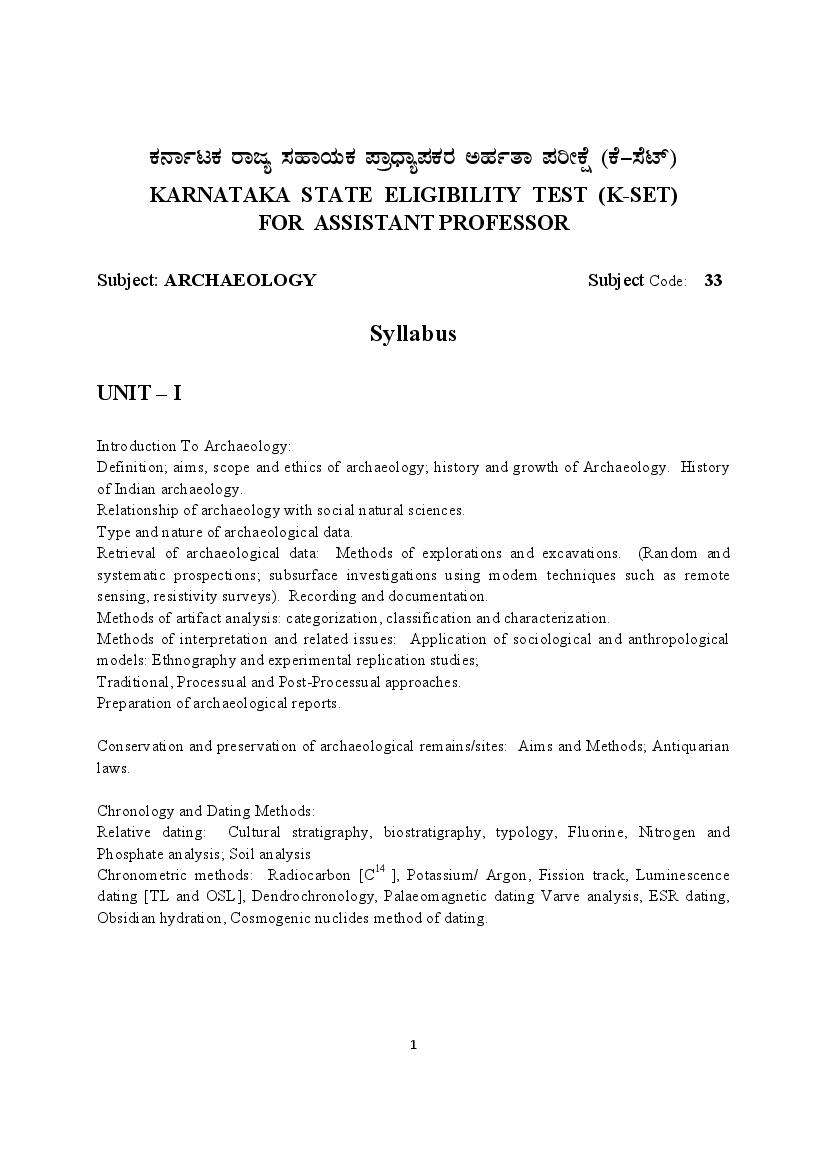
KARNATAKA STATE ELIGIBILITY TEST (K-SET)
FOR ASSISTANT PROFESSOR
Subject: ARCHAEOLOGY Subject Code: 33
Syllabus
UNIT – I
Introduction To Archaeology:
Definition; aims, scope and ethics of archaeology; history and growth of Archaeology. History
of Indian archaeology.
Relationship of archaeology with social natural sciences.
Type and nature of archaeological data.
Retrieval of archaeological data: Methods of explorations and excavations. (Random and
systematic prospections; subsurface investigations using modern techniques such as remote
sensing, resistivity surveys). Recording and documentation.
Methods of artifact analysis: categorization, classification and characterization.
Methods of interpretation and related issues: Application of sociological and anthropological
models: Ethnography and experimental replication studies;
Traditional, Processual and Post-Processual approaches.
Preparation of archaeological reports.
Conservation and preservation of archaeological remains/sites: Aims and Methods; Antiquarian
laws.
Chronology and Dating Methods:
Relative dating: Cultural stratigraphy, biostratigraphy, typology, Fluorine, Nitrogen and
Phosphate analysis; Soil analysis
Chronometric methods: Radiocarbon [C14 ], Potassium/ Argon, Fission track, Luminescence
dating [TL and OSL], Dendrochronology, Palaeomagnetic dating Varve analysis, ESR dating,
Obsidian hydration, Cosmogenic nuclides method of dating.
1
Page 2
Introduction to Prehistory
Prehistoric beginning: Geological, biological and cultural dimensions of humans. Human origin
and Geological time scale: Late Tertiary [Miocene and Pliocene] and Quaternary Periods; Plio-
Pleistocene boundary, Paleomagnetic records, Pleistocene and Holocene epochs. Major
environment and climatic changes of Pleistocene; Pleistocene and Marine Isotopic Stages [MIS].
Biostratigraphy of the Pleistocene: Pleistocene flora and Fauna.
Main stages of human evolution and important fossil records: Hominin ancestors of the Late
Miocene, Pliocene and the Pleistocene: Pre-Australopiths, Australopiths and Homo; Hypotheses
on modern human dispersal.
Cultural backdrop: Evolution of stone implements and development of lithic technologies: The
Oldowan, Acheulian and the Flake and Blade based industries of the Stone Age.
Palaeolothic cultural development in the world context:
Africa, Europe and south East Asia and China.
Early Stone Age, Middle Stone Age and Late Stone Age of Africa; Lower Palaeolithic, Middle
Palaeolothic an Upper Palaeolithic of Europe and West Asia. Palaeolothic cultural developments
in China and South East Asia.
Prehistoric Art: antiquity, significance, distribution.
UNIT – III
Palaeolithic cultural developments in the Indian subcontinent:
Geo-chronology and Stone Age cultures of India: The Sohan Valley and the Potwar Plateau sites
in the Sivalik hills, The Belan and Son valleys, Didwana dune 16R in Rajasthan, Kortlayar
valley/Attirampakkam in Tamilnadu and Jwalapuram in Andhra Pradesh.
Lower Palaeolithic culture: Tool types and lithic technology; The Sohan industry and its
antiquity; The Acheulian industry and its spread into major river valleys: Sites in the Narmada
and the Sabarmati valleys, the Belan and the Son valley sites, sites in the Hunsgi and Baichabal
valleys, sites in the Krishna and the Godavari valleys, sties in the Kortlayar valley; sites
associates with the Playas if Rajasthan.
Middle Palaeolithic culture and geographical spread; Tool types and lithic technology of the
Middle Palaeolithic: the prepared core techniques / Levallois technique.
2
Page 3
Blade and bone implements; geographic distribution and major sites.
Prehistoric Art in the Indian context: Antiquity, significance and distribution
Unit – IV
Mesolithic and Neolithic cultures:
Mesolithic in Europe; Epi - Palaeolithic developments in West Asia
Neolithic and Food Production: Neolithic stage in West Asia and China.
Mesolithic culture of the Indian subcontinent: Characteristics features; Tools types and micro-
blade technology; regional variations in tool assemblages; Evidence of incipient stages of food
production. Patterns of ecological adaptation and distribution: Sites in the alluvial plains,
horseshoe lakes, coastal sites, sand-dune sites, sites in the plateaus and rock-shelter sites.
Neolithic cultures of the Indian subcontinent: Early farming communities of Baluchistan:
Mehrgarh and Kili-Gul-Muhammad. Neolithic culture in Kashmir.
Neolithic culture in the Central Ganga and Vindhyan region: Koldihwa, Mahagara, Lahuradewa
etc. Eastern Neolithic sites: Chirand, Chechar Senuwar, Kuchai, and Baidyapur and the
Neolithic culture of the North –Eastern region: Sarutaru, Selbalgiri, Daojali Hading, Marakdola.
Neolithic cultural development in the southern peninsular India: Sanganakallu, Pikhlihal, Uttnur,
Kodekal, Teklakota, Hallur, Nagarjunakonda and Ash-mound sites.
Unit - V
Proto-history:
Courses towards urbanization: The Harappa culture.
Formative stage of the Harappa culture: Emergence of village farming/
Chalcolithic settlements and beginning of regional culture in the North and North-Western
Indian and Pakistan. Contemporary developments in the Gagghar Saraswati system and in
Gujarat [Pre-Urban/ Pre and Early Harappan cultural development].
Early Harappan and the emergence of the Urban Harappan cultural ethos.
Urban Harappan and geographical spread; settlement features; town planning and architecture;
Economic production: the urban-rural dichotomy, agriculture and craft production. Trade and
subsistence; standardization of craft and the Harappan script, evidence of overseas contracts.
Socio-political organization; art and evidence of religious beliefs; Authors? Important excavated
3
Page 4
Bagasra, Rojdi, Rangpur.
Regional variations within the material culture: the concept of Sorath and Sindhi/Classical
Harappan in Gujarat.
Post-Urban Harappan
Decline of the Urban Harappan: causes of decline and different theories on decline.
Post-Urban phase: evidence from the Indus valley, Gagghar-Saraswati system and from Gujarat
(Post-Urban or Late Harappa cultures of Sindh, Punjab, Haryana, Gujarat and Western Uttar
Pradesh].
Other Chalcolithic Culture of India:
The Copper Hoard and Ochre Coloured Pottery; Chalcolithic cultural remains in the Ganga plain.
The Banas/Ahar cultural developments in southern Rajasthan and its antiquity and distribution.
The Kayatha assemblage of Madhya Pradesh.
The Malwa culture of the Narmada valley and its geographic distribution.
Chalcolothic cultures of the Deccan region [Savalda, Malwa, Jorwe cultures].
Unit-VI
The Iron Age and growth of new urban centers. Antiquity of Iron in India: Early Stages of Iron
Age, new evidence from Malhar, Dadupur, Raja Nal-ka-tila,
Hallur, Kurmaranahalli and Kodumanal.
Painted Grey Ware culture: Extent, and Chronology and characteristic traits.
Northern Black Polished Ware culture: Extent, chronology and characteristic traits.
Iron Age in Peninsular India:
The Megalithic culture in peninsular India and beyond: Geographical spread, typology,
chronological contexts, cultural artefacts and authors of Megalithic tradition.
The beginning of early Historic period and the emergence of Urban centres in the Ganga Valley
and Peninsular India.
Multiple modes of economic production, expansion of trade and development of trade routes,
Maritime trade; emergence of new Urban centers.
Emergence of urban centers:
Important city sites: Rjghat, Ujjain, Vaisali, Taxila, Mathura, Sravasti, Kausambi, Sisupalgargh
etc.
4
Page 5
Sringaverpura, Ahichatra, Atiranjikhera, Hasthinapur, Khairadih, Chandarketugarh, Nasik,
Adam, Satanikota, Nagarjunakonda, Arikamedu, Kodumanal, Pattanam.
Unit – VII
Architecture: A significant source of Indian history
The Stupa architecture: Structural Stupas: Origin and development: North and South Indian
stupas.
Development of Rock-cut architecture: Origin and Development – Buddhist Brahmanical and
Jain.
Temple Architecture: Origin and development of temples, Main features of the temple
architecture, features and development of distinct architectural styles of Nagara, Vesara, Dravida
and Bhumija temples.
Gupta, Chalukyan, Pallava and Rashtrakuta temples. Regional styles: Khajuraho temples,
Temples of Odisha and Chola temples.
Art and Iconography
Sculptural Art: Stone and Bronze: Antiquity and development : The Mauryan pillar capitals,
early Yaksha-Yakshi images, Shunga, Western Kshatrapa, Satvahana sculptures; the Kushana
sculptures: Mathura and Gandhara Schools; Gupta sculptures; Saranath school; Chalukya,
Pallava; Pala, Chandela, Chola and Hoysala sculptures.
Iconography
Brahma, Vishnu, Shiva, Kartikeya, Ganesha, Surya, Shakti, Tirthnakara [Rishabhdev,
Parshvanath and Mahavira], Buddha, Bodhisattva and Tara.
Terracotta Art: Mauryan to the Gupta period
Paintings: Rock-cut cave paintings: Ajanta, Bagh and Sittanvavasal
Unit – VIII
Palaeography and Epigraphy:
Epigraphy a source of Indian history:
Origin and antiquity of writing in India;
Origin and development of Brahmi and Kharosthi scripts: Various theories.
Study of selected inscriptions: Ashokan Edicts: Rock Edicts II, X, XII, XIII; Lumbini
inscription of Asoka; Minor rock edict of Bairat; Besnagar Garuda pillar inscription;
Hathigumpha inscription of Kharvela, Ushavadata inscription in Nasik cave 10, Junagadh
inscription of Rudradaman, Nasik cave III inscription of Vasishtaputra Pulmavi Year 19; Swat
5
Page 6
inscription of the time of Huviska; Allahabad pillar inscription of Samudragupta; Bhitri
inscription of Skandagupta, Aihole pillar inscription of Pulkesing II; Gwalior inscription of
Mihir Bhoja; Khalimpur copper plate of Dharmpala; Sanjan copper plate of Amoghavarsha,
Mandsor inscription of Yeshovaran; Truvalangad copper plates of Rajendra Chola year 6 and
Sangli copper plate of govinda IV, Tharsapalli copper plates.
Unit – IX
Numismatics: Coins as an important source of history
Origin and antiquity of coinage in ancient India.
Techniques/Methods of manufacturing coins: Silver, copper, gold and alloys.
Main type of coins: Punch marked coins, inscribed and un-inscribed cast coins.
Janpada nd tribal coins, Indo-Greek coins, Saka-Kashtrapa, Kushana and Satavahana coinage;
Coins of the Gupta dynasty; Roman coins. Brief account of Early Medieval Indian coinage.
Unit – X
Methodology of archaeological research.
Role and characteristics of research, research ethics, methods of research; case studies and field
investigations; Hypothesis formulation and research design; data collection and processing;
Primary and secondary sources. Use of Information and Communication Technologies [ICT] in
archaeological research; Methods of systematic referencing; Systematic presentation of data and
results
***
6
Document Details
| Board / Org | Karnataka Exams |
| Exam | Karnataka State Eligibility Test |
| Type | Syllabus |
| Pages | 6 |
| Updated | 24 Sep 2026 |