Maharashtra SSC Syllabus 2022 English
Finished viewing? Save it for later —
Download Maharashtra SSC Syllabus 2022 English (PDF · 13 pages)About Maharashtra SSC Syllabus 2022 English
Maharashtra SSC Syllabus 2022 English is available here for free download. Published by Maharashtra Board for Class 10, this syllabus can be viewed online or downloaded as a PDF (13 pages). Candidates preparing for Class 10 can use Maharashtra SSC Syllabus 2022 English to understand the exam pattern, the type of questions asked, and the overall difficulty level.
Frequently Asked Questions
How can I download Maharashtra SSC Syllabus 2022 English?
Open this page and click the Download button to save Maharashtra SSC Syllabus 2022 English as a PDF. It is completely free on AglaSem Docs.
Is Maharashtra SSC Syllabus 2022 English free to download?
Yes. Maharashtra SSC Syllabus 2022 English can be viewed online and downloaded as a PDF free of cost on AglaSem Docs.
How many pages does Maharashtra SSC Syllabus 2022 English have?
Maharashtra SSC Syllabus 2022 English contains 13 pages, which you can read online or download together as a single PDF.
Where can I find more Class 10 study material?
You can find more Class 10 question papers, sample papers, syllabus, and answer keys on AglaSem Docs.
Maharashtra SSC Syllabus 2022 English – Text
Read the full text of this syllabus below — useful to quickly search, copy and reference the content online without downloading the PDF.
📄 View text version (13 pages)
Page 1
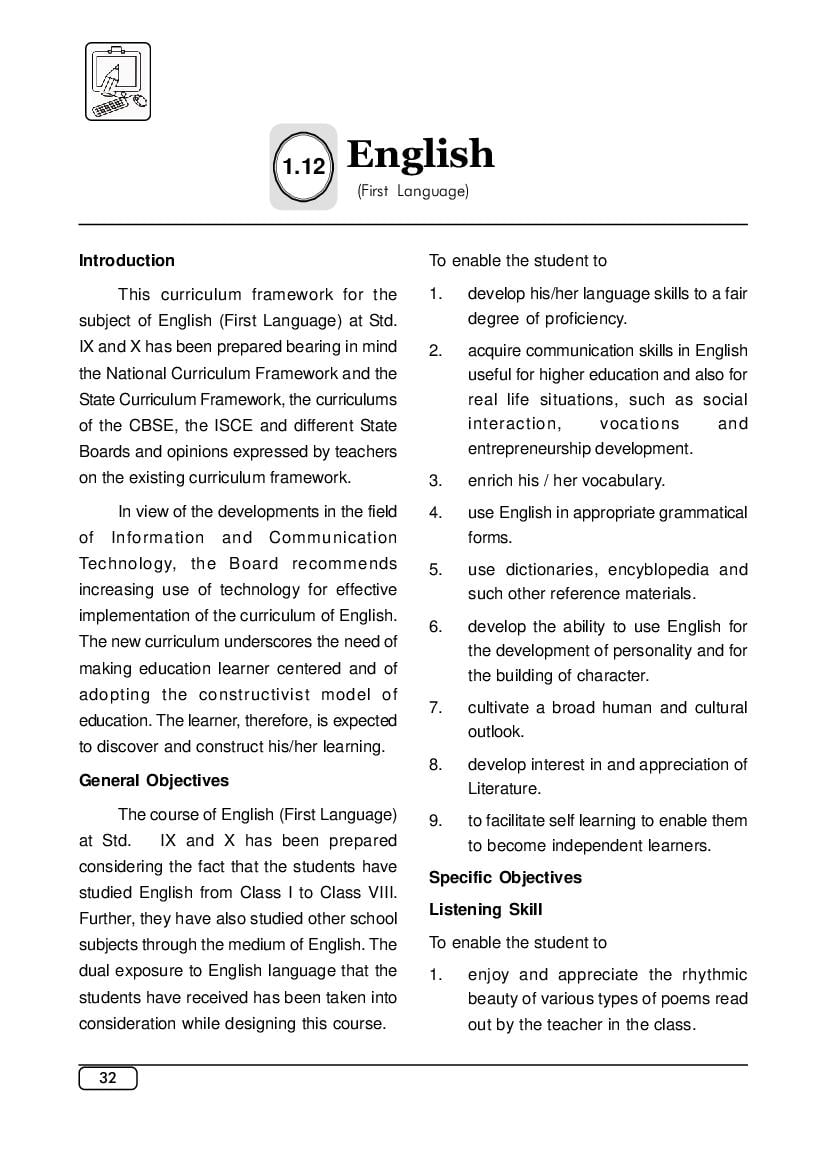
(First Language)
Introduction To enable the student to
This curriculum framework for the 1. develop his/her language skills to a fair
subject of English (First Language) at Std. degree of proficiency.
IX and X has been prepared bearing in mind 2. acquire communication skills in English
the National Curriculum Framework and the useful for higher education and also for
State Curriculum Framework, the curriculums real life situations, such as social
of the CBSE, the ISCE and different State interaction, vocations and
Boards and opinions expressed by teachers entrepreneurship development.
on the existing curriculum framework. 3. enrich his / her vocabulary.
In view of the developments in the field 4. use English in appropriate grammatical
of Information and Communication forms.
Technology, the Board recommends 5. use dictionaries, encyblopedia and
increasing use of technology for effective such other reference materials.
implementation of the curriculum of English.
6. develop the ability to use English for
The new curriculum underscores the need of
the development of personality and for
making education learner centered and of the building of character.
adopting the constructivist model of
7. cultivate a broad human and cultural
education. The learner, therefore, is expected
outlook.
to discover and construct his/her learning.
8. develop interest in and appreciation of
General Objectives Literature.
The course of English (First Language) 9. to facilitate self learning to enable them
at Std. IX and X has been prepared to become independent learners.
considering the fact that the students have
Specific Objectives
studied English from Class I to Class VIII.
Listening Skill
Further, they have also studied other school
subjects through the medium of English. The To enable the student to
dual exposure to English language that the 1. enjoy and appreciate the rhythmic
students have received has been taken into beauty of various types of poems read
consideration while designing this course. out by the teacher in the class.
32
Page 2
phrases used in different contexts. conversations and interviews.
3. get a global understanding of a variety 13. listen with comprehension to news,
of passages of a reasonable length commentaries, speeches and such
read out/recorded. other programmes on Radio/T.V./Tapes/
CDs and multimedia.
4. follow and appreciate narrative,
descriptive and such other prose texts 14. understand nuanbes bonveyed through
read aloud so as to answer the stress and intonation.
questions set on them. 15. exploit listening for other activities like
5. listen to speeches or passages for the debating, discussing, reading, writing,
purpose of taking notes and giving a role-playing, problem solving and
decision making.
gist or a short summary.
16. listen between the words. (to know what
6. understand read out or recorded
is really meant by speakers who do not
stories, narrations, descriptions, pieces
always spell out what they mean)
of information of a reasonable length
so as to ask pertinent questions on Speaking Skill
them. To enable the student to
7. identify relevant/irrelevant points; facts 1. enjoy reciting poems with proper
and opinions in the speeches or the accent, rhythm and intonation.
passages read out. 2. speak with acceptable pronunbiation
8. infer a speaker’s attitude/intention/ and appropriate stress and intonation.
mood from his/her choice of words and 3. use a variety of words and phrases in
grasp the message given. different contexts appropriately.
9. predict what is coming next in a speech, 4. give a gist of a passage of a
story, conversation; etc. using the clues reasonable length read out in the class.
from what he/she has heard.
5. answer orally questions based on
10. enjoy and appreciate various literary Specific information or details in a
forms to get sensitized to literary passage read out in the class or read
language and experiences. by the student himself/herself.
11. identify the genre and register of a text 6. express ideas and feelings correctly,
after listening to it. clearly and coherently.
33
Page 3
narrations, descriptions, pieces of comprehension depending on the kind
information of a reasonable length. of text.
8. differentiate between relevant and 3. read for pleasure short stories, extracts
irrelevant points. from biography, travelogue, plays, etc.
9. present short oral reports on news, 4. read for information newspapers,
commentaries, speeches and such advertisements, notices, leaflets, etc.
other programmes on Radio, T.V.,
5. understand the overall message,
Tapes, C.D.s, etc.
coherence, implied meanings and
10. present orally in brief his/her development of thoughts using different
interpretation of a speaker’s or writer’s techniques of reading such as
mood, attitude and intention.
skimming, scanning and close reading.
11. participate in discussions, debates,
6. read intensively so as to develop good
interviews, conversations.
study habits.
12. narrate stories, anecdotes, jokes,
7. read extensively for pleasure and
incidents, experiences.
information and to get abquainted with
13. comment on writer’s idea and point of the works of great writers and poets.
view.
8. identify and understand figures of
14. give an extempore speech (unprepared speech and other literary devices used
oral presentation) on a familiar topic in in prose and poetry.
precise words.
9. use clues from discourse markers (such
15. use a range of conversational styles as however, moreover, on the other
from formal to informal. hand, etc. - in order to predict what
16. use the language for the development could follow)
of personality, building of charabter and
10. anticipate and predict events,
participation in social life.
consequences, etc. while reading.
Reading Skill
11. identify logical relationship in a given
To enable the student to text.
1. read aloud a poem to enjoy and 12. differentiate between relevant and
appreciate rhythm and other features. irrelevant information, fact and opinion.
34
Page 4
diagrammatic form and vice-versa. 8. write expository/argumentative essays
14. develop reference skills (i.e. using a of 200-250 words.
dictionary, encyblopedia, etc.) for 9. develop a dialogue on different
detailed as well as additional situations such as at the Principal’s
understanding. office, Enquiry counter at the Railway
15. understand and appreciate features of station/S.T. stand, etc.
literary style. 10. write reports on conversation,
16. enjoy and appreciate the language and interviews, and radio talks.
its literature to develop sensitivity. 11. make notes on seen texts leading to
Writing Skill summarizing.
To enable the student to 12. write minutes, notices, curriculum vitae.
1. write correctly, neatly and legibly with 13. transfer information from verbal to
reasonable speed. diagrammatical form and viceversa.
2. master the mechanics of writing 14. write articles for school magazines,
including planning, organizing, journals, etc.
composing and revising. Vocabulary
3. write answers to questions based on 1. Consolidation and extension of
prescribed or unseen text in prose and vocaculary learnt in the previous classes
poetry and to explain figures of speech (upto Std. VIII/IX)
and other literary devices.
2. Acquisition of vocabulary arising out of
4. convey information through writings such the prescribed texts.
as instructions, posters, leaflets,
Grammar
messages and advertisements.
The grammar items listed below have to be
5. write formal and informal letters.
taught and learned only with reference to
6. desbribe/narrate events, objects and appropriate contexts. Grammar should not be
processes coherently. taught in isolation. It is not an end in itself but
7. complete a story beginning with the a means of learning to use a language.
35
Page 5
a) A Coursebook in English (Kumarbharati)
Detailed Study
1) a) Prose : About 64 pages of literary and non-literary
(informative) text
(excluding notes, illustrations, tasks, etc.)
b) Poetry : About 250 lines.
Non-detailed study : A selection of literary texts (short stories, one
b) Grammar
Sr. No. Items Specification
1 Revision of
grammatical —————————
items studied up to
Std VIII.
2 different kinds of Assertive/Exclamatory/Imperative/Negative/Interrogativ
sentences
3 The Tenses a) i) Simple present ii) Present Continuous,
iii) Simple past iv) Past Continuous
b) Sequence of tenses
4 Articles a, an. the
5 prepositions different uses
6 Tenses of Uses of ‘see’, ‘hear’, ‘smell’, ‘feel’, ‘taste’
pereception
7 Concord Subject +Verb agreement
8 Word Nouns/Adjectives/Verbs/Adverbs
Formation
9 Voice Statements, questions, negatives, indirect object
10 Question a) Yes/No question
formation b) ‘Wh’+ question
11 Reported Statements, questions, commands, requests,
Speech
12 Punctuation Usage
13 Non-finites Infinitives, Gerunds, Participles
14 Modal Uses of ‘will’, ‘shall’
Auxiliaries
15 Collocation The co-occurrence of lexical items
36
Page 6
a) A Coursebook in English (Kumarbharati)
Detailed Study
1) a) Prose : About 64 pages of literary and non-literary
(informative) text
(excluding notes, illustrations, tasks, etc.)
b) Poetry : About 250 lines.
Non-detailed study : A selection of literary texts (short stories, one act play)
b) Grammar :
Sr. No. Items Specification
1 Revision of
grammatical —————————
items studied up to
Std VIII.
2 different kinds of Simple, Compound, Complex
sentences
3 different kinds of Principal, Co-ordinate, Sub-ordinate
4 The Tenses a) Continuous
i) Present Perfect ii) Present Perfect
iii) Past Perfect
iv) Future with will/shall and ‘going to’
b) Continuous
Sequence of Tenses.
4 Articles a, an, the (advanced level)
5 prepositions different uses
8 Word Nouns/Adjectives/Verbs/Adverbs
Formation
9 Voice Statements, questions, negatives, indirect object
10 Question Tag questions
formation
11 Reported Statements, questions, commands, requests,
Speech exclamation
12 Punctuation Usage
13 Non-finites Infinitives, Gerunds, Participles
14 Modal Uses of ‘can’, ‘may’, ‘might’, etc
Auxiliaries
15 Conditionals Unreal conditions in the present/past Possible
conditions in the future
37
Page 7
The following weightage is to be given to the various aspects of the syllabus.
1 Reading Skill (Textual and non-textual) 40%
2 Grammar 15%
3 Writing skill 25%
4 Oral test 20%
38
Page 8
3.1
English
Background English at the Secondary level.
This curriculum framework for the (Some students may terminate their
subject of English (Third Language) at Std. studies after Std. X. Others may
IX and X has been prepared bearing in mind pursue higher studies in different
the National Curriculum Framework and the faculties).
State Curriculum Framework, the curriculums Objectives
of English of the CBSE, the ISCE and
different State Boards and the views/opinions The major objective of teaching English
expressed by teachers on the existing at the Secondary level is to consolidate and
curriculum framework. extend the language abilities already
In view of the developments in the field acquired. In the course of two years, students
of Information and Communication are expected to develop a broad-based
Technology the Board recommends conceptual understanding (cognition) of the
increasing use of technology for effective idiom of English and to learn to make
implementation of the Curriculum of English. effective use of English in real life contexts
The new curriculum underscores the need of (application).
making education learner centered and of General Objectives
adopting the constructivist model of
education. The learner, therefore, is expected To enable the student to
to ‘discover’ and ‘construct’ his/her learning. 1. Learn to use English appropriately.
Some of the other considerations have been
as follows : 2. Understand spoken English, used in
and outside the school.
Increasing importance of English at the
International and National level. 3. Speak with confidence using
appropriate vocaculary, grammatical
Increasing demand for English, not only
as a source language (Library forms and acceptable pronunciation.
Language) but also as an important 4. comprehend written texts in English
language of communication. (both textual and non-textual)
Introduction of English from Class I, with 5. write in simple and acceptable/
effect from June 2000, in all the Non- reasonably correct English.
English medium schools in the State of
Maharashtra. 6. acquire the necessary communication
skills required for their day to day social
The functional (communicative), literary
interaction.
(aesthetib) and cultural (integrative)
needs of the learner. 7. cultivate a broad, human and cultural
The terminal and the non-terminal outlook.
Objectives of teaching/learning 8. Facilitate self-learning.
123
Page 9
Listening Skill the message given in his speech.
To enable the student to Speaking Skill
1. enjoy and appreciate various types of To enable the student to
poems read aloud. 1. enjoy reciting poems with appropriate
2. understand meanings of words, rhythm.
phrases and sentences in context. 2. make meaningful use of words, phrases
3. guess meanings of new words and and sentences in context.
phrases. 3. use a variety of words and phrases in
4. understand statements, questions, different contexts.
commands, requests and such other 4. learn to speak fluently and intelligibly
sentences. on a given topic for a reasonable period
5. understand and respond appropriately of time.
to directive language, e.g. instrubtions, 5. answer orally the questions set on
advice, requests and warning. narrative and descriptive passages.
6. maintain his/her attention for a 6. produce simple statements, questions,
reasonable length of time. commands and requests.
7. listen for a global understanding so as 7. converse appropriately in formal and
to be able to give main points. informal contexts.
8. follow simple narrative, descriptive and 8. express his/her ideas coherently and
such other prose texts read aloud, so
logically.
as to answer questions set on them.
9. narrate events, stories and experienbes
9. enjoy and appreciate stories, short
in brief.
plays and short narrations read out in
the class. 10. describe states and processes that he/
she observes.
10. take dictation keeping pace with the
speed of the speaker. 11. participate in discussions, decates and
conversations.
11. understand and interpret spontaneous
spoken discourse in familiar social 12. use a variety of expressions for
situations. complimenting, requesting, apologizing,
12. listen with understanding news, etc.
commentaries, short speeches and Reading Skill
such other programmes on Radio/T.V./
To enable the student to
Tapes/CDs, etc.
1. read aloud effectively with correct
13. listen with understanding to telephonic
pronunciation, stress and intonation.
conversation.
2. read aloud with appropriate pace and
14. understand nuances conveyed through
pauses showing awareness of
stress and intonation.
punctuation.
124
Page 10
rhythm. non-textual reading material
4. read silently with reasonable speed, 5. frame statements, questions,
depending on the type of text. commands and requests for their
appropriate use in different contexts.
5. read silently textual and non-textual
material for overall/global understanding 6. develop a paragraph on a given theme
(skimming), for finding Specific considering coherence, logical
information (scanning), for detailed sequence and connective devices.
understanding (intensive). 7. write formal and informal letters with the
6. guess/predict appropriately while help of given points.
reading. 8. develop a story with the help of given
7. deduce the meaning of words, phrases outline/points.
with the help of context. 9. write short imaginary write ups e.g.
8. read informative material such as personal essays, compositions with the
notices, advertisements, road signs and help of guidelines.
news headlines. 10. write short reports based on interviews,
9. learn to chunk or group sentences into events and talks.
appropriate sense groups/grammatical 11. describe states and processes with the
groups. help of given guidelines.
10. learn to use a dictionary and such other 12. write a short conversation with the help
reference material. of given guidelines.
11. read to understand themes, ideas, 13. transfer the information from nonverbal
emotions, expressed in the text and to to verbal forms such as from tables,
respond appropriately. charts and maps to write-ups.
12. understand logical sequence of 14. Fill in a variety of forms in given formats
sentences in the text. such as admission form and bio-data
form.
13. read for pleasure extensively the texts
within the range of his/her imagination. Vocabulary
Writing Skill 1. Consolidation and extension of
vocabulary learnt in the previous
To enable the student to classes (up to Std. VIII / IX).
1. master the mechanics of writing 2. Abquisition of vocabulary arising out of
including the use of Punctuation marks, the prescribed texts.
capital letters and spellings.
Considering the importance of
2. write correctly, neatly and legibly with a vocabulary in language learning, a
reasonable speed. systematic effort will be made to help
3. write grammatically acceptable and students in the acquisition of
situationally appropriate forms of vocabulary. The coursebooks and
English. handbooks will offer the necessary
125
Page 11
tasks/activities will be included in the aspects of grammar and not on the
coursebooks (e.g. Dictionary entries, formal ones.
guessing meanings, finding appropriate 4. Grammar affects meaning. Therefore,
words, matbhing exercises, synonyms the teaching of grammatical meaning
and antonyms, word formation, etc.) should be emphasized.
Grammar 5. The study of grammar should lead to a
Grammar has an important role to play discovery of rules. We should draw
in the teaching and learning of English. students attention to a variety of
However, the question is how should we examples from the given text and expect
present grammar in a classroom situation to them to deduct or infer the rules.
facilitate the learning of English i.e. how can 6. Practice plays an important role in the
we help our students to learn to use their study of language. But mechanical
knowledge of grammar to use English practice is of no use. Meaningful
effectively in a variety of situations. In view of practice, that is, practice combined with
this, the Board makes the following understanding should be encouraged.
recommendations. 7. We have to move from fluency to
1. Grammar should not be taught for its accuracy.
own sake. Grammar is not an end in 8. Activities/tasks for vocabulary and
itself, it is a means to the use of grammar should help students in
language. developing their language skills.
2. Grammar should be taught with 9. The grammar of the learner’s first
reference to a context. Language is not language may be used for showing the
used in a vacuum, it is used in similarities and differences between the
situations. Isolated sentences should be two languages.
avoided.
Std IX
a) A Coursebook in English (English Reader)
For Detailed Study
i) Prose : About 50 pages of literary and non-literary texts/passages
(excluding notes, illustrations, tasks, etc.)
ii) Poetry : About 100 lines.
Non-detailed study
A selection of literary texts: About 20 pages.
(The coursebook will include reading texts for both : detailed study and
non-detailed study.)
b) Grammar
126
Page 12
1 Revision of grammatical —————————
items studied up to
Std VIII.
2 . The Sentence Types
i) Statements- Affirmatives, Negatives
ii) Questions- ‘Yes’/’No’ questions
3. The Tenses i) Simple Present-
Uses- universal truth, habitual activity,
Permanent states, future reference.
ii) Present Continuous-
Uses- action in progress, temporary states, future.
iii) Simple Past –
Uses- habitual activity, single occurrence actions.
iv) Past Continuous-
Uses- actions in progress at a point of time in past.
4. Articles Uses of ‘a’, ‘an’, ‘the’
5. Prepositions Different uses
6. Reported Speech Statements, questions, commands, requests,
exclamations
7 Passive Voice Statements, Questions, and Indirect objects.
8 Modal Auxiliaries Can, may, might, etc.
9. Non-finites Infinitives and Participles
10 Degrees of Comparison Identification and conversion
11. Word formation Interchange of word-forms
(Nouns/Adjectives/Verbs/Adverbs)
12. Punctuation Different uses
127
Page 13
Sr.No. Items Specification
1 Revision of grammatical —————————
items studied up to
Std IX.
2. The Sentence Types
i) Questions- ‘Wh’ word questions
ii) Imperatives
iii) Exclamations
3. The Tenses i) Present Perfect-
Uses- action in the past having current relevance.
ii) Present Perfect Continuous-
Uses- actions continued from past to present.
iii) Past Perfect and Past Perfect Continuous
iv) Future with will/shall and ‘going to’
4. Articles Uses of ‘a’, ‘an’, ‘the’
5. Prepositions Different uses
6. Reported Speech Statements, questions, commands, requests,
exclamations
7 Passive Voice Statements, Questions, and Indirect objects.
8 Modal Auxiliaries Can, may, might, etc.
9. Non-finites Infinitives and Participles
10 Degrees of Comparison Identification and conversion
11. Word formation Interchange of word-forms
(Nouns/Adjectives/Verbs/Adverbs)
12. Punctuation Different uses
Weightage to be given at Std. IX and X
The following weightage is to be given to the various aspects of the syllabus.
1 Reading Skill (Textual and non-textual) 40%
2 Grammar 15%
3 Writing skill 25%
4 Oral test 20%
128
Document Details
| Board / Org | Maharashtra Board |
| Exam | Class 10 |
| Type | Syllabus |
| Pages | 13 |
| Updated | 09 Jun 2026 |