Maharashtra SSC Syllabus 2022 German
Finished viewing? Save it for later —
Download Maharashtra SSC Syllabus 2022 German (PDF · 3 pages)About Maharashtra SSC Syllabus 2022 German
Maharashtra SSC Syllabus 2022 German is available here for free download. Published by Maharashtra Board for Class 10, this syllabus can be viewed online or downloaded as a PDF (3 pages). Candidates preparing for Class 10 can use Maharashtra SSC Syllabus 2022 German to understand the exam pattern, the type of questions asked, and the overall difficulty level.
Frequently Asked Questions
How can I download Maharashtra SSC Syllabus 2022 German?
Open this page and click the Download button to save Maharashtra SSC Syllabus 2022 German as a PDF. It is completely free on AglaSem Docs.
Is Maharashtra SSC Syllabus 2022 German free to download?
Yes. Maharashtra SSC Syllabus 2022 German can be viewed online and downloaded as a PDF free of cost on AglaSem Docs.
How many pages does Maharashtra SSC Syllabus 2022 German have?
Maharashtra SSC Syllabus 2022 German contains 3 pages, which you can read online or download together as a single PDF.
Where can I find more Class 10 study material?
You can find more Class 10 question papers, sample papers, syllabus, and answer keys on AglaSem Docs.
Maharashtra SSC Syllabus 2022 German – Text
Read the full text of this syllabus below — useful to quickly search, copy and reference the content online without downloading the PDF.
📄 View text version (3 pages)
Page 1
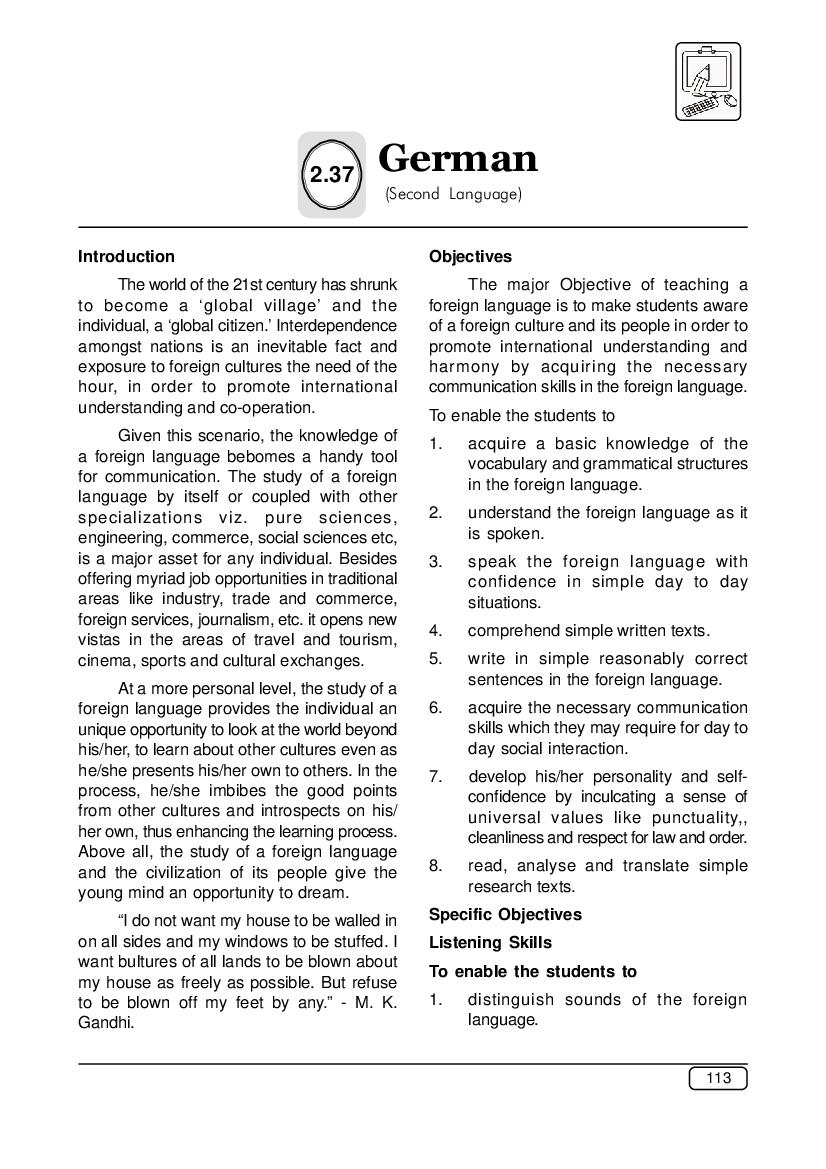
German
(Second Language)
Introduction Objectives
The world of the 21st century has shrunk The major Objective of teaching a
to become a ‘global village’ and the foreign language is to make students aware
individual, a ‘global citizen.’ Interdependence of a foreign culture and its people in order to
amongst nations is an inevitable fact and promote international understanding and
exposure to foreign cultures the need of the harmony by acquiring the necessary
hour, in order to promote international communication skills in the foreign language.
understanding and co-operation. To enable the students to
Given this scenario, the knowledge of 1. acquire a basic knowledge of the
a foreign language bebomes a handy tool vocabulary and grammatical structures
for communication. The study of a foreign in the foreign language.
language by itself or coupled with other
specializations viz. pure sciences, 2. understand the foreign language as it
engineering, commerce, social sciences etc, is spoken.
is a major asset for any individual. Besides 3. speak the foreign language with
offering myriad job opportunities in traditional confidence in simple day to day
areas like industry, trade and commerce, situations.
foreign services, journalism, etc. it opens new
4. comprehend simple written texts.
vistas in the areas of travel and tourism,
cinema, sports and cultural exchanges. 5. write in simple reasonably correct
sentences in the foreign language.
At a more personal level, the study of a
foreign language provides the individual an 6. acquire the necessary communication
unique opportunity to look at the world beyond skills which they may require for day to
his/her, to learn about other cultures even as day social interaction.
he/she presents his/her own to others. In the 7. develop his/her personality and self-
process, he/she imbibes the good points confidence by inculcating a sense of
from other cultures and introspects on his/ universal values like punctuality,,
her own, thus enhancing the learning process. cleanliness and respect for law and order.
Above all, the study of a foreign language
and the civilization of its people give the 8. read, analyse and translate simple
young mind an opportunity to dream. research texts.
“I do not want my house to be walled in Specific Objectives
on all sides and my windows to be stuffed. I Listening Skills
want bultures of all lands to be blown about
my house as freely as possible. But refuse
to be blown off my feet by any.” - M. K. 1. distinguish sounds of the foreign
Gandhi. language.
113
Page 2
reasonable length of time. with pauses, showing awareness of
3. listen for global understanding so as to Punctuation.
be able to identify main points. 3. read aloud, short texts, poems with
4. take dictation in a foreign language. appropriate rhythm.
5. follow simple texts, read aloud so as to 4. read silently with reasonable speed
answer simple questions set on them. depending on the text.
6. understand conversation in simple, 5. read texts silently for overall
familiar day to day situations. understanding (skimming) and for
finding Specific information.
7. listen to and understand simple texts
on the Cassette/CD. 6. deduce the meaning of words, phrases
8. listen to and understand a telephonic with the help of the context.
conversation. 7. read notices, advertisements, news
9. understand the nuances conveyed headlines and road signs etc.
through stress and intonation. 8. learn to club or group sentences into
Speaking Skills appropriate sense groups/grammatical
groups.
9. learn to use a dictionary and reference
1. pronounce words correctly in the foreign
material.
language.
10. and finally to be able to read for
2. make meaningful use of words, phrases
pleasure, knowledge or research.
and sentences in context.
Writing Skills
3. produce simple statements, questions,
commands and requests. To enable the students to
4. express his/her ideas coherently and 1. master the art of writing including the
logically in simple sentences. use of Punctuation marks, capital letters
5. answer questions on simple texts orally. and spellings.
6. narrate personal experiences, incidents 2. write grammatically acceptable and
and stories in brief. situationally appropriate forms of the
foreign language.
7. describe a situation or to describe a
picture. 3. write answers to questions based on
the texts or reading material as well as
8. converse appropriately in formal and
to personal response questions.
informal contexts.
4. frame statements, questions,
9. sing songs in the foreign language.
commands and requests for their
Reading Skills appropriate use in different contexts.
To enable the students to 5. develop a paragraph on a given subject
1. read aloud, with correct pronunciation, taking into abbount boherence, logical
stress and intonation. sequence and connective devices.
114
Page 3
given points. on the prescribed texts.
7. develop a story with the help of given 3. Oral/Conversational Skill
outlines/ points.
Std.X
8. write essays, compositions with the help
Course Book : Lernziel
of guidelines.
Lesson 8 to 15
9. describe a situation and events with the
of given guidelines. 1. Prose
10. write a short conversation with the help 60 pages (approximately)
of given guidelines. 2. Items of Grammar and Syntax
11. answer questions based on charts, a. Articles : Definite and indefinite
timetables, maps etc. b. Prepositions : Governing
12. fill up registration/ application form in a accusative, dative and governing
foreign language. both
Std. IX c. Verbs
Course Book- Lernziel i. Auxiliary Modal Verbs
Lessons from 1 to 7 ii. Weak, strong, mixed verbs
iii. Simple and compound verbs
1. Prose
iv. Impersonal verbs
about 60 pages
d. Adjectives : Qualitative, Numerical,
2. Items of Grammar and Syntax Demonstrative and Possessive
(a) Artibles : Indefinite, Definite e. Pronoun : Nominative, Accusative
(b) Prepositions and Dative
(c) Verbs f. Simple and compound sentence
(i) Regular and Irregular g. Tenses : Present, Perfect, Past
tense
(ii) Reflexive and Non-Reflexive
h. Cases : Accusative, Dative and
(iii) auxiliary verbs Genitive
(d) Adjectives- Qualitative, Numerical, Note : In addition to this grammar based on
Demonstrative and Possessive the prescribed texts.
(e) Pronouns - nominative, accusative 3. Oral/Conversational Skills
and dative
(f) Tenses : Present, Perfect.
115
Document Details
| Board / Org | Maharashtra Board |
| Exam | Class 10 |
| Type | Syllabus |
| Pages | 3 |
| Updated | 09 Jun 2026 |