KSET Syllabus Commerce
Finished viewing? Save it for later —
Download KSET Syllabus Commerce (PDF · 5 pages)About KSET Syllabus Commerce
KSET Syllabus Commerce is available here for free download. Published by Karnataka Exams for Karnataka State Eligibility Test, this syllabus can be viewed online or downloaded as a PDF (5 pages). Candidates preparing for Karnataka State Eligibility Test can use KSET Syllabus Commerce to understand the exam pattern, the type of questions asked, and the overall difficulty level.
Frequently Asked Questions
How can I download KSET Syllabus Commerce?
Open this page and click the Download button to save KSET Syllabus Commerce as a PDF. It is completely free on AglaSem Docs.
Is KSET Syllabus Commerce free to download?
Yes. KSET Syllabus Commerce can be viewed online and downloaded as a PDF free of cost on AglaSem Docs.
How many pages does KSET Syllabus Commerce have?
KSET Syllabus Commerce contains 5 pages, which you can read online or download together as a single PDF.
Where can I find more Karnataka State Eligibility Test study material?
You can find more Karnataka State Eligibility Test question papers, sample papers, syllabus, and answer keys on AglaSem Docs.
KSET Syllabus Commerce – Text
Read the full text of this syllabus below — useful to quickly search, copy and reference the content online without downloading the PDF.
📄 View text version (5 pages)
Page 1
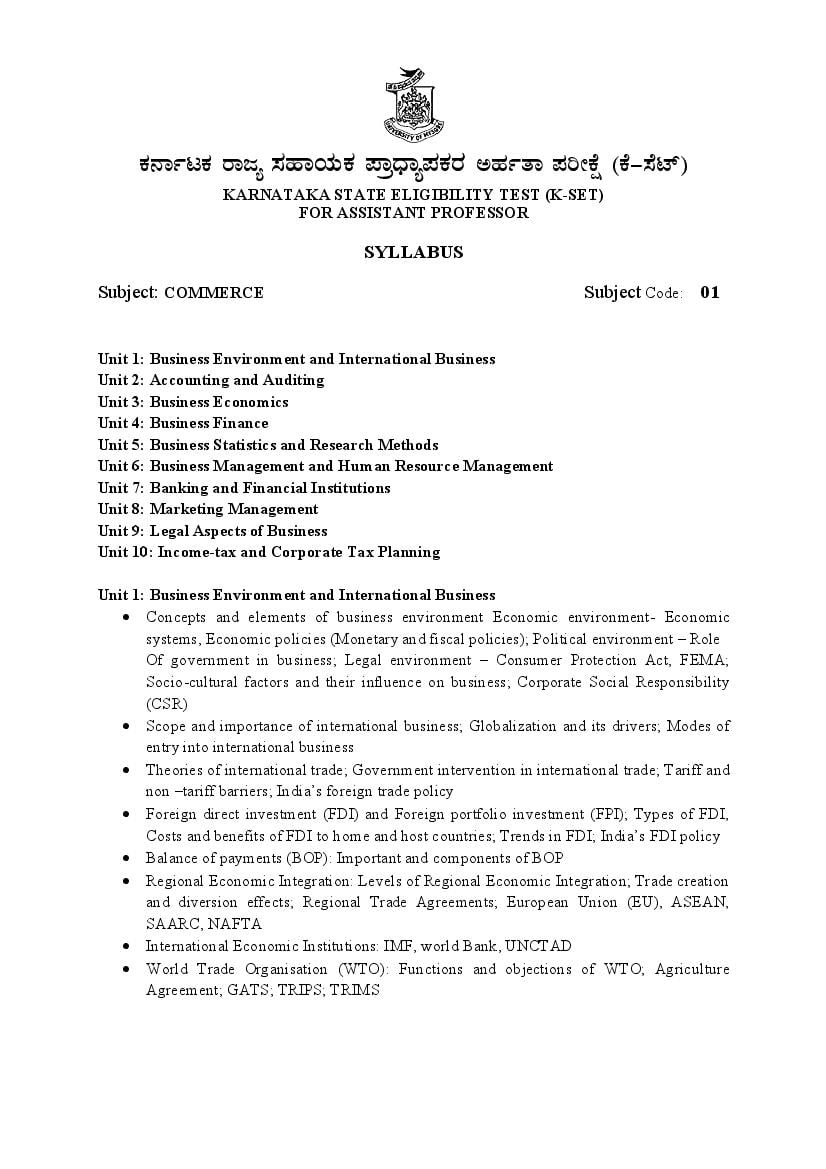
KARNATAKA STATE ELIGIBILITY TEST (K-SET)
FOR ASSISTANT PROFESSOR
SYLLABUS
Subject: COMMERCE Subject Code: 01
Unit 1: Business Environment and International Business
Unit 2: Accounting and Auditing
Unit 3: Business Economics
Unit 4: Business Finance
Unit 5: Business Statistics and Research Methods
Unit 6: Business Management and Human Resource Management
Unit 7: Banking and Financial Institutions
Unit 8: Marketing Management
Unit 9: Legal Aspects of Business
Unit 10: Income-tax and Corporate Tax Planning
Unit 1: Business Environment and International Business
Concepts and elements of business environment Economic environment- Economic
systems, Economic policies (Monetary and fiscal policies); Political environment – Role
Of government in business; Legal environment – Consumer Protection Act, FEMA;
Socio-cultural factors and their influence on business; Corporate Social Responsibility
(CSR)
Scope and importance of international business; Globalization and its drivers; Modes of
entry into international business
Theories of international trade; Government intervention in international trade; Tariff and
non –tariff barriers; India’s foreign trade policy
Foreign direct investment (FDI) and Foreign portfolio investment (FPI); Types of FDI,
Costs and benefits of FDI to home and host countries; Trends in FDI; India’s FDI policy
Balance of payments (BOP): Important and components of BOP
Regional Economic Integration: Levels of Regional Economic Integration; Trade creation
and diversion effects; Regional Trade Agreements; European Union (EU), ASEAN,
SAARC, NAFTA
International Economic Institutions: IMF, world Bank, UNCTAD
World Trade Organisation (WTO): Functions and objections of WTO; Agriculture
Agreement; GATS; TRIPS; TRIMS
Page 2
Basic accounting principles; concepts and postulates
Partnership Accounts: Admission, Retirement, Death, Dissolution and Insolvency of
partnership firms
Corporate Accounting: Issue, forfeiture and reissue of shares; Liquidation of companies;
Acquisition , merger, amalgamation and reconstruction of companies
Holidays company accounts
Cost and Management Accounting: Marginal costing and Break-even analysis; Standard
costing; Budgetary control; Process costing; Activity Based Costing (ABC); Costing for
decision-making; Life cycle costing, Target costing, Kaizen costing and JIT
Financial Statements Analysis: Ratio analysis; Funds flow Analysis; Cash flow analysis
Human Resources Accounting; Inflation Accounting; Environmental Accounting
Indian Accounting Standards and IFRS
Auditing: Independent financial audit; Vouching; Verification ad valuation of assets and
liabilities; Audit of financial statements and audit report; Cost audit
Recent Trends in Auditing; Management audit; Energy audit; Environment audit;
Systems audit; Safety audit
Unit 3: Business Economics
Meaning and scope of business economics
Objectives of business firms
Demand analysis: Law of demand; Elasticity of demand and its measurement;
Relationship between AR and MR
Consumer behavior: Utility analysis; Indifference curve analysis
Law of Variable Proportions: Law of Returns to Scale
Theory of cost: Short-run and long-run cost curves
Price determination under different market forms: Perfect competition; Monopolistic
competition; Oligopoly-Price leadership model; Monopoly; Price discrimination
Pricing strategies: Price skimming; Price penetration; Peak load pricing
Unit 4: Business Finance
Scope and sources of finance; Lease financing
Cost of capital and time value of money
Capital structure
Capital budgeting decisions; Conventional and scientific techniques of capital budgeting
analysis
Working capital management; Dividend decision; Theories and policies
Risk and returns analysis; Asset securitization
International monetary system
Page 3
International financial markets and instruments; Euro currency; GDRs; ADRs
International arbitrage; Multinational capital budgeting
Unit 5: Business Statistics and Research Methods
Measures of central tendency
Measures of dispersion
Measures of skewness
Correlation and regression of two variables
Probability: Approaches to probability; Bayes’ theorem
Probability distributions: Binomial, poisson and normal distributions
Research: Concept and types; Research designs
Data: Collection and classification of data
Sampling and estimation: Concepts; Methods of sampling – probability and non-
probability methods; Sampling distribution; Central limit theorem; standard error;
Statistical estimation
Hypothesis testing: z-test; t-test; ANOVA; Chi-square test; Mann-Whitney test (U-test);
Kruskal-Wallis test (H-test); Rank correlation test
Report writing
Unit 6: Business Management and Human Resource Management
Principles and functions of management
Organization structure: Formal and informal organizations; Span of control
Responsibility and authority: Delegation of authority and decentralization
Motivation and leadership: Concept and theories
Corporate governance and business ethics
Human resource management: Concept, role and functions of HRM; Human resource
planning; Recruitment and selection; Training and development; Succession planning
Compensation management: Job evaluation; Incentives and fringe benefits
Performance appraisal including 360 degree performance appraisal
Collective bargaining and workers’ participation in management
Personality: Perception; Attitudes; Emotions; Group dynamics; Power and politics;
Conflict and negotiations; Stress management
Organizational Culture: Organizational development and Organizational change
Unit 7: Banking and Financial Institutions
Overview of Indian financial system
Types of banks: Commercial banks; Regional Rural Banks (RRBs); Foreign banks;
Cooperative banks
Page 4
Banking sector reforms in India: Basel norms; Risk management; NPA management
Financial Institutions: Development Finance Institutions (DFIs); Non –Banking Financial
Companies (NBFCs); Mutual funds; Pension Funds
Financial Regulators in India
Digitisation of banking and other financial services: Internet banking; mobile banking;
Digital payments systems
Insurance: Types of insurance- Life and Non-life insurance; Risk classification and
management; Factors limiting the insurability of risk; RE-insurance; Regulatory
framework of insurance- IRDA and its role
Unit 8: Marketing Management
Marketing: Concept and approaches; Marketing channels; Marketing mix; Strategic
marketing planning; Market segmentation, targeting and positioning
Product decisions; Concept; Product line; Product mix decisions; Product life cycle; New
product development
Pricing decisions: Factors affecting price determination; Pricing policies and strategies
Promotion decisions: Role of promotion in marketing; Promotion methods – advertising;
Personal selling; Publicity; Sales promotion tools and techniques; Promotion mix
Distribution decisions: Channels of distribution; Channel management
Consumer Behavior; Consumer buying process; factors influencing consumer buying
decisions
Service marketing
Trends in marketing: Social marketing; Online marketing; Green marketing; direct
marketing; Rural marketing; CRM
Logistics management
Unit 9: Legal Aspects of Business
Indian Contract Act, 1872: Elements of a valid contract; Capacity of parties; Free
consent; discharge of a contract; Breach of contract and remedies against breach; Quasi
contracts;
Special contracts: Contracts of indemnity and guarantee; contracts of bailment and
pledge; Contracts of agency
Sale of Goods Act, 1930: Sale and agreement to sell; Doctrine of Caveat Emptor; rights
of unpaid seller and rights of buyer
Negotiable Instrument Act, 1881: Types of negotiable instruments; Negotiation and
assignment; Dishonour and discharge of negotiable instruments
The Companies Act, 2013: Nature and kinds of companies; Company formation;
Management, meeting and winding up of a joint stock company
Page 5
The Competition Act, 2002: Objectives and main provisions
The information Technology Act, 2000: Objectives and main provisions; Cyber crimes
and penalties
The RTI Act, 2005: Objectives and main provisions
Intellectual Property Rights (IPRs): Patents, trademarks and copyrights; Emerging issues
In intellectual property
Goods and Services Tax (GST): Objectives and main provisions; Benefits of GST;
Implementation mechanism; Working of dual GST
Unit 10: Income-tax and Corporate Tax Planning
Income-tax: Basic concepts; Residential status and tax incidence; Exempted incomes;
Agricultural income; computation of taxable income under various heads; Deductions
from Gross total income; Assessment of individuals; Clubbing of incomes
International Taxation: Double taxation and its avoidance mechanism; Transfer pricing
Corporate Tax Planning: Concepts and significance of corporate tax planning; Tax
avoidance versus tax evasion; Techniques of corporate tax planning; Tax consideration in
specific business situations; Make of buy decisions; Own or lease an asset; Retain;
Renewal or replacement of asset; Shut down or continue operations
Deduction and collection of tax at source; Advance payment of tax; E-filing of income-
tax returns
Document Details
| Board / Org | Karnataka Exams |
| Exam | Karnataka State Eligibility Test |
| Type | Syllabus |
| Pages | 5 |
| Updated | 24 Sep 2026 |