NIOS Class 12 October 2024 Question Paper Chemistry
Finished viewing? Save it for later —
Download NIOS Class 12 October 2024 Question Paper Chemistry (PDF · 15 pages)About NIOS Class 12 October 2024 Question Paper Chemistry
NIOS Class 12 October 2024 Question Paper Chemistry is available here for free download. Published by NIOS for National Institute of Open Schooling Class 12, this question paper can be viewed online or downloaded as a PDF (15 pages). Candidates preparing for National Institute of Open Schooling Class 12 can use NIOS Class 12 October 2024 Question Paper Chemistry to understand the exam pattern, the type of questions asked, and the overall difficulty level.
Frequently Asked Questions
How can I download NIOS Class 12 October 2024 Question Paper Chemistry?
Open this page and click the Download button to save NIOS Class 12 October 2024 Question Paper Chemistry as a PDF. It is completely free on AglaSem Docs.
Is NIOS Class 12 October 2024 Question Paper Chemistry free to download?
Yes. NIOS Class 12 October 2024 Question Paper Chemistry can be viewed online and downloaded as a PDF free of cost on AglaSem Docs.
How many pages does NIOS Class 12 October 2024 Question Paper Chemistry have?
NIOS Class 12 October 2024 Question Paper Chemistry contains 15 pages, which you can read online or download together as a single PDF.
Where can I find more National Institute of Open Schooling Class 12 study material?
You can find more National Institute of Open Schooling Class 12 question papers, sample papers, syllabus, and answer keys on AglaSem Docs.
NIOS Class 12 October 2024 Question Paper Chemistry – Text
Read the full text of this question paper below — useful to quickly search, copy and reference the content online without downloading the PDF.
📄 View text version (15 pages)
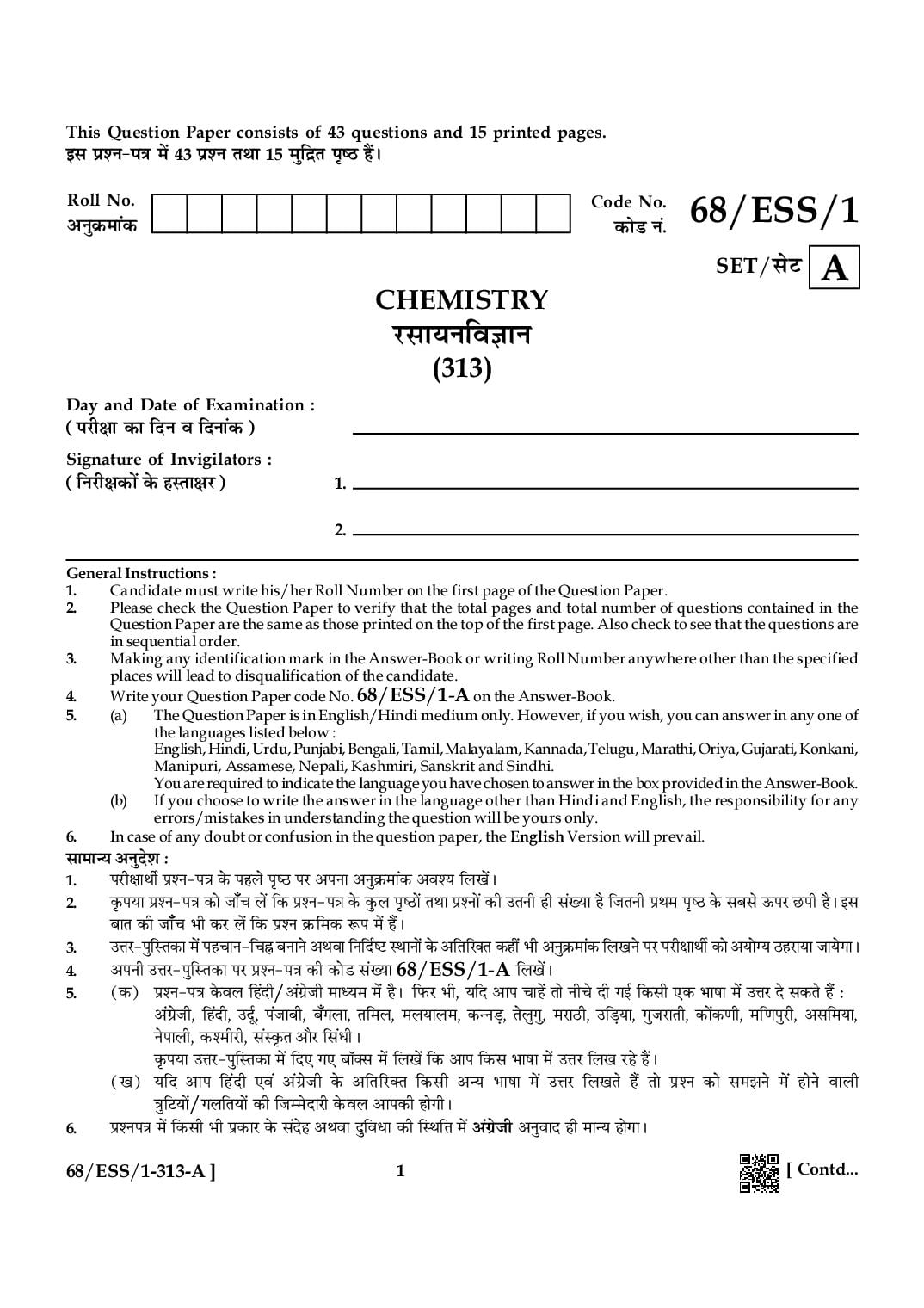
Page 1
ß‚ ¬˝‡Ÿ-¬òÊ ◊¥ 43 ¬˝‡Ÿ ÃÕÊ 15 ◊ÈÁŒ˝Ã ¬Îc∆U „Ò¥–
Roll No. Code No.
•ŸÈ∑˝§◊Ê¥∑§ ∑§Ê«U Ÿ¥.
68/ESS/1
SET/‚ ≈ A
CHEMISTRY
⁄U‚ÊÿŸÁflôÊÊŸ
(313)
Day and Date of Examination :
(¬⁄UˡÊÊ ∑§Ê ÁŒŸ fl ÁŒŸÊ¥∑§)
Signature of Invigilators :
(ÁŸ⁄UˡÊ∑§Ê¥ ∑§ „SÃÊˇÊ⁄U) 1.
2.
General Instructions :
1. Candidate must write his/her Roll Number on the first page of the Question Paper.
2. Please check the Question Paper to verify that the total pages and total number of questions contained in the
Question Paper are the same as those printed on the top of the first page. Also check to see that the questions are
in sequential order.
3. Making any identification mark in the Answer-Book or writing Roll Number anywhere other than the specified
places will lead to disqualification of the candidate.
4. Write your Question Paper code No. 68/ESS/1-A on the Answer-Book.
5. (a) The Question Paper is in English/Hindi medium only. However, if you wish, you can answer in any one of
the languages listed below :
English, Hindi, Urdu, Punjabi, Bengali, Tamil, Malayalam, Kannada, Telugu, Marathi, Oriya, Gujarati, Konkani,
Manipuri, Assamese, Nepali, Kashmiri, Sanskrit and Sindhi.
You are required to indicate the language you have chosen to answer in the box provided in the Answer-Book.
(b) If you choose to write the answer in the language other than Hindi and English, the responsibility for any
errors/mistakes in understanding the question will be yours only.
6. In case of any doubt or confusion in the question paper, the English Version will prevail.
‚Ê◊Êãÿ •ŸÈŒ‡Ê —
1. ¬⁄UˡÊÊÕ˸ ¬˝‡Ÿ-¬òÊ ∑§ ¬„‹ ¬Îc∆U ¬⁄U •¬ŸÊ •ŸÈ∑˝§◊Ê¥∑§ •fl‡ÿU Á‹π¥–
2. ∑Χ¬ÿÊ ¬˝‡Ÿ-¬òÊ ∑§Ê ¡ÊÚ°ø ‹¥ Á∑§ ¬˝‡Ÿ-¬òÊ ∑§ ∑ȧ‹ ¬Îc∆UÊ¥ ÃÕÊ ¬˝‡ŸÊ¥ ∑§Ë ©ÃŸË „Ë ‚¥ÅUÿÊ „Ò Á¡ÃŸË ¬˝Õ◊ ¬Îc∆ ∑ §‚’‚ ™§¬⁄U ¿U¬Ë „Ò– ß‚
’Êà ∑§Ë ¡ÊÚ°ø ÷Ë ∑§⁄U ‹¥ Á∑§ ¬˝‡Ÿ ∑˝ Á◊∑§ UM§¬ ◊¥ „Ò¥–
3. § ©ûÊ⁄U-¬ÈÁSUÃ∑§Ê ◊¥ ¬„øÊŸ-Áøq ’ŸÊŸ •ÕflÊ ÁŸÁŒ¸c≈U SÕÊŸÊ¥ ∑§§•ÁÃÁ⁄UÄà ∑§„Ë¥ ÷Ë •ŸÈ∑§˝ ◊Ê¥∑§ Á‹πŸ ¬⁄U ¬⁄UˡÊÊÕ˸ ∑§Ê •ÿÊÇÿ ∆U„⁄UÊÿÊ ¡ÊÿªÊ–
4. •¬ŸË ©ûÊ⁄U-¬ÈÁSUÃ∑§Ê ¬⁄U ¬˝‡Ÿ-¬òÊ ∑§Ë ∑§Ê«U ‚¥ÅÿÊ 68/ESS/1-A Á‹π¥–
5. (∑§) ¬˝‡Ÿ-¬òÊ ∑§fl‹ Á„¥ŒË/•¥ª˝¡Ë ◊Êäÿ◊ ◊¥ „Ò– Á»§⁄U ÷Ë, ÿÁŒ •Ê¬ øÊ„¥ ÃÊ ŸËø ŒË ªß¸ Á∑§‚Ë ∞∑§ ÷Ê·Ê ◊¥ ©ûÊ⁄ Œ ‚∑§Ã „Ò¥ —
•¥ª˝¡Ë, Á„¥ŒË, ©ŒÍ¸, ¬¥¡Ê’Ë, ’°ª‹Ê, ÃÁ◊‹, ◊‹ÿÊ‹◊, ∑§ãŸ«∏, ËȪÈ, ◊⁄UÊ∆UË, ©Á«∏ÿÊ, ªÈ¡⁄UÊÃË, ∑§Ê¥∑§áÊË, ◊ÁáʬÈ⁄UË, •‚Á◊ÿÊ,
Ÿ¬Ê‹Ë, ∑§‡◊Ë⁄UË, ‚¥S∑Χç•ÊÒ⁄U Á‚¥œË–
∑Χ¬ÿÊ ©ûÊ⁄U-¬ÈÁSÃ∑§Ê ◊¥ ÁŒ∞ ª∞ ’ÊÚÄ‚ ◊¥ Á‹π¥ Á∑§ •Ê¬ Á∑§‚ ÷Ê·Ê ◊¥ ©ûÊ⁄U Á‹π ⁄U„ „Ò¥–
(π) ÿÁŒ •Ê¬ Á„¥ŒË ∞fl¥ •¥ª˝¡Ë ∑§ •ÁÃÁ⁄UÄà Á∑§‚Ë •ãÿ ÷Ê·Ê ◊¥ ©ûÊ⁄U Á‹πà „Ò¥ ÃÊ ¬˝‡Ÿ ∑§Ê ‚◊¤ÊŸ ◊¥ „ÊŸ flÊ‹Ë
òÊÈÁ≈UÿÊ¥/ª‹ÁÃÿÊ¥ ∑§Ë Á¡ê◊UŒÊ⁄Ë ∑ fl‹ •Ê¬∑§Ë „ʪ˖
6. ¬˝‡Ÿ¬òÊ ◊¥ Á∑§‚Ë ÷Ë ¬˝∑§Ê⁄U ∑§ ‚¥Œ„ •ÕflÊ ŒÈÁflœÊ ∑§Ë ÁSÕÁà ◊¥ •¥ª˝¡Ë •ŸÈflÊŒ „Ë ◊Êãÿ „ʪʖ
68/ESS/1-313-A ] 1 [ Contd...
Page 2
⁄U‚ÊÿŸÁflôÊÊŸ
(313)
Time : 3 Hours ] [ Maximum Marks : 80
‚◊ÿ — 3 ÉÊá≈U ] [ ¬ÍáÊÊZ∑§ — 80
Note : (i) This question paper consists of 43 questions in all.
(ii) All questions are compulsory.
(iii) Marks are given against each question.
(iv) Use log tables if necessary.
(v) Section A consists of
(a) Q. No. 1 to 16 - Multiple choice type questions (MCQs) carrying 1 marks each.
Select and write the most appropriate option out of the four options given in each
of these questions.
(b) Q. No. 17 to 28 - Objective type questions. Q. No. 17 to 28 carry 2 mark each
(with 2 sub-parts of 1 mark each). Attempt these questions as per the instructions
given for each of the questions 17 to 28.
(vi) Section B consists of
(a) Q. No. 29 to 37 - Very short answer type questions carrying 2 marks each to be
answered in the range of 30 to 50 words.
(b) Q. No. 38 to 41 - Short answer type questions carrying 3 marks each to be
answered in the range of 50 to 80 words.
(c) Q. No. 42 and 43 - Long answer type questions carrying 5 marks each to be
answered in the range of 80 to 120 words.
ÁŸŒ¸‡Ê — (i) ß‚ ¬˝‡Ÿ ¬òÊ ◊¥ ∑ȧ‹ 43 ¬˝‡Ÿ „Ò¥–
(ii) ‚÷Ë ¬˝‡Ÿ •ÁŸflÊÿ¸ „Ò¥–
(iii) ¬˝àÿ∑§ ¬˝‡Ÿ ∑§ ‚Ê◊Ÿ •¥∑§ ÁŒÿ ªÿ „Ò¥–
(iv) •Êfl‡ÿ∑§ „ÊŸ ¬⁄U ‹ÉÊȪáÊ∑§ ÃÊÁ‹∑§Ê ∑§Ê ¬˝ÿʪ ∑§⁄¥U–
(v) πá«U A ◊¥
(a) ¬˝‡Ÿ ‚¥ÅÿÊ 1 ‚ 16 - ’„ÈÁfl∑§À¬Ëÿ ¬˝∑§Ê⁄U ∑§ ¬˝‡Ÿ „Ò¥, ¡Ê ¬˝àÿ∑§ 1 •¥∑§ ∑§Ê „Ò– ߟ ¬˝‡ŸÊ¥ ◊¥ ¬˝àÿ∑§
◊¥ ÁŒÿ ªÿ øÊ⁄U Áfl∑§À¬Ê¥ ◊¥ ‚ ‚’‚ ©¬ÿÈÄà Áfl∑§À¬ øÈÁŸÿ •ÊÒ⁄U Á‹Áπ∞–
(b) ¬˝‡Ÿ ‚¥ÅÿÊ 17 ‚ 28 - flSÃÈÁŸc∆U ¬˝‡Ÿ „Ò¥, ¬˝‡Ÿ ‚¥ÅÿÊ 17 ‚ 28 Ã∑§ ¬˝àÿ∑§ ¬˝‡Ÿ 2 •¥∑§Ê¥ ∑§Ê „Ò (ŒÊ
©¬÷ʪ ∑§ ‚ÊÕ ¬˝àÿ∑§ ∑§Ê 1 •¥∑§)– ¬˝‡Ÿ ‚¥ÅÿÊ 17 ‚ 28 ◊¥ ¬˝àÿ∑§ ¬˝‡Ÿ ◊¥ ŒË ªß¸ ‚ÍøŸÊ •ŸÈ‚Ê⁄U
¬˝‡ŸÊ¥ ∑§ ©ûÊ⁄U ŒËÁ¡∞–
(vi) πá«U B ◊¥
(a) ¬˝‡Ÿ ‚¥ÅÿÊ 29 ‚ 37 - •ÁËÉÊÈ ©ûÊ⁄UËÿ ¬˝∑§Ê⁄U ∑§ ¬˝‡Ÿ „Ò¥, ¬˝àÿ∑§ ∑§ 2 •¥∑§ „Ò¥ •ÊÒ⁄U ©ûÊ⁄U ∑§Ë ‚Ë◊Ê
30 ‚ 50 ‡ÊéŒ „Ò–
(b) ¬˝‡Ÿ ‚¥ÅÿÊ 38 ‚ 41 - ‹ÉÊÈ ©ûÊ⁄UËÿ ¬˝∑§Ê⁄U ∑§ ¬˝‡Ÿ „Ò¥, ¬˝àÿ∑§ ∑§ 3 •¥∑§ „Ò¥ •ÊÒ⁄U ©ûÊ⁄U ∑§Ë ‚Ë◊Ê 50 ‚
80 ‡ÊéŒ „Ò–
(c) ¬˝‡Ÿ ‚¥ÅÿÊ 42 •ÊÒ⁄ 43 - ŒËÉʸ ©ûÊ⁄UËÿ ¬˝∑§Ê⁄U ∑§ ¬˝‡Ÿ „Ò¥, ¬˝àÿ∑§ ∑§ 5 •¥∑§ „Ò¥ •ÊÒ⁄U ©ûÊ⁄U ∑§Ë ‚Ë◊Ê 80
‚ 120 ‡ÊéŒ „Ò–
68/ESS/1-313-A ] 2 [ Contd...
Page 3
(1) Answers of all questions are to be given in the Answer-Book given to you.
‚÷Ë ¬˝‡ŸÊ¥ ∑§ ©ûÊ⁄U •Ê¬∑§Ê ŒË ªß¸ ©ûÊ⁄U-¬ÈÁSÃ∑§Ê ◊¥ „Ë Á‹π¥–
(2) 15 minutes time has been allotted to read this Question Paper. The Question Paper will be
distributed at 2 : 15 p.m. From 2 : 15 p.m. to 2 : 30 p.m., the students will read the Question
Paper only and will not write any answer on the Answer-Book during his period.
ß‚ ¬˝‡Ÿ-¬òÊ ∑§Ê ¬…∏Ÿ ∑§ Á‹∞ 15 Á◊≈UŸ ∑§Ê ‚◊ÿ ÁŒÿÊ ªÿÊ „Ò– ¬˝‡Ÿ-¬òÊ ∑§Ê ÁflÃ⁄UáÊ ŒÊ¬„⁄U ◊¥ 2 : 15 ’¡ Á∑§ÿÊ
¡Ê∞ªÊ– 2 : 15 ’¡ ‚ 2 : 30 ’¡ Ã∑§ ¿UÊòÊ ∑§fl‹ ¬˝‡Ÿ-¬òÊ ∑§Ê ¬…∏¥ª •ÊÒ⁄U ß‚ •flÁœ ∑§ ŒÊÒ⁄UÊŸ fl ©ûÊ⁄U-¬ÈÁSÃ∑§Ê ¬⁄U
∑§Ê߸ ©ûÊ⁄U Ÿ„Ë¥ Á‹π¥ª–
SECTION - A/πá«UU - A
MCQ Questions/’„ÈÁfl∑§À¬Ëÿ ¬˝‡Ÿ
Note : Q.No. 1 to 16 are multiple choice questions of 1 mark each.
ŸÊ≈U — ¬˝‡Ÿ ‚¥ÅÿÊ 1 ‚ 16 ’„ÈÁfl∑§À¬Ëÿ ¬˝∑§Ê⁄U ∑§ ¬˝‡Ÿ „Ò¥ ¡Ê ¬˝àÿ∑§ 1 •¥∑§ ∑§Ê „Ò–
1. One atomic mass unit is equal to : 1
(A) Mass of one mole of C−12 atoms
Mass of one C − 12 atom
(B)
12
(C) Mass of one C−12 atom×12
Mass of one mole of C − 12 atoms
(D)
12
∞∑§ ¬⁄U◊ÊÁáfl∑§ Œ˝√ÿ◊ÊŸ ◊ÊòÊ∑§ ’⁄UÊ’⁄U „Ò —
(A) C−12 ¬⁄U◊ÊáÊÈ•Ê¥ ∑§ ∞∑§ ◊Ê‹ ∑§ Œ˝√ÿ◊ÊŸ ∑§
C − 12 ∑§§ ∞∑§ ¬⁄U◊ÊáÊÈ ∑§ §Œ˝√ÿ◊ÊŸ
(B) ∑§§
12
(C) C−12 ∑§ ∞∑§ ¬⁄U◊ÊáÊÈ ∑§ Œ˝√ÿ◊ÊŸ ×12 ∑§
C − 12 ¬⁄U◊ÊáÊÈ•Ê¥ ∑§ § ∞∑§ ◊Ê‹ ∑§§ Œ˝√ÿ◊ÊŸ
(D) ∑§§
12
2. In every chemical reaction, total mass of all the reactants is equal to the total mass of all the 1
products. This statement is according to :
(A) Law of constant proportions (B) Law of multiple proportions
(C) Law of conservation of mass (D) Postulates of Dalton’s atomic theory
¬˝àÿ∑§ ⁄UÊ‚ÊÿÁŸ∑§ •Á÷Á∑˝§ÿÊ ◊¥ ‚÷Ë •Á÷∑§◊¸∑§Ê¥ ∑§Ê ‚ê¬Íáʸ Œ˝√ÿ◊ÊŸ ‚÷Ë ©à¬ÊŒÊ¥ ∑§ ‚ê¬Íáʸ Œ˝√ÿ◊ÊŸ ∑§ ’⁄UÊ’⁄U „ÊÃÊ
„Ò– ÿ„ ∑§ÕŸ ÁŸêŸ ◊¥ ‚ Á∑§‚∑§ •ŸÈ‚Ê⁄U „Ò?
(A) ÁSÕ⁄U •ŸÈ¬Êà ∑§Ê ÁŸÿ◊ (B) ªÈÁáÊà •ŸÈ¬Êà ∑§Ê ÁŸÿ◊
(C) Œ˝√ÿ◊ÊŸ-‚¥⁄UˇÊáÊ ∑§Ê ÁŸÿ◊ (D) «UÊÀ≈UŸ ¬⁄U◊ÊáÊÈ Á‚hʥà ∑§Ë •flœÊ⁄UáÊÊ
3. In the species 199
80 Hg
, the number of protons, neutrons and electrons respectively are : 1
(A) 80, 119, 80 (B) 80, 199, 80 (C) 119, 80, 119 (D) 199, 80, 199
S¬Ë‡ÊË$¡ 199
80 Hg
◊¥, ¬˝Ê≈UÊŸÊ¥, ãÿÍ≈˛UÊÚŸÊ¥ ∞fl¥ ß‹Ä≈˛UÊÚŸÊ¥ ∑§Ë ‚¥ÅÿÊ ∑˝§◊‡Ê— „Ò¥ —
(A) 80, 119, 80 (B) 80, 199, 80 (C) 119, 80, 119 (D) 199, 80, 199
68/ESS/1-313-A ] 3 [ Contd...
Page 4
solution is known as :
(A) Molarity (B) Molality (C) Normality (D) Mole fraction
Áfl‹ÿŸ ◊¥ Á∑§‚Ë ∞∑§ ÉÊ≈U∑§ ∑§ ◊Ê‹Ê¥ ∑§Ë ‚¥ÅÿÊ ∑§Ê ◊Ê‹Ê¥ ∑§Ë ∑ȧ‹ ‚¥ÅÿÊ ∑§ ‚ÊÕ •ŸÈ¬Êà ∑§Ê ∑§„à „Ò¥ —
(A) ◊Ê‹⁄UÃÊ (B) ◊Ê‹‹ÃÊ (C) ŸÊÚ◊¸‹ÃÊ (D) ◊Ê‹ •¥‡Ê
5. Adiabatic processes proceeds with : 1
(A) a change in temperature
(B) no change in temperature
(C) a change in pressure
(D) an exchange of heat between the system and the surroundings
M§hÊc◊ ¬˝∑˝§◊ „ÊÃÊ „Ò —
(A) Ãʬ ◊¥ ¬Á⁄UfløŸ ∑§ ‚ÊÕ
(B) Ãʬ ◊¥ ¬Á⁄UfløŸ Á∑§∞ Á’ŸÊ
(C) ŒÊ’ ◊¥ ¬Á⁄UfløŸ ∑§ ‚ÊÕ
(D) ÁŸ∑§Êÿ ÃÕÊ ¬Á⁄Ufl‡Ê ◊¥ ™§c◊Ê-ÁflÁŸ◊ÿ ∑§ ‚ÊÕ
6. The standard enthalpy of atomisation of a substance is the change in enthalpy when : 1
(A) One mole of a substance is converted into its atoms in gaseous state at 258C and 1 bar
pressure.
(B) One molecule of a substance is converted into its atoms in gaseous state at 258C and
1 bar pressure.
(C) One mole of a substance is converted into its atoms in gaseous state at a given temperature
and 1 bar pressure.
(D) One molecule of a substance is converted into its atom in gaseous state at a given
temperature and 1 bar pressure.
Á∑§‚Ë ¬ŒÊÕ¸ ∑§Ë ¬⁄U◊ÊáÊÈ ∑§áÊŸ ∑§Ë ◊ÊŸ∑§ ∞ãÕÒÀ¬Ë fl„ ∞ãÕÒÀ¬Ë ¬Á⁄UfløŸ „Ò ¡’ —
(A) ªÒ‚Ëÿ •flSÕÊ ◊¥ 258C •ÊÒ⁄U ∞∑§ ’Ê⁄U ŒÊ’ ¬⁄U ¬ŒÊÕ¸ ∑§Ê ∞∑§ ◊Ê‹ ©‚∑§ ∑§áÊÊ¥ ◊¥ ¬Á⁄UflÁøà „Ê ¡ÊÃÊ „Ò–
(B) ªÒ‚Ëÿ •flSÕÊ ◊¥ 258C •ÊÒ⁄U ∞∑§ ’Ê⁄U ŒÊ’ ¬⁄U ¬ŒÊÕ¸ ∑§Ê ∞∑§ •áÊÈ ©‚∑§ ∑§áÊÊ¥ ◊¥ ¬Á⁄UflÁøà „Ê ¡ÊÃÊ „Ò–
(C) ªÒ‚Ëÿ •flSÕÊ ◊¥ Á∑§‚Ë ÁŒ∞ ª∞ Ãʬ◊ÊŸ •ÊÒ⁄U ∞∑§ ’Ê⁄U ŒÊ’ ¬⁄U ¬ŒÊÕ¸ ∑§Ê ∞∑§ ◊Ê‹ ©‚∑§ ∑§áÊÊ¥ ◊¥ ¬Á⁄UflÁøÃ
„Ê ¡ÊÃÊ „Ò–
(D) ªÒ‚Ëÿ •flSÕÊ ◊¥ Á∑§‚Ë ÁŒ∞ ª∞ Ãʬ◊ÊŸ •ÊÒ⁄U ∞∑§ ’Ê⁄ UŒÊ’ ¬⁄U ¬ŒÊÕ¸ ∑§Ê ∞∑§ •áÊÈ ©‚∑§ ∑§áÊÊ¥ ◊¥ ¬Á⁄UflÁøÃ
„Ê ¡ÊÃÊ „Ò–
7. The extent of ionisation of weak acids or bases and the strength of weak acids or a bases 1
are :
(A) directly related to each other (B) inversely related to each other
(C) exponentially related to each other (D) not related to each other
ŒÈ’¸‹ •ê‹Ê¥ •ÕflÊ ˇÊÊ⁄UÊ¥ ∑§Ë •ÊÿŸŸ ∑§Ë ‚Ë◊Ê •ÊÒ⁄U ŒÈ’¸‹ •ê‹Ê¥ ÿÊ ˇÊÊ⁄UÊ¥ ∑§Ë ¬˝’‹ÃÊ —
(A) ∞∑§ ŒÍ‚⁄U ‚ ‚Ëœ ‚¥’¥ÁœÃ „Ò¥ (B) ∞∑§ ŒÍ‚⁄U ‚ ¬˝ÁËÊÁ◊à M§¬ ‚ ‚¥’¥ÁœÃ „Ò¥
(C) ∞∑§ ŒÍ‚⁄U ‚ ÉÊÊÃËÿ M§¬ ‚ ‚¥’¥ÁœÃ „Ò¥ (D) ∞∑§ ŒÍ‚⁄U ‚ ‚¥’¥ÁœÃ Ÿ„Ë¥ „Ò¥
68/ESS/1-313-A ] 4 [ Contd...
Page 5
(A) donation of H+ ion and OH− ion respectively
(B) formation of H3O+ ion and OH− ion
(C) donation of proton and acceptance of proton respectively
(D) acceptance of proton and donation of proton respectively
•ê‹ •ÊÒ⁄U ˇÊÊ⁄U ∑§ ‚¥Œ÷¸ ◊¥ ’˝ÊÚS≈U«U - ‹ÊÚ⁄UË ∑§Ë œÊ⁄UáÊÊ ∑˝§◊‡Ê— •ÊœÊÁ⁄Uà „Ò —
(A) H+ •ÊÿŸ •ÊÒ⁄U OH− •ÊÿŸ ŒŸ ∑§Ë ¬˝flÎÁûÊ ¬⁄U
(B) H3O+ •ÊÿŸ •ÊÒ⁄U OH− •ÊÿŸ ∑§ ’ŸŸ ¬⁄U
(C) ¬˝Ê≈UÊÚŸ ∑§Ê ŒŸ •ÊÒ⁄U ¬˝Ê≈UÊÚŸ ∑§Ê ª˝„áÊ ∑§⁄UŸ ∑§Ë ¬˝flÎÁûÊ ¬⁄U
(D) ¬˝Ê≈UÊÚŸ ∑§Ê ª˝„áÊ ∑§⁄UŸ •ÊÒ⁄U ¬˝Ê≈UÊÚŸ ∑§Ê ŒŸ ∑§Ë ¬˝flÎÁûÊ ¬⁄U
9. The factors affecting conductivity of an electrolyte are : 1
(A) nature of the electrolyte and temperature
(B) nature of the electrolyte and concentration
(C) temperature and concentration
(D) nature of the electrolyte, temperature and concentration
Á∑§‚Ë ÁfllÈà •¬ÉÊ≈K ∑§Ë øÊ‹∑§ÃÊ ∑§Ê ¬˝÷ÊÁflà ∑§⁄UŸ flÊ‹ ∑§Ê⁄U∑§ „Ò¥ —
(A) ÁfllÈà •¬ÉÊ≈K ∑§Ë ¬˝∑ΧÁà •ÊÒ⁄U Ãʬ◊ÊŸ
(B) ÁfllÈà •¬ÉÊ≈K ∑§Ë ¬˝∑ΧÁà •ÊÒ⁄U ‚Ê¥Œ˝ÃÊ
(C) Ãʬ◊ÊŸ •ÊÒ⁄U ‚Ê¥Œ˝ÃÊ
(D) ÁfllÈà •¬ÉÊ≈K ∑§Ë ¬˝∑ΧÁÃ, Ãʬ◊ÊŸ •ÊÒ⁄U ‚Ê¥Œ˝ÃÊ
10. Which of the following is not a function of salt bridge ? 1
(A) It completes the inner circuit.
(B) It completes the outer circuit.
(C) It maintains electrical neutrality.
(D) It prevents accumulation of charges in the two half cells.
ÁŸêŸÁ‹Áπà ◊¥ ‚ ∑§ÊÒŸ ‚Ê ¬˝∑§Êÿ¸, ‚ÊÀ≈U Á’˝¡ (‹fláÊ ‚ÃÈ) ∑§Ê ¬˝∑§Êÿ¸ Ÿ„Ë¥ „Ò?
(A) ÿ„ •Ê¥ÃÁ⁄U∑§ ‚Á∑¸§≈U ∑§Ê ¬Í⁄UÊ ∑§⁄UÃÊ „Ò–
(B) ÿ„ ’Ê„⁄UË ‚Á∑¸§≈U ∑§Ê ¬Í⁄UÊ ∑§⁄UÃÊ „Ò–
(C) ÿ„ flÒlÈà ÁŸ⁄U¬ˇÊÃÊ ∑§Ê ’ŸÊ∞ ⁄UπÃÊ „Ò–
(D) ÿ„ ŒÊŸÊ¥ •œ¸‚‹Ê¥ ∑§ Áfl‹ÿŸÊ¥ ◊¥ •Êfl‡Ê ∑§ ∞∑§òÊáÊ ∑§Ê ⁄UÊ∑§ÃÊ „Ò–
11. Choose the most electronegative element from the following : 1
(A) Nitrogen (B) Oxygen (C) Sulphur (D) Fluorine
ÁŸêŸÁ‹Áπà ◊¥ ‚ ‚flʸÁœ∑§ ÁfllÈà ´§áÊÊà◊∑§ Ãàfl ¿UÊ°Á≈U∞ —
(A) ŸÊß≈˛UÊ¡Ÿ (B) •ÊÚÄ‚Ë¡Ÿ (C) ‚À»§⁄U (D) ç‹È•Ê⁄UËŸ
68/ESS/1-313-A ] 5 [ Contd...
Page 6
(A) Yttrium to Lanthanum (B) Scandium to Copper
(C) Scandium to Zinc (D) Actinium to Lawrencium
‚¥∑˝§◊áÊ œÊÃÈ•Ê¥/ÃàflÊ¥ ∑§Ë 3d ‚¥∑˝§◊áÊ üÊáÊË —
(A) ßÁ≈˛Uÿ◊ ‚ ‹Ò¥ÕŸ◊ Ã∑§ „Ò (B) S∑Ò¥§Á«Uÿ◊ ‚ ÃÊ◊˝ Ã∑§ „Ò
(C) S∑Ò¥§Á«Uÿ◊ ‚ ÿ‡ÊŒ Ã∑§ „Ò (D) ∞Ä≈UËÁŸÿ◊ ‚ ‹Ê⁄¥UÁ‚ÿ◊ Ã∑§ „Ò
13. Lanthanide contraction is due to increase in : 1
(A) Shielding by 4f electrons (B) Atomic number
(C) Effective nuclear charge (D) Size of 4f orbital
‹ÒãÕŸÊß«U ‚¥∑ȧøŸ, ÁŸêŸ ◊¥ flÎÁh ∑§ ∑§Ê⁄UáÊ „ÊÃÊ „Ò —
(A) 4f ß‹Ä≈˛UÊÚŸÊ¥ mÊ⁄UÊ ¬Á⁄U⁄UˇÊáÊ (B) ¬⁄U◊ÊáÊÈ ‚¥ÅÿÊ
(C) ¬˝÷ÊflË ŸÊÁ÷∑§Ëÿ •Êfl‡Ê (D) 4f ∑§ˇÊ∑§ ∑§Ê •Ê∑§Ê⁄U
14. Geometrical isomerism is shown by isomers in which first coordination sphere is same but 1
geometrical arrangement of ligands varies. This isomerism is only possible for coordination
number :
(A) greater than or equal to four (B) less than or equal to four
(C) greater than or equal to two (D) equal to two
íÿÊÁ◊ÃËÿ ‚◊ÊflÿflÃÊ ©Ÿ ‚◊ÊflÿflÊ¥ mÊ⁄UÊ Œ‡Êʸ߸ ¡ÊÃË „Ò Á¡Ÿ◊¥ ¬˝Õ◊ ©¬‚„‚¥ÿÊ¡∑§ÃÊ ∑§Ê ‚¥ÉÊ≈U∑§ ∞∑§ ‚◊ÊŸ „ÊÃÊ
„Ò, ‹Á∑§Ÿ Á‹ªÚã«U ∑§Ë íÿÊÁ◊ÃËÿ √ÿflSÕÊ Á÷㟠„ÊÃË „Ò– ÿ„ ‚◊ÊflÿflÃÊ ‚¥÷fl „ÊÃË „Ò Á¡Ÿ∑§Ë ©¬‚„‚¥ÿÊ¡∑§ÃÊ
‚¥ÅÿÊ „ÊÃË „Ò ∑§fl‹ —
(A) øÊ⁄U ‚ •Áœ∑§ ÿÊ øÊ⁄U ∑§ ’⁄UÊ’⁄U (B) øÊ⁄U ‚ ÁŸêŸ ÿÊ øÊ⁄U
(C) ŒÊ ‚ •Áœ∑§ ÿÊ ŒÊ ∑§ ’⁄UÊ’⁄U (D) ŒÊ ∑§ ’⁄UÊ’⁄U
15. Vulcanization of rubber produces : 1
(A) an elastomer (B) a thermoplastic polymer
(C) a thermosetting polymer (D) a plasticizer
⁄U’⁄U ∑§Ê flÀ∑§ŸË∑§⁄UáÊ ©à¬ãŸ ∑§⁄UÃÊ „Ò —
(A) ∞∑§ ¬˝àÿÊSÕÊ‹∑§ (B) ∞∑§ Õ◊ʸå‹ÊÁS≈U∑§ ’„È‹∑§
(C) ∞∑§ Õ◊ʸ‚Á≈¥Uª ’„È‹∑§ (D) ∞∑§ å‹ÊÁS≈U‚Êß¡⁄U
16. Low density polythene : 1
(A) has linear chain of molecules
(B) has branching in polymer chains
(C) is packed in a compact fashion
(D) is harder and stronger than polypropylene
∑§◊ ÉÊŸàfl flÊ‹ ¬ÊÚ‹Ë∞ÕËŸ ◊¥ —
(A) •áÊÈ•Ê¥ ∑§Ë ⁄UπËÿ oÎ¥π‹Ê∞° „ÊÃË „Ò¥–
(B) ’„È‹∑§ oÎÎ¥π‹Ê∞° ‡ÊÊÁπà „ÊÃË „Ò¥–
(C) •áÊÈ•Ê¥ ∑§Ë oÎ¥π‹Ê∞° ÉÊŸM§¬ ‚ ‚¥∑§Á‹Ã „ÊÃË „Ò¥–
(D) ¬Êڋˬ˝ÊÁ¬‹ËŸ ∑§Ë •¬ˇÊÊ ∑§∆UÊ⁄U ∞fl¥ ŒÎ…∏ „ÊÃË „Ò¥–
68/ESS/1-313-A ] 6 [ Contd...
Page 7
ŸÊ≈U — ¬˝‡Ÿ ‚¥ÅÿÊ 17 ‚ 28 flSÃÈÁŸc∆U ¬˝‡Ÿ „Ò¥– ¬˝àÿ∑§ ¬˝‡Ÿ ŒÊ •¥∑§Ê¥ ∑§Ê „Ò–
17. Complete the following by given options below : 2
(CHO, CH2O, CHO2, 27.59%, 72.41%, 27.89%)
(1) The empirical formula of fructose is __________.
(2) The percentage of oxygen in Fe3O4 is __________.
(Atomic mass of Fe is 56.0 amu)
ÁŸêŸÁ‹Áπà Á⁄UÄà SÕÊŸÊ¥ ∑§Ê ÁŒ∞ ª∞ Áfl∑§À¬Ê¥ ◊¥ ‚ øÿŸ ∑§⁄U∑§ ¬Íáʸ ∑§ËÁ¡ÿ —
(CHO, CH2O, CHO2, 27.59%, 72.41%, 27.89%)
(1) »˝§Ä≈UÊ‚ ∑§Ê ◊͋ʟȬÊÃË ‚ÍòÊ __________ „Ò–
(2) Fe3O4 ◊¥ •ÊÚÄ‚Ë¡Ÿ __________ ¬˝ÁÇÊà „Ò–
(Fe ∑§Ê ¬⁄U◊ÊáÊÈ Œ˝√ÿ◊ÊŸ 56.0 amu „Ò )
18. Read the passage and answer the following questions : 2
Louis de-Broglie proposed that if light can show particle as well as wave nature, why should
particles of matter not possess wave like characteristics ? On this wave-particle duality of
matter and radiation, Heisenberg stated that more accurately you measure a particle’s position,
the less accurately you are able to measure its momentum and vice-versa.
(1) Give the mathematical expression of de-Broglie equation.
(2) State Heisenberg’s uncertainty principle.
ŸËø ÁŒÿÊ ªÿÊ ¬Á⁄Uë¿UŒ ¬Á…∏ÿ •ÊÒ⁄U ÁŸêŸÁ‹Áπà ¬˝‡ŸÊ¥ ∑§ ©ûÊ⁄U ŒËÁ¡ÿ —
‹È߸-ŒË-’˝ÊÚª‹Ë Ÿ ¬˝ÁìÊÁŒÃ Á∑§ÿÊ Á∑§ ÿÁŒ ¬˝∑§Ê‡Ê, Ã⁄¥Uª •ÊÒ⁄U ∑§áÊ ¬˝∑ΧÁà Œ‡Êʸ ‚∑§ÃÊ „Ò, Ã’ Œ˝√ÿ ∑§ ∑§áÊÊ¥ ◊¥ Ã⁄¥Uª
¡Ò‚ ªÈáÊœ◊¸ ÄÿÊ¥ Ÿ„Ë¥ „Ê ‚∑§Ã? ¬˝∑§Ê‡Ê •ÊÒ⁄U ÁflÁ∑§⁄UáÊ ∑§ ß‚ Ã⁄¥Uª-∑§áÊ flÊ‹ mÒà Sfl÷Êfl ¬⁄U „Êß$¡Ÿ’ª¸ Ÿ √ÿÄÃ
Á∑§ÿÊ Á∑§ •ª⁄U •Ê¬ ∑§áÊ ∑§Ë ¬Á⁄U‡ÊÈh ÁSÕÁà ôÊÊà ∑§⁄Uà „Ò¥ ÃÊ ©‚∑§Ê •ÊÉÊÍáʸ ∑§◊ ¬Á⁄U‡ÊÈh ôÊÊà „ÊªÊ •ÊÒ⁄U Áfl‹Ê◊×–
(1) ŒË-’˝ÊÚÁÇ‹ ‚◊Ë∑§⁄UáÊ ∑§Ê ªÁáÊÃËÿ √ÿ¥¡∑§ ŒËÁ¡ÿ–
(2) „Êß$¡Ÿ’ª¸ •ÁŸÁ‡øÃÃÊ ∑§Ê ÁŸÿ◊ √ÿÄà ∑§ËÁ¡ÿ–
19. Write True (T) for correct statement and False (F) for incorrect statement. 1x2=2
(1) Raoult’s law is applicable only if the liquids are volatile and miscible.
(2) Boiling point of a liquid is the temperature at which the vapour pressure of the liquid
becomes zero.
‚„Ë ∑§ÕŸ ∑§ Á‹∞ ‚àÿ (T) •ÊÒ⁄U ª‹Ã ∑§ÕŸ ∑§ Á‹∞ •‚àÿ (F) Á‹π¥–
(1) ⁄UÊ©À≈U ÁŸÿ◊ ∑§fl‹ Á◊üÊáÊËÿ ∞fl¥ flÊc¬‡ÊË‹ Œ˝flÊ¥ ∑§ Á‹∞ •ŸÈ¬˝ÿÈÄà „ÊÃÊ „Ò–
(2) Á∑§‚Ë Œ˝fl ∑§Ê ÄflÕŸÊ¥∑§ fl„ Ãʬ „Ò Á¡‚ ¬⁄U ©‚ Œ˝fl ∑§Ê flÊc¬ ŒÊ’ ‡ÊÍãÿ „Ê ¡ÊÃÊ „Ò–
68/ESS/1-313-A ] 7 [ Contd...
Page 8
(+20 kJ, +80 kJ, −1574 kJ mol−1, +1574 kJ mol−1)
(1) When a certain change is accompanied by absorption of 50 kJ of heat and expenditure
of 30 kJ of work, then the change in internal energy is _________.
(2) If the bond enthalpy of C − H and C − Cl bonds are 415 kJ mol−1 and 339 kJ mol−1
respectively, then the energy released in the formation of one mole of CH3Cl molecules
is _________.
ÁŸêŸÁ‹Áπà Á⁄UÄà SÕÊŸÊ¥ ∑§Ê ÁŒ∞ ª∞ Áfl∑§À¬Ê¥ ◊¥ ‚ øÿŸ ∑§⁄U∑§ ¬Íáʸ ∑§ËÁ¡∞ —
(+20 kJ, +80 kJ, −1574 kJ mol−1, +1574 kJ mol−1)
(1) ÿÁŒ Á∑§‚Ë ¬Á⁄UfløŸ ◊¥ 50 kJ ™§c◊Ê •fl‡ÊÊÁ·Ã „ÊÃË „Ò •ÊÒ⁄U 30 kJ ∑§Êÿ¸ ∑§⁄UŸ ◊¥ √ÿÿ „ÊÃÊ „Ò, Ã’ •Ê¥ÃÁ⁄U∑§
™§¡Ê¸ ◊¥ _________ ¬Á⁄UfløŸ „ʪʖ
(2) ÿÁŒ C − H •ÊÒ⁄U C − Cl •Ê’¥œÊ¥ ∑§Ë •Ê’¥œ ∞ãÕÒÀ¬Ë ∑˝§◊‡Ê— 415 kJ mol−1 •ÊÒ⁄U 339 kJ mol−1 „Ò¥, Ã’
∞∑§ ◊Ê‹ CH3Cl •áÊÈ•Ê¥ ∑§ ÁŸ◊ʸáÊ ◊¥ ◊ÈÄà ™§¡Ê¸ _________ „ʪ˖
21. Complete the following by given options below : 1x2=2
(open, isolated, closed, state, path)
(1) A system which can exchange energy but not matter with the surroundings is called
_________ system.
(2) Enthalpy is a _________ function.
ÁŸêŸÁ‹Áπà Á⁄UÄà SÕÊŸÊ¥ ∑§Ê ÁŒ∞ ª∞ Áfl∑§À¬Ê¥ ◊¥ ‚ øÿŸ ∑§⁄U∑§ ¬Íáʸ ∑§ËÁ¡∞ —
(ÁflflÎÃ, ÁflÿÈÄÃ, ‚¥flÎÃ, •flSÕÊ, ¬Õ)
(1) fl„ ÁŸ∑§Êÿ ¡Ê ¬Á⁄Ufl‡Ê ∑§ ‚ÊÕ ™§¡Ê¸ ∑§Ê ÁflÁŸ◊ÿ ÃÊ ∑§⁄U ‚∑§ÃÊ „Ò Á∑§ãÃÈ Œ˝√ÿ ∑§Ê ÁflÁŸ◊ÿ Ÿ„Ë¥ ∑§⁄U ‚∑§ÃÊ,
_________ ∑§„‹ÊÃÊ „Ò–
(2) ∞ãÕÒÀ¬Ë ∞∑§ _________ »§‹Ÿ „Ò–
22. Read the passage given below and answer the following questions : 1x2=2
Oxidation number is the state of oxidation of an element in a compound which is calculated
by a set of rules. It is based on the concept that electrons in a covalent bond belong to the
more electronegative element.
(1) What is the oxidation number of atoms in their elemental form ?
(2) State the oxidation number of N and Cl in NCl3.
ŸËø ÁŒÿÊ ªÿÊ ¬Á⁄Uë¿UŒ ¬Á…∏ÿ •ÊÒ⁄U ÁŸêŸÁ‹Áπà ¬˝‡ŸÊ¥ ∑§ ©ûÊ⁄U ŒËÁ¡ÿ —
Á∑§‚Ë ÿÊÒÁª∑§ ◊¥ Á∑§‚Ë Ãàfl ∑§Ë •ÊÚÄ‚Ë∑§⁄UáÊ ‚¥ÅÿÊ •ÊÚÄ‚Ë∑§⁄UáÊ ∑§Ë fl„ •flSÕÊ „ÊÃË „Ò ¡Ê ∞∑§ ÁŸÁ‡øà ÁŸÿ◊Ê¥ ∑§
mÊ⁄UÊ ¬Á⁄U∑§Á‹Ã ∑§Ë ¡ÊÃË „Ò– ÿ„ ß‚ œÊ⁄UáÊÊ ¬⁄U •ÊœÊÁ⁄Uà „Ò Á∑§ ‚„‚¥ÿÊ¡Ë •Ê’¥œÊ¥ ◊¥ ß‹Ä≈˛UÊÚŸ •Áœ∑§ ÁfllÈô§áÊË
Ãàfl ‚ •Áœ∑§ ‚¥’¥ÁœÃ „Êà „Ò¥–
(1) ¬⁄U◊ÊáÊÈ•Ê¥ ∑§Ë •ÊÚÄ‚Ë∑§⁄UáÊ ‚¥ÅÿÊ ©Ÿ∑§ ÃÊÁàfl∑§ M§¬ ◊¥ ÄÿÊ „ÊÃË „Ò?
(2) NCl3 ◊¥ N •ÊÒ⁄U Cl ∑§Ë •ÊÚÄ‚Ë∑§⁄UáÊ ‚¥ÅÿÊ √ÿÄà ∑§ËÁ¡ÿ–
68/ESS/1-313-A ] 8 [ Contd...
Page 9
The similarity between first member of one group and the second member of the succeeding
group is called diagonal relationship. Thus lithium shows properties similar to magnesium.
The closeness of the diagonal elements arises due to their comparable polarizing power. So
lithium and magnesium have some physical and chemical properties.
(1) State one physical property which is same for lithium and magnesium.
(2) Name two elements which show a diagonal relationship other than lithium and
magnesium.
ŸËø ÁŒÿÊ ªÿÊ ¬Á⁄Uë¿UŒ ¬Á…∏ÿ •ÊÒ⁄U ÁŸêŸÁ‹Áπà ¬˝‡ŸÊ¥ ∑§ ©ûÊ⁄U ŒËÁ¡ÿ —
∞∑§ flª¸ ∑§ ¬˝Õ◊ ‚ŒSÿ •ÊÒ⁄U ’ÊŒ ∑§ flª¸ ∑§ ÁmÃËÿ ‚ŒSÿ ∑§ ’Ëø ∑§Ë ‚◊ÊŸÃÊ Áfl∑§áʸ ‚¥’¥œ ∑§„‹ÊÃË „Ò– ß‚Á‹∞
‹ËÁÕÿ◊ ◊ÒÇŸËÁ‡Êÿ◊ ∑§ ‚◊ÊŸ ªÈáÊœ◊¸ Œ‡ÊʸÃÊ „Ò– Áfl∑§áʸ ÃàflÊ¥ ◊¥ ‚◊ÊŸÃÊ ∞∑§ ‚◊ÊŸ œ˝ÈflËÿ∑§⁄UáÊ ‡ÊÁÄà ∑§ ∑§Ê⁄UáÊ
„ÊÃË „Ò– ß‚Á‹∞ ‹ËÁÕÿ◊ •ÊÒ⁄U ◊ÒÇŸËÁ‡Êÿ◊ ∑§ ÷ÊÒÁÃ∑§ •ÊÒ⁄U ⁄UÊ‚ÊÿÁŸ∑§ ªÈáÊ ∞∑§‚◊ÊŸ „Êà „Ò¥–
(1) ∞∑§ ÷ÊÒÁÃ∑§ ªÈáÊœ◊¸ Á‹Áπÿ ¡Ê ‹ËÁÕÿ◊ •ÊÒ⁄U ◊ÒÇŸËÁ‡Êÿ◊ ◊¥ ∞∑§‚◊ÊŸ „Ê–
(2) ‹ËÁÕÿ◊ •ÊÒ⁄U ◊ÒÇŸËÁ‡Êÿ◊ ∑§ •‹ÊflÊ ŒÊ ∞‚ ÃàflÊ¥ ∑§ ŸÊ◊ Á‹Áπÿ ¡Ê Áfl∑§áʸ ‚¥’¥œ Œ‡Êʸà „Ê¥–
24. Match the item in column - I with column - II. ½x4=2
Column - I Column - II
(a) Tailing of mercury (1) Conc. Sulphuric acid
(b) Blue CuSO4 → white CuSO4 (2) Rhombic sulphur
(c) Decomposed in a strong beam of light (3) Ozone
(d) Yellow and transparent crystalline substance (4) Sulphur dioxide
SÃ¥÷ - I ∑§ ∞∑§∑§Ê¥ ∑§Ê SÃ¥÷ - II ‚ ‚È◊Á‹Ã ∑§ËÁ¡ÿ —
SÃ¥÷ - I SÃ¥÷ - II
(a) ¬Ê⁄U ∑§Ë ¬Í°¿U (1) ‚Ê¥Œ˝ ‚ÀçÿÍÁ⁄U∑§ •ê‹
(b) ŸË‹Ê CuSO4 → ‡flà CuSO4 (2) Áfl·◊ÃÿÊˇÊ ª¥œ∑§
(c) ¬˝∑§Ê‡Ê ∑§ ∞∑§ ¬˝’‹ ¬¥È¡ ◊¥ •¬ÉÊ≈UŸ (3) •Ê$¡ÊŸ
(d) ¬Ë‹Ê ∞fl¥ ¬Ê⁄UŒ‡Ê˸ ∆UÊ‚ ¬ŒÊÕ¸ (4) ‚À»§⁄U «UÊß•ÊÚÄ‚Êß«U
25. Complete and balance the following chemical equations : 1x2=2
(1) XeF6+2H2O →
(2) 423K
NaCl+Conc. H2SO4 →
ÁŸêŸÁ‹Áπà ⁄UÊ‚ÊÿÁŸ∑§ •Á÷Á∑˝§ÿÊ•Ê¥ ∑§Ê ¬Íáʸ ∞fl¥ ‚¥ÃÈÁ‹Ã ∑§ËÁ¡ÿ -
(1) XeF6+2H2O →
(2) NaCl+‚Ê¥Œ˝ H2SO4 →
423K
68/ESS/1-313-A ] 9 [ Contd...
Page 10
The fission of a covalent bond involving unequal sharing of bonding electrons is known as
heterolytic fission. It results in the formation of ions such as a carbocation or carbanion.
These charged species can initiate chemical reactions and are classified as electrophiles or
nucleophiles.
(1) Which compound forms ethyl carbocation ?
(2) Give two examples of nucleophiles.
ŸËø ÁŒÿÊ ªÿÊ ¬Á⁄Uë¿UŒ ¬Á…∏ÿ •ÊÒ⁄U ÁŸêŸÁ‹Áπà ¬˝‡ŸÊ¥ ∑§ ©ûÊ⁄U ŒËÁ¡ÿ —
‚„‚¥ÿÊ¡Ë •Ê’¥œ ∑§Ê fl„ ÁflŒ‹Ÿ Á¡‚◊¥ •Ê’¥œË ß‹Ä≈˛UÊÚŸÊ¥ ∑§Ê •‚◊ÊŸ ÁflÃ⁄UáÊ „ÊÃÊ „Ò, Áfl·◊Ê¥ªË ÁflŒ‹Ÿ ∑§„‹ÊÃÊ
„Ò– ß‚∑§Ê ¬Á⁄UáÊÊ◊ ©Ÿ •ÊÿŸÊ¥ ∑§Ê ÁŸ◊ʸáÊ „Ò ¡Ò‚ ∑§Ê’ʸœŸÊÿŸ ÿÊ ∑§Ê’¸´§áÊÊÿŸ– ÿ •ÊflÁ‡Êà S¬Ë‡ÊË¡ ⁄UÊ‚ÊÿÁŸ∑§
•Á÷Á∑˝§ÿÊ•Ê¥ ∑§Ë ‡ÊÈL§•Êà ∑§⁄U ‚∑§ÃË „Ò •ÊÒ⁄U ß‹Ä≈˛UÊÚŸF„Ë ÿÊ ŸÊÁ÷∑§SŸ„Ë ◊¥ flªË¸∑Χà ∑§Ë ¡ÊÃË „Ò¥–
(1) ∑§ÊÒŸ ‚Ê ÿÊÒÁª∑§ ∞ÁÕ‹ ∑§Ê’ʸœŸÊÿŸ ’ŸÊÃÊ „Ò?
(2) ŸÊÁ÷∑§SŸ„Ë ∑§ ∑§Ê߸ ŒÊ ©ŒÊ„⁄UáÊ ŒËÁ¡ÿ–
27. Write TRUE (T) for correct statement and FALSE (F) for incorrect statements. 1x2=2
(1) Benzoic acid can be prepared by oxidation of toluene by alkaline KMnO4.
(2) In HVZ reaction, carboxylic acids undergo halogenation at β-Carbon atom.
‚„Ë ∑§ÕŸ ∑§ Á‹ÿ ‚àÿ (T) •ÊÒ⁄U ª‹Ã ∑§ÕŸ ∑§ Á‹ÿ •‚àÿ (F) Á‹π¥–
(1) ˇÊÊ⁄UËÿ KMnO4 ∑§ ‚ÊÕ ≈UÊÚ‹Í߸Ÿ ∑§ ©¬øÿŸ mÊ⁄UÊ ’ã¡Êß∑§ •ê‹ ∑§Ê Áfl⁄UøŸ Á∑§ÿÊ ¡Ê ‚∑§ÃÊ „Ò–
(2) „‹-flÊ‹Ê«¸ ¡Á‹¥S∑§Ë •Á÷Á∑˝§ÿÊ ◊¥ ∑§Ê’ʸÁÄ‚Á‹∑§ •ê‹Ê¥ ∑§Ê „Ò‹Ê¡ŸË∑§⁄UáÊ β ∑§Ê’¸Ÿ ¬⁄U◊ÊáÊÈ ¬⁄U „ÊÃÊ „Ò–
28. Read the passage given below and answer the following questions : 1x2=2
Hormones are chemical messengers which are secreted by the endocrine glands. Majority of
the hormones in humans are steroids. One class is of sex hormones which control maturation,
tissue growth and reproduction. The hormones which one polypeptide in nature are
vasopressin and oxytocin.
(1) How are hormones transported to their place of action ?
(2) State the function of oxytocin.
ŸËø ÁŒÿÊ ªÿÊ ¬Á⁄Uë¿UŒ ¬Á…∏ÿ •ÊÒ⁄U ÁŸêŸÁ‹Áπà ¬˝‡ŸÊ¥ ∑§ ©ûÊ⁄U ŒËÁ¡ÿ —
„Ê◊ʸ゠⁄UÊ‚ÊÿÁŸ∑§ ‚¥¬˝·∑§ „Êà „Ò¥ ¡Ê Á∑§ ∞ã«UÊ∑˝§Êߟ ª˝¥ÁÕÿÊ¥ ‚ dÊÁflà „Êà „Ò¥– ◊ŸÈcÿÊ¥ ◊¥ •Áœ∑§Ã⁄U „Ê◊ʸŸ S≈UË⁄UÊÿ«U
„Êà „Ò¥– ߟ∑§Ê ∞∑§ flª¸ Á‹¥ª „Ê◊ʸ゠∑§Ê „Ò ¡Ê ¬Á⁄U¬ÄflÃÊ, ©ûÊ∑§ flÎÁh •ÊÒ⁄U ¬˝¡ŸŸ ∑§Ê ÁŸÿ¥ÁòÊà ∑§⁄UÃÊ „Ò– fl҂ʬ˝Á‚Ÿ
•ÊÒ⁄U •ÊÚÄ‚Ë≈UÊÁ‚Ÿ ¡Ò‚ „Ê◊ʸŸ ¬˝∑ΧÁà ‚ ¬Êڋˬå≈UÊß«U „Ò¥–
(1) „Ê◊ʸŸÊ¥ ∑§Ê ©Ÿ∑§ ∑§Êÿ¸SÕ‹ Ã∑§ ¬Á⁄Ufl„Ÿ ∑Ò§‚ „ÊÃÊ „Ò?
(2) •ÊÚÄ‚Ë≈UÊÁ‚Ÿ ∑§Ê ¬˝∑§Êÿ¸ Á‹Áπÿ–
68/ESS/1-313-A ] 10 [ Contd...
Page 11
Subjective Questions/√ÿÁÄÃÁŸc∆U ¬˝‡Ÿ
Note : Q.No. 29 to 43 are subjective type questions. An internal choice has been provided in
some of these questions.
ŸÊ≈U — ¬˝‡Ÿ ‚¥ÅÿÊ 29 ‚ 43 √ÿÁÄÃÁŸc∆U ¬˝‡Ÿ „Ò¥– ߟ◊¥ ‚ ∑ȧ¿U ¬˝‡ŸÊ¥ ◊¥ •Ê¥ÃÁ⁄U∑§ Áfl∑§À¬ ÁŒÿ ªÿ „Ò¥–U
29. (i) If 3d and 4p orbitals are to be filled in an atom by an electron then which orbital will be
occupied first ? Explain it on the basis of Aufbau Principle. 1x2=2
OR
(ii) Which observation of Rutherford’s α-ray scattering experiment led to the conclusion
that all the positive charge of the atom was contained in the nucleus ?
(i) ÿÁŒ Á∑§‚Ë ¬⁄U◊ÊáÊÈ ∑§ 3d •ÊÒ⁄U 4p ∑§ˇÊ∑§Ê¥ ◊¥ ß‹Ä≈˛UÊÚŸ ÷⁄UÊ ¡ÊŸÊ „Ò Ã’ ∑§ÊÒŸ ‚ ∑§ˇÊ∑§ ◊¥ ¬„‹ ß‹Ä≈˛UÊÚŸ ÷⁄UÊ
¡Ê∞ªÊ? •ÊÚ»§’Ê™§ Á‚hʥà ∑§ •ÊœÊ⁄U ¬⁄U ß‚ ‚◊¤ÊÊßÿ–
•ÕflÊ
(ii) ⁄UŒ⁄U»§Ê«¸U ∑§ α-Á∑§⁄UáÊ ¬˝∑§ËáʸŸ ¬˝ÿʪ ∑§ ∑§ÊÒŸ ‚ •fl‹Ê∑§Ÿ ‚ ÿ„ ¬Á⁄UáÊÊ◊ ÁŸ∑§‹Ê Á∑§ ¬⁄U◊ÊáÊÈ ∑§Ê ‚Ê⁄UÊ/¬Íáʸ
œŸÊfl‡Ê ŸÊÁ÷∑§ ◊¥ „ÊÃÊ „Ò?
30. Why the shape of ammonia molecule is trigonal pyramidal ? 2
•◊ÊÁŸÿÊ •áÊÈ ∑§Ë •Ê∑ΧÁà ÁòÊ∑§ÊáÊËÿ Á¬⁄UÁ◊«UË ÄÿÊ¥ „ÊÃË „Ò?
31. (i) A solution containing 12.5 g of a non-electrolyte substance in 175 g of water gave 2
boiling point elevation of 0.70 K. Calculate the molar mass of the substance.
OR
(ii) What is the molar concentration of solute particles in human blood if the osmotic pressure
is 7.2 atm at normal body temperature of 378C ? (R=0.0821 L atm K−1mol−1)
(i) ¡‹ ∑§ 175 g ◊¥ ÉÊÈ‹ 12.5 g ∞∑§ flÒlÈà •Ÿ•¬ÉÊ≈˜Uÿ ¬ŒÊÕ¸ ∑§Ê ∞∑§ Áfl‹ÿŸ 0.70 K ∑§Ê ÄflÕŸÊ¥∑§ ©ãŸÿŸ
ŒÃÊ „Ò– ¬ŒÊÕ¸ ∑§Ê ◊Ê‹⁄U Œ˝√ÿ◊ÊŸ ¬Á⁄U∑§Á‹Ã ∑§ËÁ¡ÿ–
•ÕflÊ
(ii) ◊ÊŸfl L§Áœ⁄U ◊¥ Áfl‹ÿ ∑§ ∑§áÊÊ¥ ∑§Ë ◊Ê‹⁄U ‚Ê¥Œ˝ÃÊ ÄÿÊ „ÊªË ÿÁŒ 378C ∑§ ‚Ê◊Êãÿ ‡ÊÊ⁄UËÁ⁄U∑§ Ãʬ◊ÊŸ ¬⁄U
¬⁄UÊ‚⁄UáÊ ŒÊ’ ∑§Ê ◊ÊŸ 7.2 atm „Ò? (R=0.0821 L atm K−1mol−1)
32. (i) How will you prove that a solution of acetic acid and sodium acetate is a buffer solution ? 2
OR
(ii) What is the pH of a 0.001 M aqueous solution of HCl ?
(i) •Ê¬ ∑Ò§‚ Á‚h ∑§⁄¥Uª Á∑§ ∞‚ËÁ≈U∑§ •ê‹ •ÊÒ⁄U ‚ÊÁ«Uÿ◊ ∞‚Ë≈U≈U ∑§Ê ∞∑§ Áfl‹ÿŸ ’»§⁄U Áfl‹ÿŸ „Ò?
•ÕflÊ
(ii) 0.001 M HCl ∑§ ¡‹Ëÿ Áfl‹ÿŸ ∑§Ë pH ÄÿÊ „ʪË?
68/ESS/1-313-A ] 11 [ Contd...
Page 12
ÁŸêŸÁ‹Áπà •ÊÚÄ‚Êß«UÊ¥ ∑§Ê •ê‹Ëÿ, ˇÊÊ⁄UUËÿ ÿÊ ©÷ÿœ◊˸ •ÊÚÄ‚Êß«UÊ¥ ◊¥ flªË¸∑Χà ∑§ËÁ¡ÿ —
FeO, SiO2, SO2, Al2O3
34. Explain with the help of Valence Bond Theory (VBT) the shape and magnetic behaviour of 2
2−
Ni ( CN ) 4 ion ?
2−
Ni ( CN ) 4 •ÊÿŸ ∑§Ë •Ê∑ΧÁà •ÊÒ⁄U øÈê’∑§Ëÿ √ÿfl„Ê⁄U ÄÿÊ „Ò? ‚¥ÿÊ¡∑§ÃÊ •Ê’㜠Á‚hÊãà mÊ⁄UÊ ‚◊¤ÊÊßÿ–
35. (i) Write the IUPAC name of the following compounds : 2
(a)
(b)
OR
(ii) (a) Distinguish between a haloalkane and a haloarene by a chemical test.
(b) Why is chloroform stored in dark coloured bottles ?
(i) ÁŸêŸÁ‹Áπà ÿÊÒÁª∑§Ê¥ ∑§ IUPAC ŸÊ◊ Á‹Áπÿ —
(a)
(b)
•ÕflÊ
(ii) (a) ∞∑§ ⁄UÊ‚ÊÿÁŸ∑§ ¬⁄UˡÊáÊ mÊ⁄UÊ „Ò‹Ê∞À∑§Ÿ •ÊÒ⁄U „Ò‹Ê∞⁄UËŸ ◊¥ Áfl÷ŒŸ ∑§ËÁ¡ÿ–
(b) Ä‹Ê⁄UÊ»§ÊÚ◊¸ ∑§Ê ª„⁄U ⁄¥Uª ∑§Ë ’ÊËʥ ◊¥ ÄÿÊ¥ ⁄UπÊ ¡ÊÃÊ „Ò?
68/ESS/1-313-A ] 12 [ Contd...
Page 13
equation involved.
„ÊÚ»§◊ÊŸ-’˝Ê◊Ê◊Êß«U •Á÷Á∑˝§ÿÊ ∑§Ê ¬˝ÿÈÄà ∑§⁄U∑§ •Ê¬ ∞ÕŸ◊ËŸ ∑Ò§‚ ¬˝Êåà ∑§⁄U ‚∑§Ã „Ò¥? ß‚◊¥ ‚Áê◊Á‹Ã ⁄UÊ‚ÊÿÁŸ∑§
‚◊Ë∑§⁄UáÊ Á‹Áπ∞–
37. What is the active component of soap ? What is the polar part in (i) a soap molecule and 2
(ii) a synthetic detergent molecule ?
‚Ê’ÈŸ ∑§Ê ‚Á∑˝§ÿ ÷ʪ ÄÿÊ „Ò? (i) ‚Ê’ÈŸ ∑§ •áÊÈ ∑§Ê •ÊÒ⁄U (ii) ‚¥Á‡‹c≈ •¬◊Ê¡¸∑§ •áÊÈ ∑§Ê œ˝ÈflËÿ ÷ʪ ÄÿÊ „Ò¥?U
38. (i) Define bond enthalpy. Calculate the bond enthalpy of CH4 molecule if average bond 3
enthalpy of C−H bond is 414 kJ mol−1.
OR
(ii) Define Hybridisation. What is meant by ‘sp’ hybridisation, explain with the help of
formation of BeCl2 molecule ?
(i) •Ê’¥œ ∞ãÕÒÀ¬Ë ¬Á⁄U÷ÊÁ·Ã ∑§ËÁ¡ÿ– CH4 •áÊÈ ∑§Ë •Ê’¥œ ∞ãÕÒÀ¬Ë ¬Á⁄U∑§Á‹Ã ∑§ËÁ¡ÿ ÿÁŒ C−H •Ê’¥œ ∑§Ë
•ÊÒ‚Ã ∞ãÕÒÀ¬Ë 414 kJ mol−1 „Ò–
•ÕflÊ
(ii) ‚¥∑§⁄UáÊ ¬Á⁄U÷ÊÁ·Ã ∑§ËÁ¡ÿ– ‘sp’ ‚¥∑§⁄UáÊ ‚ ÄÿÊ •Á÷¬˝Êÿ „Ò, BeCl2 •áÊÈ ’ŸŸ ∑§Ë ‚„ÊÿÃÊ ‚ √ÿÊÅÿÊ
∑§ËÁ¡∞–
39. Which liquid pairs show negative deviation from Raoult’s Law ? Explain and draw the 3
graph for it by taking an example of chloroform and acetone.
∑§ÊÒŸ ‚ Œ˝fl ÿȪ‹ ⁄UÊ©À≈U ÁŸÿ◊ ‚ ´§áÊÊà◊∑§ Áflø‹Ÿ Œ‡Êʸà „Ò¥? Ä‹Ê⁄UÊ»§ÊÚ◊¸ •ÊÒ⁄U ∞‚Ë≈UÊŸ ∑§Ê ©ŒÊ„⁄UáÊ ‹∑§⁄U ß‚
‚◊¤ÊÊßÿ •ÊÒ⁄U ß‚∑§Ê ª˝Ê»§ πË¥Áøÿ–
40. (i) (a) State Faraday’s first law of electrolysis. 3
(b) What is the mass of silver deposited when 300 coulomb electricity is passed through
a solution of AgNO3 ? (Atomic mass of Ag=108 u)
OR
(ii) Calculate the reduction potential of the following half-cell at 298 K.
Ag+(0.1 M)+e−→ Ag(s) L20 = 0.80 V
(i) (a) »§⁄UÊ«U ∑§Ê ÁfllÈà •¬ÉÊ≈UŸ ∑§Ê ¬˝Õ◊ ÁŸÿ◊ Á‹Áπÿ–
(b) ¡’ 300 ∑ͧ‹ÊÚ◊ ∑§Ë ÁfllÈà AgNO3 ∑§ Áfl‹ÿŸ ◊¥ ¬˝flÊÁ„à ∑§Ë ¡ÊÃË „Ò, Ã’ Á‚Àfl⁄U ∑§Ê Á∑§ÃŸÊ
Œ˝√ÿ◊ÊŸ ¡◊Ê „ʪÊ? (Ag ∑§Ê ¬⁄U◊ÊáÊÈ Œ˝√ÿ◊ÊŸ =108 u)
•ÕflÊ
(ii) 298 K ¬⁄U ÁŸêŸÁ‹Áπà •œ¸‚‹ ∑§Ê •¬øÿŸ Áfl÷fl ¬Á⁄U∑§Á‹Ã ∑§ËÁ¡ÿ–
Ag+(0.1 M)+e−→ Ag(s) L20 = 0.80 V
41. How will you carry out the following conversions ? 3
(i) Ethanol to But-2-enal
(ii) Propanone to 2-Methyl Butan-2-ol
(iii) Butanoic acid to 2-Bromobutanoic acid
•Ê¬ ÁŸêŸÁ‹Áπà M§¬ÊãÃ⁄UáÊ ∑Ò§‚ ‚ê¬ãŸ ∑§⁄¥Uª?
(i) ßÕŸÊÚ‹ ∑§Ê éÿÍ≈U-2-ߟʋ ◊¥
(ii) ¬˝Ê¬ŸÊŸ ∑§Ê 2-◊ÁÕ‹éÿÍ≈UŸ-2-•Ê‹ ◊¥
(iii) éÿÍ≈UŸÊß∑§ •ê‹ ∑§Ê 2-’˝Ê◊ÊéÿÍ≈UŸÊß∑§ •ê‹ ◊¥
68/ESS/1-313-A ] 13 [ Contd...
Page 14
(a) Manganese shows the largest number of oxidation states among 3d elements.
(b) Sc3+ ion does not show magnetic behaviour.
(c) Copper sulphate solution is blue in colour.
(d) Transition metals of first series form alloys.
(e) Transition metals form interstitial compounds.
OR
(ii) Complete and balance the following reactions :
(a) KMnO4+KOH →
(b) KMnO4+H2S →
(c) Na2Cr2O7+KCl →
(d) K2Cr2O7+H2SO4 →
(e) Cr2O72−+H++Fe2+ →
(i) ÁŸêŸÁ‹Áπà ∑§ ∑§Ê⁄UáÊ ŒËÁ¡∞ —
(a) 3d ÃàflÊ¥ ◊¥ ◊Ò¥ªŸË$¡ •ÊÚÄ‚Ë∑§⁄UáÊ •flSÕÊ ∑§Ë •Áœ∑§Ã◊ ‚¥ÅÿÊ Œ‡ÊʸÃÊ „Ò–
(b) Sc3+ •ÊÿŸ øÈ¥’∑§Ëÿ √ÿfl„Ê⁄U Ÿ„Ë¥ Œ‡ÊʸÃÊ–
(c) ∑§ÊÚ¬⁄U ‚À»§≈U Áfl‹ÿŸ ∑§Ê ⁄¥Uª ŸË‹Ê „Ò–
(d) ¬˝Õ◊ ‚¥∑˝§◊áÊ üÊáÊË ∑§Ë ‚¥∑˝§◊áÊ œÊÃÈ∞° Á◊üÊœÊÃÈ ’ŸÊÃË „Ò¥–
(e) ‚¥∑˝§◊áÊ œÊÃÈ∞° •¥Ã⁄UÊ∑§Ê‡ÊË ÿÊÒÁª∑§Ê¥ ∑§Ë ⁄UøŸÊ ∑§⁄UÃË „Ò¥–
•ÕflÊ
(ii) ÁŸêŸÁ‹Áπà ‚◊Ë∑§⁄UáÊÊ¥ ∑§Ê ¬Íáʸ ∞fl¥ ‚¥ÃÈÁ‹Ã ∑§ËÁ¡ÿ —
(a) KMnO4+KOH →
(b) KMnO4+H2S →
(c) Na2Cr2O7+KCl →
(d) K2Cr2O7+H2SO4 →
(e) Cr2O72−+H++Fe2+ →
68/ESS/1-313-A ] 14 [ Contd...
Page 15
(a) Phenols exhibit higher boiling points as compared to the hydrocarbons of
similar molecular weight.
(b) Ethers have geometry similar to water and alcohols.
(II) Explain Lucas’ test. What is its use, explain ?
OR
(ii) (a) How will you convert aniline to phenol ?
(b) Give chemical equations for the following :
I. Kolbe reaction
II. Coupling reaction
(i) (I) ÁŸêŸÁ‹Áπà ∑§ ∑§Ê⁄UáÊ ŒËÁ¡ÿ —
(a) »§ËŸÊ‹ ‚◊ÊŸ •ÊÁáfl∑§ Œ˝√ÿ◊ÊŸ ∑§ „Êß«˛UÊ∑§Ê’¸ŸÊ¥ ‚ ÃÈ‹ŸÊ ∑§⁄UŸ ¬⁄U ©ëøÃ⁄ ÄflÕŸÊ¥∑§ Œ‡ÊʸÃ
„Ò–¥
(b) ߸Õ⁄U ∑§Ë íÿÊÁ◊Áà ¡‹ ∞fl¥ ∞À∑§Ê„‹Ê¥ ¡Ò‚Ë „Ë „ÊÃË „Ò–
(II) ÀÿÍ∑Ò§‚ ¬⁄UˡÊáÊ ∑§Ë √ÿÊÅÿÊ ∑§ËÁ¡ÿ– ß‚∑§Ê ÄÿÊ ©¬ÿʪ „Ò, √ÿÊÅÿÊ ∑§ËÁ¡∞?
•ÕflÊ
(ii) (a) •Ê¬ ∞ŸËÁ‹Ÿ ∑§Ê »§ËŸÊ‹ ◊¥ M§¬ÊãÃ⁄UáÊ ∑Ò§‚ ∑§⁄¥Uª?
(b) ÁŸêŸ ∑§Ë ⁄UÊ‚ÊÿÁŸ∑§ •Á÷Á∑˝§ÿÊ∞° Á‹Áπÿ —
I. ∑§ÊÀ’ •Á÷Á∑˝§ÿÊ
II. ÿÈÇ◊Ÿ •Á÷Á∑˝§ÿÊ
-oOo-
68/ESS/1-313-A ] 15 [ Contd...
Document Details
| Board / Org | NIOS |
| Exam | National Institute of Open Schooling Class 12 |
| Type | Question Paper |
| Pages | 15 |
| Language | english |
| Updated | 24 Sep 2026 |