HBSE Class 12 Syllabus 2027 Computer Science
Finished viewing? Save it for later —
Download HBSE Class 12 Syllabus 2027 Computer Science (PDF · 18 pages)About HBSE Class 12 Syllabus 2027 Computer Science
HBSE Class 12 Syllabus 2027 Computer Science is available here for free download. Published by Haryana Board for Class 12, this syllabus can be viewed online or downloaded as a PDF (18 pages). Candidates preparing for Class 12 can use HBSE Class 12 Syllabus 2027 Computer Science to understand the exam pattern, the type of questions asked, and the overall difficulty level.
Frequently Asked Questions
How can I download HBSE Class 12 Syllabus 2027 Computer Science?
Open this page and click the Download button to save HBSE Class 12 Syllabus 2027 Computer Science as a PDF. It is completely free on AglaSem Docs.
Is HBSE Class 12 Syllabus 2027 Computer Science free to download?
Yes. HBSE Class 12 Syllabus 2027 Computer Science can be viewed online and downloaded as a PDF free of cost on AglaSem Docs.
How many pages does HBSE Class 12 Syllabus 2027 Computer Science have?
HBSE Class 12 Syllabus 2027 Computer Science contains 18 pages, which you can read online or download together as a single PDF.
Where can I find more Class 12 study material?
You can find more Class 12 question papers, sample papers, syllabus, and answer keys on AglaSem Docs.
HBSE Class 12 Syllabus 2027 Computer Science – Text
Read the full text of this syllabus below — useful to quickly search, copy and reference the content online without downloading the PDF.
📄 View text version (19 pages)
Page 1
HBSE Class 12
Syllabus 2027
Computer Science
EXAM YEAR TYPE SUBJECT
Haryana Class 12 2027 Syllabus Computer Science
Notes · Sample Papers · Previous Year Papers · Mock Tests
Page 2
m .co
m .co s em
se g la
a
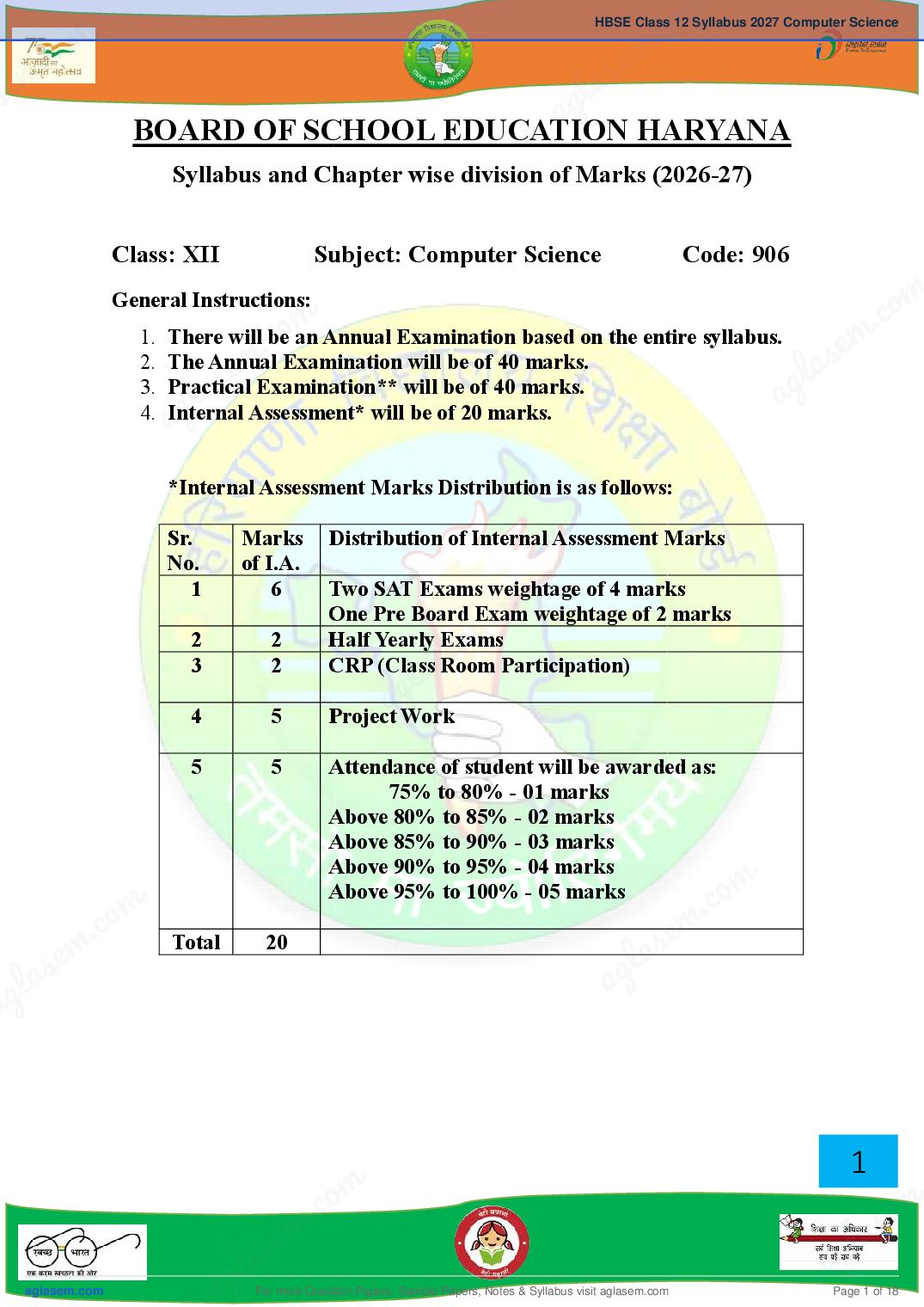
BOARD OF SCHOOL EDUCATION HARYANA
Syllabus and Chapter wise division of Marks ((2026
2026-27)
Class: XII Subject: Computer Science Code: 906
m
.co
General Instructions:
m
m .co
1. There will be an Annual Examination based on the entire syllabus.
s e m
s e
2. The Annual Examination
mination will be of 40 marks.
l a
a
3. Practical Examination** will be of 40 marks.
g l ag
a
4. Internal Assessment* will be of 20 marks.
*Internal Assessment Marks Distribution is as follows:
Sr. Marks Distribution of Internal Assessment Marks
No. of I.A.
1 6 Two SAT Ex
Exams
ams weightage of 4 marks
m
2 2 Half Yearly Exams .co
One Pre Board Exam weightage of 2 marks
m
s e
3 2
la
CRP (Class Room Participation)
g
4 5 ProjectaWork
5 5 Attendance of student will be awarded as:
75% to 80% - 01 marks
Above 80% to 85% - 02 marks
Abov
Above 85% to 90% - 03 marks
Above 90% to 95% - 04 marks
m
.co
Above 95% to 100% - 05 marks
m
m .co Total 20 s e m
s e g l a
g la a
a
1
m .
.co s e m
s em l a
g la ag
a For more Question Papers, Sample Papers, Notes & Syllabus visit Page 1 of 18
Page 3
Sr. No. Unit Name Marks
1 Lab Test:
Two Python Program
Programs (One from Exception Handling/file handling 15
and one from Data Struc
Structure using Python).
(60% Logic + 20% documentation + 20% code quality)
One SQL Queries including all clauses
2 Report File:
Minimum 10 Python programs (Based on Exception Handling, File 10
Handling and Data Structure using Python only).
Minimum 5 SQL Queries
3 Project:
That uses most of the concepts that have been learnt in 12th. 5
4 Viva Voce 10
Total Marks 40
Learning outcomes:
After the completion of the course Students will be able to
1. Implement exception handling for error management
management.
2. Practice basic searching and sorting algorithms.
3. Explore file handling and data serialization.
4. Learn about data structures like stacks and queues.
5. Understand fundamentals of databases and SQL.
6. Discover basics of computer networks.
7. Explore different types of data communication.
8. Learn about network security and common threats.
9. Gain knowledge about network devices and topologies.
10.Recognize common threats in computer systems and networks.
11.Learn preventive measures against viruses, worms, and security threats.
2
For more Question Papers, Sample Papers, Notes & Syllabus visit Page 2 of 18
Page 4
m .co
m .co s e m
se g l a
a
Course Structure ((2026-27)
Class: XII Subject: Computer Science Code: 906
Sr. Periods
m
.co
No. UNIT NAME Marks
o m Theory Practical
m
1 Programming c
. in Python 6 20 10 s e
e m l a
2 a s
Datal Structure using Python 7 30 a20g
ag
3 Database and SQL 8 35 20
4 Computer Networks 6 20 -
5 Data Communication 8 27 -
6 Security Aspects 5 13 -
Total 40
m
.co
Practical Examination 40
Internal Assessment
e m 20
Grand Total
las 100
ag
m
m .co
m .co s e m
s e g l a
g la a
a
3
m .
.co s e m
s em l a
g la ag
a For more Question Papers, Sample Papers, Notes & Syllabus visit Page 3 of 18
Page 5
Class- XII Subject: Co
Computer Science Code: 906
Unit I: Programming in Python
Exception Handling: Syntax errors, exceptions, need of
exception handling, raising exceptions, handling exceptions,
catching exceptions, Try - except - else clause, Try - finally
clause, buil
built-in exception classes.
File Handling: text file and binary file, open and close text
files, reading and writing text files, file access modes.
Important Exception, Syntax, Error, Exception Handling, Try-
Try
Terminology except-else clause, Try-finally
ally clause,
claus built-in
exceptions
Unit II: Data Structure (Using Python)
Stack
Stack: Introduction to stack (LIFO), operations on stack
(PUSH and POP) and its implementation in python.
Queue
Queue: Introduction to Queue (FIFO), Operations on
Queue (ENQUEUE and DEQUEUE) and it
its
implementation in Python.
Searching: Sequential Search (Linear Search) and Binary
Search (Theoretical Analysis Only)
Sorting: Bubble Sort and Selection Sort (Theoretical
Analysis Only)
Important Stack, List, LIFO, PUSH, POP, Queue, FIFO
Terminology ENQUEUE,EUE, DEQUEUE, Searching, Linear search,
Binary Search, Sorting, Bubble sort, Selection sort
Unit III: Database & SQL
Database Concepts: Introduction to database and its
concepts, difference between database and file system,
relational data model: concept of domain, tuple, relation,
keys - candidate key, primary key, alternate key, foreign key
Structured Query Language (SQL): Introduction to SQL, SQL
4
For more Question Papers, Sample Papers, Notes & Syllabus visit Page 4 of 18
Page 6
m .co
m .co s e m
se g l a
Data Types in SQL. a
Data Definition Language (DDL): CREATE TABLE,
DROP TABLE and ALTER TABLE.
Data Query Languag
Language (DQL): SELECT, FROM and
WHERE
Data Manipulation Language (DML): INSERT, UPDATE
and DELETE
DELETE. m
m
Aggregate Functions: MAX (), MIN
IN (), AVG (), SUM (), .co
.co
COUNT (), using COUNT (*). e m
s em Important Data, Collection of Data, Organization ofgldata, as
g la a
a Terminology Database, file,
e, relational data model, tuple, relation,
candidate key, primary key, alternate key, foreign
key, Data type, DDL, DQL, DML, Aggregate
functions
Unit IV: Computer Networks
Introduction to computer networks, Network types: PAN,
m
.co
LAN, WAN, MAN
Network devic
devices: Modem, Ethernet Card, Repeater, Hub,
e m
Switch, Router, Gateway.
las
topologies ag
Network Topologies: Mesh, Ring, Bus, Star, and Tree
Important Computer Network, PAN, LAN, MAN, WAN,
Terminology Modem, Ethernet Card, Repeater, Hub, Switch,
Router, Gateway, Networkork Topology, Mesh, Ring,
Bus, Star, and Tree topology
Unit V: Data Communication o m
m . c
m .co Communication: Types of Data Communication,
s
m
e – Twisted pair
s e Communication Media: Wired Technologies
axial cable, Ethernet Cable, g
a
l Fibre.
g la cable, Co
Co-axial
a Optical
a Mobile telecommunication ation technologies: Wireless
Technologies – Bluetooth, Wi-Fi,
Fi, Infrared, Microwave.
Network Protocol: Need for Protocol, Categorization and
Examples of protocol, HTTP, FTP, IP, SMTP.
Concept of Channel
Channel, Bandwidth (Hz, KHz, and MHz) and
5
m .
.co s e m
s em l a
g la ag
a For more Question Papers, Sample Papers, Notes & Syllabus visit Page 5 of 18
Page 7
ps, Kbps, Mbps, Gbps and Tbps).
Important Communication, Wired Technology, Twisted
Terminology pair cable, co axial cable, Ethernet cable,
optical fibre, Wireless Technology, Bluetooth,
Wi-Fi,
Fi, Infrared, Microwave, Protocol, HTTP,
FTP, IP, SMTP, Bandwidth,, Data Transfer rate
Unit VI: Security Aspects
Threats and prevention: Malware
Malware-- virus, worms,
Trojan, Spyware, Adware.
Antivirus and its importance.
Network Security Concepts: http vs https, Firewall,
Cookies, Hackers and Crackers
Important Malware, Virus, Worms, Trojan, Spyware,
Terminology Adware, Antivirus, http, https, Firewall, Cookies,
Hackers, Crackers
6
For more Question Papers, Sample Papers, Notes & Syllabus visit Page 6 of 18
Page 8
m .co
m .co s e m
se g l a
Suggested Practical List a
1. Program to handle a ZeroDivisionError when dividing a number by zero.
2. Program to handle a FileNotFoundError when opening a non-existing
non
file.
3. Program to handle a TypeError when concatenating incompatible data
types.
4. Program to demonstrate the use of try
try-except-else clause.
m
m
5. Program to handle multiple exceptions in a single try block.
.co
m .co
6. Program to raise a custom ex
exception
ception when a certain condition is met.
s e m
7. Program to handle an IndexError when accessing elements from a list.
s e l a
a
8. Program to handle a KeyError when accessing a dictionary.
g l ag
a
9. Program to handle a KeyboardInterrupt gracefully.
10.Program to read and display the conten
contents of a text file.
11.Program to write user input to a text file.
12.Program to append new data to an existing text file.
13.Program to implement a stack using a list.
14.Program to implement a queue using a list.
15.Program to push an element onto the stack.
16.Program to pop an element from the stack.
m
17.Program to insert an element into the queue.
18.Program to delete an element from the queue. m .co
19.Program to check if a stack is empty. s e
g
20.Program to check if a queue is empty. la
a
m
m .co
m .co s e m
s e g l a
g la a
a
7
m .
.co s e m
s em l a
g la ag
a For more Question Papers, Sample Papers, Notes & Syllabus visit Page 7 of 18
Page 9
2026-27)
Class: XII Subject: Computer Science Code: 906
Month Subject
Subject- content Teaching Revision Practical
Periods Periods Work
April Programming in Python: 10 5 9
Exception Handling,
File Handling
May Data Structure 12 5 7
Stack, Queue, Searching, Sorting
June Summer Vacation
( Holiday Homework / Assignments )
July Database & SQL: Database 12 4 8
Concepts, DDL, DQL, DML
August Database & SQL: Aggregate 12 5 7
Functions
September Half Yearly Exam 9 4 -
Computer Networks:
Introduction, Network devices,
Network Topologies
October Data Communication: 18 6 -
Communication, Mobile
telecommunication technologies.
November Data Communication: 14 8 -
Network Protocol
Protocols, Concept of
Channel, Bandwidth, Data
Transfer rate
December Security Aspects
Aspects: Threats and 18 6 -
prevention: Malwa
Malware, Antivirus
and its importance.
January Winter vacation
( Holiday Homework / Assignments )
Security Aspects
Aspects: Network 7 4 -
Security Concepts
February Revision
March Annual Examination
8
For more Question Papers, Sample Papers, Notes & Syllabus visit Page 8 of 18
Page 10
m .co
m .co s e m
se g l a
a
Note:
Subject teachers are advised to direct the students to prepare
notebook of the Terminology/Definitional Words used in the chapters
for enhancement of vocabulary or clarity of the concept.
m
m
The NCERT textbooks present information in boxes across the book.
.co
m .co
These help students to get conceptual clarity. However, the
s e m
information in these boxes would not be assessed in the year
s e year-end
l a
a
examination.
g l ag
a
Prescribed Books:
1. NCERT Textbook for COMPUTER SCIENCE (Class XII).
2. Support materials on BSEH website.
m
m .co
s e
g la
a
m
m .co
m .co s e m
s e g l a
g la a
a
9
m .
.co s e m
s em l a
g la ag
a For more Question Papers, Sample Papers, Notes & Syllabus visit Page 9 of 18
Page 11
Design (2026-27)
Class: XII Subject: Computer Science Code: 906
Time: 2:30 hr
Competencies Total
Knowledge 40%
Understanding 30%
Application 20%
Skill 10%
100%
Type of Marks Number Description Total
Question Marks
Essay type 4 3 Internal choice will be given 12
in all the questions
Include two Case study-
Short Answer 2 7 based questions. Out of the 14
remaining five questions,
two questions will have
internal choices.
Very Short 1 4 One internal choice will be 4
Answer provided among the four
questions
4 Multiple Choice Questions
Objective 10 1 2 Fill in the Blanks 10
type (1x10) 2 True/ False
2 Assertion-Reason
Total 15 40
10
For more Question Papers, Sample Papers, Notes & Syllabus visit Page 10 of 18
Page 12
m .co
m .co s e m
se g l a
a
ह रयाणा िव ालय िश ा बोड
पाਉॿम और अ ायवार अंकों का िवभाजन (2026
2026-27)
m
.co
का: XII िवषय: कं ूटर िव৯ान कोड: 906
m
सामा िनद८ श:
m .co s e m
s e l a
l a
1. पू रे पाਉॿम के आधार पर एक वािष१क परीा होगी।
g क परीा 40 अंकों की होगी।
2. वािष१
ag
a
3. ঋै ्ঠकल परीा** 40 अं कों की होगी।
4. आं तौरक मू ां कन* 20 अं कों का होगा।
*आं तौरक मू ां कन अं क िवतरण इस ঋकार है :
ॿमांक आं तौरक
मू ांकन अं कों का िवतरण
के अं क
o m
1 6 c
दो सैट परीाएं िजनका.भारां क 04 अं क का होगा व एक ঋी बोड१ परीा
िजसका भारां क 02em
2 2 la s
अध१वािष१ क परीा
अं क अक होगा
3 2
g
सीआरपीa(का की भागीदारी)
4 5 पौरयोजना काय१
5 5 छाআ की उप् थित के ॺप म७ स ािनत िकया जाएगा:
75% से 80% - 01 अंक
80% से 85% से अिधक - 02 अंक
85% से 90% से अिधक - 03 अंक
90% से 95% से अिधक - 04 अंक m
m 95% से अिधक से 100% - 05 अंक .co
m .co s e m
s e कुल 20
g l a
g la a
a
11
m .
.co s e m
s em l a
g la ag
a For more Question Papers, Sample Papers, Notes & Syllabus visit Page 11 of 18
Page 13
ॿमां क इकाई का नाम अं क
1 लै ब टे :
दो पायथन ঋोঁाम (एक एসे शन ह॰ डिलंग/फ़ाइल ह॰ डिलंग से और एक पायथन का
15
उपयोग करके डे टा ३ ঞर से)। (60% तक१ + 20% ঋले खन + 20% कोड
गु णव ा) एक SQL রेरी
2 ौरपोट१ फाइल: ू नतम 10 पायथन ঋोঁाम (एসे शन ह॰ डिलंग, फ़ाइल ह॰ डिलंग
और केवल पायथन का उपयोग करके डे टा ३ ঞर के आधार पर)।
10
ू नतम 5 SQL রेरीज
3 पौरयोजना:
यह 12 वी ं म७ सीखी गई अिधकां श अवधारणाओं का उपयोग करता है । 5
4 वीवा वॉइस 10
कुल अं क 40
सीखने के पौरणाम:
कोस१ पू रा होने के बाद छाআ कर सक७गे
1. আुिट ঋबंधन के िलए एসे शन ह॰ डिलंग लागू कर सक७गे ।
2. बुिनयादी खोज और सॉिट४ ग ए ोौरदम का अ ास कर सक७गे ।
3. फ़ाइल ह॰ डिलंग और डे टा ॿमां कन का अ े षण कर सक७गे ।
4. ै क और ভू जै सी डे टा ३ ঞरओं के बारे म७ जान सक७गे ।
5. डे टाबेस और SQL के मूल िस ां तों को समझ सक७गे ।
6. कं ू टर ने टवक१ की मूल बात७ खोज सक७गे ।
7. िविभ ঋकार के डे टा सं चार का अ े षण कर सक७गे ।
8. ने टवक१ सु रा और सामा खतरों के बारे म७ जान सक७गे ।
9. ने टवक१ उपकरणों और टोपोलॉजी के बारे म७ ৯ान ঋा कर सक७गे ।
10. कं ू टर िस म और ने टवक१ म७ आम खतरों को पहचान सक७गे ।
11. वायरस, कीड़े और सु रा खतरों के ्खलाफ िनवारक उपाय जान सक७गे ।
12
For more Question Papers, Sample Papers, Notes & Syllabus visit Page 12 of 18
Page 14
m .co
m .co s e m
se g l a
a
पाਉॿम संरचना (2026-27)
का: 12 िवषय: कं ूटर िव৯ान कोड 906
कोड:
समय
ॿमांक यूिनट का नाम अं क
िशण ঋयोगा क
कालांश काय१
m
1 पायथन म७ ঋोঁािमंग
m 6 20 10
.co
.co 20 s
e m
2
s em
पायथन का उपयोग करके डे टा ३ ঞर 7 30
g l a
3 डे टाबेlसaऔर SQL 8 35 a20
4 कa
g
ं ू टर ने टवक१ 6 20 -
5 डे टा सं चार 8 27 -
6 सु रा पहलू 5 13 -
कुल 40
ঋै्ঠकल परीा 40
आं तौरक मू ां कन
m 20
महायोग c. o 100
s em
l a
ag
m
m .co
m .co s e m
s e g l a
g la a
a
13
m .
.co s e m
s em l a
g la ag
a For more Question Papers, Sample Papers, Notes & Syllabus visit Page 13 of 18
Page 15
का- XII िवषय: कं ूटर िव৯ान कोड:
कोड 906
यू िनट I: पायथन म७ ঋोঁािमंग
िसंटैস एरर, अपवाद (Exception), अपवाद ह॰ डिलंग की आव कता,
कता अपवाद
उ Raising Exceptions), अपवाद ह॰ डिलंग, अपवाद पकड़ना
करना (Rais
Catching Exceptions), Try - except - else মॉज़, Try -
(Catching
finally মॉज़ মॉज़, िब -इन अपवाद वग१ (Built- -in Exception
Classes)।
फ़ाइल ह॰ डिलंग (
(File Handling): पाठ फ़ाइल (Text
Text File) और बाइनरी
फ़ाइल (Binary
Binary File), पाठ ठ फ़ाइल खोलना और बंद करना (Open & Close
Text Files), पाठ फ़ाइल पढ़ना और िलखना (ReadingReading & Writing
Text Files), फ़ाइल एসेस मोड (File
File Access Modes)।
Modes)
यू िनट II: डे टा ३ ঞर ((पायथन का उपयोग करके)
ै क ((सू ची काया१ यन): ै क का पौरचय (LIFO सं चालन), ै क पर
सं चालन (PUSH और POP) और पायथन म७ इसका काया१ यन।
ভू ((सू ची काया१ यन): ভू का पौरचय (FIFO), ভू पर सं चालन
(ENQUEUE और DEQUEUE) और पायथन म७ इसका काया१ यन।
सिच४ ग: अनुॿिमक खोज )Sequential Search - Linear Search) और
िसफ१ सै ां ितक अ यन।(
बाइनरी खोज )Binary Search) (िसफ
सॉिट४ ग: बबल सॉट१ )Bubble Sort) और चयन सॉट१ )Selection Sort)
(िसफ
िसफ१ सै ां ितक अ यन।(
यू िनट III: डे टाबे स और SQL
डे टाबेस अवधारणाएँ (Database Concepts):
डे टाबेस और इसकी अवधारणाएँ , डे टाबेस और फ़ाइल िस म म७ अं तरर,
ौरलेशनल डे टा मॉडल
मॉडल: डोमेन, टपल, ौरलेशन, कीज - क॰िडडे ट की,
ঋाइमरी कीकी, अ रने ट की, फॉरे न की।
संरिचत ঋ भाषा (SQL - Structured Query Language):
Language)
SQL का पौरचय
पौरचय, SQL म७ डे टा ঋकार।
डे टा पौरभाषा भाषा (DDL - Data Definition Language):
Language)
CREATE TABLE, DROP TABLE, और ALTER TABLE। TABLE
डे टा রेरी भाषा (DQL - Data Query Language):
SELECT, FROM और WHERE।
14
For more Question Papers, Sample Papers, Notes & Syllabus visit Page 14 of 18
Page 16
m .co
m .co s em
se g la
a
डे टा हेरफेर भाषा (DML - Data Manipulation Language)
Language):
INSERT, UPDATE और DELETE।
एঁीगेट फंল (Aggregate Functions):
MAX(), MIN(), AVG(), SUM(), COUNT(), COUNT(*) का उपयोग।
यू िनट IV: कं ूटर नेटवक१
कं ूटर नेटवक१ का पौरचय, नेटवक१ ঋकार: PAN, LAN, WAN, MAN
m
.co
नेटवक१ िडवाइस: मोडे म, ईथरनेट काड१ , ौरपीटर, हब, ् च,
च राउटर, गेटवे ।
m
यू िनट V: डेm
.co
नेटवक१ टोपोलॉजी: मेष, ौरं ग, बस, ार और ट३ ी टोपोलॉजी
s e m
s e टा संचार l a
l a सं चार:: डे टा सं चार के ঋकार, सं चार मीिडया: वायड१ टे নोलॉजीज - िਆagे ड
ag बल, सह-अीय केबल, ईथरने ट केबल, ऑि कल फाइबर।
जोड़ी केबल
मोबाइल दू रसंचार ঋौ ोिगिकयां: वायरलेस टे নोलॉजीज - ूटूथ, Wi-Fi ,
इ ঌारे ड
ड, माइॿोवे व।
नेटवक१ ঋोटोकॉल
ঋोटोकॉल: ঋोटोकॉल, वग५करण और ঋोटोकॉल के उदाहरण,
उदाहरण
HTTP, FTP, IP
IP, SMTP की आव कता।
चै नल ब॰ डिवड् थ (Hz, KHz, और MHz) और डे टा ट३ ां सफर दर (bps,
Kbps, Mbps, Gbps और Tbps) की अवधारणा।
m
यू िनट VI: सु रा पहलू
m .co
ইे ट और िঋव७शन
e
न: मैलवे यर- वायरस, कीड़े , ट३ ोजन, ाइवे यर,
s
र एडवे यर।
la
एं टीवायरस और इसका मह ।
g
और ॿैकस१
a
नेटवक१ सु रा अवधारणाएँ : http बनाम https, फ़ायरवॉल,
फ़ायरवॉल कुकीज़, है कस१
सु झाई गई ঋै ्ঠकल सू ची
1. िकसी संূा को शू से िवभािजत करते समय ZeroDivisionError को सं भालने का ঋोঁाम।
2. एक गैर-मौजू दा फ़ाइल खोलते समय FileNotFoundError को ह॰ डल करने के िलए ঋोঁाम।
3. असं गत डे टा ঋकारों को जोड़ते समय TypeError को सं भालने के िलए ঋोঁाम।
m
.co
4. कोिशश-िसवाय-अ खं ड के उपयोग को ঋदिश१ त करने के िलए ঋोঁाम।
m
.co m
5. एक एकल ঋयास ॉक म७ कई अपवादों को सं भालने के िलए ঋोঁाम।
m 6. एक िनि त शत१ पू री होने पर एक क म एসे शन बढ़ाने का ঋोঁाम। s e
s e 7. िकसी सू ची से त ों तक पॽँ चने पर IndexError को सं भालने का ঋोঁाम।
g l a
g la 8. एक श कोश तक पॽँ चने पर एक KeyError को सं भालने के िलए ঋोঁाम। a
a 9. ঋोঁाम एक KeyboardInterrupt इनायत से सं भाल करने के िलए.
10. एक पाठ फ़ाइल की सामঁी को पढ़ने और ঋदिश१ त करने के िलए ঋोঁाम।
11. एक पाठ फ़ाइल म७ उपयोगकता१ इनपु ट िलखने के िलए ঋोঁाम।
12. िकसी मौजू दा पाठ फ़ाइल म७ नया डे टा जोड़ने का ঋोঁाम.
13. एक सू ची का उपयोग कर एक ढे र को लागू करने के िलए ঋोঁाम।
15
m .
.co s e m
s em l a
g la ag
a For more Question Papers, Sample Papers, Notes & Syllabus visit Page 15 of 18
Page 17
15. ै क पर एक त को धজा दे ने का ঋोঁाम।
16. ै क से एक त को पॉप करने का ঋोঁाम।
17. ভू म७ एक त डालने का ঋोঁाम।
18. ভू से एक त को हटाने के िलए ঋोঁाम।
19. यह जां चने के िलए ঋोঁाम िक ভा ै क खाली है ।
20. यह जां चने के िलए ঋोঁाम िक ভा कोई ভू खाली है ।
मािसक पाਉॿम िशण योजना (2026
2026-27)
का: 12 िवषय: कं ूटर िव৯ान कोड 906
कोड:
मास िवषय- सामঁी िशण दोहराई ঋयोगा क
कालांश अविध काय१
अঋै ल पायथन म७ ঋोঁािमं ग: 10 5 9
एসे शन ह॰ ड
डिलं
िलं ग,
फ़ाइल ह॰ डिलं ग
मई डे टा ३ ঞर 12 5 7
ै क, ভू , सिच४ग सॉिट४ ग
जून गम५ की छु ਂी (हॉिलडे होमवक१ / असाइनम७ट)
जुलाई डे टाबे स और एसভूएल
ल: डे टाबेस 12 4 8
अवधारणाओं, डीडीएल
डीडीएल, डीভूएल,
डीएमएल
अग डे टाबे स और एसভूएल: एঁीगेट 12 5 7
फ़ंলं स
िसतंबर अध१वािष१ क परीा 9 4 -
कं ूटर नेटवक१: पौरचय, नेटवक१
िडवाइस, ने टवक१ टोपोलॉजी
अঠू बर डे टा सं चार: संचारार, मोबाइल दू रसंचार 18 6 -
ঋौ ोिगिकयां
नवं बर डे टा सं चार: ने टवक१ ঋोटोकॉल, चैनल 14 8 -
की अवधारणा, ब॰डिवड् थ, डे टा ट३ ां सफर
दर
िदसंबर सुरा पहलू: ইे ट और रोकथाम: 18 6 -
मै लवेयर, एं टीवायरस और मह ।
जनवरी शीतकालीन अवकाश (हॉिलडे होमवक१ / असाइनम७ट)
16
For more Question Papers, Sample Papers, Notes & Syllabus visit Page 16 of 18
Page 18
m .co
m .co s em
se g la
सुरा पहलू: ने टवक१ सुरा 7a 4 -
अवधारणाएं
फ़रवरी पुनरावृि
माच१ वािष१ क परीा
नोट:
m
m .co
.co
एनसीईआरटी की पाਉपुपु क७ पू री पु क म७ बসों म७ जानकारी ঋ ु त करती ह॰ । ये छाআों को
e m
वै चाौरक
e
ता ঋा करने म७ मदद करते ह॰ । हालां िक
m क, इन बসों म७ दी गई जानकारी का
l as
l as
आकलन साल के अं त म७ होने वाली परीा म७ नही ं िकया जाएगा।
ag
ag
िनधा१ ौरत पु क७:
5. कं ू टर िव৯ान के िलए एनसीईआरटी पाਉपु क (का बारहवी)ं ।
6. BSEH वे बसाइट पर सहायता सामঁी।
m
m .co
s e
g la
a
m
m .co
m .co s e m
s e g l a
g la a
a
17
m .
.co s e m
s em l a
g la ag
a For more Question Papers, Sample Papers, Notes & Syllabus visit Page 17 of 18
Page 19
का: XII िवषय: कं ू टर िव৯ान कोड
कोड: 906
समय: 2:30 घे
ঋ का ঋकार अं क संূा िववरण कुल अं क
दीघ१ उ रा क 4 3 सभी ঋ ों म७ आं तौरक िवक उपल 12
ঋ होगा
दो केस डी आधाौरत ঋ शािमल
लघुउ रा क ঋ 2 7 िकए जाएं गे। शे ष पाँ च ঋ ों म७ , दो ঋ ों 14
म७ आं तौरक िवक उपल होंगे।
अित 1 4 चार ঋ ों म७ से एक ঋ म७ आं तौरक 4
लघुउ रा क ঋ िवक ঋदान िकया जाएगा।
4 बॽिवक ीय ঋ
व ु िन ঋ 10 1 2 ौरঢ थानों की पूित१ कीिजए 10
(1x10) 2 सही/गलत
2 अिभकथन-कारण
कुल 15 40
18
For more Question Papers, Sample Papers, Notes & Syllabus visit Page 18 of 18
Document Details
| Board / Org | Haryana Board |
| Exam | Class 12 |
| Type | Syllabus |
| Pages | 18 |
| Updated | 04 Nov 2026 |