Maharashtra SSC Syllabus 2022 Gujarati
Finished viewing? Save it for later —
Download Maharashtra SSC Syllabus 2022 Gujarati (PDF · 8 pages)About Maharashtra SSC Syllabus 2022 Gujarati
Maharashtra SSC Syllabus 2022 Gujarati is available here for free download. Published by Maharashtra Board for Class 10, this syllabus can be viewed online or downloaded as a PDF (8 pages). Candidates preparing for Class 10 can use Maharashtra SSC Syllabus 2022 Gujarati to understand the exam pattern, the type of questions asked, and the overall difficulty level.
Frequently Asked Questions
How can I download Maharashtra SSC Syllabus 2022 Gujarati?
Open this page and click the Download button to save Maharashtra SSC Syllabus 2022 Gujarati as a PDF. It is completely free on AglaSem Docs.
Is Maharashtra SSC Syllabus 2022 Gujarati free to download?
Yes. Maharashtra SSC Syllabus 2022 Gujarati can be viewed online and downloaded as a PDF free of cost on AglaSem Docs.
How many pages does Maharashtra SSC Syllabus 2022 Gujarati have?
Maharashtra SSC Syllabus 2022 Gujarati contains 8 pages, which you can read online or download together as a single PDF.
Where can I find more Class 10 study material?
You can find more Class 10 question papers, sample papers, syllabus, and answer keys on AglaSem Docs.
Maharashtra SSC Syllabus 2022 Gujarati – Text
Read the full text of this syllabus below — useful to quickly search, copy and reference the content online without downloading the PDF.
📄 View text version (8 pages)
Page 1
(First Language)
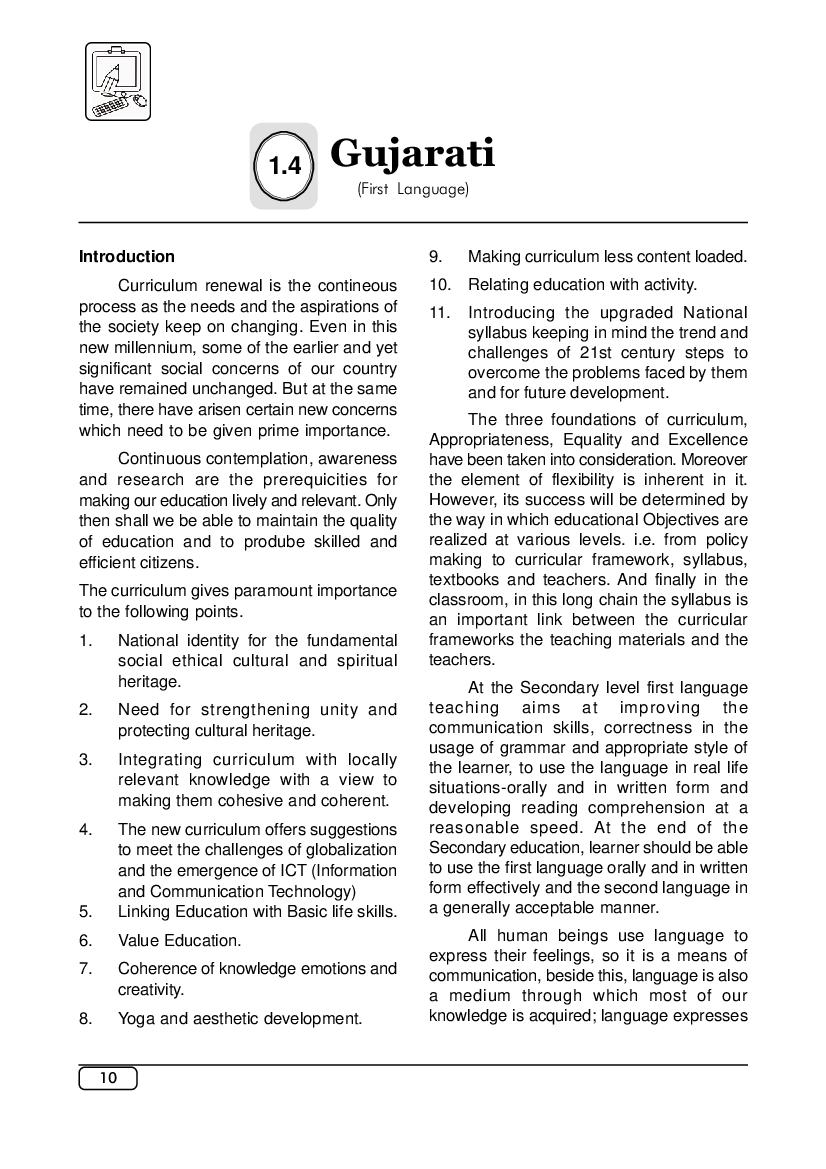
Introduction 9. Making curriculum less content loaded.
Curriculum renewal is the contineous 10. Relating education with activity.
process as the needs and the aspirations of 11. Introducing the upgraded National
the society keep on changing. Even in this syllabus keeping in mind the trend and
new millennium, some of the earlier and yet challenges of 21st century steps to
significant social concerns of our country overcome the problems faced by them
have remained unchanged. But at the same and for future development.
time, there have arisen certain new concerns
The three foundations of curriculum,
which need to be given prime importance.
Appropriateness, Equality and Excellence
Continuous contemplation, awareness have been taken into consideration. Moreover
and research are the prerequicities for the element of flexibility is inherent in it.
making our education lively and relevant. Only However, its success will be determined by
then shall we be able to maintain the quality the way in which educational Objectives are
of education and to prodube skilled and realized at various levels. i.e. from policy
efficient citizens. making to curricular framework, syllabus,
textbooks and teachers. And finally in the
The curriculum gives paramount importance
classroom, in this long chain the syllabus is
to the following points. an important link between the curricular
1. National identity for the fundamental frameworks the teaching materials and the
social ethical cultural and spiritual teachers.
heritage. At the Secondary level first language
2. Need for strengthening unity and teaching aims at improving the
protecting cultural heritage. communication skills, correctness in the
usage of grammar and appropriate style of
3. Integrating curriculum with locally
the learner, to use the language in real life
relevant knowledge with a view to situations-orally and in written form and
making them cohesive and coherent. developing reading comprehension at a
4. The new curriculum offers suggestions reasonable speed. At the end of the
to meet the challenges of globalization Secondary education, learner should be able
and the emergence of ICT (Information to use the first language orally and in written
and Communication Technology) form effectively and the second language in
5. Linking Education with Basic life skills. a generally acceptable manner.
6. Value Education. All human beings use language to
express their feelings, so it is a means of
7. Coherence of knowledge emotions and communication, beside this, language is also
creativity. a medium through which most of our
8. Yoga and aesthetic development. knowledge is acquired; language expresses
10
Page 2
the language we celebrate our trend and diversity.
tradition. 7. Increase the ability to use Gujarati with
Development of language is ultimately proper use of grammar.
stimulated by our cultural heritage and the 8. Increase competency of listening,
needs of social development, but we would speaking, reading, writing and thinking
not overlook the reverse dependence either.
Human society can not do without language 9. Respect India’s historical, geographical
as the most important, most perfect and and cultural heritage.
universal means of communication, 10. Increase the knowledge, to motivate the
expression of thoughts and accumulation and students for extra reading.
means of expression. It is equally important 11. Know different types of literature and
to realize that languages are not discrete maintain their values.
objects our theme almost frozen in time and
space, both physical and mental 12. Participate in different cultural program
in mothertongue.
The syllabi in Gujarati have been set to
introduce the aims and to achieve the goal 13. Develop the art of appreciation.
set by M.S.B.S and H.S.E. It enhances the 14. Increase cultural, moral and spiritual
basic language abilities like learning, values through literature.
speaking, reading, writing and thinking. For 15. Improve their power of expression.
this purpose syllabus is prepared as per the
age class and standards. The basic aim is 16. Develop scientific approach, self
to introduce. ‘Linguistic Units’ and to develop reliance and respect for all religions.
linguistic skills of the students. 17. Develop originality, imagination power,
creativity and appreciation of beauty.
Last but not the least it is hoped that this will
cater to the needs of the present education 18. Motivate students to use library.
systems for which it is formulated. 19. Make students independent for future
Objectives vocational life.
To enable the students to 20. Prepare students to face and solve all
natural calamities.
1. Understand Gujarati literature and
increase competenby to analyse 21. Understand the beauty of script.
different aspects of literature. 22. Motivate the students to use reference
2. Develop competenby to pronounce books.
effectively and properly. 23. Encourage students for self-study.
3. Increase vocabulary of the students and 24. Encourage students to prepare different
to make use of the same. projects.
4. Increase competency to study other 25. Make learning process more interesting
subjects through mother tongue. and joyful.
5. Add to their vocabulary and modes of 26. Encourage students to use Gujarati
expression in their mother tongue. effectively and spontaneously.
11
Page 3
expressions. understanding.
28. Develop skill of information technology. 4. Writing
Spebific Objectives To enable the students to
1. Listening Skill 1. Use appropriate words and know the
To enable the students to beauty of script.
1. Develop ability to listen with 2. Use dictionary.
understanding to conversations, 3. Develop ability of comprehension and
lectures, discussions, talks and various writing skill.
programmes presented through mass
4. develop creativity.
media and also activate ability to share
Ideas. 5. Acquire knowledge of the basic
structure of the language idioms, figure
2. Develop ability to listen to others with
patience. of speech, phrases and proverbs.
3. Understand speaker’s satire and 5. Thinking
humor. To enable the students to
4. Develop concentration power. 1. Express their opinion about different
2. Narration Skill aspect of literature.
To enable the students to 2. Motivate students for comparative study.
1. Use correct words with proper 3. Express their ideas and views for or
pronounciation. against
2. Develop fluency in expressing their 4. motivate students to think
ideas. independently.
3. Be good speakers of the language. 6. Understanding
4. Develop their ability to express ideas To enable the students to
spontaneously. 1. Develop oral skills to enable them to
3. Reading answer questions and narrate incidents-
experiences in a discussion mode;
To enable the students to express ideas correctly and clearly with
1. Read about the short prose passage, confidence.
dialogues and poems with proper 2. Have a knowledge of dignity of labour.
pronounciation, and intonation.
3. Be aware about the problems like
2. Enrich vocabulary with the help of the
regionality, superstitions, population
knowledge of different types of
growth, pollution, terrorisim, corruption,
literature.
etc.
3. Develop interest in literature through
7. Conversation
reading.
To enable the students to
4. Make use of dictionaries and other
reference materials. 1. participate in debates, discussions,
12
Page 4
2. develop oral skills to enable students 4. COMPOSITION
answer questions and narrate incidents.
Develop confidence in discussing and a) Essays: Descriptive, Reflective,
express ideas, feelings correctly and Imaginative, Autobiographibal
clearly. b) Precis
3. express their views on different subjects b) Comprehension
like social, political, scientific and
cultural issues, etc. 5. COMMUNICATION SKILL
4. introduce guest, express vote of thanks, a) Letter writing
etc.
b) Report writing
8. Grammar
b) Advertisement
To enable the students to
d) Programme
1. understand and know the basic rules of
Grammar through wellknown Panini and e) Expansion of ideas
Hembhandracharya.
6. ORAL/CONVERSATION SKILL
2. acquire knowledge of the basic
a) Listening
structure of language, idioms and
principles of grammar. b) Narration
3. know Noun, Pronoun, Sandhi, b) Loud reading
Compound.
d) Conversation
Std IX
7. GRAMMAR
1. PROSE : About 64 pages.
a) Adjectives - formation
(Essay, part of an autobiographies,
novels, short stories, one act plays, part b) Sandhi (swar and vyanjan)
of biographies, travelogues, critiques,
b) Opposite words
humorous articles, satirical articles) (One
lesson for self-study) It should be small d) Meanings of words
in length.
e) Compounds
2. POETRY : About 200 lines.
Dwandwa - Dwigu - Madhyampadlopi-
Forms of Medieival literature- pada,
Bahuvrihi
akhyan, chappa, garbi, bodh kavya,
folk-song, sonnet, gazzal, song, f) Figures of speech Varnanupras,
apadyagadya, poem on nature, Muktak, Shabdanupras, Antyanupras
ancient and modern poetry (One poem
Arthalankar —— Upma
for self-study) It should be small in length.
3. RAPID READER : About 24 pages. Utpreksha Sajivaropan
13
Page 5
1. PROSE e) Expansion of ideas
About 64 pages. (One lesson for self- 6. ORAL/CONVERSATION SKILL
study) a) Listening
[Essay, Extracts from autobiographies, b) Narration
from novel, short stories, one-act-plays,
biographies, travelogues, critiques, b) Loud reading
humorous articles, satirical articles] d) Conversation
2. POETRY 7. GRAMMAR
About 200 lines. (One poem for self- a) Adjectives- formation
study)
b) Sandhi (swar and vyanjan)
[Forms of medieval literature- pada,
b) Opposite words
akhyan, chhappa, garbi, bodh kavya,
folk-song, khand-kavya, sonnet, gazzal, d) Meanings of words
song, apadyagadya, (blank verse) on e) Compounds
nature] It should be small in length.
Dwandwa, Dwigu, Madhyampadlopi,
3. RAPID READER : About 24 pages. Bahuvrihi
4. COMPOSITION g) Figures of speech Varnanupras,
a) Essays: Descriptive, Reflective, Shabdanupras, Antyanupras
Imaginative, Autobiographical Arthalankar —— Upma
b) Precis Utpreksha
b) Comprehension Sajivaropan
5. COMMUNICATION SKILL
a) Letter writing
b) Report writing
b) Advertisement
14
Page 6
(Second Language)
Introduction 10. Relating education with activity.
Curriculum renewal is the continuous 11. Introducing the upgraded National
process as the needs and the aspirations of syllabus keeping in mind the trend and
the society keep on changing. Even in this challenges of 21st century steps to
new millennium, some of the earlier and yet overcome the problems faced by then
significant social concerns of our country and for future development.
have remained unchanged. But at the same The three foundations of curriculum,
time, there have arisen certain new concerns Appropriateness, Equality and Excellence
which need to be given prime importance. have been taken into consideration. Moreover
Continuous contemplation, awareness the element of flexibility is inherent in it.
and research are the prerequisites for making However, its success will be determined by
the way in which educational Objectives are
our education lively and relevant. Only then
realized at various levels. i.e. from policy
shall we be able to maintain the quality of
making to curricula framework, syllabus,
education and to produce skilled and efficient
textbooks and teachers. And finally in the
citizens. classroom, in this long chain the syllabus is
The curriculum gives paramount an important link between the curricula
importance of the following points. framework the teaching materials and the
teachers.
1. National identity for the fundamental
social ethical cultural and spiritual At the Secondary level first language
heritage. teaching aims at improving the
communication skills, correctness in the
2. need for strengthening unity and
usage of grammar and appropriate style of
protecting cultural heritage. the learner, to use the language in real life
3. Integrating syllabi with locally relevant situations-orally and in written form and
knowledge with a view to making them developing reading bomprehension at a
cohesive and coherent. reasonable speed. At the end of the
Secondary education, learner should be able
4. The new syllabi offers suggestions to
to use the first language orally and in written,
meet the challenges of globalization and
form effectively and the second language in
the emergence of ICT (Information and
a generally acceptable manner.
Communication Technology).
All human beings use language to
5. Linking education with basic life skills. express their feelings, so it is a means of
6. Value education. communication beside this, language is also
a medium through which most of our
7. Coherence of knowledge, emotions
knowledge is abquired. Language expresses
and breativity.
our ideas, views, and other imaginations.
8. Yoga and aesthetic development. With the language we celebrate our trend and
9. Making syllabi less content loaded. tradition.
49
Page 7
stimulated by our cultural heritage and the essays, letters, etc.
needs of social development, but we would 7. make proper use of dictionary and other
not overlook the reverse dependence either. reference material on their own.
Human society can not do without language
as the most important, most perfect and 8. develop interest in reading literary
universal means of communication, passages and appreciating the beauty
expression of thoughts and accumulation and of language and ideas in them.
means of expression. It is equally important 9. cultivate broad human and cultural
to realize that languages are not discrete outlook through literature read by them.
objects our theme almost frozen in time and
10. develop the asthetic sense to
space, both physical and mental.
appreciate imagination and creative
The syllabi in Gujarati have been set to pieces of literature.
introduce the aims and to achieve the goal 11. develop awareness of unity in diversity.
set by M.S.B.S. and H.S.E. It enhances the
basic language abilities like learning, 12. develop the ability to understand the
speaking, reading, writing and thinking. For subject in a tension free environment.
this purpose syllabus is prepared as per the STD. - IX
age and standards. The basic aim is to
1. PROSE : About 60 pages.
introduce, Linguistic Units and to develop
linguistic skills of the students. 2. POETRY : About 60 Lines.
Last but not the least it is hoped that 3. RAPID READER : About 20 pages.
this will cater to the needs of the present 4. COMPOSITION
education systems for which it is formulated.
a) Conversation
Objectives
b) Letter writing i) Formal
To enable student’s to
ii) Informal
1. acquire fair knowledge of basic
structure of the language and elements c) Story writing by given points.
of grammar as per syllabus. d) Advertisement.
2. enrich the vocaculary. e) Unseen prose and poetry.
3. accquire skill in reading silently story f) Essay Writing i) Biographical
books, news papers, magazines and ii) Descriptive
other prescribed texts with proper
speed and understanding. iii) Imaginative
4. develop ability to narrate experiences, g) Translation from English to Gujarati
participate in debates and discussion e) Precis
and express their views in correct
5. GRAMMAR :
language and in logical sequence.
a) Type of sentences
5. develop ability to express ideas from
the text in their own language without b) Noun/Pronoun
sacrificing the content. c) Adjective
50
Page 8
e) Punctuation ii) Descriptive
f) Sandhi iii) Imaginative
g) Samas [Dwandwa, Dwigu, g) Translation from English to Gujarati
Madhyampadlopi] e) Precis
STD. -X 5. GRAMMAR
1. PROSE : About 60 pages a) Type of sentences
2. POETRY : About 60 Lines b) Noun/Pronoun
3. RAPID READER : About 20 pages c) Adjective
4. COMPOSITION d) Verb
a) Conversation e) Punctuation
b) Letter writing i) Formal f) Sandhi
ii) Informal g) Samas [Dwandwa, Dwigu,
b) Story writing by given points Madhyampadlopi]
d) Advertisement
e) Unseen prose and poetry
51
Document Details
| Board / Org | Maharashtra Board |
| Exam | Class 10 |
| Type | Syllabus |
| Pages | 8 |
| Updated | 09 Jun 2026 |