KSET Syllabus Earth Science
Finished viewing? Save it for later —
Download KSET Syllabus Earth Science (PDF · 12 pages)About KSET Syllabus Earth Science
KSET Syllabus Earth Science is available here for free download. Published by Karnataka Exams for Karnataka State Eligibility Test, this syllabus can be viewed online or downloaded as a PDF (12 pages). Candidates preparing for Karnataka State Eligibility Test can use KSET Syllabus Earth Science to understand the exam pattern, the type of questions asked, and the overall difficulty level.
Frequently Asked Questions
How can I download KSET Syllabus Earth Science?
Open this page and click the Download button to save KSET Syllabus Earth Science as a PDF. It is completely free on AglaSem Docs.
Is KSET Syllabus Earth Science free to download?
Yes. KSET Syllabus Earth Science can be viewed online and downloaded as a PDF free of cost on AglaSem Docs.
How many pages does KSET Syllabus Earth Science have?
KSET Syllabus Earth Science contains 12 pages, which you can read online or download together as a single PDF.
Where can I find more Karnataka State Eligibility Test study material?
You can find more Karnataka State Eligibility Test question papers, sample papers, syllabus, and answer keys on AglaSem Docs.
KSET Syllabus Earth Science – Text
Read the full text of this syllabus below — useful to quickly search, copy and reference the content online without downloading the PDF.
📄 View text version (12 pages)
Page 1
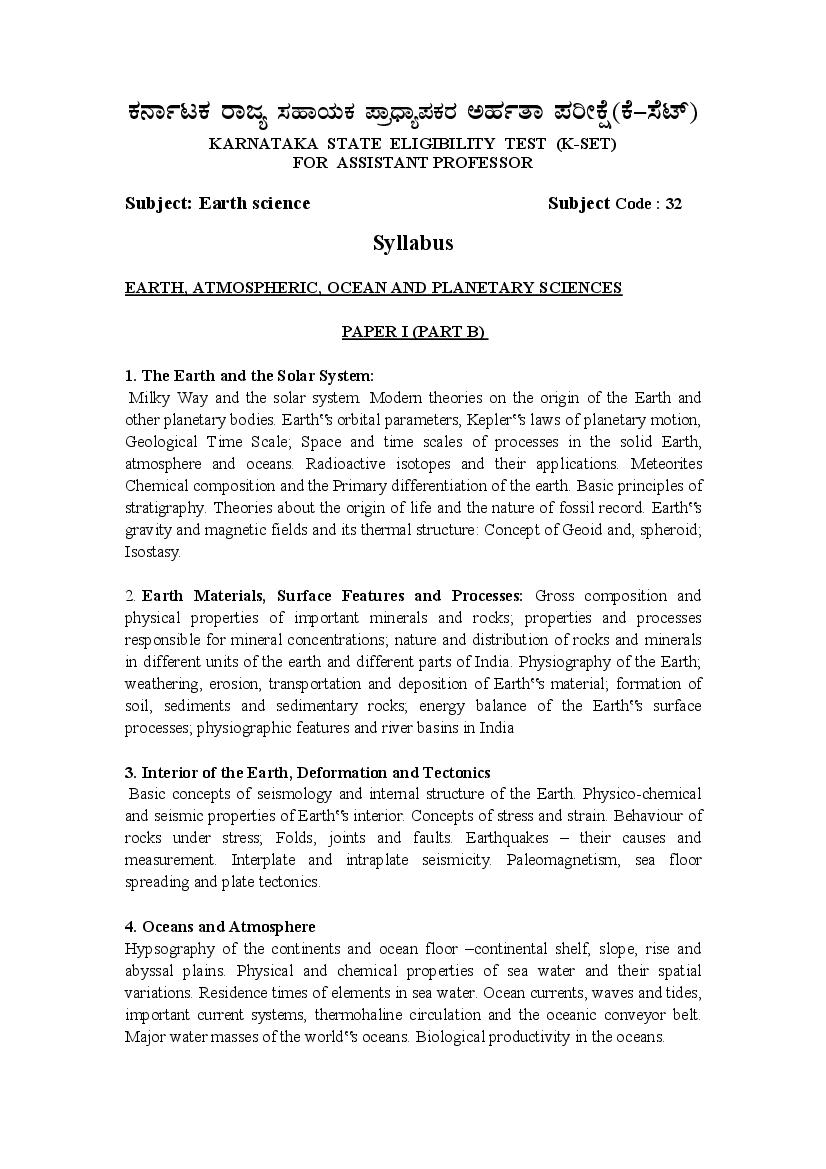
KARNATAKA STATE ELIGIBILITY TEST (K-SET)
FOR ASSISTANT PROFESSOR
Subject: Earth science Subject Code : 32
Syllabus
EARTH, ATMOSPHERIC, OCEAN AND PLANETARY SCIENCES
PAPER I (PART B)
1. The Earth and the Solar System:
Milky Way and the solar system. Modern theories on the origin of the Earth and
other planetary bodies. Earth‟s orbital parameters, Kepler‟s laws of planetary motion,
Geological Time Scale; Space and time scales of processes in the solid Earth,
atmosphere and oceans. Radioactive isotopes and their applications. Meteorites
Chemical composition and the Primary differentiation of the earth. Basic principles of
stratigraphy. Theories about the origin of life and the nature of fossil record. Earth‟s
gravity and magnetic fields and its thermal structure: Concept of Geoid and, spheroid;
Isostasy.
2. Earth Materials, Surface Features and Processes: Gross composition and
physical properties of important minerals and rocks; properties and processes
responsible for mineral concentrations; nature and distribution of rocks and minerals
in different units of the earth and different parts of India. Physiography of the Earth;
weathering, erosion, transportation and deposition of Earth‟s material; formation of
soil, sediments and sedimentary rocks; energy balance of the Earth‟s surface
processes; physiographic features and river basins in India
3. Interior of the Earth, Deformation and Tectonics
Basic concepts of seismology and internal structure of the Earth. Physico-chemical
and seismic properties of Earth‟s interior. Concepts of stress and strain. Behaviour of
rocks under stress; Folds, joints and faults. Earthquakes – their causes and
measurement. Interplate and intraplate seismicity. Paleomagnetism, sea floor
spreading and plate tectonics.
4. Oceans and Atmosphere
Hypsography of the continents and ocean floor –continental shelf, slope, rise and
abyssal plains. Physical and chemical properties of sea water and their spatial
variations. Residence times of elements in sea water. Ocean currents, waves and tides,
important current systems, thermohaline circulation and the oceanic conveyor belt.
Major water masses of the world‟s oceans. Biological productivity in the oceans.
Page 2
and boundary layer. Structure and chemical composition of the atmosphere, lapse rate
and stability, scale height, geopotential, greenhouse gases and global warming. Cloud
formation and precipitation processes, air- sea interactions on different space and time
scales. Insolation and heat budget, radiation balance, general circulation of the
atmosphere and ocean. Climatic and sea level changes on different time scales.
Coupled ocean-atmosphere system, El Nino Southern Oscillation (ENSO). General
weather systems of India, - Monsoon system, cyclone and jet stream, Western
disturbances and severe local convective systems, distribution of precipitation over
India.
Marine and atmospheric pollution, ozone depletion
5. Environmental Earth Sciences
Properties of water; hydrological cycle; water resources and management. Energy
resources, uses, degradation, alternatives and management; Ecology and biodiversity.
Impact of use of energy and land on the environment. Exploitation and conservation
of mineral and other natural resources. Natural hazards. Elements of Remote Sensing.
PAPER I (PART C)
I. GEOLOGY
1) MINERALOGY AND PETROLOGY:
Concept of point group, space group, reciprocal lattice, diffraction and imaging.
Concepts of crystal field theory and mineralogical spectroscopy. Lattice defects
(point, line and planar). Electrical, magnetic and optical properties of minerals.
Bonding and crystal structures of common oxides, sulphides, and silicates.
Transformation of minerals – polymorphism, polytypism, and polysomatism. Solid
solution and exsolution.
Steady-state geotherms. Genesis, properties, emplacement and crystallization of
magmas. Phase equilibrium studies of simple systems, effect of volatiles on melt
equilibria. Magma-mixing, - mingling and -immiscibility.
Metamorphic structures and textures; isograds and facies. Mineral reactions with
condensed phases, solid solutions, mixed volatile equilibria and thermobarometry.
Metamorphism of pelites, mafic-ultra mafic rocks and siliceous dolomites. Material
transport during metamorphism. P-T-t path in regional metamorphic terrains, plate
tectonics and metamorphism.
Petrogenetic aspects of important rock suites of India, such as the Deccan Traps,
layered intrusive complexes, anorthosites, carbonatites, charnockites, alkaline rocks,
Kimberlites, ophiolites and granitoids.
Page 3
Theory of stress and strain. Behaviour of rocks under stress. Mohr circle. Various
states of stress and their representation by Mohr circles. Different types of failure and
sliding criteria. Geometry and mechanics of fracturing and conditions for reactivation
of pre-existing discontinuities. Common types of finite strain ellipsoids. L-, L-S-, and
S-tectonic fabrics. Techniques of strain analysis. Particle paths and flow patterns.
Progressive strain history. Introduction to deformation mechanisms. Role of fluids in
deformation processes. Geometry and analyses of brittle-ductile and ductile shear
zones. Sheath folds. Geometry and mechanics of development of folds, boudins,
foliations and lineations. Interference patterns of superposed fold. Fault-related
folding. Gravity induced structures. Tectonic features of extensional-, compressional-,
and strike-slip-terrains and relevance to plate boundaries. mantle plumes.
Himalayan Orogeny; concept of super continent, their assembly and breakup.
3) PALEONTOLOGY AND ITS APPLICATIONS:
Theories on origin of life. Organic evolution – Punctuated Equilibrium and Phyletic
Gradualism models. Mass extinctions and their causes. Application of fossils in age
determination and correlation. Paleoecology, Life habitats and various ecosystems,
Paleobiogeography. Modes of preservation of fossils and taphonomic considerations.
Types of microfossils. Environmental significance of fossils and trace fossils. Use of
microfossils in interpretation of sea floor tectonism. Application of micropaleontology
in hydrocarbon exploration. Oxygen and Carbon isotope studies of microfossils and
their use in paleoceanographic and paleoclimatic interpretation. Important
invertebrate fossils, vertebrate fossils, plant fossils and microfossils in Indian
stratigraphy.
4) SEDIMENTOLOGY AND STRATIGRAPHY:
Classification of sediments and sedimentary rocks ; elastic, volcanoclastic and
chemical. Classification of elastic rocks. Flow regimes and processes of sediment
transport. Sedimentary textures and structures. Sedimentary facies and environments,
reconstruction of paleoenvironments. Formation and evolution of sedimentary basins.
Diagenesis of siliciclastic and carbonate rocks. Recent developments in stratigraphic
classification. Code of stratigraphic nomenclature – Stratotypes, Global Boundary
Stratotype Sections and Points (GSSP). Lithostratigraphic, chronostratigraphic and
biostratigraphic subdivisions. Methods of startigraphic correlation including Shaw‟s
Graphic correlation. Concept of sequence stratigraphy. Rates of sediment
accumulation, unconformities. Facies concept in Stratigraphy – Walther‟s law.
Methods for paleogeographic reconstruction. Earth‟s Climatic History. Phanerozoic
Page 4
formations in other regions. Boundary problems in Indian Phanerozoic stratigraphy.
5) MARINE GEOLOGY AND PALEOCEANOGRAPHY:
Morphologic and tectonic domains of the ocean floor. Structure, composition and
mechanism of the formation of oceanic crust. hydrothermal vents-. Ocean margins
and their significance. Ocean Circulation, Coriolis effect and Ekman spiral,
convergence, divergence and upwelling, El Nino. Indian Ocean Dipole Thermohaline
circulation and oceanic conveyor belt. Formation of Bottom waters; major water
masses of the world‟s oceans. Oceanic sediments: Factors controlling the deposition
and distribution of oceanic sediments; geochronology of oceanic sediments,
diagenetic changes in oxic and anoxic environments. Tectonic evolution of the ocean
basins. Mineral resources. Paleoceanography – Approaches to paleoceanographic
reconstructions; various proxy indicators for paleoceanographic interpretation.
Reconstruction of monsoon variability by using marine proxy records Opening and
closing of ocean gateways and their effect on circulation and climate during the
Cenozoic. Sea level processes and Sea level changes.
Methods of paleo Sea Surface temperature. Quantifications.
6) GEOCHEMISTRY:
Atomic Structure and properties of elements, the Periodic Table; ionic substitution in
minerals; Phase rule and its applications in petrology, thermodynamics of reactions
involving pure phases, ideal and non-ideal solutions, and fluids; equilibrium and
distribution coefficients. Nucleation and diffusion processes in igneous, metamorphic
and sedimentary environments, redox reactions and EhpH diagrams and their
applications. Mineral/mineral assemblages as „sensors‟ of ambient environments.
Geochemical studies of aerosols, surface-, marine-, and ground waters. Radioactive
decay schemes and their application to geochronology and petrogenesis. Stable
isotopes and their application to earth system processes; geochemical differentiation
of the earth; geochemical cycles.
7) ECONOMIC GEOLOGY:
Magmatic, hydrothermal and surface processes of ore formation. Metallogeny and its
relation to crustal evolution; Active ore-forming systems, methods of mineral deposit
studies including ore microscopy, fluid inclusions and isotopic systematics; ores and
metamorphism- cause and effect relationships. Geological setting, characteristics, and
genesis of ferrous, base and noble metals. Origin, migration and entrapment of
petroleum; properties of source and reservoir rocks; structural, stratigraphic and
combination traps. Methods of petroleum exploration. Concepts of petrophysics,
Petroliferous basins of India. Origin of peat, lignite, bitumen and anthracite.
Page 5
Gas hydrates and coal bed methane. Nuclear and non-conventional energy resources.
8) PRECAMBRIAN GEOLOGY AND CRUSTAL EVOLUTION:
Evolution of lithosphere, hydrosphere, atmosphere, biosphere, and cryosphere;,
lithological, geochemical and stratigraphic characteristics of granite – greenstone and
granulite belts. Stratigraphy and geochronology of the cratonic nuclei, mobile belts
and Proterozoic sedimentary basins of India. Life in Precambrian. Precambrian –
Cambrian boundary with special reference to India.
9) QUATERNARY GEOLOGY:
Definition of Quaternary. Quaternary Stratigraphy – Oxygen Isotope stratigraphy,
biostratigraphy and magnetostratigraphy. Quaternary climates – glacial-interglacial
cycles, eustatic changes, proxy indicators of paleoenvironmental/ paleoclimatic
changes, - land, ocean and cryosphere (ice core studies). Responses of geomorphic
systems to climate, sea level and tectonics on variable time scales in the Quaternary,
Quaternary dating methods, –radiocarbon, Uranium series, Luminescence,
Aminoacid. Quaternary stratigraphy of India– continental records (fluvial, glacial,
aeolian, palaeosols and duricrust); marine records; continental-marine correlation of
Quaternary record. Evolution of man and Stone Age cultures. Plant and animal life in
relation to glacial and interglacial cycles during Quaternary.
Tectonic geomorphology, neotectonics, active tectonics and their applications to
natural hazard assessment.
10) (I)APPLIED GEOLOGY:
(i) Remote Sensing and GIS: Elements of photogrammetry, elements of photo-
interpretation, electromagnetic spectrum, emission range, film and imagery, sensors,
geological interpretations of air photos and imageries. Global positioning systems.
GIS- data structure, attribute data, thematic layers and query analysis.
(ii) Engineering Geology: Engineering properties of rocks and physical
characteristics of building stones, concretes and other aggregates. Geological
investigations for construction of dams, bridges, highways and tunnels. Remedial
measures. Mass movements with special emphasis on landslides and causes of
hillslope instability. Seismic design of buildings.
(iii) Mineral Exploration: Geological, geophysical, geochemical and geobotanical
methods of surface and sub-surface exploration on different scales. Sampling,
assaying and evaluation of mineral deposits.
Page 6
aquifers, hydrological cycle. Precipitation, evapotranspiration and infiltration
processes. Hydrological classification of water-bearing formations. Fresh and salt-
water relationships in coastal and inland areas. Groundwater exploration and water
pollution. Groundwater regimes in India.
(II) PHYSICAL GEOGRAPHY
1) Geomorphology: Concepts in geomorphology. Historical and process
Geomorphology. Landforms in relation to climate, rock type, structure and tectonics.
Processes – weathering, pedogenesis, mass movement, erosion, transportation and
deposition. Geomorphic processes and landforms – fluvial, glacial, eolian, coastal and
karst. River forms and processes – stream flow, stagedischarge relationship;
hydrographs and flood frequency analysis. Submarine relief. Geomorphology and
topographic analysis including DEM, Environmental change– causes, effects on
processes and landforms. Extra-terrestrial geomorphology
2) Climatology: Fundamental principles of climatology. Earth‟s radiation balance;
latitudinal and seasonal variation of insolation, temperature, pressure, wind belts,
humidity, cloud formation and precipitation, water balance. Air masses, monsoon, Jet
streams, tropical cyclones, and ENSO. Classification of climates – Koppen‟s and
Thornthwaite‟s scheme of classification. Climate change.
3) Bio-geography: Elements of biogeography with special reference to India;
environment, habitat, plant-animal association; zoo-geography of India; Biomes,
elements of plantgeography, distribution of forests and major plant
communities.Distribution of major animal communities. Conservation of forests.
Wildlife sanctuaries and parks.
4) Environmental Geography: Man-land relationship. Resources – renewable and
non-renewable. Natural and man-made hazards – droughts, floods, cyclones,
earthquakes, landslides, tsunamis. Ecological balance, environmental pollution and
deterioration.
5) Geography of India: Physiography, drainage, climate, soils and natural resources
– the Himalaya, Ganga-Brahmaputra Plains, and peninsular India Precambrian shield,
the Gondwana rift basins, Deccan Plateau. Indian climatology with special reference
to seasonal distribution and variation of temperature, humidity, wind and
precipitation; Climate zones of India. Agricultural geography of India. Population –
its distribution and characteristics. Urbanization and migration. Environmental
problems and issues.
Page 7
1) Signal Processing: Continuous and discrete signals; Fourier series; auto and cross
correlations, linear time invariant systems with deterministic and random inputs;
band limited signal and sampling theorem; Fourier and Fast Fourier transforms; Z-
transform; convolution; Filters: discrete and continuous, recursive, non-recursive,
optimal and inverse filters; deconvolution; fractal analysis.
2) Field theory: Newtonian potential; Laplace and Poisson‟s equations; Green‟s
Theorem; Gauss‟ law; Continuation integral; equivalent stratum; Maxwell‟s
equations and electromagnetic theory; Displacement potential, Helmhotz‟s theorem
and seismic wave propagation.
3) Numerical analysis and inversion: Numerical differentiation and integration,
finite element, and finite difference techniques; Simpson‟s rules; Gauss‟ quadrature
formula; initial value problems; pattern recognition in Geophysics. Well posed and
ill-posed problems; method of least squares; direct search and gradient methods;
generalized inversion techniques; singular value decomposition; global optimization.
4) Gravity and Magnetic fields of the earth: Normal gravity field; Clairaut‟s
theorem; Shape of the earth; deflection of the vertical, geoid, free-air, Bouguer and
isostatic anomalies, isostatic models for local and regional compensation.
Geomagnetic field, secular and transient variations and their theories;
palaeomagnetism, construction of polar wandering curves.
5) Plate Tectonics and Geodynamics: Marine magnetic anomalies, sea floor
spreading; midoceanic ridges and geodynamics; plate tectonics hypothesis; plate
boundaries and seismicity. Heat flow mechanisms, thermal moddling of earth,core-
mantle convection and mantle plumes.
6) Seismology Elastic theory: Seismometry: short period, long period, broad band
and strong motion; elements of earthquake seismology; seismic sources: faulting
source, double couple hypothesis, seismic moment tensor, focal mechanism and fault
plane solutions; seismic gaps; seismotectonics and structure of the earth; Himalayan
and stable continental region earthquakes, reservoir induced seismicity; seismic
hazards; earthquake prediction, travel time residuals, velocity anomalies, seismic
tomography.
7) Gravity and Magnetic Methods: Gravimeters and magnetometers; data
acquisition from land, air and ship; corrections and reduction of anomalies;
ambiguity; regional and residual separation; continuation and derivative calculations;
interpretation of anomalies of simple geometric bodies, single pole, sphere,
horizontal cylinder, sheet, dyke and fault. Forward modelling and inversion of
Page 8
domain.
8) Electrical and Electromagnetic Methods: Electrical profiling and sounding,
typical sounding curves, pseudo-sections; resistivity transform and direct
interpretation; induced polarization methods. Electromagnetic field techniques;
elliptic polarization, in-phase and out of phase components, horizontal and vertical
loop methods; interpretation; VLF (very low frequency); AFMAG (Audio frequency
magnetic) methods; and central frequency sounding; transient electromagnetic
methods; magneto-telluric method; geomagnetic depth sounding.
9) Seismic Methods: Generalized Snell‟s Law; Ray theory; reflection, refraction,
diffraction; Zoeppritz‟s equation; seismic energy sources; detectors; seismic noises
and noise profile analysis; seismic data recording, reduction to a datum and
weathering corrections; Interpretation of refraction and reflection data; CDP/CMP;
velocity analysis, F-K filtering, stacking, deconvolution, migration before and after
stack; bright spot analysis; wavelet processing; attenuation studies, shear waves,
AVO; VSP; introduction to 3D seismics; seismic stratigraphy.
10) Well logging: Open hole, cased hole and production logging; Electrical logs;
lateral, latero, induction, temperature, S.P; porosity logs; sonic, density, neutron;
natural gamma; determination of formation factor, porosity, permeability, density,
water saturation, lithology; logging while drilling.
(IV) METEOROLOGY
1) Climatology: Same as under Geography
2) Physical Meteorology: Thermal structure of the atmosphere and its composition.
Radiation: basic Laws - Rayleigh and Mie scattering, multiple scattering, radiation
from the sun, solar constant, effect of clouds, surface and planetary albedo. Emission
and absorption of terrestrial radiation, radiation windows, radiative transfer,
Greenhouse effect, net radiation budget; Thermodynamics of dry and moist air:
specific gas constant, Adiabatic and isoentropic processes, entropy and enthalpy,
Moisture variables, virtual temperature; Clausius – Clapeyron equation, adiabatic
process of moist air; thermodynamic diagrams: Hydrostatic equilibrium: Hydrostatic
equation, variation of pressure with height, geopotential, standard atmosphere,
altimetry. Vertical stability of the atmosphere: Dry and moist air parcel and slice
methods. Tropical convection. Atmospheric optics - visibility - optical phenomenon
- rainbows, haloes, corona, glarg, mirage.
3) Atmospheric Electricity: Fair weather electric field in the atmosphere and
potential gradients, ionization in the atmosphere. Electrical fields in thunderstorms,
Page 9
earth-atmospheric change balance-role of thunderstroms.
4) Cloud Physics: Cloud classification, condensation nuclei, growth of cloud drops
and ice-crystals, precipitation mechanisms: Bergeron, Findeisen process,
coalescence process – Precipitation of warm and mixed clouds, artificial
precipitation, hail suppression, fog and cloud – dissipation, radar observation of
clouds and precipitation, radar equation, rain drop spectra, radar echoes of hail storm
and tornadoes, radar observation of hurricanes, measurements of rainfall by radar.
5) Dynamic Meteorology: Basic equations and fundamental forces: Pressure,
gravity, centripetal and Corolis forces, continuity equation in Cartesian and isobaric
coordinates. Momentum equation Cartesian and spherical coordinates; scale
analysis, inertial flow, geostrophic and gradient winds, thermal wind. Divergence
and vertical motion Rossby, Richardson, Reynolds and Froude numbers. Circulation,
vorticity and divergence; Bjerknese circulation theorem and applications, vorticity
and divergence equations, scale analysis, potential vorticity, stream function and
velocity potential. Atmospheric turbulence: Mixing length theory, planetary
boundary layer equations, surface layer, Ekman layer, eddy transport of heat,
moisture and momentum, Richardson criterion; Linear Perturbation Theory: Internal
and external gravity waves, inertia waves, gravity waves, Rossby waves, wave
motion in the tropics, barotropic and baroclinic instabilities. Atmospheric
Energetics: Kinetic, potential and internal energies – conversion of potential and
internal energies into kinetic energy, available potential energy.
6) Numerical Weather Prediction: computational instability, filtering of sound and
gravity waves, filtered forecast equations, barotropic and equivalent barotropic
models, two parameter baroclinic model, relaxation method. Multi-layer primitive
equation models. Short, medium and long range weather prediction. Objective
analysis; Initialization of the data for use in weather prediction models; data
assimilation techniques, application of satellite in NWP (Numerical Weather
Prediction) and remotely sensed data.
7) General Circulation and Climate Modelling: Observed zonally symmetric
circulations, meridional circulation models, mean meridional and eddy transport of
momentum and energy, angular momentum and energy budgets; zonally asymmetric
features of general circulation; standing eddies; east-west circulations in tropics:
climate variability and forcings; feedback processes, low frequency variability, MJO
Madden-Julian oscillation), ENSO, QBO (quasi-biennial oscillation) and sunspot
cycles. Basic principles of general circulation modelling; grid-point and spectral
GCMs; role of the ocean in climate modelling; interannual variability of ocean fields
(SST, winds, circulation, etc.) and its relationship with monsoon, concepts of ocean
– atmosphere coupled models.
Page 10
analysis of surface, upper air another derivative chart, stream-lines, isotachs and
contour analysis; tilt and slope of pressure/weather systems with height. Synoptic
weather forecasting, prediction of weather elements such as rain, maximum and
minimum temperature and fog; hazardous weather elements like thunderstorms,
duststorms, tornadoes. Tropical meteorology: Trade wind inversion, ITCZ; monsoon
trough tropical cyclones, their structure and development theory; monsoon
depressions; tropical easterly jet stream; low level jets, Somali jet, waves in
easterlies; western disturbances; SW and NE monsoons; synoptic features associated
with onset, withdrawal, break active and weak monsoons and their prediction. Air
masses and fronts: sources, origin and classification of air masses; and fronts,
frontogenesis and frontolysis; structure of cold and warm fronts; weather systems
associated with fronts. Extra-tropical synoptic scale features: jet streams,
extratropical cyclones and anticyclones.
9) Aviation Meteorology: Role of meteorology in aviation, weather hazards
associated with take off cruising and landing, inflight – icing, turbulence, visibility,
fog, clouds, rain, gusts, wind shear and thunderstorms, nowcasting and very short
range forecasting.
10) Satellite Meteorology: Meteorological satellites – Polar orbiting and
geostationary satellites, visible and infrared radiometers, multiscanner radiometers;
identification of synoptic systems, fog and sandstorms, detection of cyclones,
estimation of SST, cloud top temperatures, winds and rainfall: temperature and
humidity soundings.
(V) OCEAN SCIENCES
1) Physical Oceanography: T-S diagrams; mixing processes in the oceans;
characteristics of important water masses.
Wind generated waves in the oceans; their characteristics; shallow and deep water
waves. Propagation, refraction, and reflection of waves. Wave spectrum, principles
of wave forecasting.
Tide-producing forces and their magnitudes; prediction of tides by the harmonic
method; tides and tidal currents in shallow seas, estuaries and rivers. Factors
influencing coastal processes; transformation of waves in shallow water; effects of
stratification; effect of bottom friction, phenomena of wave reflection, refraction
and diffraction; breakers and surf; littoral currents; wave action on sediments –
movement to beach material; rip currents; beach stability, ocean beach
nourishment; harbour resonance; seiches; tsunami; interaction of waves and
structure.
Page 11
mixing; depth – averaged and breadth – averaged models; sedimentation in estuaries;
salinity intrusion in estuaries; effect of stratification; coastal pollution; mixing and
dispersal of pollutants in estuaries and nearshore areas; coastal zone management.
The global wind system; action of wind on ocean surface; Ekman‟s theory; Sverdrup,
Stommel and Munk‟s theories; upwelling and sinking with special reference to the
Indian ocean. Inertial currents; divergences and convergences; geostrophic motion;
barotropic and baroclinic conditions;
Oceanic eddies, relationship between density, pressure and dynamic topography;
relative and slope currents. Wind driven coastal currents; typical scales of motion in
the ocean.
Characteristics of the global conveyor belt circulation and its causes.
Formation of subtropical gyres; western boundary currents; equatorial current
systems; El Nino; monsoonal winds and currents over the North Indian Ocean; Somali
current; southern ocean. Upwelling process in the Arabian Sea.
2) Chemical Oceanography: Composition of seawater – Classification of elements
based on their distribution; major and minor elements, their behavior and chemical
exchanges across interfaces and residence times in seawater.
Element chemistry in atypical conditions-estuaries, hydrothermal vents, anoxic
basins, HNLC waters, sediment pore fluid and anthropogenic inputs.
Chemical and biological interactions – Ionic interactions; biochemical cycling of
nutrients, trace metals and organic matter. Air-sea exchange of important biogenic
dissolved gases; carbon dioxidecarbonate system; alkalinity and control of pH;
biological pump.
Factors affecting sedimentary deposits-CaCO3, Silicate, Manganese nodules,
phosphorites and massive single deposits.
3) Geological Oceanography: Same topics as under subhead “Marine Geology &
paleooceanography”
4) Biological Oceanography: Classification of the marine environment and marine
organisms.
Physio-chemical factors affecting marine life – light, temperature, salinity, pressure,
nutrients, dissolved gases; adaptation and biological processes.
plankton abundance and diversity; nekton and fisheries oceanography; benthic
organisms; coastal marine communities and community ecology – estuaries, coral
reefs and mangrove communities, deep-sea ecology including hydrothermal vent
communities.
Page 12
through different trophic levels; food webs including the microbial loop.
Human impacts on marine communities; impacts of climate change on marine
biodiversity. Impact of pollution on marine environments including fisheries.
***
Document Details
| Board / Org | Karnataka Exams |
| Exam | Karnataka State Eligibility Test |
| Type | Syllabus |
| Pages | 12 |
| Updated | 24 Sep 2026 |