NBSE Class 9 Question Paper 2020 Science
Finished viewing? Save it for later —
Download NBSE Class 9 Question Paper 2020 Science (PDF · 4 pages)About NBSE Class 9 Question Paper 2020 Science
NBSE Class 9 Question Paper 2020 Science is available here for free download. Published by Nagaland Board for Class 9, this question paper can be viewed online or downloaded as a PDF (4 pages). Candidates preparing for Class 9 can use NBSE Class 9 Question Paper 2020 Science to understand the exam pattern, the type of questions asked, and the overall difficulty level.
Frequently Asked Questions
How can I download NBSE Class 9 Question Paper 2020 Science?
Open this page and click the Download button to save NBSE Class 9 Question Paper 2020 Science as a PDF. It is completely free on AglaSem Docs.
Is NBSE Class 9 Question Paper 2020 Science free to download?
Yes. NBSE Class 9 Question Paper 2020 Science can be viewed online and downloaded as a PDF free of cost on AglaSem Docs.
How many pages does NBSE Class 9 Question Paper 2020 Science have?
NBSE Class 9 Question Paper 2020 Science contains 4 pages, which you can read online or download together as a single PDF.
Where can I find more Class 9 study material?
You can find more Class 9 question papers, sample papers, syllabus, and answer keys on AglaSem Docs.
NBSE Class 9 Question Paper 2020 Science – Text
Read the full text of this question paper below — useful to quickly search, copy and reference the content online without downloading the PDF.
📄 View text version (4 pages)
Page 1
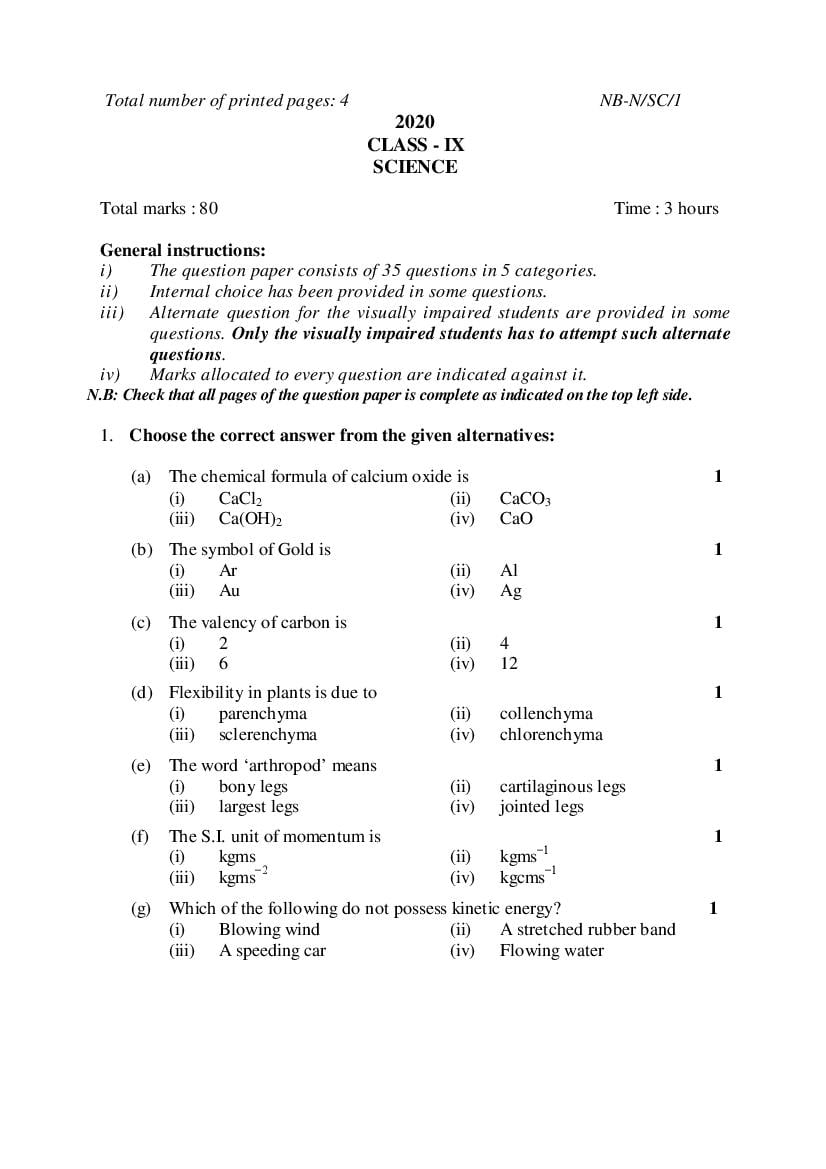
2020
CLASS - IX
SCIENCE
Total marks : 80 Time : 3 hours
General instructions:
i) The question paper consists of 35 questions in 5 categories.
ii) Internal choice has been provided in some questions.
iii) Alternate question for the visually impaired students are provided in some
questions. Only the visually impaired students has to attempt such alternate
questions.
iv) Marks allocated to every question are indicated against it.
N.B: Check that all pages of the question paper is complete as indicated on the top left side.
1. Choose the correct answer from the given alternatives:
(a) The chemical formula of calcium oxide is 1
(i) CaCl2 (ii) CaCO3
(iii) Ca(OH)2 (iv) CaO
(b) The symbol of Gold is 1
(i) Ar (ii) Al
(iii) Au (iv) Ag
(c) The valency of carbon is 1
(i) 2 (ii) 4
(iii) 6 (iv) 12
(d) Flexibility in plants is due to 1
(i) parenchyma (ii) collenchyma
(iii) sclerenchyma (iv) chlorenchyma
(e) The word ‘arthropod’ means 1
(i) bony legs (ii) cartilaginous legs
(iii) largest legs (iv) jointed legs
(f) The S.I. unit of momentum is 1
−1
(i) kgms (ii) kgms
(iii) kgms−2 (iv) kgcms−1
(g) Which of the following do not possess kinetic energy? 1
(i) Blowing wind (ii) A stretched rubber band
(iii) A speeding car (iv) Flowing water
Page 2
(h) Loudness is a sensation depending upon 1
(i) time period (ii) phase
(iii) frequency (iv) intensity
(i) Most skin infection is commonly caused by 1
(i) virus (ii) protozoans
(iii) fungi (iv) bacteria
(j) Which of the following is a rich source of protein? 1
(i) Pea (ii) Carrot
(iii) Rice (iv) Soya bean
Answer the following questions in one word or one sentence:
2. State the Law of Conservation of Mass. 1
3. Name the Scientist who discovered electrons. 1
4. What is a Eukaryotic cell? 1
5. Define 1 Joule of work. 1
6. What is vermi-composting? 1
Answer the following questions in about 20-30 words:
7. Calculate the molecular mass of HNO3. 2
8. Write any two meristematic tissues and give their locations. 2
9. What is the function of ligaments and tendons? 2
10. Give two conditions needed for work to be done. 2
11. What is potential energy? Give its mathematical expression. 2
Answer the following questions in about 40-60 words:
12. What is a molecule? Give one example each of monoatomic and diatomic
molecule. 1+2=3
13. Write three applications of Isotopes. 3
Page 3
14. Draw and label the structure of a neuron. 3
Explain any three types of epithelial tissues. (3×1=3)
15. a. Draw and label the structure of Paramecium.
Or 3
b. Draw and label the structure of Neries.
Differentiate between Gymnosperms and Angiosperms giving one example each.
(1½+1½=3)
16. a. Explain why a cricket player lowers his hand while catching a ball.
Or 3
b. Explain why a gun recoil when it is fired.
17. a. An electric bulb of 60W is used for 6 hours per day. Calculate the units of
energy consumed in one day by the bulb.
Or 3
b. An electric heater is rated 1500W. How much energy does it use in 10 hours?
18. Write three uses of multiple reflection of sound. 3
19. a. Differentiate between acute and chronic diseases with one example each.
Or 3
b. Differentiate between infectious and non-infectious diseases with one example
each.
20. Explain the three types of cropping pattern. 3
21. Mention three ways to keep the cattle healthy and to increase its production. 3
Answer the following questions in about 70-100 words:
22. a. How are electrons distributed in different orbits or shells? Explain with one
example. 5
Or
b. Define atomic number and mass number of an element. Explain 147N. (2+3=5)
23. a. Write any five characteristics of Aves.
Or 5
Page 4
b. Write any five characteristics of Mammalia.
24. State Newton’s First Law of Motion. Explain why:
(i) We jerk wet clothes before spreading them on the clothes line.
(ii) The fruits fall off the branches when a strong wind blows. 1+2+2=5
25. a. Explain with a diagram the auditory aspects of the human ear.
Or 3+2=5
b. Explain the characteristics of a sound wave. Draw a graph to show that soft
sound has small amplitude and louder sound has large amplitude.
Explain the auditory aspects of the human ear. Write the difference between
compression and rarefactions. (3+2=5)
26. a. Write any two limitations in dealing with a person with infectious diseases.
Explain three ways of prevention of infectious diseases.
Or 2+3=5
b. Write the two principles of prevention. Explain any three modes of spread of
communicable diseases.
***************************************