HBSE Class 12 Syllabus 2027 Chemistry
Finished viewing? Save it for later —
Download HBSE Class 12 Syllabus 2027 Chemistry (PDF · 11 pages)About HBSE Class 12 Syllabus 2027 Chemistry
HBSE Class 12 Syllabus 2027 Chemistry is available here for free download. Published by Haryana Board for Class 12, this syllabus can be viewed online or downloaded as a PDF (11 pages). Candidates preparing for Class 12 can use HBSE Class 12 Syllabus 2027 Chemistry to understand the exam pattern, the type of questions asked, and the overall difficulty level.
Frequently Asked Questions
How can I download HBSE Class 12 Syllabus 2027 Chemistry?
Open this page and click the Download button to save HBSE Class 12 Syllabus 2027 Chemistry as a PDF. It is completely free on AglaSem Docs.
Is HBSE Class 12 Syllabus 2027 Chemistry free to download?
Yes. HBSE Class 12 Syllabus 2027 Chemistry can be viewed online and downloaded as a PDF free of cost on AglaSem Docs.
How many pages does HBSE Class 12 Syllabus 2027 Chemistry have?
HBSE Class 12 Syllabus 2027 Chemistry contains 11 pages, which you can read online or download together as a single PDF.
Where can I find more Class 12 study material?
You can find more Class 12 question papers, sample papers, syllabus, and answer keys on AglaSem Docs.
HBSE Class 12 Syllabus 2027 Chemistry – Text
Read the full text of this syllabus below — useful to quickly search, copy and reference the content online without downloading the PDF.
📄 View text version (12 pages)
Page 1
HBSE Class 12 Syllabus
2027 Chemistry
EXAM YEAR TYPE SUBJECT
Haryana Class 12 2027 Syllabus Chemistry
Notes · Sample Papers · Previous Year Papers · Mock Tests
Page 2
m .co s e m HBSE Class 12 Syllabus 2027 Chemistry
s e l a
a ag
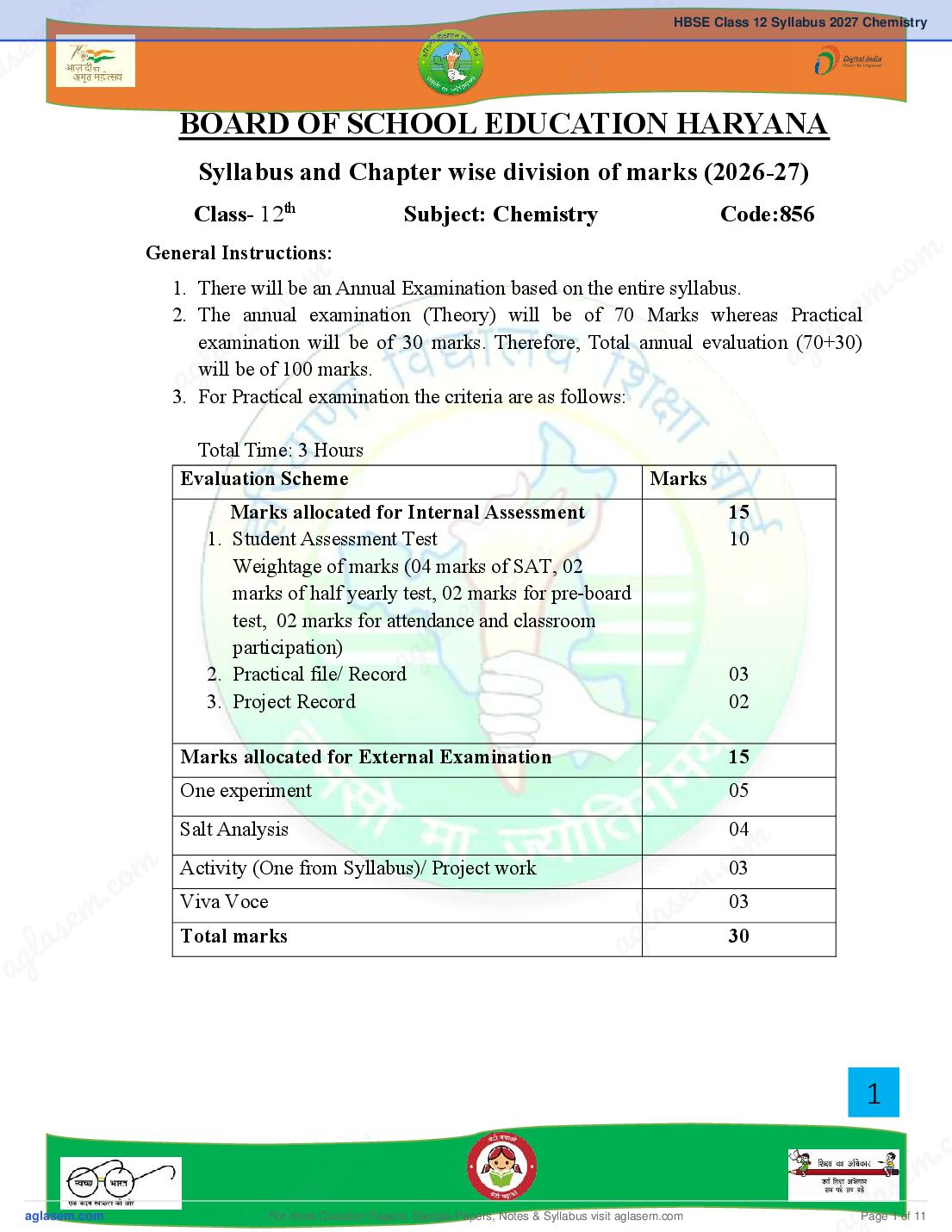
BOARD OF SCHOOL EDUCATION HARYANA
Syllabus and Chapter wise division of marks (2026-27)
Class- 12th Subject: Chemistry Code:856
General Instructions:
o m
m . c
1. There will be
. coexamination (Theory) will be of 70 Marks whereas Practicalsem
an Annual Examination based on the entire syllabus.
em will be of 30 marks. Therefore, Total annual evaluation (70+30)
2. The annual
s
examination g l a
g la be of 100 marks.
will a
3.a For Practical examination the criteria are as follows:
Total Time: 3 Hours
Evaluation Scheme Marks
Marks allocated for Internal Assessment 15
1. Student Assessment Test 10
m
.co
Weightage of marks (04 marks of SAT, 02
marks of half yearly test, 02 marks for pre-board
e m
l as
test, 02 marks for attendance and classroom
ag
participation)
2. Practical file/ Record 03
3. Project Record 02
Marks allocated for External Examination 15
One experiment 05
Salt Analysis 04
m
m Activity (One from Syllabus)/ Project work .c03o
m .co Viva Voce s e m 03
s e g la
g la Total marks
a 30
a
1
m . c
c. o s e m
s em
For more Question Papers, Sample Papers, Notes & Syllabus visit
gl a
Page 1 of 11
Page 3
Course Structure (2026-27)
Class- 12th Subject: Chemistry Code:856
Sr. Name of Chapter Marks
No.
1 Unit 1: Solutions 8
2 Unit 2: Electro Chemistry 8
3 Unit 3: Chemical Kinetics 7
4 Unit 4: d & f Block Elements 7
5 Unit 5: Co-ordination Compounds 7
6 Unit 6: Halo Alkanes & Halo Arenes 6
7 Unit 7: Alcohols, Phenols and Ethers 6
8 Unit 8: Aldehydes, Ketones and Carboxylic Acids 8
9 Unit 9: Amines 6
10 Unit 10: Biomolecules 7
Total 70
Practical 30
Grand Total 100
2
For more Question Papers, Sample Papers, Notes & Syllabus visit Page 2 of 11
Page 4
m .co s e m HBSE Class 12 Syllabus 2027 Chemistry
s e l a
a ag
Unit 1: Solutions
1.1 Types of Solutions
1.2 Expressing Concentration of Solutions
m
om
1.3 Solubility: Solubility of a Solid in a Liquid, Solubility of a Gas in a Liquid,
. co
. c e m
1.4 Vapour Pressure of Liquid Solutions: Vapour Pressure of Liquid-Liquid Solutions,
em l as
l a
in Liquids
s
Raoult’s Law as a special case of Henry’s Law, Vapour Pressure of Solutions of Solids
ag
a g
1.5 Ideal and Non-ideal Solutions: Ideal Solutions, Non-ideal Solutions
1.6 Colligative Properties and Determination of Molar Mass: Relative Lowering of
Vapour Pressure, Elevation of Boiling Point, Depression of Freezing Point, 4 Osmosis
and Osmotic Pressure, Reverse Osmosis and Water Purification
1.7 Abnormal Molar Masses
m
Unit 2: Electrochemistry m .co
s e
2.1 Electrochemical Cells
g l a
a
2.2 Galvanic Cells: Measurement of Electrode Potential,
2.3 Nernst Equation: Equilibrium Constant from Nernst Equation, Electrochemical
Cell and Gibbs Energy of the Reaction,
2.4 Conductance of Electrolytic Solutions: Measurement of the Conductivity of Ionic
Solutions, Variation of Conductivity and Molar Conductivity with Concentration,
2.5 Electrolytic Cells and Electrolysis: Products of Electrolysis, m
m
c. o 2.6 Batteries: Primary Batteries, Secondary Batteries m.co
m s e
s e 2.7 Fuel Cells
g la
g la 2.8 Corrosion a
a
3
m . c
c. o s e m
s em
For more Question Papers, Sample Papers, Notes & Syllabus visit
gl a
Page 3 of 11
Page 5
Unit 3: Chemical Kinetics
3.1 Rate of a Chemical Reaction
3.2 Factors Influencing Rate of a Reaction: Dependence of Rate on Concentration,
Rate Expression and Rate Constant, Order of a Reaction Molecularity of a Reaction,
3.3 Integrated Rate Equations: Zero Order Reactions, First Order Reactions, Half-Life
of a Reaction,
3.4 Temperature Dependence of the Rate of a Reaction: Effect of Catalyst.
3.5 Collision Theory of Chemical Reactions
Unit 4: The d-and f-Block Elements
4.1 Position in the Periodic Table
4.2 Electronic Configurations of the d-Block Elements
4.3 General Properties of the Transition Elements (d-Block): Physical Properties,
Variation in Atomic and Ionic Sizes of Transition Metals, Ionisation Enthalpies,
Oxidation States, Trends in the M2+/M Standard Electrode Potentials, Trends in the
M3+/M2+ Standard Electrode Potentials, Trends in Stability of Higher Oxidation State,
Chemical Reactivity and Eo Values, Magnetic Properties, Formation of Coloured Ions,
Formation of Complex Compounds, Catalytic Properties, Formation of Interstitial
Compounds, Alloy Formation,
4.4 Some Important Compounds of Transition Elements
4.5 The Lanthanoids: Electronic Configurations, Atomic and Ionic Sizes, Oxidation
States, General Characteristics,
4.6 The Actinoids: Electronic Configurations, Ionic Sizes, Oxidation States, General
Characteristics and Comparison with Lanthanoids,
4.7 Some Applications of d- and f-Block Elements
Unit 5: Coordination Compounds
5.1 Werner's Theory of Coordination Compounds
5.2 Definitions of Some Important Terms Pertaining to Coordination Compounds
4
For more Question Papers, Sample Papers, Notes & Syllabus visit Page 4 of 11
Page 6
m .co s e m HBSE Class 12 Syllabus 2027 Chemistry
s e l a
a ag
5.3 Nomenclature of Coordination Compounds: Formulas of Mononuclear
Coordination Entities, Naming of Mononuclear Coordination Compounds,
5.4 Isomerism in Coordination Compounds: Geometric Isomerism, Optical Isomerism,
Linkage Isomerism, Coordination Isomerism, Ionisation Isomerism, Solvate
Isomerism, ,
m
5.5 Bonding in Coordination Compounds: Valence Bond Theory, Magnetic Properties
om . co
c
of Coordination Compounds, Limitations of Valence Bond Theory, Crystal Field
. e m
m
Theory, Colour in Coordination Compounds, Limitations of Crystal Field Theory,
e l as
l as
5.6 Bonding in Metal Carbonyls ag
5.7 a
g
Importance and Applications of Coordination Compounds
Unit 6: Haloalkanes and Haloarenes
6.1 Classification: On the Basis of Number of Halogen Atoms, Compounds Containing
sp3 C—X Bond (X= F, Cl, Br, I), Compounds Containing sp 2 C—X Bond .
m
6.2 Nomenclature
m .co
6.3 Nature of C–X Bond e
las
6.4 Methods of Preparation of gHaloalkanes: From Alcohols, From Hydrocarbons,
a
Halogen Exchange, Reactions of Haloalkanes
6.5 Preparation of Haloarenes
6.6 Physical Properties
6.7 Chemical Reactions: Reactions of Haloarenes
6.8 Polyhalogen Compounds: Dichloromethane (Methylene chloride,
m
.co
Trichloromethane (Chloroform), Triiodomethane (Iodoform), Tetrachloromethane
m
.co
(Carbon tetrachloride) Freons, p, p’-Dichlorodiphenyltrichloroethane (DDT)
e m
e m las
las ag
ag Unit 7 Alcohols, Phenols and Ethers
7.1 Classification: Alcohols— Mono, Di, Tri or Polyhydric alcohols,
7.2 Nomenclature
5
m . c
c. o s e m
s em
For more Question Papers, Sample Papers, Notes & Syllabus visit
gl a
Page 5 of 11
Page 7
7.3 Structures of Functional Groups
7.4 Alcohols and Phenols: Preparation of Alcohols, Preparation of Phenols, Physical
Properties, Chemical Reactions,
7.5 Some Commercially Important Alcohols
7.6 Ethers: Preparation of Ethers, Physical Properties, Chemical Reactions
Unit 8 Aldehydes, Ketones and Carboxylic Acids
8.1 Nomenclature and Structure of Carbonyl Group: Nomenclature, Structure of the
Carbonyl Group,
8.2 Preparation of Aldehydes and Ketones: Preparation of Aldehydes and Ketones,
Preparation of Aldehydes, Preparation of Ketone,
8.3 Physical Properties
8.4 Chemical Reactions
8.5 Uses of Aldehydes and Ketones
8.6 Nomenclature and Structure of Carboxyl Group: Nomenclature, Structure of
Carboxyl Group,
8.7 Methods of Preparation of Carboxylic Acids
8.8 Physical Properties
8.9 Chemical Reactions: Reactions Involving Cleavage of O–H Bond, Reactions
Involving Cleavage of C–OH Bond, Reactions Involving –COOH Group, Substitution
Reactions in the Hydrocarbon Part,
8.10 Uses of Carboxylic Acids
Unit 9 Amines
9.1 Structure of Amines
9.2 Classification
9.3 Nomenclature
9.4 Preparation of Amines
6
For more Question Papers, Sample Papers, Notes & Syllabus visit Page 6 of 11
Page 8
m .co s e m HBSE Class 12 Syllabus 2027 Chemistry
s e l a
a ag
9.5 Physical Properties
9.6 Chemical Reactions
9.7 Method of Preparation of Diazonium Salts
9.8 Physical Properties
m
9.9 Chemical Reactions
m . co
coDiazonium Salts in Synthesis of Aromatic Compounds
9.10 Importance.of
s e m
s em g l a
a a
Unitag10l Biomolecules
10.1 Carbohydrates: Classification of Carbohydrates, Monosaccharides, Glucose,
Fructose, Disaccharides, Polysaccharides, Importance of Carbohydrates.
10.2 Proteins: Amino Acids, Classification of Amino Acid, Structure of Proteins,
10.3 Enzymes: Mechanism of Enzyme Action.
10.4 Vitamins: Classification of Vitamins
m
.co
10.5 Nucleic Acids: Chemical Composition of Nucleic Acid, Structure of Nucleic Acid,
m
e
Biological Functions of Nucleic Acids,
s
l a
ag
10.6 Hormone Elementary idea (excluding structure)
PRACTICALS:
1. Determine the enthalpy change for the interaction between acetone and
chloroform (hydrogen bond formation).
2. Study the variation in cell potential of the cell Zn/Zn2+|| Cu2+/Cu with change in
concentration of electrolytes (CuSO4 or ZnSO4) at room temperature.
o m
3. Study the effect of concentration and temperature variation respectively on the
m rate of reaction between sodium thiosulphate and hydrochloricmacid.. c
c. o s e
e m 4. Detect one cation and one anion in the given salt from l
thea following ions:
las g
g Cation: Pb , Cu As , Al , Fe , Mn , Zna , Ni , Ca , Sr , Ba ,
2+ 2+, 3+ 3+ 3+ 2+ 2+ 2+ 2+ 2+ 2+
a Mg , NH
2+
4
+
Anions:
(CO3)2-, S2-, (SO3)2, (NO2)-,(SO4)2-,Cl- ,Br-, I-, (PO4)3-, (C2O4)2-, CH3COO-, NO3-
(Note: Insoluble salts excluded)
7
m . c
c. o s e m
s em
For more Question Papers, Sample Papers, Notes & Syllabus visit
gl a
Page 7 of 11
Page 9
5. Determine the concentration/molarity of KMnO4 solution by titrating it against a
0.1 M standard solution of oxalic acid.
6. Prepare double salts: ferrous ammonium sulphate (Mohr's salt) and potash alum.
7. Identify the functional groups present in an organic compound.
8. Prepare aniline yellow (p-amino-azobenzene).
9. Prepare acetanilide.
10.Detection of carbohydrates, fats and proteins in the given foodstuffs.
Monthwise Syllabus Teaching Plan (2026-27)
Class- 12th Subject: Chemistry Code:856
Chapter / Topic Teaching Revision Practical
Month Periods periods Periods
Unit 1: Solutions 20 4
Practical:
Determine the enthalpy change
April for the interaction between
acetone and chloroform 2
(hydrogen bond formation).
Unit 2: Electrochemistry 20 5
Practical:
Study the variation in cell
potential of the cell Zn/Zn2+||
4
May Cu /Cu
2+
with change in
concentration of electrolytes
(CuSO4 or ZnSO4) at room
temperature.
Summer Vacations: -
June Investigatory Projects, charts and working innovative models
should be given during the summer vacations
8
For more Question Papers, Sample Papers, Notes & Syllabus visit Page 8 of 11
Page 10
m .co s e m HBSE Class 12 Syllabus 2027 Chemistry
s e l a
a ag
Unit 3 : Chemical Kinetics 12 2
Practical:
Study the effect of
concentration and temperature 2
m
co
variation respectively on the
. c om
rate of reaction between sodium
thiosulphate and hydrochloric em .
m
eacid. l as
as
l Unit 4: d & f- block elements ag
a g
July
14 2
Practical: Detect one cation and 2
one anion in the given salt.
Practical: Determine the
concentration/molarity of
KMnO4 solution by titrating it 2
m
.co
against a 0.1 M standard
solution of oxalic acid.
e m
Unit 5 : Coordinationlas 18 5
compounds ag
Practical:
August
Prepare double salts: ferrous 4
ammonium sulphate (Mohr's
salt) and potash alum
Unit 6 : Halo Alkanes & Halo 18 4
m
.co
Arenes
m September
.co
Half Yearly Exam
e m
e m s
la 4
las Unit 7: Alcohols, Phenols and
Ethers
20
ag
ag October
9
m . c
c. o s e m
s em
For more Question Papers, Sample Papers, Notes & Syllabus visit
gl a
Page 9 of 11
Page 11
Unit 8: Aldehydes, Ketones 24 4
November and Carboxylic Acids
Unit 9: Amines 12 2
Practical: Prepare aniline
yellow (p-amino-azobenzene). 2
Practical: Prepare acetanilide. 2
Practical: Identify the
functional groups present in an 4
December
organic compound.
Unit 10: Biomolecules 10 2
Practical: Detection of
carbohydrates, fats and proteins 4
in the given foodstuffs.
January Revision -- -- --
Revision and Annual Practical -- -- --
February Exams
March Annual Exams
Note:
Subject teachers are advised to direct the students to prepare notebook of
the Terminology/Definitional Words used in the chapters for enhancement
of vocabulary for clarity of the concept.
The NCERT textbooks present information in boxes across the book. These
help students to get conceptual clarity. However, the information in these
boxes would not be assessed in the year-end examination.
Prescribed Books:
1. Chemistry Part-I and Part II, Class XII , BSEH Publications © NCERT
2. Laboratory Manual of Chemistry, Class XII published by (NCERT)
10
For more Question Papers, Sample Papers, Notes & Syllabus visit Page 10 of 11
Page 12
m .co s e m HBSE Class 12 Syllabus 2027 Chemistry
s e l a
a ag
Question Paper Design(2026-27)
Class- 12th Subject: Chemistry Code: 856
Time: 3 Hours m
m . co
c. o
Competencies Marks Percentage
s e m
s em
Knowledge 28 40%
g l a
g laUnderstanding 21 30% a
a Application 14 20%
Skill 7 10%
Total 70 100%
Type of Marks Number Description Total Marks
Question of
Question o m
1 18 c
09.Multiple Choice Questions, 18
m
e 03 Fill in the blanks
Objective
Questions l as 03 One Word Answer based.
ag 03 Assertion-Reason Questions
Very Short 2 7 Internal choice will be given in 14
Answer Type any 3 questions
Question
Short Answer 3 5 Internal choice will be given in 15
Type Question any 2 questions
Case Study 4 2 Internal choice will be given 8
only in one part of both
m
mLong Answer
c. o Type
questions
.co
m
5 3 Internal choice will be given in
s em 15
la
Question all the questions and may be
s e g
la
given in the parts
g Total 35 a 70
a
11
m . c
c. o s e m
s em
For more Question Papers, Sample Papers, Notes & Syllabus visit
gl a
Page 11 of 11
Document Details
| Board / Org | Haryana Board |
| Exam | Class 12 |
| Type | Syllabus |
| Pages | 11 |
| Updated | 04 Nov 2026 |