KSET Syllabus General Paper
Finished viewing? Save it for later —
Download KSET Syllabus General Paper (PDF · 5 pages)About KSET Syllabus General Paper
KSET Syllabus General Paper is available here for free download. Published by Karnataka Exams for Karnataka State Eligibility Test, this syllabus can be viewed online or downloaded as a PDF (5 pages). Candidates preparing for Karnataka State Eligibility Test can use KSET Syllabus General Paper to understand the exam pattern, the type of questions asked, and the overall difficulty level.
Frequently Asked Questions
How can I download KSET Syllabus General Paper?
Open this page and click the Download button to save KSET Syllabus General Paper as a PDF. It is completely free on AglaSem Docs.
Is KSET Syllabus General Paper free to download?
Yes. KSET Syllabus General Paper can be viewed online and downloaded as a PDF free of cost on AglaSem Docs.
How many pages does KSET Syllabus General Paper have?
KSET Syllabus General Paper contains 5 pages, which you can read online or download together as a single PDF.
Where can I find more Karnataka State Eligibility Test study material?
You can find more Karnataka State Eligibility Test question papers, sample papers, syllabus, and answer keys on AglaSem Docs.
KSET Syllabus General Paper – Text
Read the full text of this syllabus below — useful to quickly search, copy and reference the content online without downloading the PDF.
📄 View text version (5 pages)
Page 1
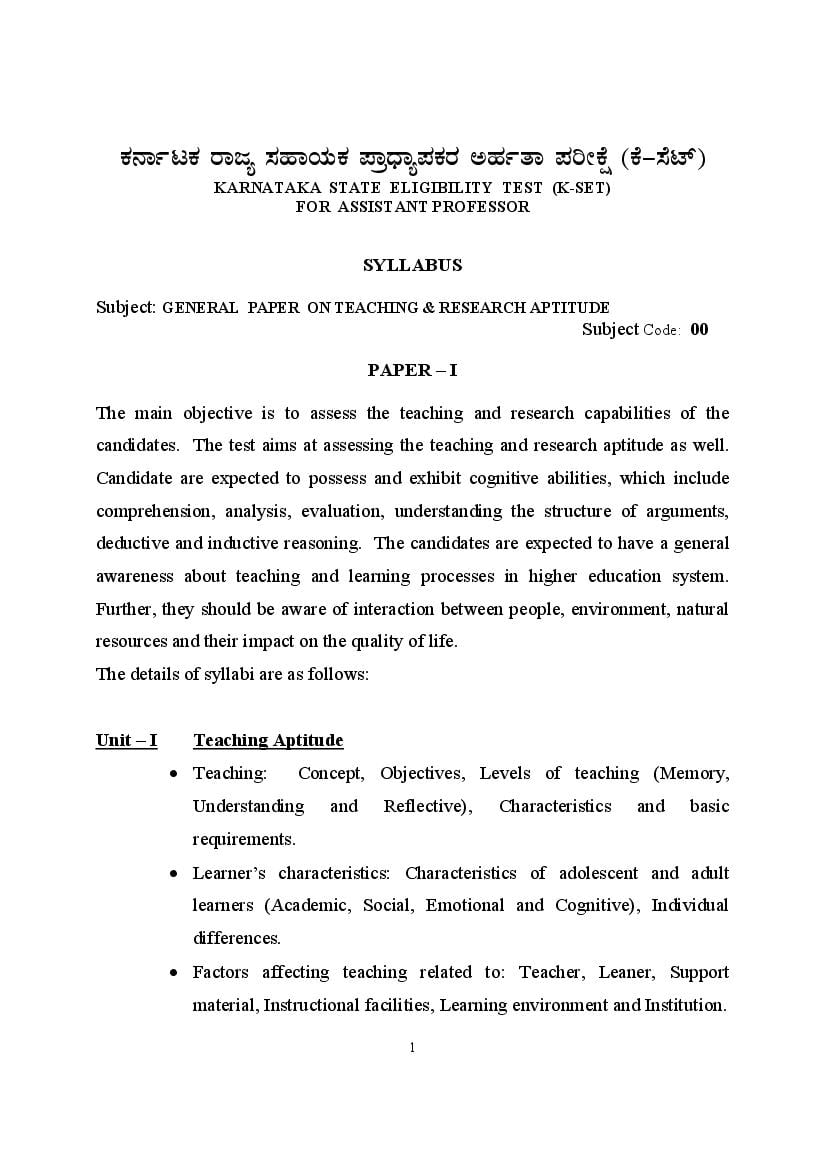
KARNATAKA STATE ELIGIBILITY TEST (K-SET)
FOR ASSISTANT PROFESSOR
SYLLABUS
Subject: GENERAL PAPER ON TEACHING & RESEARCH APTITUDE
Subject Code: 00
PAPER – I
The main objective is to assess the teaching and research capabilities of the
candidates. The test aims at assessing the teaching and research aptitude as well.
Candidate are expected to possess and exhibit cognitive abilities, which include
comprehension, analysis, evaluation, understanding the structure of arguments,
deductive and inductive reasoning. The candidates are expected to have a general
awareness about teaching and learning processes in higher education system.
Further, they should be aware of interaction between people, environment, natural
resources and their impact on the quality of life.
The details of syllabi are as follows:
Unit – I Teaching Aptitude
Teaching: Concept, Objectives, Levels of teaching (Memory,
Understanding and Reflective), Characteristics and basic
requirements.
Learner’s characteristics: Characteristics of adolescent and adult
learners (Academic, Social, Emotional and Cognitive), Individual
differences.
Factors affecting teaching related to: Teacher, Leaner, Support
material, Instructional facilities, Learning environment and Institution.
1
Page 2
centred vs. Learner centred methods; Off-line vs. On-line methods
(Swayam, Swayamprabha, MOOCs etc.).
Teaching Support System: Traditional, Modern and ICT based.
Evaluation Systems: Elements and Types of evaluation, Evaluation in
Choice Based Credit System in Higher education, Computer based
testing, Innovations in evaluation systems.
Unit – II Research Aptitude
Research: Meaning, Types, and Characteristics, Positivism and
Post-positivistic approach to research.
Methods of Research: Experimental, Descriptive, Historical,
Qualitative and Quantitative methods.
Steps of Research.
Thesis and Article writing: Format and Styles of referencing.
Application of ICT in research.
Research ethics.
Unit - III Comprehension
A passage of text be given. Questions be asked from the passage
to be answered.
Unit – IV Communication
Communication: Meaning, types and characteristics of
communication.
Effective communication: Verbal and Non-verbal, Inter-Cultural and
group communications, Classroom communication.
2
Page 3
Mass-Media and Society.
Unit-V Mathematical Reasoning and Aptitude
Types of reasoning.
Number series, Letter series, Codes and Relationships.
Mathematical Aptitude (Fraction, Time & Distance, Ratio, Proportion
and Percentage, Profit and Loss, Interest and Discounting, Averages
etc.).
Unit – VI Logical Reasoning
Understanding the structure of arguments: arguments forms, structure
of categorical propositions, Mood and Figure, Formal and Informal
fallacies, Uses of language, Connotations and denotations of terms,
Classical square of opposition.
Evaluating and distinguishing deductive and inductive reasoning.
Analogies.
Venn diagram: Simple and multiple use for establishing validity of
arguments.
Indian Logic: Means of knowledge.
Pramanas: Pratyaksha (Perception), Anumana (Inference), Upamana
(Comparison), Shabda (Verbal testimony), Arthapatti (Implication)
and Anupalabddhi ( Non-apprehension).
Structure and kinds of Anumana (inference), Vyapti (invariable
relation), Hetvabhasas (fallacies of inference).
3
Page 4
Sources, acquisition and classification of Data.
Quantitative and Qualitative Data.
Graphical representation (Bar-chart, Histograms, Pie-chart, Table-
chart and Line-chart) and mapping of Data.
Data Interpretation.
Data and Governance.
Unit-VIII Information and Communication Technology (ICT)
ICT: General abbreviations and terminology.
Basics of Internet, Intranet, E-mail, Audio and Video-conferencing.
Digital initiatives in higher education.
ICT and Governance.
Unit-IX People, Development and Environment
Development and environment: Millennium development and
Sustainable development goals.
Human and environment interaction: Anthropogenic activities and their
impacts on environment.
Environmental Issues: Local, Regional and Global; Air pollution, Water
pollution, Soil pollution, Noise pollution, Waste (solid, liquid,
biomedical, hazardous, electronic), Climate change and its Socio-
Economic and Political dimensions.
Impacts of pollutants on human health.
Natural and energy resources: Solar, Wind, Soil, Hydro, Geothermal,
Biomass, Nuclear and Forests.
Natural hazards and disasters: Mitigation strategies.
4
Page 5
change, International agreements/efforts –Montreal Protocol, Rio
Summit, Convention on Biodiversity, Kyoto Protocol, Paris
Agreement, International Solar Alliance.
Unit – X Higher Education System
Institutions of higher learning and education in ancient India.
Evolution of higher learning and research in Post Independence India.
Oriental, Conventional and Non-conventional learning programmes in
India.
Professional, Technical and Skill Based education.
Value education and environmental education.
Polices, Governance, and Administration.
NOTE: (i) Five questions each carrying 2 marks are to be set from each
Module.
(ii) Whenever graphical/pictorial question(s) are set for sighted
candidates, a passage followed by equal number of questions
and weightage be set for visually impaired candidates.
5
Document Details
| Board / Org | Karnataka Exams |
| Exam | Karnataka State Eligibility Test |
| Type | Syllabus |
| Pages | 5 |
| Updated | 24 Sep 2026 |