Maharashtra SSC Syllabus 2022 Pali
Finished viewing? Save it for later —
Download Maharashtra SSC Syllabus 2022 Pali (PDF · 3 pages)About Maharashtra SSC Syllabus 2022 Pali
Maharashtra SSC Syllabus 2022 Pali is available here for free download. Published by Maharashtra Board for Class 10, this syllabus can be viewed online or downloaded as a PDF (3 pages). Candidates preparing for Class 10 can use Maharashtra SSC Syllabus 2022 Pali to understand the exam pattern, the type of questions asked, and the overall difficulty level.
Frequently Asked Questions
How can I download Maharashtra SSC Syllabus 2022 Pali?
Open this page and click the Download button to save Maharashtra SSC Syllabus 2022 Pali as a PDF. It is completely free on AglaSem Docs.
Is Maharashtra SSC Syllabus 2022 Pali free to download?
Yes. Maharashtra SSC Syllabus 2022 Pali can be viewed online and downloaded as a PDF free of cost on AglaSem Docs.
How many pages does Maharashtra SSC Syllabus 2022 Pali have?
Maharashtra SSC Syllabus 2022 Pali contains 3 pages, which you can read online or download together as a single PDF.
Where can I find more Class 10 study material?
You can find more Class 10 question papers, sample papers, syllabus, and answer keys on AglaSem Docs.
Maharashtra SSC Syllabus 2022 Pali – Text
Read the full text of this syllabus below — useful to quickly search, copy and reference the content online without downloading the PDF.
📄 View text version (3 pages)
Page 1
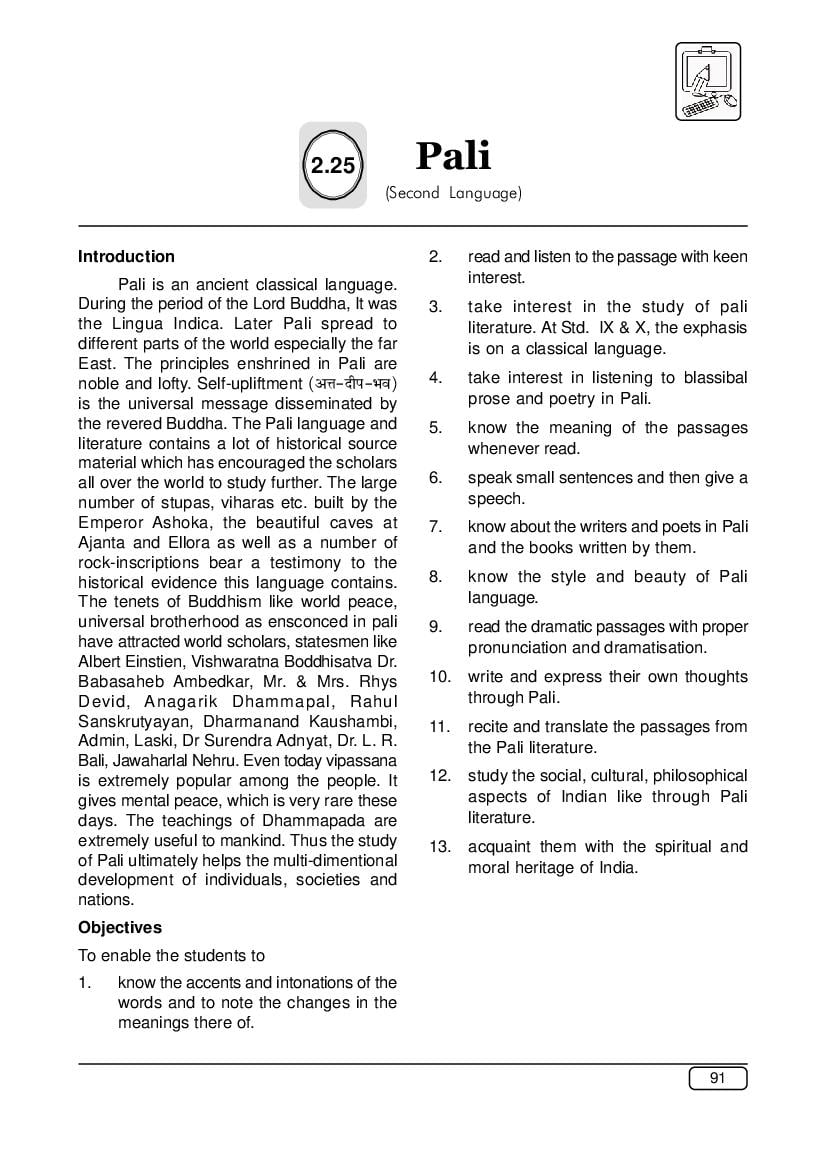
(Second Language)
Introduction 2. read and listen to the passage with keen
Pali is an ancient classical language. interest.
During the period of the Lord Buddha, It was 3. take interest in the study of pali
the Lingua Indica. Later Pali spread to literature. At Std. IX & X, the exphasis
different parts of the world especially the far is on a classical language.
East. The principles enshrined in Pali are
noble and lofty. Self-upliftment (AÎm-Xrn-^d) 4. take interest in listening to blassibal
is the universal message disseminated by prose and poetry in Pali.
the revered Buddha. The Pali language and 5. know the meaning of the passages
literature contains a lot of historical source whenever read.
material which has encouraged the scholars
all over the world to study further. The large 6. speak small sentences and then give a
number of stupas, viharas etc. built by the speech.
Emperor Ashoka, the beautiful caves at 7. know about the writers and poets in Pali
Ajanta and Ellora as well as a number of and the books written by them.
rock-inscriptions bear a testimony to the
historical evidence this language contains. 8. know the style and beauty of Pali
The tenets of Buddhism like world peace, language.
universal brotherhood as ensconced in pali 9. read the dramatic passages with proper
have attracted world scholars, statesmen like pronunciation and dramatisation.
Albert Einstien, Vishwaratna Boddhisatva Dr.
Babasaheb Ambedkar, Mr. & Mrs. Rhys 10. write and express their own thoughts
Devid, Anagarik Dhammapal, Rahul through Pali.
Sanskrutyayan, Dharmanand Kaushambi, 11. recite and translate the passages from
Admin, Laski, Dr Surendra Adnyat, Dr. L. R. the Pali literature.
Bali, Jawaharlal Nehru. Even today vipassana
is extremely popular among the people. It 12. study the social, cultural, philosophical
gives mental peace, which is very rare these aspects of Indian like through Pali
days. The teachings of Dhammapada are literature.
extremely useful to mankind. Thus the study 13. acquaint them with the spiritual and
of Pali ultimately helps the multi-dimentional moral heritage of India.
development of individuals, societies and
nations.
Objectives
1. know the accents and intonations of the
words and to note the changes in the
meanings there of.
91
Page 2
1) Prose : JÁO - About 200 lines. 1) Prose : JÁO - About 200 lines.
2) Poetry : nÁO - About 120 lines (60 2) Poetry : nÁO - About 120 lines
lines for Recitation)
(60 lines for Recitation)
3) Rapid Reading - About 50 lines.
3) Rapid Reading : About 60 lines
4) Grammar : dU©, dU© n[adV©Z - Tense and 4) Grammar : Tense, Sandhi, Case,
Sandhi, Nouns Pronouns. Compounds
5) General knowledge – Pabbajja, 5) General knowledge : Vihar, Chaitya,
Tisaran, Chiwar, Arhant, Chariya. Stupas, Short notes on Pali books
6) Oral Skills – Listening, Loud Reading, Dhammapada. Suttanipat, Therigatha,
Speaking and Conversation. Jataka, Caves- Ajantha & Ellora,
6) Oral Skills : Listening, loud reading,
92
Page 3
(Composite Language)
Objectives Std. IX
1) Prose : JÁO - About 100 lines.
1. listen carefully to passages in Pali
2) Poetry : nÁO - About 50 lines
2. know the intonations
3) Grammar : dU©, dU© n[adV©Z, H$mi, g§Yr
3. read out the subhashits loudly after the
teacher’s reading 4) General knowledge – Pabbajja,
Chariya, Tisaran
4. read the passages properly on their
own. 5) Oral Skills – Listening, loud reading,
5. translate the passage into the mother
tongue and the medium offered. Std. X
6. take interest in other extracts from Pali 1) Prose : JÁO - About 100 lines.
literature
2) Poetry : nÁO - About 50 lines
7. write and express their own thoughts
through Pali 3) Grammar : Tense, Sandhi, Case
8. study the Social, Cultural, philosophical 4) General Knowledge : Vihar, Chaittya,
aspects, Spiritual and moral heritage Stupas, Ajantha, Ellora and Nasik
of India through Pali literature (Trirashmi) Caves
5) Oral Skills : Listening, Loud Reading,
Speaking and Conversation
93
Document Details
| Board / Org | Maharashtra Board |
| Exam | Class 10 |
| Type | Syllabus |
| Pages | 3 |
| Updated | 09 Jun 2026 |