KSET Syllabus Home Science
Finished viewing? Save it for later —
Download KSET Syllabus Home Science (PDF · 7 pages)About KSET Syllabus Home Science
KSET Syllabus Home Science is available here for free download. Published by Karnataka Exams for Karnataka State Eligibility Test, this syllabus can be viewed online or downloaded as a PDF (7 pages). Candidates preparing for Karnataka State Eligibility Test can use KSET Syllabus Home Science to understand the exam pattern, the type of questions asked, and the overall difficulty level.
Frequently Asked Questions
How can I download KSET Syllabus Home Science?
Open this page and click the Download button to save KSET Syllabus Home Science as a PDF. It is completely free on AglaSem Docs.
Is KSET Syllabus Home Science free to download?
Yes. KSET Syllabus Home Science can be viewed online and downloaded as a PDF free of cost on AglaSem Docs.
How many pages does KSET Syllabus Home Science have?
KSET Syllabus Home Science contains 7 pages, which you can read online or download together as a single PDF.
Where can I find more Karnataka State Eligibility Test study material?
You can find more Karnataka State Eligibility Test question papers, sample papers, syllabus, and answer keys on AglaSem Docs.
KSET Syllabus Home Science – Text
Read the full text of this syllabus below — useful to quickly search, copy and reference the content online without downloading the PDF.
📄 View text version (7 pages)
Page 1
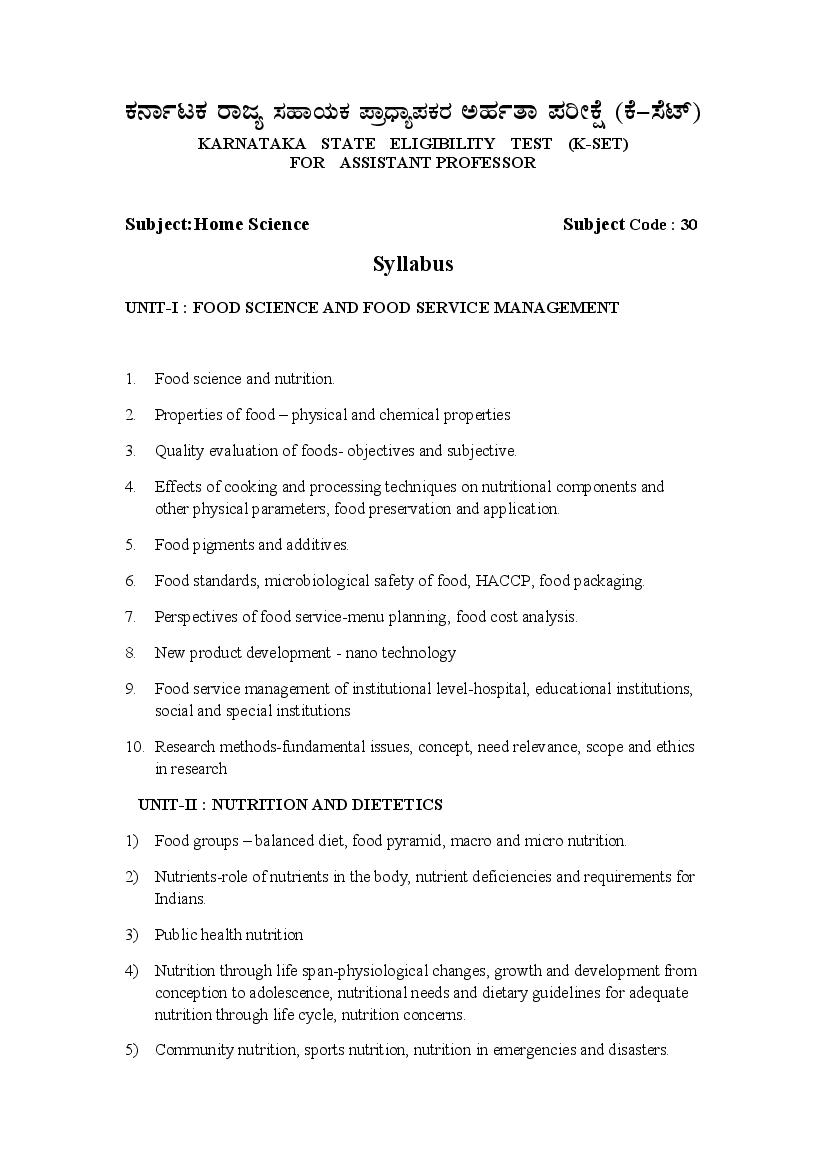
KARNATAKA STATE ELIGIBILITY TEST (K-SET)
FOR ASSISTANT PROFESSOR
Subject:Home Science Subject Code : 30
Syllabus
UNIT-I : FOOD SCIENCE AND FOOD SERVICE MANAGEMENT
1. Food science and nutrition.
2. Properties of food – physical and chemical properties
3. Quality evaluation of foods- objectives and subjective.
4. Effects of cooking and processing techniques on nutritional components and
other physical parameters, food preservation and application.
5. Food pigments and additives.
6. Food standards, microbiological safety of food, HACCP, food packaging.
7. Perspectives of food service-menu planning, food cost analysis.
8. New product development - nano technology
9. Food service management of institutional level-hospital, educational institutions,
social and special institutions
10. Research methods-fundamental issues, concept, need relevance, scope and ethics
in research
UNIT-II : NUTRITION AND DIETETICS
1) Food groups – balanced diet, food pyramid, macro and micro nutrition.
2) Nutrients-role of nutrients in the body, nutrient deficiencies and requirements for
Indians.
3) Public health nutrition
4) Nutrition through life span-physiological changes, growth and development from
conception to adolescence, nutritional needs and dietary guidelines for adequate
nutrition through life cycle, nutrition concerns.
5) Community nutrition, sports nutrition, nutrition in emergencies and disasters.
Page 2
7) Nutritional intervention-national nutrition policies and programmes, food and
nutrition security
8) Clinical and therapeutic nutrition.
9) Diet counseling and management.
10) Research methods- research designs, principles and purpose of research
Unit-III: TEXTILES
1. Textile terminologies- fibre, yarn, weave, fabric etc., classification of fibers,
yarns and weaves, Identification of fibres and weaves.
2. Manufacturing process of major natural and manmade fibres, properties and their
end uses.
3. Different methods of fabric construction-woven, knitted and non woven fabrics,
their properties and end uses.
4. Textiles finishes-classification, processing and purposes of finishes.
5. Dyeing and printing-classification, method of block printing, tie and dye, batik,
roller printing, screen printing, discharge, heat transfer printing and digitized
printing
6. .6. Traditional textiles of India-embroidered textiles, printed textiles, woven
textiles, dyed textiles of various regions in India. Identification on the basis of
fibre content, technique, motif, colour and designed.
7. Textile Testing and quality control-need of testing, sampling method, techniques
of testing fibres, yarn, fabrics and garments. Testing of colour-fastness, shrinkage,
pilling and GSM of fabrics.
8. Textile and environment-banned dyes, eco-friendly textiles, contamination and
effluent treatment, Eco-label and eco marks.
9. Recent developments in textiles and apparels- nano textiles, technical textiles,
occupational clothing, zero waste designing, up cycling and recycling.
10. Research methods-types of research, descriptive, survey, historical, qualitative,
quantitative, analytical and action research
Page 3
1) Body measurements-procedure, need, figure types and anthropometry.
2) Equipments and tools used for manufacturing garments-advancements and
attachments used for sewing machine. Types of machines used and their parts.
3) Elements and principles of design and its application to apparel. Illustrations and
parts of garments.
4) Fashion-Terminologies, fashion cycle, fashion theories, fashion adoption, fashion
forecasting and factors affecting fashion.
5) Pattern making-drafting, draping and flat pattern making techniques, pattern
alteration and dart manipulation techniques
6) . 6. Apparel manufacturing-terminology used, seams, techniques and machines
used, process of fabric to apparel manufacture.
7) 7 Apparel Quality testing-Quality standards and specification, Quality parameters
and defects of fabrics and garments.
8) Care and maintenance of clothing-principles of washing, laundry agents, storage
techniques case labels and symbols.
9) Selection of clothing for different age groups. Selection of fabrics for different
and uses.
10) Research methods-hypothesis testing, types and scope
UNIT-V : RESOURCE MANAGEMENT AND CONSUMER ISSUES
1. Management-concept, approaches, management of time, energy, money, space,
motivating factors, motivation theories, decision making.
2. Functions of management-planning, supervision, controlling, organizing,
evaluation, family life cycle-stages, availability and use of resources.
3. Resources-classification, characteristics, factors affecting use, resource
conservation, time management, work simplification techniques, classes of
change, fatigue and its management.
4. Management of natural resources-land, forest, water, air, water harvesting,
municipal solid waste management, concept of sustainable development, SDGs.
5. Money management-family income, types, supplementation, budgeting,
household accounts, family savings and investment, tax implications.
Page 4
7. Consumer-definition, role, rights and responsibilities, consumer behavior,
consumer problems, education and empowerment.
8. Consumer protection- consumer organization, cooperatives, alternative redressal,
standardization, standard marks, quality control, buying aids, consumer
legislation.
9. Entrepreneurship-concept, process, barriers, entrepreneurial motivation,
challenges, enterprise setting, project planning and appraisal, enterprise
management.
10. Research methods-sampling techniques, types of sampling, sampling procedures,
probability and non probability sampling
UNIT-VI : HOUSING AND INTERIOR DESIGN
1) Design fundamentals – elements of art, principles of design, principles of
composition.
2) Colour - dimensions of colour, psychological effects of colour, colour schemes,
factors affecting use of colour.
3) Space planning and design-housing need and important, principles of planning
spaces, types of house plans, economy in construction, planning for different
income groups
4) 4 . Building regulations-norms and standards, zoning, housing for special groups
and areas, housing finance.
5) 5 Housing and environment- building materials- impact on environment, green
rating systems, energy efficiency in buildings, energy auditing, indices of indoor
comfort
6) Energy as a resource- conventional and non- conventional sources, renewable
/nonrenewable energy, energy management, national efforts on energy
conservation.
7) 7. Product design - design thinking process, diffusion and innovation, design
communication, ergonomic considerations.
8) Ergonomics - significance, scope, anthropometry, man, machine, environment
relationship, factors affecting physiological cost of work, body mechanics,
functional design of work place, time and motion study, energy studies.
Page 5
contemporary tends, wall finishes, window and window treatments.
10) Research methods-selection and preparation of tools for data
collectionquestionnaire, interview, observation, measuring scales, ranking and
measurement, reliability and validity of tools
UNIT-VII : CHILD/HUMAN DEVELOPMENT
1. Principles of growth and development, care during pregnancy and pre-natal and
neonatal development.
2. Theories of human development and behavior.
3. Early childhood care and education – activities to promote holistic development.
4. Influence of family, peers, school, community and culture on personality
development.
5. Children and persons with special needs, care and support, special education,
prevention of disabilities, rehabilitation.
6. Children at risk-child labour, street children, children of destitute, orphans, child
abuse and trafficking.
7. Adolescence and youth: changes, challenges and programs to promote optimal
development.
8. Adulthood, characteristics, changing roles and responsibilities in early and
middle adulthood.
9. Aging-physical and psychological changes and care needs.
10. Research methods-types of variables and their selection.
UNIT-VIII : FAMILY STUDIES
1) Dynamics of marriage and family relationships.
2) Family welfare-approaches, programmes and challenges, role in national
development
3) Domestic violence, marital disharmony, conflict, resolution of conflict.
4) Parent education, positive parenting, community education.
5) Family disorganization, single parent families.
6) Family studies-family in crisis, family therapy, initiatives for child development.
Page 6
roles.
8) . Guidance and counseling- across life span and for care givers.
9) Health and well being across life span development.
10) Research methods- data collection and classification, coding, tabulation,
inferential and descriptive statistics.
UNIT-IX : COMMUNICATION FOR DEVELOPMENT
1. Basics of communication- nature, characteristics, functions, process, models,
elements, principles, barriers, perception, persuasion and empathy, types of
communication, levels (settings) of communication transactions, process of
listening.
2. Communication systems and communication theories- human interaction theories,
mass communication theories, message design theories, communication systems,
culture and communication.
3. Concept of development- theories, models, measurement and indicators of
development.
4. Concept of development- communication models and approaches, diffusion and
innovation, mass media, social marketing.
5. Role of communication in development- need and importance, development
journalism, writing for development-print, radio, television and internet
6. . 6. Concerns of development communication- gender, health, environment,
sustainability, human rights, population, literacy, rural and tribal development.
7. 7 Advocacy and behavior change communication- concept, theories, models,
approaches, application and challenges.
8. Traditional, modern and new media for development - folk forms of songs, art,
dance, theatre, puppetry, advertisement, cinema, ICTs for
development-community radio, participatory video, social media and mobile
phones.
9. Organisation/agencies/institutes working for development
communicationinternational/national/state and local.
10. Research methods-analysis of data through parametric and non parametric tests.
Page 7
DEVELOPMENT
1) Historical perspectives of extension–genesis of extension education and extension
systems in India and other countries, objectives of extension education and
extension service, philosophy and principles of extension programme
development.
2) Programme management- need assessment, situation analysis, planning,
organization, implementation, monitoring and evaluation.
3) Extension methods and materials- interpersonal, small and large group methods,
audiovisual aids-need, importance, planning, classification, preparation and field
testing, use and evaluation of audio-visual materials.
4) Curriculum development and planning for extension education and development
activities, Bloom’s taxonomy of educational objectives and learning.
5) Non-Formal, adult and lifelong education-historical perspectives, concept,
theories, approaches, scope, methods and materials used, challenges of
implementation and evaluation, issues to be addressed.
6) Training, skill development and capacity building for human resource
developmentmethods of training, entrepreneurship development.
7) Community development- perspectives, approaches, community organization,
leadership, support structures for community development, Panchyati raj
institutions, NGOs and community based organisations.
8) People’s participation and stakeholders’ perspectives, Participatory Learning and
Action-methods and techniques.
9) Development programmes in India for urban, rural and tribal population
groupsprogrammes for nutrition, health, education, wage and self employment,
women’s development, skill development, sanitation and infrastructure.
10) Research methods-scientific report writing, presentation of data, interpretation
and discussion.
***
Document Details
| Board / Org | Karnataka Exams |
| Exam | Karnataka State Eligibility Test |
| Type | Syllabus |
| Pages | 7 |
| Updated | 24 Sep 2026 |