ACET 2020 Answer Key (Oct)
Finished viewing? Save it for later —
Download ACET 2020 Answer Key (Oct) (PDF · 10 pages)About ACET 2020 Answer Key (Oct)
ACET 2020 Answer Key (Oct) is available here for free download. Published by Actuaries India for ACET, this answer key can be viewed online or downloaded as a PDF (10 pages). Candidates preparing for ACET can use ACET 2020 Answer Key (Oct) to understand the exam pattern, the type of questions asked, and the overall difficulty level.
Frequently Asked Questions
How can I download ACET 2020 Answer Key (Oct)?
Open this page and click the Download button to save ACET 2020 Answer Key (Oct) as a PDF. It is completely free on AglaSem Docs.
Is ACET 2020 Answer Key (Oct) free to download?
Yes. ACET 2020 Answer Key (Oct) can be viewed online and downloaded as a PDF free of cost on AglaSem Docs.
How many pages does ACET 2020 Answer Key (Oct) have?
ACET 2020 Answer Key (Oct) contains 10 pages, which you can read online or download together as a single PDF.
Where can I find more ACET study material?
You can find more ACET question papers, sample papers, syllabus, and answer keys on AglaSem Docs.
ACET 2020 Answer Key (Oct) – Text
Read the full text of this answer key below — useful to quickly search, copy and reference the content online without downloading the PDF.
📄 View text version (10 pages)
Page 1
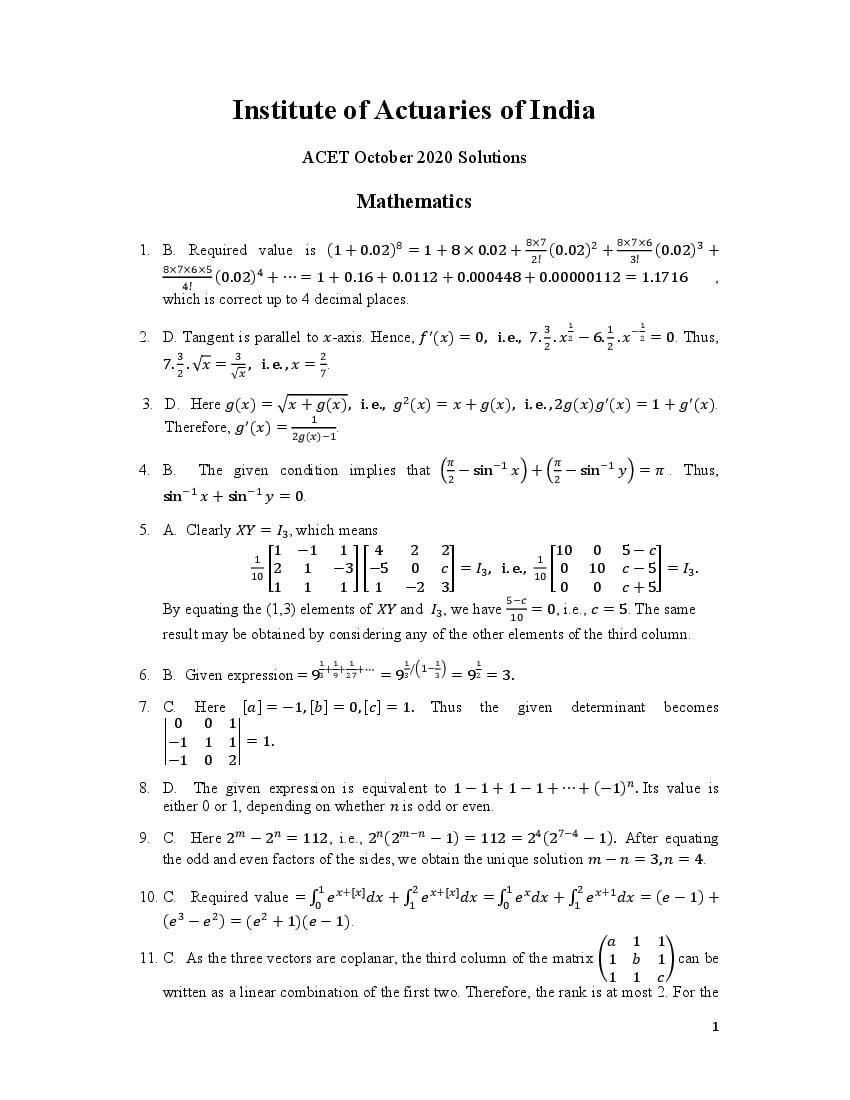
ACET October 2020 Solutions
Mathematics
× × ×
1. B. Required value is (1 + 0.02) = 1 + 8 × 0.02 + (0.02) + (0.02) +
! !
× × ×
(0.02) + ⋯ = 1 + 0.16 + 0.0112 + 0.000448 + 0.00000112 = 1.1716 ,
!
which is correct up to 4 decimal places.
2. D. Tangent is parallel to 𝑥-axis. Hence, 𝑓 (𝑥 ) = 0, i. e., 7. . 𝑥 − 6. . 𝑥 = 0. Thus,
7. . √𝑥 = , i. e. , 𝑥 = .
√
3. D. Here 𝑔(𝑥) = 𝑥 + 𝑔(𝑥), i. e., 𝑔 (𝑥) = 𝑥 + 𝑔(𝑥), i. e. , 2𝑔(𝑥)𝑔 (𝑥) = 1 + 𝑔 (𝑥).
Therefore, 𝑔 (𝑥) = ( ) .
4. B. The given condition implies that − sin 𝑥 + − sin 𝑦 = 𝜋 . Thus,
sin 𝑥 + sin 𝑦 = 0.
5. A. Clearly 𝑋𝑌 = 𝐼 , which means
1 −1 1 4 2 2 10 0 5 − 𝑐
2 1 −3 −5 0 𝑐 = 𝐼 , i. e., 0 10 𝑐 − 5 = 𝐼 .
1 1 1 1 −2 3 0 0 𝑐+5
By equating the (1,3) elements of 𝑋𝑌 and 𝐼 , we have = 0, i.e., 𝑐 = 5. The same
result may be obtained by considering any of the other elements of the third column.
⋯ /
6. B. Given expression = 9 =9 = 9 = 3.
7. C. Here [𝑎] = −1, [𝑏] = 0, [𝑐] = 1. Thus the given determinant becomes
0 0 1
−1 1 1 = 1.
−1 0 2
8. D. The given expression is equivalent to 1 − 1 + 1 − 1 + ⋯ + (−1) . Its value is
either 0 or 1, depending on whether 𝑛 is odd or even.
9. C. Here 2 − 2 = 112, i.e., 2 (2 − 1) = 112 = 2 (2 − 1). After equating
the odd and even factors of the sides, we obtain the unique solution 𝑚 − 𝑛 = 3, 𝑛 = 4.
10. C. Required value = ∫ 𝑒 [ ] 𝑑𝑥 + ∫ 𝑒 [ ]
𝑑𝑥 = ∫ 𝑒 𝑑𝑥 + ∫ 𝑒 𝑑𝑥 = (𝑒 − 1) +
(𝑒 − 𝑒 ) = (𝑒 + 1)(𝑒 − 1).
𝑎 1 1
11. C. As the three vectors are coplanar, the third column of the matrix 1 𝑏 1 can be
1 1 𝑐
written as a linear combination of the first two. Therefore, the rank is at most 2. For the
1
Page 2
rank is 2.
12. B. tan = tan 3𝜋 + = √3 ; tan = tan 2𝜋 + = 1 ; tan =
tan 𝜋 + = . Clearly, √3, 1, are in GP.
√ √
( )
13. A. = = −𝑖 . Therefore (−𝑖) = −1 = (−𝑖) . The least positive integer is
𝑚 = 2.
14. A. Clearly, > 0, i.e. 𝑥 ∈ (−∞, −2) ∪ (0, ∞).
Also, 1 ≥ log = = , i.e., ≤ 2. In view of the preceding range
restriction on 𝑥, we have 𝑥 ∈ (−∞, −4] ∪ (0, ∞).
15. D. The n-th term of the given series 𝑡 = = ( )
=2 − . The
⋯
required sum is
1 1 1 1 1 1 1
lim 𝑡 = lim 2 1− + − + − + ⋯+ −
→ → 2 2 3 3 4 𝑛 𝑛+1
1
= lim 2 1 − = 2.
→ 𝑛+1
16. A. The given integral I = ∫ ( ) =∫ ( ) =∫ ( ) (from the given
( ) ( )
condition), which simplifies to ∫ ( ) . Hence 𝐼 + 𝐼 = ∫ ( ) +∫ ( ) =
∫ 𝑑𝑥 = 𝑎, i.e., 𝐼 = .
17. A. A vector perpendicular (orthogonal) to the given vectors is the outer product
𝚤̂ 𝚥̂ 𝑘
𝑎⃗ × 𝑏⃗ = 1 1 1 = 4𝚤̂ − 𝚥̂ − 3𝑘.
2 −1 3
⃗× ⃗
The corresponding unit vector is = 4𝚤̂ − 𝚥̂ − 3𝑘 .
⃗× ⃗ √
Two possible unit vectors orthogonal to the given vectors are ± 4𝚤̂ − 𝚥̂ − 3𝑘 .
√
Acute angle with 𝑘 means that the required vector has positive coefficient of 𝑘 .
Thus the required unit vector is (−4𝚤̂ + 𝚥̂ + 3𝑘 ).
√
18. C. The digit in the unit place is equivalent to the remainder after dividing the number
by 10. We note that each of 5!, 6!, 7!, … ,99! is divisible by 10. So also is their sum.
Thus we get the remainder zero, when 5! + 6! + 7! + ⋯ + 99! is divided by 10. Now
1! + 2! + 3! + 4! = 33, which when divided by 10, gives the remainder 3. In this way
we conclude that 1! + 2! + 3! + 4! + 5! + ⋯ + 99! gives the remainder 3, when divided
by 10. Therefore, the required digit in the unit place is 3.
19. D. Case 0 ≤ 𝛼 < 𝛽: Here |𝑥| = 𝑥, |𝛼| = 𝛼, |𝛽| = 𝛽. Thus 𝐼 = 𝛽 − 𝛼 = |𝛽| − |𝛼|.
Case 𝛼 < 𝛽 ≤ 0: Here |𝑥| = −𝑥, |𝛼| = −𝛼, |𝛽| = −𝛽. So 𝐼 = −(𝛽 − 𝛼) = |𝛽| − |𝛼|.
2
Page 3
Case 𝛼 < 0 < 𝛽. Here |𝛼| = −𝛼, |𝛽| = 𝛽. Thus 𝐼=∫ 𝑑𝑥 + ∫ 𝑑𝑥 =
∫ (−1)𝑑𝑥 + ∫ 1𝑑𝑥 = 𝛼 + 𝛽 = |𝛽| − |𝛼|.
2 1 −3 2
20. D. Let 𝑌 = ,𝑍= . The given equation is 𝑌𝑋𝑍 = 𝐼 .
3 2 5 −3
Pre-multiplying by 𝑌 , we have (𝑌 𝑌)𝑋𝑍 = 𝑌 𝐼 , i.e., 𝑋𝑍 = 𝑌 .
Post-multiplying by 𝑍 , we obtain 𝑋(𝑍𝑍 ) = 𝑌 𝑍 , i.e., 𝑋 = 𝑌 𝑍 . Now
1 2 −1 1 −3 −2 3 2
𝑌 = , 𝑍 = = .
4 − 3 −3 2 9 − 10 −5 −3 5 3
2 −1 3 2 1 1
Thus, 𝑋 = 𝑌 𝑍 = = .
−3 2 5 3 1 0
3
Page 4
21. B. Since variance ≥ 0, we have Σ𝑥 ≥ Σ𝑥 , i.e., ≥ or 𝑛 ≥ 16.
22. D. All the summary statistics except the minimum are smaller in the case of y.
23. C. The restricted sample space when the chosen number is known to be prime is
{2,3,5,7,11,13,17,19,23}. Since there are just three prime numbers greater than 13 in
this set, the probability that the chosen number is one of these is 3/9 = 1/3.
!
24. D. Total number of arrangements = , of which (i) two I’s come together in 9! choices
!
!
and (ii) do not come together in − 9! choices. Hence the required probability is
!
10!
− 9! 9! 4
2! =1− = .
10! 10 5
9! ×
2! 2
25. A.
3 7 2 3 1
𝑃 (𝑋 ) = , 𝑃 (𝑌 ) = , 𝑃 (𝑋 ∪ 𝑌) = 𝑃 (𝑋) + 𝑃(𝑌) − 𝑃 (𝑋 ∩ 𝑌) = + −
5 10 5 10 5
1 1
= , 𝑃(𝑋 ∩ 𝑌 ) = 1 − 𝑃(𝑋 ∪ 𝑌) = .
2 2
𝑃 (𝑋 ∩ 𝑌 ) 1/2 5
Thus 𝑃(𝑋 |𝑌 ) = = = .
𝑃 (𝑌 ) 7/10 7
26. D. The mean is 15; the mode and the median are 10.
27. B. The probability of getting a spade is = and that of a club is also . The
probability of getting a red card is = . In 6 draws, 2 spades, 2 clubs and two red
6 4 2
cards can be selected in × × = 15 × 6 × 1 = 90 ways. Thus the required
2 2 2
probability is
1 1 1 90
90 × × × = .
4 4 2 2
28. A. Let 𝐸 be the event that the ball transferred was white, and 𝐸 be the event that the
ball drawn from urn B is white.
𝑃 (𝐸 |𝐸 )𝑃 (𝐸 ) (2/7) × (2/3)
𝑃(𝐸 |𝐸 ) = =
𝑃 (𝐸 |𝐸 )𝑃(𝐸 ) + 𝑃 (𝐸 |𝐸 )𝑃 (𝐸 ) (2/7) × (2/3) + (1/7) × (1/3)
4
= .
5
29. B. Here 𝑛 = 8, 𝑝 = . 𝑋 follows binomial distribution.
4
Page 5
= 1 − [𝑃(𝑋 = 0) + 𝑃(𝑋 = 1) + 𝑃(𝑋 = 7) + 𝑃(𝑋 = 8)]
1 1 1 1
=1− 1× +8× +8× +1×
2 2 2 2
1 18 119
=1− × (1 + 8 + 8 + 1) = 1 − = .
2 256 128
30. C. Since the colour of the first draw is not known, it does not change anything. The
probability of a red ball being chosen is 5/(5 + 4) = 5/9.
Alternative method: Consider the events
𝐸 : a red ball is drawn in the 1st draw;
𝐸 : a blue ball is drawn in the 1st draw;
𝑋 ∶ a red ball is drawn in the 2nd draw.
𝑃(𝐸 ) = , 𝑃(𝐸 ) = , 𝑃(𝑋|𝐸 ) = , 𝑃(𝑋|𝐸 ) = . (Since 1st ball is not replaced)
5 4 4 5 5
𝑃(𝑋) = 𝑃 (𝐸 ). 𝑃(𝑋|𝐸 ) + 𝑃(𝐸 ). 𝑃(𝑋|𝐸 ) = . + . = .
9 8 9 8 9
31. A. The sum of the first sample is 15 × 100 = 1500. The combined sum is 3900.
Therefore the sum of the second sample is 3900 − 1500 = 2400, and the mean is
2400/150 = 16.
The sum of squares of the first sample is (3 + 15 ) × 100 = 23400. The combined
sum of squares is 64200 . Therefore the sum of squares of the second sample is
64200 − 23400 = 40800. The second moment is 40800/150 = 272 and the variance
is 272 − 16 = 16. Hence the standard deviation is 4.
32. C. Let the replacement time be 𝑇 and the warranty period be 𝑤. We need
𝑃(𝑇 ≤ 𝑤) = 0.02, i.e., 𝑃 (𝑇 − 91)/18 ≤ (𝑤 − 91)/18 = 0.02,
i.e., 𝑃(𝑍 ≤ (𝑤 − 91)/18) = 0.02,
i.e., 𝑃(𝑍 ≤ −(𝑤 − 91)/18) = 0.98,
( )
i.e., − = 2.05375,
i.e., 𝑤 = 91 − 18 × 2.05375 = 54 months, or 4 years 6 months (approximately).
5
Page 6
following table of probabilities.
𝑛 0 1 2 3 4 5
𝑃(𝑋 = 𝑛) 0.050 0.149 0.224 0.224 0.168 0.101
𝑃(𝑋 ≤ 𝑛) 0.050 0.199 0.423 0.647 0.815 0.916
Thus, 5 counters would suffice.
34. B. The number of necessary draws, X, has the geometric distribution with success
probability 𝑝 = 0.85. Therefore 𝐸 (𝑋) = = = 1.176.
.
35. B. The slope of the regression of 𝑌 on 𝑋 (where 𝑌 is written in terms of 𝑋) is 𝑟 ,
while the slope of the regression of 𝑋 on 𝑌 (where 𝑋 is written in terms of 𝑌) is 𝑟 .
When the latter equation is written with 𝑌 expressed in terms of 𝑋, the slope is × ,
which is greater than 𝑟 . Thus, the correct regression of 𝑌 on 𝑋 is the one having
smaller magnitude of coefficient of 𝑋 when 𝑌 is written in terms of 𝑋.
Here, the first equation has smaller slope, and hence must be the regression of 𝑌 on 𝑋.
From the given equations 𝑏 = = 0.8 ; 𝑏 = = 0.45 . This implies 𝑟 =
𝑏 𝑏 = 0.8 × 0.45 = 0.36, that is 𝑟 = 0.6 (positive since 𝑏 > 0).
Further, 𝑏 =𝑟 , i.e., 𝜎 = 𝑏 = 0.8 × = 4.
.
36. C. The expected value of the numbers on the face that turns up from the throw of a
single dice is 𝐸 (𝑋) = [1 + 2 + 3 + 4 + 5 + 6] = . Therefore, the sum of the
expected values of two such random variables is 7.
37. A.
/ /
𝑃(𝑋 > 6, 𝑋 > 0) 𝑃 (𝑋 > 6) ∫ 𝑐𝑒 𝑑𝑥 3𝑐𝑒
𝑃(𝑋 > 6|𝑋 > 0) = = = = /
=𝑒 .
𝑃 (𝑋 > 0 ) 𝑃 (𝑋 > 0) ∫ 𝑐𝑒 / 𝑑𝑥 3𝑐𝑒
38. D.
39. A. The probability of any candidate having score above 30 is ∫ 𝑑𝑥 = 0.7.
Therefore, the number of candidates having score above 30 is a binomial random
variable with 𝑛 = 1000 and 𝑝 = 0.7. Its variance is 𝑛𝑝(1 − 𝑝) = 210.
40. B. 𝐶𝑜𝑣(𝑋 − 𝑌, 𝑋) = 𝐶𝑜𝑣(𝑋, 𝑋) − 𝐶𝑜𝑣(𝑌, 𝑋) = 3 − 0 = 3.
6
Page 7
41. B. The maximum possible score by Rahul in Match 1 is 24, which is 10% of 240. In
Match 3, 10% of 210 is 21, which is higher than 15. Hence 14 is the maximum possible
score by Rahul in Match 3. Thus, the maximum contribution by Rahul is
(24 + 90 + 14 + 45) 173
= = 19.4%.
(240 + 270 + 210 + 170) 890
42. D. The largest and smallest missing scores in each match are summarized below.
Missing score Match 1 Match 2 Match 3 Match 4
Total 240 − 78 270 − 68 210 − 100 170 − 45
− 67 − 50 − 65 − 90 − 15 − 70 − 50 − 48
= 45 = 47 = 25 = 27
Largest 0.1 × 240 0.1 × 270 15 − 1 0.1 × 170
= 24 = 27 = 14 = 17
Smallest 45 − 24 47 − 27 25 − 14 27 − 17
= 21 = 20 = 11 = 10
The minimum missing scores of Rahul are 45 − 24 = 21 and 25 − 14 = 11 for
matches 1 and 3, respectively (see table). Thus, his minimum total score is 21 + 90 +
11 + 45 = 167. Likewise, minimum total score of Virat is 78 + 65 + 11 + 50 = 204,
that of Rohit is 21 + 20 + 100 + 10 = 151, that of Laxman is 67 + 68 + 15 + 48 =
198 and that of Vijay is 50 + 20 + 70 + 10 = 150.
43. C. Refer to the maximum values of the missing scores given in the solution of the
previous problem. Thus, the maximum possible score of Rahul, Virat, Rohit, Laxman
and Vijay are 24 + 90 + 14 + 45 = 173 , 78 + 65 + 14 + 50 = 207 , 24 + 27 +
100 + 17 = 168, 67 + 68 + 15 + 48 = 198, 50 + 27 + 70 + 17 = 164, respectively.
Comparing these numbers with the minimum scores given in the solution of the
previous problem, we conclude that Virat and Laxman undoubtedly occupy the top two
ranks, but the ranks of the other players cannot be guessed because of the missing
information.
44. A. Royalty to be paid is (25000/15%) × 10% = Rs. 16667.
45. D. Cost of paper per book is (200/1.15) × 30% = Rs. 52.2.
46. A. Royalty is less than printing cost by (15 − 10)/15 = 33.3%.
47. C. Total salary paid during the period is Rs. 1210 lakh. The total bonus paid during this
period is Rs. 17 Lakh, which is 1.4% of Rs. 1210 lakh.
48. D. Total taxes paid during the period 2015-2019 is Rs. 401 lakhs. The total fuel and
transport expenditure during this period is Rs. 536 lakh. The ratio is approximately 3: 4.
7
Page 8
84/236 = 35.6%. The largest percentage increase in fuel and transport happened in the
year 2018, when it was 32/91 = 35.2%. The largest percentage increase in bonus
happened in the year 2017, when it was 1.32/2.52 = 52.4%. The largest percentage
increase in interest on loans happened in the year 2016, when it was 9.1/13.4 = 67.9%.
50. B. Increase in turnover of Company B was 170 − 150 = Rs. 20 crores. Company C
would have seen the same increase if its turnover in the second year had been 140 +
20 = Rs. 160 crores.
51. C. Difference of averages, which is the same as average of differences, is (20 + 20 +
10 + 10 + 40)/5 = Rs. 20 crores.
8
Page 9
52. D
53. A
54. C
55. B
56. B
57. C
58. B
59. A
60. B
61. A
62. B
9
Page 10
63. B. Number of students in football team is 𝑛(𝐹) = 10.
Number of students in science club is 𝑛(𝑆) = 14.
Number of students in both football team and science club is 𝑛(𝐹 ∩ 𝑆) = 5.
Therefore, number of students only in football team is 𝑛(𝐹 ) − 𝑛(𝐹 ∩ 𝑆) = 10 − 5 = 5.
Number of students only in science club is 𝑛(𝑆) − 𝑛(𝐹 ∩ 𝑆) = 14 − 5 = 9.
Number of students in only one of the two groups is 5 + 9 = 14.
64. C. The following sitting arrangement emerges from the given description.
A
G B
F H
E C
D
65. A.
66. C. The time gap between 3 pm and 7 am is 8 hours, which is two-thirds of 12 hours.
Since 12 hours account for 360º, eight hours cover 240º.
67. D. Since 2004 was a leap year, the two given dates are separated by 366 = 7 × 52 + 2
days. Therefore, 8th February 2004 was two days before Tuesday.
68. D. If Gopal belonged to union A, he could not have said that he always lies. If he
belonged to union B, then the utterance becomes a truth that he could not possibly
speak.
69. B. By negating the given implication, we can conclude that if any one of Sunil,
Mohinder and Chandrasekhar is found not to attend the event, then Kapil would not
have attended it.
70. D. There is no given information about the overlap between Lillies and flowers.
10
Document Details
| Board / Org | Actuaries India |
| Exam | ACET |
| Type | Answer Key |
| Pages | 10 |
| Updated | 09 Jun 2026 |