CBSE Class 10 Marking Scheme 2022 for Maths Standard
Finished viewing? Save it for later —
Download CBSE Class 10 Marking Scheme 2022 for Maths Standard (PDF · 5 pages)About CBSE Class 10 Marking Scheme 2022 for Maths Standard
CBSE Class 10 Marking Scheme 2022 for Maths Standard is available here for free download. Published by CBSE for Class 10, this marking scheme can be viewed online or downloaded as a PDF (5 pages). Candidates preparing for Class 10 can use CBSE Class 10 Marking Scheme 2022 for Maths Standard to understand the exam pattern, the type of questions asked, and the overall difficulty level.
Frequently Asked Questions
How can I download CBSE Class 10 Marking Scheme 2022 for Maths Standard?
Open this page and click the Download button to save CBSE Class 10 Marking Scheme 2022 for Maths Standard as a PDF. It is completely free on AglaSem Docs.
Is CBSE Class 10 Marking Scheme 2022 for Maths Standard free to download?
Yes. CBSE Class 10 Marking Scheme 2022 for Maths Standard can be viewed online and downloaded as a PDF free of cost on AglaSem Docs.
How many pages does CBSE Class 10 Marking Scheme 2022 for Maths Standard have?
CBSE Class 10 Marking Scheme 2022 for Maths Standard contains 5 pages, which you can read online or download together as a single PDF.
Where can I find more Class 10 study material?
You can find more Class 10 question papers, sample papers, syllabus, and answer keys on AglaSem Docs.
CBSE Class 10 Marking Scheme 2022 for Maths Standard – Text
Read the full text of this marking scheme below — useful to quickly search, copy and reference the content online without downloading the PDF.
📄 View text version (5 pages)
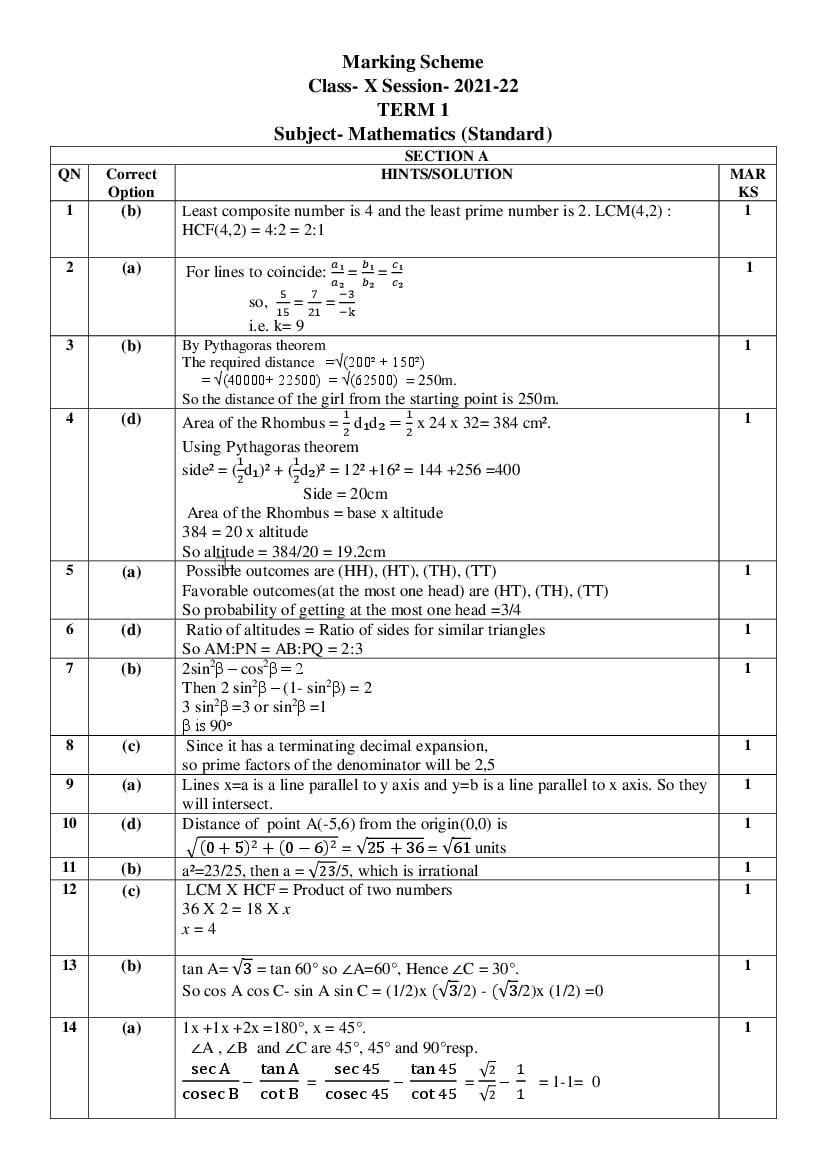
Page 1
Class- X Session- 2021-22
TERM 1
Subject- Mathematics (Standard)
SECTION A
QN Correct HINTS/SOLUTION MAR
Option KS
1 (b) Least composite number is 4 and the least prime number is 2. LCM(4,2) : 1
HCF(4,2) = 4:2 = 2:1
2 (a) 𝑎₁ 𝑏₁ 𝑐₁ 1
For lines to coincide: 𝑎₂ = 𝑏₂ = 𝑐₂
5 7 −3
so, 15 = 21 = −k
i.e. k= 9
3 (b) By Pythagoras theorem 1
The required distance =√(200² + 150²)
= √(40000+ 22500) = √(62500) = 250m.
So the distance of the girl from the starting point is 250m.
4 (d) 1 1 1
Area of the Rhombus = 2 d₁d₂ = 2 x 24 x 32= 384 cm².
Using Pythagoras theorem
1 1
side² = (2d₁)² + (2d₂)² = 12² +16² = 144 +256 =400
Side = 20cm
Area of the Rhombus = base x altitude
384 = 20 x altitude
So altitude = 384/20 = 19.2cm
5 (a) Possible outcomes are (HH), (HT), (TH), (TT) 1
Favorable outcomes(at the most one head) are (HT), (TH), (TT)
So probability of getting at the most one head =3/4
6 (d) Ratio of altitudes = Ratio of sides for similar triangles 1
So AM:PN = AB:PQ = 2:3
7 (b) 2sin2β – cos2β = 2 1
Then 2 sin2β – (1- sin2β) = 2
3 sin2β =3 or sin2β =1
β is 90ᵒ
8 (c) Since it has a terminating decimal expansion, 1
so prime factors of the denominator will be 2,5
9 (a) Lines x=a is a line parallel to y axis and y=b is a line parallel to x axis. So they 1
will intersect.
10 (d) Distance of point A(-5,6) from the origin(0,0) is 1
√(0 + 5)2 + (0 − 6)2 = √25 + 36 = √61 units
11 (b) a²=23/25, then a = √23/5, which is irrational 1
12 (c) LCM X HCF = Product of two numbers 1
36 X 2 = 18 X x
x=4
13 (b) tan A= √3 = tan 60° so ∠A=60°, Hence ∠C = 30°. 1
So cos A cos C- sin A sin C = (1/2)x (√3/2) - (√3/2)x (1/2) =0
14 (a) 1x +1x +2x =180°, x = 45°. 1
∠A , ∠B and ∠C are 45°, 45° and 90°resp.
sec A tan A sec 45 tan 45 √2 1
– = – = – = 1-1= 0
cosec B cot B cosec 45 cot 45 √2 1
Page 2
Number of revolutions= = 22
circumference 2 X 7 X 0.7
= 40
16 (b) perimeter of ∆ABC BC 1
=
perimeter of ∆DEF EF
7.5 2
= . So perimeter of ∆DEF = 15cm
perimeter of ∆DEF 4
17 (b) Since DE∥ BC, ∆ABC ~ ∆ADE ( By AA rule of similarity) 1
AD DE 3 DE
So = i.e. = . So DE = 6cm
AB BC 7 14
18 (a) Dividing both numerator and denominator by cosβ, 1
4 𝑠𝑖𝑛𝛽−3 cos 𝛽 4 𝑡𝑎𝑛𝛽−3 3−3
= = =0
4 sin 𝛽+3 cos 𝛽 4 tan 𝛽+3 3+3
19 (d) 𝑎₁ 𝑏₁ 𝑐₁ 1
-2(–5x + 7y = 2) gives 10x – 14y = –4. Now = 𝑏₂ = 𝑐₂ = -2
𝑎₂
20 (a) Number of Possible outcomes are 26 1
Favorable outcomes are M, A, T, H, E, I, C, S
probability = 8/26 = 4/13
SECTION B
21 (c) Since HCF = 81, two numbers can be taken as 81x and 81y, 1
ATQ 81x + 81y = 1215
Or x+y = 15
which gives four co prime pairs-
1,14
2,13
4,11
7, 8
22 (c) Required Area is area of triangle ACD = ½(6)2 1
= 6 sq units
23 (b) tan α + cot α = 2 gives α=45°. So tan α = cot α = 1 1
tan20α + cot 20α = 120 + 120 = 1+1 = 2
24 (a) Adding the two given equations we get: 348x + 348y = 1740. 1
So x +y =5
25 (c) LCM of two prime numbers = product of the numbers 1
221= 13 x 17.
So p= 17 & q= 13
⸫3p - q= 51-13 =38
26 (a) Probability that the card drawn is neither a king nor a queen 1
52−8
= 52
= 44/52 = 11/13
27 (b) Outcomes when 5 will come up at least once are- 1
(1,5), (2,5), (3,5), (4,5), (5,5), (6,5), (5,1), (5,2), (5,3), (5,4) and (5,6)
Probability that 5 will come up at least once = 11/36
28 (c) 1+ sin2α = 3 sinα cos α 1
sin2α + cos2α + sin2α = 3 sinα cos α
2 sin2α - 3sinα cos α + cos2α = 0
(2sinα -cos α)( sinα- cosα) =0
⸫cotα = 2 or cotα = 1
29 (a) Since ABCD is a parallelogram, diagonals AC and BD bisect each other, ∴ mid 1
point of AC= mid point of BD
Page 3
( 2 , 2 )=( 2 , 2 )
Comparing the co-ordinates, we get,
𝑥+1 3+4
= 2 . So, x= 6
2
6+2 5+𝑦
Similarly, 2 = . So, y= 3
2
∴(x, y) = (6,3)
30 (c) ∆ACD ~∆ ABC( AA ) 1
AC AD
∴ = (CPST)
AB AC
8/AB = 3/8
This gives AB = 64/3 cm.
So BD = AB – AD = 64/3 -3 = 55/3cm.
31 (d) Any point (x, y) of perpendicular bisector will be equidistant from A & B. 1
∴ √(𝑥 − 4)2 + (𝑦 − 5)2 = √(𝑥 + 2)2 + (𝑦 − 3)2
Solving we get -12x – 4y + 28=0 or 3x + y – 7=0
32 (b) cot 𝑦 ° AC/ BC 1
= = CD/ BC = CD/ 2CD = ½
cot 𝑥 ° 𝐴𝐶/𝐶𝐷
33 (a) The smallest number by which 1/13 should be multiplied so that its decimal 1
1 13 1
expansion terminates after two decimal points is 13/100 as 13 x 100 = 100 =
0.01
Ans: 13/100
34 (b) 1
∆ABE is a right triangle & FDGB is a
square of side x cm
∆AFD ~∆ DGE( AA )
AF FD
∴ = (CPST)
DG GE
16 − x x
= (CPST)
x 8−x
128 = 24x or x = 16/3cm
35 (a) Since P divides the line segment joining R(-1, 3) and S(9,8) in ratio k:1 ∴ 1
9k −1 8k+3
coordinates of P are ( k+1 , k+1 )
9k −1 8k+3
Since P lies on the line x – y +2=0, then - k+1 +2 =0
k+1
9k -1 -8k-3 +2k+2 =0
which gives k=2/3
36 (c) 1
Shaded area = Area of semicircle +
(Area of half square – Area of two
quadrants)
= Area of semicircle +(Area of half
square – Area of semicircle)
= Area of half square
= ½ x 14 x14 = 98cm²
Page 4
.o
Let O be the
center of the circle. OA = OB = AB =1cm.
So ∆OAB is an equilateral triangle and ∴ ∠AOB =60°
Required Area= 8x Area of one segment with r=1cm, ѳ= 60°
60 √3
= 8x(360 x π x 1²- 4 x 1²)
= 8(π/6 - √3/4)cm²
38 (b) Sum of zeroes = 2 + ½ = -5/p 1
i.e. 5/2 = -5/p . So p= -2
Product of zeroes = 2x ½ = r/p
i.e. r/p = 1 or r = p = -2
39 (c) 2πr =100. So Diameter = 2r =100/π = diagonal of the square. 1
side√2 = diagonal of square = 100/ π
∴ side = 100/√2π = 50√2/π
40 (b) 3x+y = 243 = 35 1
So x+y =5-----------------------------------(1)
243x-y = 3
(35) x-y = 31
So 5x -5y =1--------------------------------(2)
𝑎₁ 𝑏₁
Since : 𝑎₂ ≠ 𝑏₂ , so unique solution
SECTION C
41 (c) Initially, at t=0, Annie’s height is 48ft 1
So, at t =0, h should be equal to 48
h(0) = -16(0)² + 8(0) + k = 48
So k = 48
42 (b) When Annie touches the pool, her height =0 feet 1
i.e. -16t² + 8t + 48 =0 above water level
2t² - t -6 =0
2t² - 4t +3t -6 =0
2t(t-2) +3(t-2) =0
(2t +3) (t-2) =0
i.e. t= 2 or t= -3/2
Since time cannot be negative , so t= 2seconds
43 (d) t= -1 & t=2 are the two zeroes of the polynomial p(t) 1
Then p(t)=k (t- -1)(t-2)
= k(t +1)(t-2)
When t = 0 (initially) h₁ = 48ft
p(0)=k(0²- 0 -2)= 48
i.e. -2k = 48
So the polynomial is -24(t²- t -2) = -24t² + 24t + 48.
44 (c) A polynomial q(t) with sum of zeroes as 1 and the product as -6 is given by 1
q(t) = k(t² - (sum of zeroes)t + product of zeroes)
= k(t² -1t + -6) ………..(1)
When t=0 (initially) q(0)= 48ft
Page 5
i.e. -6k = 48 or k= -8
Putting k = -8 in equation (1), reqd. polynomial is -8(t² -1t + -6)
= -8t² + 8t + 48
45 (a) When the zeroes are negative of each other, 1
sum of the zeroes = 0
So, -b/a = 0
(k-3)
- −12 = 0
k−3
+ 12 = 0
k-3 = 0,
i.e. k = 3.
46 (a) Centroid of ΔEHJ with E(2,1), H(-2,4) & J(-2,-2) is 1
2+−2+ −2 1+4+ −2
( , ) = (-2/3, 1)
3 3
47 (c) If P needs to be at equal distance from A(3,6) and G(1,-3), such that A,P and G 1
are collinear, then P will be the mid-point of AG.
3+1 6+ −3
So coordinates of P will be ( 2 , 2 ) = (2, 3/2)
48 (a) Let the point on x axis equidistant from I(-1,1) and E(2,1) be (x,0) 1
then √(𝑥 + 1)2 + (0 − 1)2 = √(𝑥 − 2)2 + (0 − 1)2
x2 + 1 + 2x +1 = x2 + 4 - 4x +1
6x = 3
So x = ½ .
∴ the required point is (½, 0)
49 (b) Let the coordinates of the position of a player Q such that his distance from 1
K(-4,1) is twice his distance from E(2,1) be Q(x, y)
Then KQ : QE = 2: 1
2 X 2+1 X−4 2 X 1+1 X 1
Q(x, y) = ( , )
3 3
= (0,1)
50 (d) Let the point on y axis equidistant from B(4,3) and C(4,-1) be (0,y) 1
then √(4 − 0)2 + (3 − 𝑦)2 = √(4 − 0)2 + (𝑦 + 1)2
16 + y2 + 9 - 6y = 16 + y2 + 1 + 2y
-8y = -8
So y = 1 .
∴ the required point is (0, 1)
Document Details
| Board / Org | CBSE |
| Exam | Class 10 |
| Type | Solution |
| Pages | 5 |
| Updated | 30 Apr 2026 |