NCERT Solutions Class 5 Maths Chapter 11 Grandmother s Quilt
Finished viewing? Save it for later —
Download NCERT Solutions Class 5 Maths Chapter 11 Grandmother s Quilt (PDF · 96 pages)About NCERT Solutions Class 5 Maths Chapter 11 Grandmother s Quilt
NCERT Solutions Class 5 Maths Chapter 11 Grandmother s Quilt is available here for free download. Published by NCERT for Class 5, this solution can be viewed online or downloaded as a PDF (96 pages). Candidates preparing for Class 5 can use NCERT Solutions Class 5 Maths Chapter 11 Grandmother s Quilt to understand the exam pattern, the type of questions asked, and the overall difficulty level.
Frequently Asked Questions
How can I download NCERT Solutions Class 5 Maths Chapter 11 Grandmother s Quilt?
Open this page and click the Download button to save NCERT Solutions Class 5 Maths Chapter 11 Grandmother s Quilt as a PDF. It is completely free on AglaSem Docs.
Is NCERT Solutions Class 5 Maths Chapter 11 Grandmother s Quilt free to download?
Yes. NCERT Solutions Class 5 Maths Chapter 11 Grandmother s Quilt can be viewed online and downloaded as a PDF free of cost on AglaSem Docs.
How many pages does NCERT Solutions Class 5 Maths Chapter 11 Grandmother s Quilt have?
NCERT Solutions Class 5 Maths Chapter 11 Grandmother s Quilt contains 96 pages, which you can read online or download together as a single PDF.
Where can I find more Class 5 study material?
You can find more Class 5 question papers, sample papers, syllabus, and answer keys on AglaSem Docs.
NCERT Solutions Class 5 Maths Chapter 11 Grandmother s Quilt – Text
Read the full text of this solution below — useful to quickly search, copy and reference the content online without downloading the PDF.
📄 View text version (60 pages)
Page 1
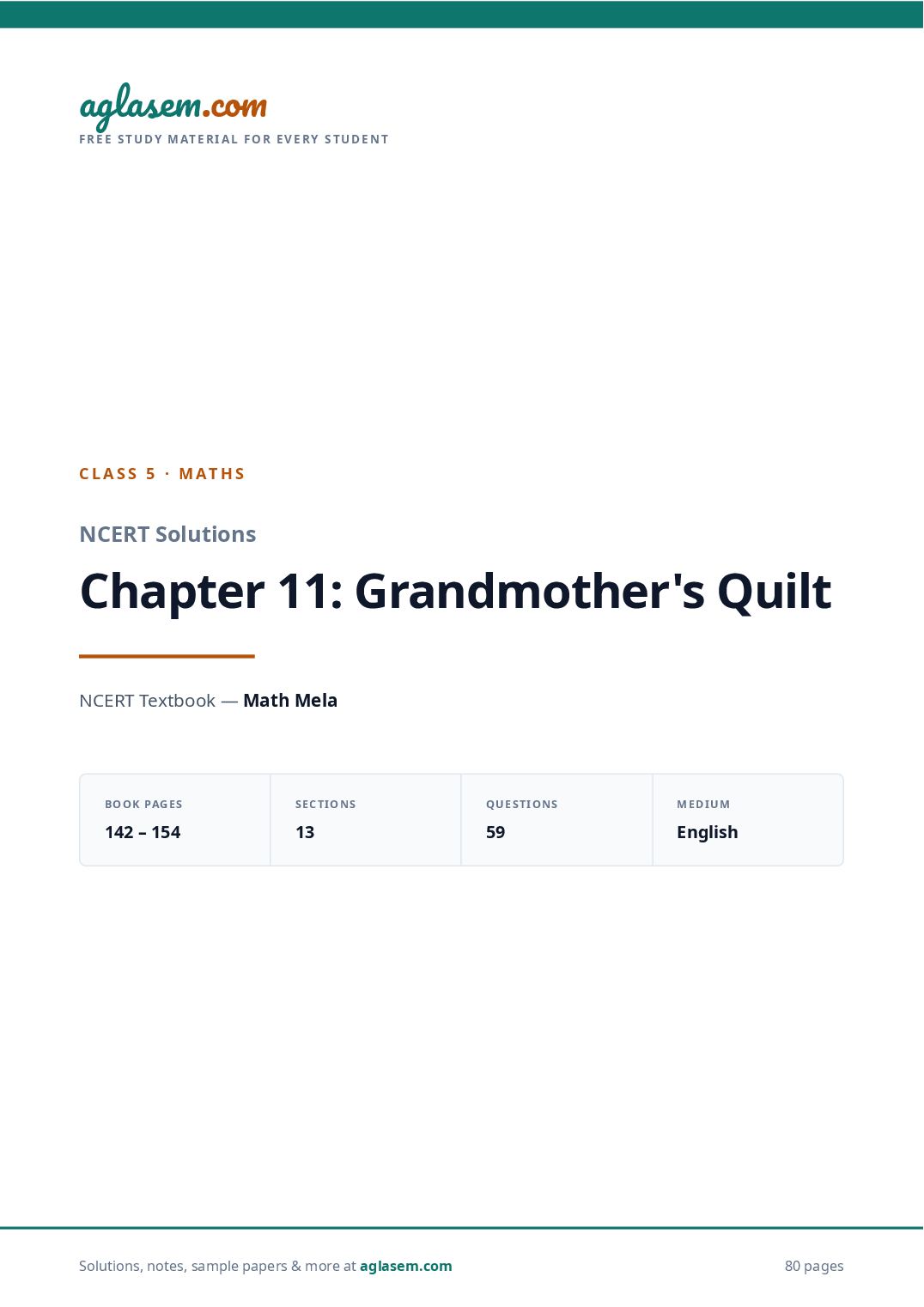
C L A S S 5 · M AT H S
NCERT Solutions
Chapter 11: Grandmother's Quilt
NCERT Textbook — Math Mela
BOOK PAGES SECTIONS QUESTIONS MEDIUM
142 – 154 13 59 English
Solutions, notes, sample papers & more at 80 pages
Page 2
CLASS 5 · MATHS · MATH MELA
NCERT Solutions — Chapter 11: Grandmother's Quilt
Chapter 11 of Math Mela is about perimeter and area — the two measurements you need whenever you
cover something or go round it. Preetha and Adrit's grandmother stitches a quilt cover, a rug of square
patches and two patchwork mats, and from her sewing come both ideas: the lace round the edge is the
perimeter, and the cloth that fills the middle is the area. The chapter builds up from counting tiles to the two
rules a Class 5 student should carry away — Area of a rectangle = Length × Breadth and Perimeter of a
rectangle = 2 × Length + 2 × Breadth — and shows, again and again, that two shapes can share one and still
differ in the other.
TEXTBOOK BOOK PAGES
Math Mela (Class 5) 142 – 154
SECTIONS QUESTIONS
13 59
MEDIUM
English
The Quilt Border — Page 142
Grandmother's quilt cover and the three reels of lace
Q1 Preetha and Adrit's grandmother made a quilt cover using old clothes. Now she
wants to decorate it with lace. Tick the lace option that would cover the entire
border of the quilt. (i) Red lace 40 units (ii) Green lace 50 units (iii) Blue lace 25 units
Tick (ii) — the green lace, 50 units.
The lace is stitched along the edge of the quilt, right round it. The length of that edge, all the
way round, is called the perimeter.
Here is an easy way to remember the two big words of this chapter.
Perimeter is the ribbon you need to go round a shape.
Area is the cloth you need to cover a shape.
Page 1 of 80
Page 3
the red line is the border
40
50
the quilt
25
Only the green reel reaches 50.
Border all the way round = perimeter = 50 units
Red is 10 units short. Blue covers only half.
The lace runs along the edge, not across the middle. That edge length is the perimeter.
1. See where the lace goes. It runs along the four edges of the quilt cover.
2. Find how long that trip is. Going once round the quilt in the picture measures 50 units.
3. Check each reel. Red has 40 units — that is 10 units short. Blue has 25 units — that is only
half the way round. Green has 50 units — it fits exactly.
4. Tick the reel that is long enough. That is the green one.
Lace needed = perimeter of the quilt = 50 units
Red reel = 40 units → 50 − 40 = 10 units short ✗
Blue reel = 25 units → 50 − 25 = 25 units short ✗
Green reel = 50 units → just enough ✓
Why it happens: A shorter lace can never go all the way round, however you turn it.
You must compare the length of the lace with the length of the border. The border is
50 units long, so the lace must be at least 50 units long.
Tip: Do not measure the quilt from side to side. Perimeter means the whole journey
round the outside — along the top, down one side, along the bottom and up the
other side.
Page 2 of 80
Page 4
Q2 She decides to use two different coloured laces. How much lace of each kind will be
needed to cover the entire border?
The two laces together must measure 50 units. The neatest answer is 25 units of blue lace
and 25 units of red lace.
1. Write down what is needed. The whole border is 50 units long.
2. Share 50 between two colours. Any two lengths that add up to 50 will do.
3. Pick an easy pair. The blue reel has exactly 25 units. Use all of it, then cut 25 units from the
red reel.
4. Check. 25 + 25 = 50 ✓
Blue + Red = 25 + 25 = 50 units ✓
Other correct answers are possible. Here are three more.
FIRST LACE SECOND LACE TOTAL
Red 40 units Blue 10 units 50 units
Green 30 units Blue 20 units 50 units
Red 35 units Green 15 units 50 units
Why it happens: The border does not care which colour is on it. It only cares about
length. So the two pieces just have to join up to make the full 50-unit journey.
Check it yourself: Lay the two lengths end to end on the floor. If together they are
as long as one trip round the quilt, they are right.
Let Us Do — Page 142
Page 3 of 80
Page 5
Class 5 Maths Chapter 11 Grandmother's Quilt
a g l AglaSem · NCERT Solutions
Perimeter of shapes with equal sides; drawing rectangles to a given perimeter
co m
e m.
m as
LET US DO
.co a g l
a s emthe perimeter of the following shapes. All sides of the following shapes are
gl
Find
a
Q1
equal. (First shape.)
co m
e m . ag
g l as
a
co m
em.
m l as
m .co 4 cm a g
l a se
a g
m a s
m .co agl
l a se
ag
co m
m .
m as e
.co a g l
se m
g l a
a
se m
com g l a
m . a
e
as with five equal sides. One side is marked.
g l
A shape
a
co m
m .
as e
m l
.co
Perimeter = 20 cm.
m a g
l a se
ag
.c
s e m
m a
e m . co agl
g l as
a
co m
m .
m ase
.co
a g l Page 4 of 80
Page 6
4 cm 4 cm
4 cm 4 cm
4 cm
Five equal sides. Walk round: 4 + 4 + 4 + 4 + 4 = 20 cm.
1. Count the sides. The shape has 5 sides.
2. Read one side. One side is 4 cm, and the question says all sides are equal. So every side is 4
cm.
3. Add all the sides. 4 + 4 + 4 + 4 + 4 = 20.
4. Write the unit. The answer is a length, so it is in cm.
Perimeter = 4 + 4 + 4 + 4 + 4
Perimeter = 5 × 4 cm
Perimeter = 20 cm
Why it happens: Perimeter is the whole walk round the outside. Walking round this
shape means walking along 5 sides, one after another. Each walk is 4 cm long, so five
walks are 5 × 4 = 20 cm.
Page 5 of 80
Page 7
Short cut: When all the sides of a shape are equal, you do not have to add. Just
multiply: number of sides × length of one side.
Q2 Find the perimeter of the following shapes. All sides of the following shapes are
equal. (Second shape.)
5 cm
Two triangles joined at one point. All the sides are equal.
Perimeter = 30 cm.
Page 6 of 80
Page 8
5 cm
5 cm 5 cm
5 cm 5 cm
5 cm
Two triangles joined at one point. The outside has 6 equal sides.
1. Trace the outside with your finger. Start at the top-left corner. Go along the top (1 side),
slide down to the middle point (2), down to the bottom-left corner (3), along the bottom (4),
up to the middle point (5), and back up to the top-left corner (6).
2. Count what you walked. That is 6 sides.
3. Use the length given. All sides are equal and one is 5 cm, so each of the 6 sides is 5 cm.
4. Multiply. 6 × 5 = 30.
Number of sides on the outside = 6
Perimeter = 6 × 5 cm
Perimeter = 30 cm
Page 7 of 80
Page 9
Why it happens: The shape is made of two triangles that touch at one point. Each
triangle gives 3 sides to the outside — its top (or bottom) and its two slanting sides.
3 + 3 = 6 sides in all. The point where they touch is not a side, so nothing is added
there.
Careful: Do not count 8 sides. The two lines that cross in the middle are not four
separate straight edges of the outside — each one is split at the touching point into
two of the six sides you already counted.
Q3 Draw two rectangles each having the following perimeter: (a) 26 cm
Two rectangles with perimeter 26 cm: one of 8 cm × 5 cm, and one of 10 cm × 3 cm.
1. Remember what perimeter means for a rectangle. A rectangle has 2 long sides and 2
short sides. So perimeter = length + length + breadth + breadth.
2. Halve the perimeter. One long side and one short side together make half the perimeter. 26
÷ 2 = 13 cm.
3. Split 13 into two whole numbers. 8 + 5 = 13, and 10 + 3 = 13.
4. Draw them. Draw one rectangle 8 cm long and 5 cm broad. Draw another 10 cm long and 3
cm broad.
8 cm 10 cm
3 cm
5 cm
Two different rectangles, both with a 26 cm border.
Check the first: 8 + 5 + 8 + 5 = 26 cm ✓
Check the second: 10 + 3 + 10 + 3 = 26 cm ✓
Page 8 of 80
Page 10
Class 5 Maths Chapter 11 Grandmother's Quilt
a g l AglaSem · NCERT Solutions
co m
m.
Why halving works: Going round a rectangle you walk the length twice and the
m l a se
breadth twice. So the whole trip is two lots of (length + breadth). Half the trip is
o
.c length plus one breadth. a g
m
exactly one
l a se
g
aOther correct answers: 9 cm × 4 cm, 7 cm × 6 cm, 11 cm × 2 cm, 12 cm × 1 cm —
co m
ag
any pair that adds to 13 cm.
m .
as e
a g l
Draw two rectangles each having the following perimeter: (b) 18 cm
m
Q4
co
se m.
o m l a
gof 7 cm × 2 cm.
.c with perimeter 18 cm: one of 6 cm × 3 cm, and one
m a
se
Two rectangles
l a
ag1. Halve the perimeter. 18 ÷ 2 = 9 cm. This is one length plus one breadth.
2. Split 9 into two whole numbers. 6 + 3 = 9, and 7 + 2 = 9.
m a s
.co agl
3. Draw them. One rectangle 6 cm by 3 cm, and one 7 cm by 2 cm.
se m
g l a
a
6 cm 7 cm com
m .
m as e
.co 3 cm a g l 2 cm
se m
g l a
a
se m
com g l a
m . a
e
as need exactly 18 cm of ribbon to go round.
a g l
Both rectangles
co m
Check the first: 6 + 3 + 6 + 3 = 18 cm ✓
m .
m as e
.co
Check the second: 7 + 2 + 7 + 2 = 18 cm ✓
a g l
se m
g l a
a c
Did you notice? The 6 cm × 3 cm rectangle covers 18 square cm, but the 7 cm × 2 cm
m .
m a s e
co agl
one covers only 14 square cm. Same border, different amount of cloth. You will meet
m .
e
this idea again on page 148.
g l as
a
co m
m .
m ase
.co
a g l Page 9 of 80
Page 11
Other correct answers: 5 cm × 4 cm and 8 cm × 1 cm — any pair that adds to 9 cm.
The Rug and the Four Tables — Page 143
Counting patches; which shapes tile a table top; meeting the word area
Q1 Preetha and Adrit's grandmother is making a rug with square patches. The picture
below shows the rug. How many patches have they used to make this?
Grandmother's rug. Every patch is a square of cloth.
90 patches.
Page 10 of 80
Page 12
15 patches across, 6 patches down
You do not have to count all 90. Count one row and one column, then multiply.
1. Count along the top. There are 15 patches in one row.
2. Count down one side. There are 6 rows.
3. Multiply. Every row has the same 15 patches, and there are 6 such rows.
Patches = 15 × 6
Patches = 90 patches
Why it happens: The patches are laid out in neat rows and columns. When things
are set out this way you never need to count them one by one. Counting one row
and one column is enough, because 6 rows of 15 is just 15 taken 6 times.
Check it yourself: Add instead of multiplying. 15 + 15 + 15 + 15 + 15 + 15 = 90. Same
answer.
Page 11 of 80
Page 13
Q2 They found that __________, __________ and __________ shapes cover the top of the table
without gaps and overlaps. __________ shape leaves gaps.
Table 1 Table 2
Table 3 Table 4
The four tables. Preetha used triangles and circles; Adrit used squares and rectangles.
Triangles, squares and rectangles cover the top of the table without gaps and overlaps. The
circle shape leaves gaps.
TABLE TILE USED ANY GAPS?
Table 1 Triangles No gaps
Table 2 Circles Gaps left
Table 3 Squares No gaps
Table 4 Rectangles No gaps
Page 12 of 80
Page 14
The white bits between the circles are the gaps.
Round tiles always leave little empty corners. They do not tile.
Why it happens: Triangles, squares and rectangles have straight edges. A straight
edge can lie flat against the next straight edge with nothing left between them. A
circle has a curved edge. Two curves touch at only one point, so small empty corners
are always left over.
Word to remember: When shapes fit together with no gaps and no overlaps, we say
they tile the region. Look at the floor tiles in your school — they are squares or
rectangles, never circles.
Q3 __________ triangles cover Table 1.
20 triangles cover Table 1.
Table 1: 5 squares across, 2 down, each cut into 2 triangles
Every small square holds 2 triangles. 10 squares × 2 = 20 triangles.
1. Look at the pattern. The table top is first divided into small squares — 5 across and 2 down.
2. Count the squares. 5 × 2 = 10 squares.
3. Look inside one square. A line runs from corner to corner, cutting it into 2 triangles.
Page 13 of 80
Page 15
Class 5 Maths Chapter 11 Grandmother's Quilt
a g l AglaSem · NCERT Solutions
4. Multiply. 10 squares × 2 triangles = 20.
co m
em.
m l as
m .co
Squares on the table top = 5 × 2 = 10
a g
l a se
g
Triangles in each square = 2
aTriangles in all = 10 × 2 = 20 triangles
co m
e m . ag
g l as
Why it happens: Cutting a square along its corner-to-corner line makes two
a
triangles of exactly the same size. Nothing is thrown away, so every square turns
m
into two triangles.
co
em.
m l as
m .co a g
l a
Q4se __________ squares cover Table 3.
ag
m a s
8 squares cover Table 3.
m .co agl
l a se
ag
Table 3: 4 squares across, 2 squares down
co m
m .
m ase
.co a g l
se m
g l a
a
se m
com g l a
m . a
ase
agl
The thick black lines mark the square tiles: 4 × 2 = 8.
co m
1. Count along the top. 4 squares.
m .
as e
om 4 × 2 = 8.
2. Count down the side. 2 rows.
3..cMultiply.
a g l
a sem
agl c
Squares = 4 × 2 = 8 squares
m .
m a s e
m . co agl
l a se
Look carefully: The green cloth has a small check pattern printed on it. Do not
agchecks. Count only the tiles marked by the thick dividing lines.
count the tiny printed
co m
m .
m as e
.co
a g l Page 14 of 80
Page 16
Q5 __________ rectangles cover Table 4.
12 rectangles cover Table 4.
Table 4: 3 rectangles across, 4 rows down
3 × 4 = 12 rectangular tiles.
1. Count along the top. 3 rectangles.
2. Count down the side. 4 rows.
3. Multiply. 3 × 4 = 12.
Rectangles = 3 × 4 = 12 rectangles
Why the three tables give three different numbers: The table tops are the same
size, but the tiles are not. Table 3 uses big squares, so only 8 are needed. Table 4
uses smaller rectangles, so 12 are needed. Table 1 uses even smaller triangles, so 20
are needed. Smaller tile, bigger number.
Page 15 of 80
Page 17
Q6 Do circles tile? Can we use them to cover a region?
No, circles do not tile. We cannot use them to cover a region completely.
The white bits between the circles are the gaps.
Round tiles always leave little empty corners. They do not tile.
1. Push two circles together. They touch at only one point.
2. Look at the space around that point. A small curved corner is left empty on every side.
3. Try to fill that corner. Another circle will not fit into it, because the corner is not round.
Why it happens: To cover a region with no gaps, the edge of one tile must lie flat
along the edge of the next. Only straight edges can do that. A circle is curved
everywhere, so it can never lie flat against its neighbour.
Try This: Put five one-rupee coins on your desk and push them as close as you can.
You will still see little white gaps between them. Now do the same with five square
erasers — no gaps at all.
Page 16 of 80
Page 18
Q7 The area of Table 1 is __________ triangle units.
Table 1
Table 1, covered with triangles.
The area of Table 1 is 20 triangle units.
The word area means the amount of surface a shape covers — the cloth you would need to
cover it. We measure area by counting how many tiles fit on it. Here the tile is one triangle, so
we count in triangle units.
Small squares on the table top = 5 × 2 = 10
Triangles in each square = 2
Area = 10 × 2 = 20 triangle units
Why we say “triangle units”: A number on its own does not tell us the area. “20” is
meaningless until we say 20 of what. Here we chose the triangle as our tile, so the
answer is 20 triangle units.
Page 17 of 80
Page 19
Q8 The area of Table 3 is __________ square units.
Table 3
Table 3, covered with squares.
The area of Table 3 is 8 square units.
Squares across = 4
Rows of squares = 2
Area = 4 × 2 = 8 square units
Why it happens: The whole table top is exactly filled by 8 equal squares, with
nothing left over and nothing doubled up. So 8 of these squares is the amount of
surface the table top has.
Tip: The square is the tile we shall use for the rest of this chapter, because all four of
its sides are the same length. That makes it easy to draw and easy to count.
Page 18 of 80
Page 20
Class 5 Maths Chapter 11 Grandmother's Quilt
a g l AglaSem · NCERT Solutions
co m
m.
The area of Table 4 is __________ rectangle units.
e
Q9
m l as
m .co a g
l a se
a g
co m
e m . ag
g l as
a
co m
m.
Table 4
m as e
.co Table 4, covered with rectangles. a g l
se m
g l a
a
m a s
The area of Table 4 is 12 rectangle units.
m .co agl
l a se
Rectangles across = 3 a g
Rows of rectangles = 4
co m
m .
m as e
l
Area = 3 × 4 = 12 rectangle units
.co a g
a s emput the three answers side by side.
agl Now
se m
com a
TABLE TILE CHOSEN AREA OF THE SAME TABLE TOP
. a g l
m
ase
Table 1 triangle 20 triangle units
Table 3 square agl 8 square units
co m
.
Table 4 rectangle 12 rectangle units
se m
o m l a
m agsame, but each child chose
.cWhy the numbers are different: The table tops are the
l a se
ag a different tile. A small tile fits in more times, a big tile fits in fewer times. This is why
we must always say which unit we used. Later in the chapter everybody uses the
.c
s e m
m a
same unit — the 1 cm square — and then the numbers can be compared fairly.
e m . co agl
g l as
a
co m
m .
m ase
.co
a g l Page 19 of 80
Page 21
Q10 Now, try to cover the top of your table without gaps and overlaps with the
following objects of same size. (a) Notebooks (b) Lunch boxes (c) Pencil boxes (d)
Maths textbooks. Which of the above objects covered the region completely?
The notebooks and the maths textbooks cover the table completely. The lunch boxes and
the pencil boxes leave gaps.
OBJECT SHAPE OF ITS BASE DOES IT COVER COMPLETELY?
(a) Notebooks flat rectangle Yes — no gaps
(b) Lunch boxes often round or oval, with curved corners No — gaps at the corners
(c) Pencil boxes long and narrow, curved ends No — gaps at the ends
(d) Maths textbooks flat rectangle Yes — no gaps
1. Lay the objects in rows. Start at one corner of the table and keep the edges touching.
2. Look down at the table from above. Can you see any bit of the table top?
3. Decide. If no table top shows, the object covers completely.
Why it happens: Only objects with straight edges and square corners can sit edge
to edge with nothing between them. Notebooks and textbooks are flat rectangles,
so they work. Lunch boxes and pencil boxes have rounded shapes, so little empty
patches are always left, just like the circles on Table 2.
Sample answer: “We covered our table with maths textbooks. It took 3 books across
and 4 books down, so 12 books covered the whole table with no gaps. When we
tried the lunch boxes, small gaps were left at every corner, so they did not cover it
completely.”
Let Us Do — Page 144
Page 20 of 80
Page 22
Preetha's desk: how many of each tile would cover it
LET US DO
Q1 Look at the different tiles on her desk and answer how many of the following
shapes will cover the desk. (a) Green triangles __________
Preetha's desk with the tiles she has put on it — one blue square, one red triangle and
one green triangle.
108 green triangles.
Preetha's desk: 9 squares across, 6 squares down = 54 squares
Page 21 of 80
Page 23
The blue tile is one square. The green tile is half a square. The red tile covers four and a half squares.
1. Count the squares of the desk. 9 across and 6 down, so 9 × 6 = 54 squares.
2. Look at the green tile. It sits inside one square and covers exactly half of it.
3. See how many greens fill one square. Two halves make one whole, so 2 green triangles fill
1 square.
4. Multiply. 54 squares × 2 = 108.
Squares on the desk = 9 × 6 = 54
Green triangles in 1 square = 2
Green triangles for the whole desk = 54 × 2 = 108 green triangles
Why it happens: The green tile is smaller than the square, so it takes more of them.
Exactly twice as many, because it is exactly half the size.
Page 22 of 80
Page 24
Q2 Look at the different tiles on her desk and answer how many of the following
shapes will cover the desk. (b) Red triangles __________
Preetha's desk with the tiles she has put on it — one blue square, one red triangle and
one green triangle.
12 red triangles.
1. Measure the red tile on the grid. Its straight top edge is 3 squares long and its straight side
edge is 3 squares long.
2. Think of the square it came from. A 3-by-3 square holds 3 × 3 = 9 small squares. The red
triangle is exactly half of that square.
3. Find its area. Half of 9 is 4 and a half. So one red triangle covers 4½ squares.
4. Share the desk out. 54 ÷ 4½ = 12.
Page 23 of 80
Page 25
Class 5 Maths Chapter 11 Grandmother's Quilt
a g l AglaSem · NCERT Solutions
co m
e m.
Red triangle = half of a 3 × 3 square
m l as
.co
Area of red triangle = (3 × 3) ÷ 2 = 9 ÷ 2 = 4½ squares
m a g
l a se
g
Red triangles needed = 54 ÷ 4½
aTwo red triangles = 9 squares, so 54 ÷ 9 = 6 pairs
co m
. ag
Red triangles = 6 × 2 = 12 red triangles
e m
g l as
a
An easier way to do the division: Halves are awkward to divide by. So join two red
triangles together — they make a 3 × 3 square of 9 small squares. The desk holds 54
co m
÷ 9 = 6 such big squares, and each one needs 2 red triangles. 6 × 2 = 12.
em.
m l as
.co a g
a s em it yourself: 12 red triangles × 4½ squares each = 12 × 4 + 12 × ½ = 48 + 6 = 54
gl
Check
a squares. That is the whole desk. ✓
m a s
m .co agl
l a se
ag
co m
m .
m as e
.co a g l
se m
g l a
a
se m
com g l a
m . a
ase
agl
co m
m .
m as e
.co a g l
se m
g l a
a c
m .
m a s e
e m . co agl
g l as
a
co m
m .
m ase
.co
a g l Page 24 of 80
Page 26
Q3 Look at the different tiles on her desk and answer how many of the following
shapes will cover the desk. (c) Blue squares __________
Preetha's desk with the tiles she has put on it — one blue square, one red triangle and
one green triangle.
54 blue squares.
1. Look at the blue tile. It fits exactly on one square of the grid.
2. Count the squares of the desk. 9 across, 6 down.
3. Multiply. 9 × 6 = 54.
Blue squares = 9 × 6 = 54 blue squares
Now compare all three tiles.
Page 25 of 80
Page 27
TILE HOW MUCH IT COVERS NUMBER NEEDED
Green triangle ½ square 108
Blue square 1 square 54
Red triangle 4½ squares 12
Why the pattern goes that way: The desk never changes. Only the tile changes. A
bigger tile fits fewer times; a smaller tile fits more times. The green tile is half the
blue one, so twice as many are needed. The red tile is 4½ times the blue one, so only
about a ninth as many are needed.
Comparing Shapes — Pages 144–145
Rectangles A, B and C — which has the largest area?
COMPARING SHAPES
Q1 Which of the above rectangles has the largest area? Trace these shapes on to a
paper and cut them to find out the one that has the largest area.
A B
C
Three rectangles cut from coloured paper.
Rectangle A has the largest area.
Page 26 of 80
Page 28
Here is how to find out with paper and scissors, the way the book asks.
1. Trace all three rectangles on a sheet of paper and cut them out neatly.
2. Put A on top of B. B disappears completely under A, and some of A still shows. So A is bigger
than B.
3. Put A on top of C. C is narrow but tall, so it pokes out at the bottom while A pokes out at the
side. Neither hides the other, so we cannot tell yet.
4. Cut and rearrange. Cut the bit of C that pokes out and slide it beside the rest. Now C fits
inside A with a little of A left over. So A is the largest.
Why cutting is needed: Covering one shape with another only settles the question
when one hides the other completely. When each one pokes out somewhere, the eye
cannot judge. Cutting and rearranging turns both into the same kind of shape so
they can be compared.
Coming next: On page 145 the book gives us a much easier tool — a square grid.
Then we simply count squares and no cutting is needed at all.
Q2 Do you see that the area of rectangle A is larger than that of B? What about B and
C?
Yes, A is larger than B. And C is larger than B. So the order so far is A and C both above B.
The three rectangles on the square grid
A B C
Count the squares: A = 12, B = 8, C = 10.
Page 27 of 80
Page 29
Area of A = 3 × 4 = 12 unit squares
Area of B = 2 × 4 = 8 unit squares
Area of C = 2 × 5 = 10 unit squares
1. A and B. Both are 4 squares tall, but A is 3 squares wide while B is only 2 squares wide. Same
height, more width, so A > B.
2. B and C. Both are 2 squares wide, but C is 5 squares tall while B is only 4. Same width, more
height, so C > B.
Why you can compare these two pairs by eye: In each pair one measurement is
the same. When only one measurement changes, the bigger one is easy to see. It is
only when both measurements change — as with A and C — that the eye gets stuck.
Q3 Which shape has a larger area among A and C? How will you find out?
A has the larger area. A covers 12 unit squares and C covers 10 unit squares.
Here are two ways to find out.
1. Way 1 — cut and fit. Trace both, cut them out, then cut C into pieces and try to lay those
pieces inside A. They all fit, and 2 squares of A are still empty. So A is bigger.
2. Way 2 — use a square grid. Place both rectangles on the same square grid and count the
squares each one covers. A covers 12, C covers 10.
A is 3 squares wide and 4 squares tall → 3 × 4 = 12
C is 2 squares wide and 5 squares tall → 2 × 5 = 10
12 > 10, so A is larger
Why A wins even though C is taller: C is taller by 1 square but narrower by 1
square. Losing a whole column of 4 squares costs more than gaining a short row of
2 squares. Area depends on both measurements together, not on height alone.
The order: A (12) > C (10) > B (8).
Page 28 of 80
Page 30
Class 5 Maths Chapter 11 Grandmother's Quilt
a g l AglaSem · NCERT Solutions
co m
m.
Let us put these rectangles on a square grid. Now, can you identify the rectangle
e
Q4
m l as
.co
that has the largest area?
a g
se m
g l a
a
Yes — rectangle A, with an area of 12 unit squares.
co m
e m . ag
s
gla on the square grid
The three rectangles
a
co m
C ase m.
m A B
m .co agl
l a se
a g
m a s
m .co agl
l a se
ag
A = 12, B = 8, C = 10 unit squares. A is the largest.
co m
m .
m
1. Look at A. 3 squares across, 4 rows down. 3 × 4 = 12 unit squares.
as e
.co a g l
em
2. Look at B. 2 squares across, 4 rows down. 2 × 4 = 8 unit squares.
l a s3. Look at C. 2 squares across, 5 rows down. 2 × 5 = 10 unit squares.
ag 4. Compare. 12 is the biggest, so A has the largest area.
se m
co·mC = 10 unit squares g l a
. a
em
A = 12 unit squares · B = 8 unit squares
a s
agl
A has the largest area.
co m
Why the grid makes this so easy: All the squares of the grid are exactly the same
m .
o m l a se
size. So the shape that covers more squares must cover more surface. There is
.cnothing to judge by eye and nothing to cut. This is whyagthe book says a square grid
m is the most convenient way to find area. A square with sides of 1 unit has an area of
l a se
ag 1 unit square.
.c
s e m
. c o m
a g la
s e
New word: unit square — one m little square of the grid, the amount of surface we
a squares are 1 cm across, one unit square is 1 square cm.
agl
count with. When the grid
co m
m .
m as e
.co
a g l Page 29 of 80
Page 31
Let Us Do — Pages 145–147
Two gardens on a grid, your palm, leaves, and the two mats
LET US DO
Q1 Compare the areas of the two gardens given below on the square grid. Share your
observations. Area of Garden A = _____ cm square. Area of Garden B = _____ cm square.
1 cm
Garden B
Garden A
The two gardens on a square grid, with a path between them. Each small square is 1 cm
by 1 cm.
Area of Garden A = 10 square cm. Area of Garden B = 12 square cm. Garden B is bigger, by 2
square cm.
Page 30 of 80
Page 32
Each small square is 1 cm by 1 cm
Garden B
Garden A
Garden A is 2 wide and 5 tall. Garden B is 4 wide and 3 tall. The cream strip between them is the path.
1. Look at Garden A. It is 2 squares wide and 5 squares tall.
2. Count or multiply. 2 × 5 = 10 squares. Each square is 1 square cm, so the area is 10 square
cm.
3. Look at Garden B. It is 4 squares wide and 3 squares tall.
4. Count or multiply. 4 × 3 = 12 squares, that is 12 square cm.
5. Compare. 12 − 10 = 2, so Garden B has 2 square cm more.
Area of Garden A = 2 × 5 = 10 square cm
Area of Garden B = 4 × 3 = 12 square cm
Difference = 12 − 10 = 2 square cm
Observations to share: Garden A looks taller, and a tall shape can trick the eye into
looking bigger. But Garden B, although shorter, is twice as wide. On the grid the eye
cannot cheat — we simply count squares, and B covers two more of them.
Tip: The book writes the unit as “cm square”. We usually say square cm. Both mean
the same thing: how many 1 cm × 1 cm squares fit inside.
Page 31 of 80
Page 33
Q2 Trace your palm on the square grid given below and find the approximate area of
your palm. Compare the area of your palm with your friend's palm. Who has a
bigger palm?
1 cm
The square grid for tracing your palm. Each small square is 1 cm by 1 cm.
Method: trace, then count whole squares first and half squares afterwards. A Class 5 palm
Page 32 of 80
Page 34
usually comes to about 50 to 70 square cm.
1. Trace. Put your open palm flat on the grid, fingers together, and draw round it with a pencil.
2. Count the full squares. Mark a dot in every square that is completely inside the outline.
Suppose you get 46.
3. Count the part squares. Now look at the squares that the outline cuts. Count a square if
more than half of it is inside; leave it out if less than half is inside. Suppose you get 12 more.
4. Add. 46 + 12 = 58 squares, so the area is about 58 square cm.
5. Compare with a friend. The bigger number means the bigger palm.
Full squares = 46
Part squares counted in = 12
Approximate area of palm = 46 + 12 = about 58 square cm
Why we say “approximate”: A palm has curved edges, so it never lands neatly on
the grid lines. Counting the more-than-half squares and dropping the less-than-half
ones balances out — some are a little too much, some a little too little, and the
errors cancel.
Sample answer: “My palm covered about 58 square cm. Meera's palm covered
about 54 square cm. So my palm is bigger, by about 4 square cm.”
Q3 Collect leaves of different kinds. Put them on a square grid and find their area. (a)
Name the leaf with the largest area.
The biggest leaf is usually the banyan or the peepal leaf. Measure them the same way you
measured your palm.
1. Collect fallen leaves — neem, peepal, banyan, mango, tulsi. Do not pluck them from the
tree.
2. Place one leaf flat on the grid and draw round it.
3. Count full squares, then the more-than-half squares, and add.
4. Write each leaf's area in a table and pick the largest number.
Page 33 of 80
Page 35
Class 5 Maths Chapter 11 Grandmother's Quilt
a g l AglaSem · NCERT Solutions
co m
m.
LEAF FULL SQUARES PART SQUARES COUNTED AREA
m as e
Banyan
.co
34 10
a g l
about 44 square cm
se m 26
g l a
a
Peepal 9 about 35 square cm
Mango 14 6 about 20 square cm
co m
Neem 3 2
em . about 5 square cm ag
g2l
as
Tulsi 1
a about 3 square cm
co m
Largest area = 44 square cm → the banyan leaf
em.
m l as
.co a g
a s em answer: “The leaf with the largest area is the banyan leaf. It covered about
a gl Sample
44 square cm on the grid.” Your own answer will depend on the leaves you collect —
write down what you actually measured.
m a s
m .co agl
l a se
ag
Q4 Collect leaves of different kinds. Put them on a square grid and find their area. (b)
Name the leaf with the smallest area.
co m
m .
m as e
.co a g l
a s emsmallest leaf is usually the tulsi leaf — in the table above it covered only about 3 square
gl cm.
The
a
se m
a
1. Look at the same table you made in part (a).
.
2. Find the smallest number in the areacomcolumn. Here it is 3 square cm. a g l
a s em
agl
3. Name that leaf. Tulsi.
m
Smallest area = 3 square cm → the tulsi leaf
. co
em
as
Banyan (44) is about 14 times bigger than tulsi (3)
m l
m .co a g
l a se
ag Why the grid is the fair way to decide: A leaf can be long and thin, like a neem
leaflet, or short and wide, like a peepal leaf. Looking at length alone would give the
.c
s e m
m a
agl
wrong answer. Counting squares measures the whole surface, so the comparison is
. co
fair.
e m
g l as
a
co m
m .
m ase
.co
a g l Page 34 of 80
Page 36
Sample answer: “The leaf with the smallest area is the tulsi leaf. It covered about 3
square cm.”
Q5 The following mats are made of square patches of equal size. How many square
patches will be required to cover each mat? Trace and cut out a small square of the
size given below and find the area. Mat (a): Area = ______ Perimeter = ______
Mat (a) needs 10 square patches. Area = 10 square units. Perimeter = 14 units.
Mat (a): 5 patches across, 2 patches down
Ten patches fill the mat exactly. Its border is 5 + 2 + 5 + 2 = 14 units long.
1. Lay the little square along the top of the mat. It fits 5 times.
2. Lay it down the side. It fits 2 times.
3. Multiply for the area. 5 × 2 = 10 patches, so the area is 10 square units.
4. Add the four sides for the perimeter. 5 + 2 + 5 + 2 = 14 units.
Area of mat (a) = 5 × 2 = 10 square units
Perimeter of mat (a) = 5 + 2 + 5 + 2 = 14 units
Why area and perimeter are counted so differently: For the area you count the
patches inside — the cloth. For the perimeter you measure the edge outside — the
ribbon. One is about filling, the other is about going round.
Page 35 of 80
Page 37
Q6 The following mats are made of square patches of equal size. How many square
patches will be required to cover each mat? Mat (b): Area = ______ Perimeter = ______
Mat (b) needs 12 square patches. Area = 12 square units. Perimeter = 14 units.
Mat (b): 4 patches across, 3 patches down
Twelve patches fill this mat. Its border is 4 + 3 + 4 + 3 = 14 units long — the same as mat (a).
1. Lay the little square along the top. It fits 4 times.
2. Lay it down the side. It fits 3 times.
3. Multiply for the area. 4 × 3 = 12 patches, so the area is 12 square units.
4. Add the four sides for the perimeter. 4 + 3 + 4 + 3 = 14 units.
Area of mat (b) = 4 × 3 = 12 square units
Perimeter of mat (b) = 4 + 3 + 4 + 3 = 14 units
Something surprising: Mat (a) and mat (b) have the same perimeter, 14 units, but
different areas — 10 and 12. The same length of ribbon can go round two mats that
need different amounts of cloth. The squarer a shape is, the more it holds.
Q7 Would both mats require an equal or different number of patches?
A different number. Mat (a) needs 10 patches and mat (b) needs 12 patches, so mat (b) needs 2
patches more.
Page 36 of 80
Page 38
Mat (a): 10 patches
Mat (b): 12 patches
Same border of 14 units, but mat (b) holds two more patches.
Mat (a) = 5 × 2 = 10 patches
Mat (b) = 4 × 3 = 12 patches
Difference = 12 − 10 = 2 patches
Why the squarer mat holds more: Both mats use 14 units of edge. Mat (a) spends
most of that edge on being long and thin, so it stays skinny. Mat (b) spreads its edge
more evenly, 4 and 3 instead of 5 and 2, so it becomes fatter and holds more
patches. Out of all the shapes with the same perimeter, the one closest to a square
holds the most.
Try This: Take 14 units of edge and try 6 + 1: that mat holds only 6 patches. Now try
4 + 3: it holds 12. The closer the two numbers, the more it holds.
Trisha's Two Rectangles — Page 147
Does a bigger area always mean a bigger perimeter?
Q1 Trisha makes these two rectangles. She says, “I increased the area of my rectangle,
and the perimeter increased.” Do you think this is always true?
No, it is not always true. It happened for Trisha's two rectangles, but you can easily find a pair
where the area grows and the perimeter shrinks.
First check Trisha's own rectangles.
Page 37 of 80
Page 39
2 × 3: area 6, perimeter 10
3 × 4: area 12, perimeter 14
Trisha is right about her own two rectangles — both numbers went up.
First rectangle: area = 2 × 3 = 6 square units, perimeter = 2 + 3 + 2 + 3 = 10 units
Second rectangle: area = 3 × 4 = 12 square units, perimeter = 3 + 4 + 3 + 4 = 14 units
Area went 6 → 12 (up) and perimeter went 10 → 14 (up)
Now here is a pair where her rule breaks.
8 × 1: area 8, perimeter 18
3 × 3: area 9, perimeter 12
The second one has MORE area but LESS perimeter. Trisha's rule is not always true.
Long thin rectangle 8 × 1: area = 8 square units, perimeter = 8 + 1 + 8 + 1 = 18 units
Square 3 × 3: area = 9 square units, perimeter = 3 + 3 + 3 + 3 = 12 units
Area grew from 8 to 9, but perimeter fell from 18 to 12
Why area and perimeter do not have to move together: Perimeter is about the
edge. Area is about the inside. A long thin strip has a huge edge and very little inside.
A fat, square shape has a short edge and a lot of inside. So changing the shape can
push the two numbers in opposite directions.
Page 38 of 80
Page 40
Class 5 Maths Chapter 11 Grandmother's Quilt
a g l AglaSem · NCERT Solutions
co m
m.
What is true: If you add squares to a rectangle without changing its width — as
as e
om always. l
Trisha did — the area must go up, and the perimeter goes up too. Trisha's mistake is
. cword a g
em
only in the
a s
agl
Let Us Explore — Pages 147–148
. com ag
a s em but different area
Same area but different perimeter; same perimeter
LET US EXPLORE agl
co m
em.
Tick the shapes with the same area.
as
Q1
m l
m .co a g
l a se
ag
1 cm (b)
(a)
m a s
m .co agl
l a se
ag
co m
.
(c) (d)
e m
m l as
m .co a g
l a se
a g (e)
se m
com l a
(f)
. a g
m
ase
agl
Six shapes drawn on a 1 cm square grid.
co m
m .
o m
l a se
.c (a), (b), (c), (d) and (f). Each of them covers 12 square cm.
a gOnly shape (e) is different — it
m
se covers 8 square cm.
Tick
a
agl c
m .
m a s e
e m . co agl
g l as
a
co m
m .
m ase
.co
a g l Page 39 of 80
Page 41
(a) 6 × 2
(d) 4 × 3
(c) 3 × 4
(b) staircase
(e) 8 × 1 (f) 12 × 1
1. Count the shaded squares in each shape. Each grid square is 1 cm by 1 cm, so each one is
1 square cm.
2. Use rows and columns where you can. For a rectangle, multiply instead of counting one by
one.
3. For the staircase shape (b), count carefully. The top row has 2 squares and the five rows
below have 2 squares each: 2 + 10 = 12.
4. Compare the six numbers and tick the ones that match.
SHAPE HOW IT IS MADE AREA TICK?
(a) 6 across, 2 down 12 square cm ✓
(b) 2 + (5 × 2) staircase 12 square cm ✓
(c) 3 across, 4 down 12 square cm ✓
(d) 4 across, 3 down 12 square cm ✓
(e) 8 across, 1 down 8 square cm ✗
(f) 12 across, 1 down 12 square cm ✓
Page 40 of 80
Page 42
Why so many different-looking shapes share one area: Area only asks how many
squares, never where they are. Twelve squares in a long line, twelve in a fat block and
twelve in a staircase are still twelve squares.
Q2 Find the perimeters of these shapes.
1 cm (b)
(a)
(c) (d)
(e)
(f)
Six shapes drawn on a 1 cm square grid.
Here are the perimeters. They are not the same, even though the areas are.
SHAPE AREA WORKING FOR THE PERIMETER PERIMETER
(a) 6 × 2 12 square cm 6+2+6+2 16 cm
(b) staircase 12 square cm count the edge steps 18 cm
(c) 3 × 4 12 square cm 3+4+3+4 14 cm
(d) 4 × 3 12 square cm 4+3+4+3 14 cm
(e) 8 × 1 8 square cm 8+1+8+1 18 cm
(f) 12 × 1 12 square cm 12 + 1 + 12 + 1 26 cm
Page 41 of 80
Page 43
How to measure the perimeter of a shape drawn on a grid:
1. Put your pencil on one corner of the shape.
2. Travel along the outline and say “one” for every 1 cm side you pass.
3. Do not cut across the middle. Follow every step in and out.
4. Stop when you come back to your starting corner and read off your count.
Shape (b), the staircase: going round the edge you pass 18 sides of 1 cm each
Perimeter of (b) = 18 cm
Tip for rectangles: You never need to walk round. Perimeter = 2 × (length +
breadth). For (f), 2 × (12 + 1) = 2 × 13 = 26 cm.
Q3 What do you notice? Discuss.
We notice this: shapes can have the same area and still have very different perimeters.
All of (a), (b), (c), (d) and (f) have area = 12 square cm
But their perimeters are 16 cm, 18 cm, 14 cm, 14 cm and 26 cm
The smallest perimeter belongs to the shapes closest to a square — (c) 3 × 4 and (d) 4 × 3,
both 14 cm.
The largest perimeter belongs to the longest, thinnest shape — (f) 12 × 1, a huge 26 cm.
The staircase (b) has extra steps in its outline, so it needs more edge than the plain rectangle
(a) that holds the same 12 squares.
Why this happens: Think of 12 patches of cloth. If you stitch them into a fat block,
most of the joins are hidden inside and only a short edge is left showing. If you stitch
them into one long strip, almost every patch has two of its sides on the outside, so
the edge is very long. Same cloth, very different amount of lace.
Sample answer for the discussion: “All five shapes need the same amount of cloth,
because each is made of 12 one-centimetre squares. But they do not need the same
amount of lace. The 3 × 4 shape needs only 14 cm of lace, while the 12 × 1 strip
needs 26 cm. So knowing the area does not tell us the perimeter.”
Page 42 of 80
Page 44
Q4 Tick the shapes with the same perimeter.
1 cm
(a)
(b) (c)
(d) (e)
Five shapes drawn on a 1 cm square grid.
Tick (c), (d) and (e). Each of these three has a perimeter of 16 cm. Shapes (a) and (b) form a
second matching pair, both 12 cm.
(a) (b)
(c)
(d)
Page 43 of 80
Page 45
Class 5 Maths Chapter 11 Grandmother's Quilt
a g l AglaSem · NCERT Solutions
co m
e m.
m l as
m .co a g
l a se
a g
com
e m . ag
g l as
a
(e) em.
co m
m l as
m .co a g
l a se
a g
a s
com a direction.
How to count the perimeter of a stepped shape:
1. Start at one corner of the outline and .choose agl
a sem counting each 1 cm side as you pass it.
2. Follow the outline all the waylround,
agDo not take short cuts across a corner.
3. Go in and out of every step.
4. Stop where you started and read your total.
co m
m .
m as e
SHAPE
.co
PERIMETER TICK?
a g l
a s e(a)m
gl
12 cm — (matches (b))
a
se m
(b) 12 cm — (matches (a))
com g l a
m. a
(c) 16 cm
ase
✓
agl
(d) 16 cm ✓
m
(e) 16 cm ✓
. co
em
m l as
.co a g
Why (a) and (b) come out shorter: Both of them are almost a filled 3 × 3 block,
s e m which is a fat, tidy shape with a short edge. Shapes (c), (d) and (e) are spread out — a
agla plus-shape, an L and a long strip — so their outlines have more sides poking out.
.c
s e m
m a
em . co agl
g l as
a
co m
m .
m ase
.co
a g l Page 44 of 80
Page 46
Q5 Find the areas of these shapes.
1 cm
(a)
(b) (c)
(d) (e)
Five shapes drawn on a 1 cm square grid.
All five shapes have the same area — 7 square cm each.
SHAPE HOW TO COUNT AREA PERIMETER
(a) 3+3+1 7 square cm 12 cm
(b) 3+2+2 7 square cm 12 cm
(c) 2+1+3+1 7 square cm 16 cm
(d) 4+3 7 square cm 16 cm
(e) 7 in one row 7 square cm 16 cm
1. Take one shape at a time.
2. Count the shaded squares row by row and write each row's count.
3. Add the row counts. For shape (c): 2 + 1 + 3 + 1 = 7.
4. Write the unit. Each grid square is 1 square cm, so the area is 7 square cm.
Why counting row by row is safer than counting one by one: With stepped
shapes it is very easy to miss a square or count one twice. Taking one row at a time
keeps your place, and adding four small numbers is easier than counting to seven
around a corner.
Page 45 of 80
Page 47
Q6 What do you notice? Discuss.
We notice this: shapes can have the same perimeter and still be different shapes — and
having the same area does not mean having the same perimeter either.
All five shapes: area = 7 square cm
Perimeters: (a) 12 cm, (b) 12 cm, (c) 16 cm, (d) 16 cm, (e) 16 cm
Shapes (c), (d) and (e) look completely different — a plus, an L and a straight strip — yet each
needs exactly 16 cm of lace.
Shapes (a) and (b) hold the very same 7 squares but need only 12 cm of lace, because they
are packed into a tidy block.
So the perimeter depends on how spread out the squares are, not on how many there are.
Put both explorations together: On page 147 we saw shapes with the same area
and different perimeters. Here we see shapes with the same perimeter that look
nothing alike. Area and perimeter are two separate measurements of a shape.
Knowing one never tells you the other.
Sample answer for the discussion: “Shapes (c), (d) and (e) all need 16 cm of lace
even though one is a plus, one is an L and one is a straight strip. All five shapes need
7 square cm of cloth. So two shapes can need the same lace and the same cloth and
still not be the same shape.”
Let Us Do — Pages 149–150
Page 46 of 80
Page 48
Making new shapes with the same area; comparing a square with a triangle
LET US DO
Q1 Draw different shapes having the same area as the given shape. Write the
perimeter of each shape. What do you notice? Discuss.
1 cm
(a)
The given shape on a 1 cm square grid. The empty part of the grid is for the shapes you
draw.
The given shape is 9 squares across and 2 squares down, so its area is 18 square cm and its
perimeter is 22 cm. Every new shape you draw must also cover 18 squares.
1. Find the area of the given shape. 9 × 2 = 18 square cm.
2. Find pairs of numbers that multiply to 18. 1 × 18, 2 × 9, 3 × 6. Each pair gives a rectangle of
area 18.
3. Draw those rectangles on your grid: 18 × 1, 9 × 2 and 6 × 3.
4. Draw a shape that is not a rectangle too — for example a wide block of 3 rows of 4 with a
smaller block of 3 rows of 2 stuck under it. Count: 12 + 6 = 18 squares.
5. Write the perimeter beside each shape. Walk round the outline and count the 1 cm sides.
Page 47 of 80
Page 49
9 × 2 : P = 22 cm
6 × 3 : P = 18 cm
L-shape : P = 22 cm
SHAPE (ALL 18 SQUARE CM) PERIMETER
18 × 1 rectangle 2 × (18 + 1) = 38 cm
9 × 2 rectangle (the given one) 2 × (9 + 2) = 22 cm
6 × 3 rectangle 2 × (6 + 3) = 18 cm
L-shape (4 wide top, 2 wide foot) 22 cm
What we notice: All these shapes need exactly the same amount of cloth — 18
square cm. But the lace they need is completely different, from 18 cm up to 38 cm.
The fatter the shape, the less lace. The 6 × 3 rectangle is the closest to a square, and
it has the smallest perimeter of the four.
Sample answer for the discussion: “We drew four shapes, all with an area of 18
square cm. Their perimeters were 38 cm, 22 cm, 18 cm and 22 cm. So shapes with
the same area can have different perimeters, and the shape nearest to a square has
the smallest perimeter.”
Page 48 of 80
Page 50
Class 5 Maths Chapter 11 Grandmother's Quilt
a g l AglaSem · NCERT Solutions
co m
m.
Is the area of shape (a) less than the area of shape (b) given below? Discuss.
e
Q2
m l as
m .co a g
l a se
a g (a)
. com(b) ag
em
g l as
a
co m
se m.
o m l a
g same grid.
m .c Shape (a) is a square on the grid. Shape (b) is a triangle onathe
l a se
a g
om a s
. c agl
s e m covers 9 square cm.
No. The two areas are equal — each shape
a
agl
m
Shape (a) is a 3 × 3 square. Shape (b) is a triangle, 6 wide and 3 tall.
. co
e m
m l as
m .co a g
l a se
a g
se m
com a
(a) square (b) triangle
. a g l
m
ase
agl
Both cover 9 square cm, even though one is a square and the other a triangle.
1. Shape (a). It is a square, 3 grid squares across and 3 down. Area = 3 × 3 = 9 square cm.
. com
2. Shape (b). Its flat top edge is 6 squares long and it comes down to a point 3 squares below.
3. Think of the rectangle it fits inside. A 6-by-3 rectangle holds 6 ×em
m a s 3 = 18 squares.
o half. The triangle is exactly half of that rectangle. Area
4..cTake
a g=l 18 ÷ 2 = 9 square cm.
asem
l
5. Compare. 9 = 9, so neither shape is less than the other.
a g
.c
s e m
m a
agl
Area of (a) = 3 × 3 = 9 square cm
. c o
Area of (b) = (6 × 3) ÷ 2 = 18 ÷m2 = 9 square cm
l a se
The areas are equal ag
co m
m .
m ase
.co
a g l Page 49 of 80
Page 51
Why the triangle is half the rectangle: Draw the 6 × 3 rectangle round the triangle.
The two empty corners left over can be slid together and they fill exactly one more
triangle the same size as the first. So the rectangle is made of two of these triangles,
and the triangle is half of it.
Check it yourself by counting: On the grid the triangle covers 6 whole squares plus
6 half squares. 6 + (6 × ½) = 6 + 3 = 9 square cm. The same answer.
Area of a Rectangle — Page 150
Grandmother's square patchwork: Area = Length × Breadth
Q1 What are other ways of finding area?
There are three ways, and they get quicker as you go down the list.
1. Cover and count the tiles. Lay squares over the shape and count them one by one. Slow,
but it always works and it shows what area really means.
2. Put the shape on a square grid and count squares. No tiles needed. Count whole squares
first, then the part squares.
3. For a rectangle, multiply. Count how many squares fit along the length, count how many
rows there are, and multiply the two numbers.
Area of a rectangle = Length × Breadth
Why multiplying works: A rectangle drawn on a grid is made of equal rows. If one
row holds 6 squares and there are 4 such rows, the total is 6 taken 4 times. That is
exactly what 6 × 4 means. So the multiplication is not a new rule — it is just a faster
way of doing the same counting.
Careful: Multiplying only works when the shape is a rectangle, so that all the rows
are equally full. For a stepped or curved shape you must go back to counting
squares.
Page 50 of 80
Page 52
Q2 Preetha and Adrit's grandmother is making another square patchwork. She
arranges the patches as shown below. Can you guess how many patches she will
need? How did you find it?
Breadth
Length
Grandmother's patchwork. The patches she has already laid are shown in pink.
She will need 24 patches.
Page 51 of 80
Page 53
Length 6 patches, breadth 4 patches
Grandmother has laid the top row and the left column. The whole rectangle needs 6 × 4 = 24 patches.
1. Look at what she has already laid. The top row has 4 patches, so every row will hold 4
patches.
2. Look at the left column. It has 6 patches, so there will be 6 rows.
3. Do not count the whole thing. 6 rows of 4 patches each is 6 × 4.
4. Multiply. 6 × 4 = 24 patches.
Patches in one row = 4
Number of rows = 6
Total patches = 6 × 4 = 24 patches
Area of the patchwork = 6 cm × 4 cm = 24 square cm
Why the two arms are enough: Grandmother has laid one full row and one full
column. The row tells us how wide the rectangle is; the column tells us how tall.
Every other row will be a copy of the first one, so nothing more needs to be counted.
Check it yourself: Add instead. 4 + 4 + 4 + 4 + 4 + 4 = 24. The same answer, but
multiplying was much faster.
Page 52 of 80
Page 54
Q3 Did you notice that 6 is the length of one side and 4 is the length of the non-equal
side of the rectangle?
Yes. The 6 we multiplied is the length of the patchwork and the 4 is its breadth.
1. The number of patches in one row is the same as the number of centimetres along the
long side. Here, 6.
2. The number of rows is the same as the number of centimetres along the short side. Here, 4.
3. So “rows × patches in a row” is really “length × breadth”.
Rows × patches in a row = 6 × 4 = 24 patches
Length × Breadth = 6 cm × 4 cm = 24 square cm
Same numbers, same answer
Why the two ways match: Each patch is 1 cm wide. So laying 6 patches in a row
makes a row 6 cm long, and stacking 4 rows makes the patchwork 4 cm tall.
Counting patches and measuring with a ruler must therefore give the same
numbers.
New words: the length is the longer side of a rectangle and the breadth is the
shorter side. The book calls the breadth “the non-equal side” because it is not equal
to the length.
Q4 Go back to the previous examples and check whether the product of the length and
the breadth of the rectangles is the same as the area you had calculated by
counting.
Yes — in every rectangle in this chapter, length × breadth gives exactly the area we had
counted.
Page 53 of 80
Page 55
Class 5 Maths Chapter 11 Grandmother's Quilt
a g l AglaSem · NCERT Solutions
co m
m.
RECTANGLE AREA BY COUNTING LENGTH × BREADTH MATCH?
m as e
.co
Table 3 (page 143) 8 square units 4×2=8
a g l ✓
se m
g l a ✓
a
Rectangle A (page 145) 12 unit squares 3 × 4 = 12
Rectangle B (page 145) 8 unit squares 2×4=8 ✓
co m
Rectangle C (page 145) 10 unit squares
em . 2 × 5 = 10 ✓ ag
g l as
Garden A (page 145)
a
10 square cm 2 × 5 = 10 ✓
Garden B (page 145) 12 square cm 4 × 3 = 12
co m✓
m .
com ase
✓
agl
Mat (a) (page 147) 10 patches 5 × 2 = 10
e m.
las
Mat (b) (page 147) 12 patches 4 × 3 = 12 ✓
ag Shape (a) (page 149) 18 square cm 9 × 2 = 18 ✓
om a s
e
. c
m is only a short cut for counting equal rows. agl
s
Why it always matches: Multiplying
ais made of equal rows, the short cut can never give a
agl
Since every rectangle on a grid
different answer from the slow count.
. com
m a s em when you
Remember: Area of a rectangle = Length × Breadth. Count squares
. coto be sure; multiply when you want to be quick. agl
em
need
a s
agl
se m
From Rectangle to Square — Pagem151
co g l a
m . a
ase
Perimeter = 2 × Length + 2 × Breadth, and what happens when all sides are equal
agl
Q1 What will happen if all the sides of a rectangle are equal, that is, the case of square?
co m
m .
o m
l a se
g
.c rectangle becomes a square, and both formulas get shorter.
a
se m
The
a
agl 1. Start from the rectangle. Area = Length × Breadth, and Perimeter = 2 × Length + 2 ×
c
m .
e
Breadth.
m a s
co agl
2. Make all four sides equal. Now the breadth is the same as the length.
m .
as e
3. Put “length” in place of “breadth”. Area becomes Length × Length. Perimeter becomes
a g l
Length + Length + Length + Length, that is 4 × Length.
com
m .
m as e
.co
a g l Page 54 of 80
Page 56
Rectangle
Area = Length × Breadth
Perimeter = 2 × Length + 2 × Breadth
Square
Area = Length × Length
Perimeter = 4 × Length
Why the shorter rules are allowed: A square is not a different kind of shape — it is
a rectangle whose four sides happen to be equal. So every rule for a rectangle still
works. We can just write it more simply, because there is only one measurement to
remember instead of two.
Also true for the 6 cm × 4 cm rectangle on this page: Area = 6 × 4 = 24 square cm,
and Perimeter = 2 × 6 + 2 × 4 = 12 + 8 = 20 cm.
Q2 Let us think about a square whose sides are 5 units long. (Find its area and its
perimeter.)
Area = 25 square cm. Perimeter = 20 cm.
A square of side 5
Area = 5 × 5 = 25 square cm
Perimeter = 4 × 5 = 20 cm
Page 55 of 80
Page 57
1. Draw the square on a grid. 5 squares across and 5 squares down.
2. Find the area. Each row has 5 unit squares and there are 5 rows, so 5 × 5 = 25 unit squares.
3. Find the perimeter. Walk round the four sides: 5 + 5 + 5 + 5, which is 4 × 5 = 20.
4. Write the units. Area is measured in square cm; perimeter is measured in cm.
Area of square = Length × Length
Area = 5 × 5
Area = 25 square cm
Perimeter of square = Length + Length + Length + Length
Perimeter = 4 × Length = 4 × 5
Perimeter = 20 cm
Why area and perimeter use different units: Perimeter is a length — a piece of
string you could pull straight, so it is measured in cm. Area is a covering — a number
of little 1 cm squares, so it is measured in square cm. Never write “25 cm” for an
area, and never write “20 square cm” for a perimeter.
Check it yourself: Count the squares in the picture, five rows of five. You will reach
25. Now count the little edges round the outside — five on each side, so 20 in all.
Let Us Do — Pages 151–153
Your classroom floor, five grid shapes, everyday objects, and three word problems
LET US DO
Q1 Find the area of your classroom floor in square meters. Take the help of your
teacher to measure the length and breadth of the floor. What is the perimeter of
the classroom floor?
Measure the two sides with a measuring tape, then multiply for the area and add all four
sides for the perimeter. A common Indian classroom is about 8 m by 6 m, which gives an area
of 48 square m and a perimeter of 28 m.
Page 56 of 80
Page 58
1. Measure the length. Lay the measuring tape along the longer wall, at floor level. Suppose it
reads 8 m.
2. Measure the breadth. Now measure the shorter wall. Suppose it reads 6 m.
3. Find the area. Area = Length × Breadth = 8 × 6 = 48 square m.
4. Find the perimeter. Perimeter = 8 + 6 + 8 + 6 = 28 m, or 2 × (8 + 6) = 2 × 14 = 28 m.
Length of floor = 8 m
Breadth of floor = 6 m
Area = 8 m × 6 m = 48 square m
Perimeter = 2 × (8 + 6) = 2 × 14 = 28 m
Why the unit is square metres and not square centimetres: A classroom floor
would take thousands of 1 cm squares — far too many to think about. So we use a
bigger tile: a square 1 m by 1 m. Counting in square metres keeps the number small
and sensible.
Sample answer: “Our classroom floor is 8 m long and 6 m broad. Its area is 48
square m and its perimeter is 28 m.” Measure your own room and write your own
numbers.
Page 57 of 80
Page 59
Q2 Find the area and perimeter of the following shapes. (a)
(a)
____ cm
____ cm
Shape (a) on a 1 cm square grid. Measure its two sides.
Shape (a) is a square of side 6 cm. Area = 36 square cm. Perimeter = 24 cm.
Page 58 of 80
Page 60
Class 5 Maths Chapter 11 Grandmother's Quilt
a g l AglaSem · NCERT Solutions
co m
e m.
o m l as
Shape
e m . c (a): 6 cm by 6 cm a g
ag las
co m
e m . ag
g l as
a
co m
e m.
m l as
m .co a g
l a se
a g
m a s
m .co agl
l a se
ag
co m
.
m a s em
Six rows of six squares. All four sides are equal, so it is a square.
m . co agl
l a s1.e Count along the bottom. 6 squares, so the length is 6 cm.
ag 2. Count up the side. 6 squares, so the breadth is also 6 cm.
3. Area. 6 × 6 = 36 square cm.
se m
c 4m
4. Perimeter. All four sides are 6 cm, so o g l a
. × 6 = 24 cm.
a
a s em
gl cm
Area = 6 cm × 6 cm = 36 asquare
Perimeter = 4 × 6 cm = 24 cm
co m
m .
m as e
.co a g l
se m
g l a
a c
m .
m a s e
e m . co agl
g l as
a
co m
m .
m as e
.co
a g l Page 59 of 80
Document Details
| Board / Org | NCERT |
| Exam | Class 5 |
| Type | Solution |
| Pages | 96 |
| Language | english |
| Updated | 13 Oct 2026 |