MAHA SET 2018 Question Paper 2 Public Administration
Finished viewing? Save it for later —
Download MAHA SET 2018 Question Paper 2 Public Administration (PDF · 24 pages)About MAHA SET 2018 Question Paper 2 Public Administration
MAHA SET 2018 Question Paper 2 Public Administration is available here for free download. Published by Maharashtra Exams for Maharashtra State Eligibility Test, this question paper can be viewed online or downloaded as a PDF (24 pages). Candidates preparing for Maharashtra State Eligibility Test can use MAHA SET 2018 Question Paper 2 Public Administration to understand the exam pattern, the type of questions asked, and the overall difficulty level.
Frequently Asked Questions
How can I download MAHA SET 2018 Question Paper 2 Public Administration?
Open this page and click the Download button to save MAHA SET 2018 Question Paper 2 Public Administration as a PDF. It is completely free on AglaSem Docs.
Is MAHA SET 2018 Question Paper 2 Public Administration free to download?
Yes. MAHA SET 2018 Question Paper 2 Public Administration can be viewed online and downloaded as a PDF free of cost on AglaSem Docs.
How many pages does MAHA SET 2018 Question Paper 2 Public Administration have?
MAHA SET 2018 Question Paper 2 Public Administration contains 24 pages, which you can read online or download together as a single PDF.
Where can I find more Maharashtra State Eligibility Test study material?
You can find more Maharashtra State Eligibility Test question papers, sample papers, syllabus, and answer keys on AglaSem Docs.
MAHA SET 2018 Question Paper 2 Public Administration – Text
Read the full text of this question paper below — useful to quickly search, copy and reference the content online without downloading the PDF.
📄 View text version (24 pages)
Page 1
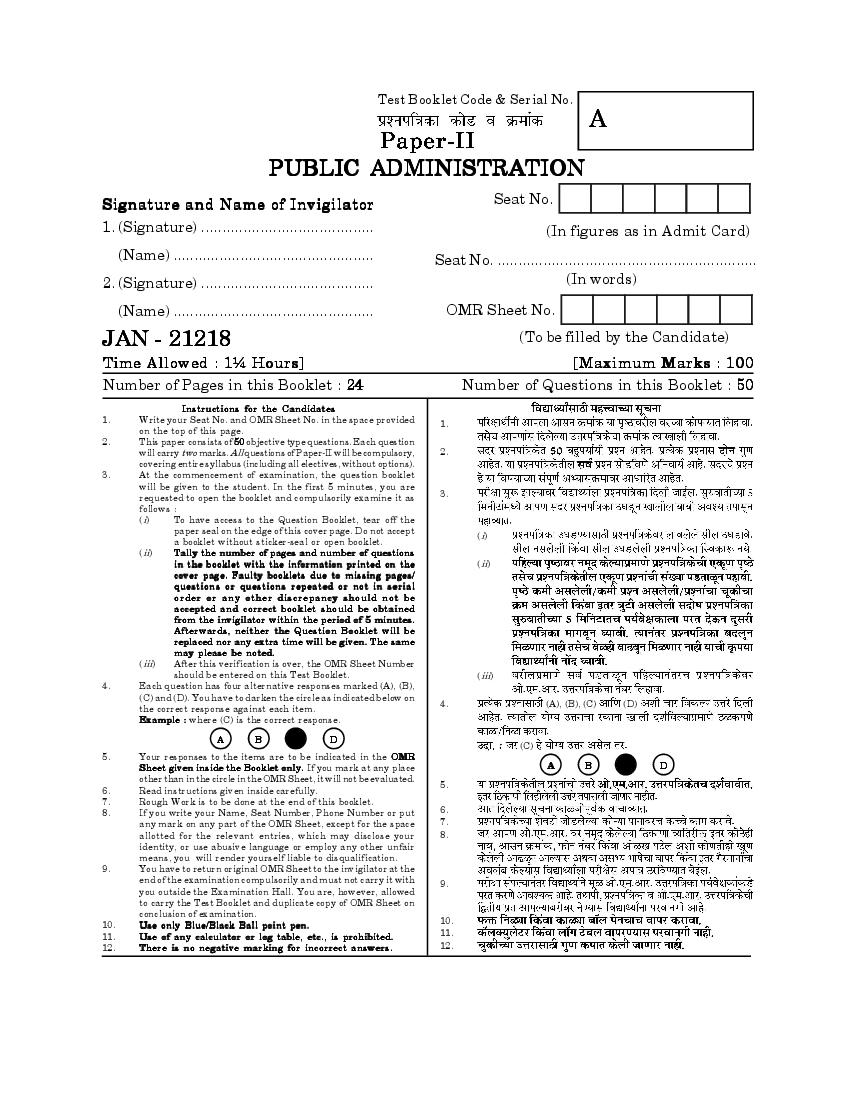
A
PUBLIC ADMINISTRATION
Signature and Name of Invigilator Seat No.
1. (Signature) ......................................... (In figures as in Admit Card)
(Name) ................................................ Seat No. ..............................................................
2. (Signature) ......................................... (In words)
(Name) ................................................ OMR Sheet No.
JAN - 21218 (To be filled by the Candidate)
Time Allowed : 1¼ Hours] [Maximum Marks : 100
Number of Pages in this Booklet : 24 Number of Questions in this Booklet : 50
Instructions for the Candidates
1. Write your Seat No. and OMR Sheet No. in the space provided 1.
on the top of this page.
2. This paper consists of 50 objective type questions. Each question
will carry two marks. All questions of Paper-II will be compulsory, 2.
covering entire syllabus (including all electives, without options).
3. At the commencement of examination, the question booklet
will be given to the student. In the first 5 minutes, you are
requested to open the booklet and compulsorily examine it as 3.
follows :
(i) To have access to the Question Booklet, tear off the
paper seal on the edge of this cover page. Do not accept (i)
a booklet without sticker-seal or open booklet.
(ii) Tally the number of pages and number of questions
in the booklet with the information printed on the (ii)
cover page. Faulty booklets due to missing pages/
questions or questions repeated or not in serial
o rder or any other discre pancy should not be
accepted and correct booklet should be obtained
from the invigilator within the period of 5 minutes.
Afterwards, neither the Question Booklet will be
replaced nor any extra time will be given. The same
may please be noted.
(iii) After this verification is over, the OMR Sheet Number
should be entered on this Test Booklet. (iii)
4. Each question has four alternative responses marked (A), (B),
(C) and (D). You have to darken the circle as indicated below on
the correct response against each item. 4. (A), (B), (C) (D)
Example : where (C) is the correct response.
A B D
(C)
5. Your responses to the items are to be indicated in the OMR
Sheet given inside the Booklet only. If you mark at any place A B D
other than in the circle in the OMR Sheet, it will not be evaluated.
5.
6. Read instructions given inside carefully.
7. Rough Work is to be done at the end of this booklet.
8. If you write your Name, Seat Number, Phone Number or put 6.
any mark on any part of the OMR Sheet, except for the space 7.
allotted for the relevant entries, which may disclose your 8.
identity, or use abusive language or employ any other unfair
means, you will render yourself liable to disqualification.
9. You have to return original OMR Sheet to the invigilator at the
end of the examination compulsorily and must not carry it with 9.
you outside the Examination Hall. You are, however, allowed
to carry the Test Booklet and duplicate copy of OMR Sheet on
conclusion of examination.
10. Use only Blue/Black Ball point pen. 10.
11. Use of any calculator or log table, etc., is prohibited. 11.
12. There is no negative marking for incorrect answers. 12.
Page 2
Page 3
Paper II
II
Time Allowed : 75 Minutes] [Maximum Marks : 100
Note : This paper contains Fifty (50) multiple choice questions. Each question
carries Two (2) marks. Attempt All questions.
(50) (2)
1. ‘‘Administration is now so vast an 1.
area that a philosophy of
Administration comes close to being
a philosophy of life.’’ Who said
this ?
(A)
(A) Herbert Simon
(B)
(B) L.D. White
(C) Vincent Ostrom (C)
(D) Marshall E. Dimock (D)
2. Market model in public 2.
administration is related with :
(A) Extreme form of decentra
lisation (A)
(B) Market-oriented public (B)
administration
(C)
(C) Fiscal policy of Government
(D) Bazaar canteen model (D)
3 [P.T.O.
Page 4
for ...........................
(A) planning (A)
(B) policy making (B)
(C) overall control (C)
(D) routine work (D)
4. Follet distinguished between which 4.
3 types of leadership ?
(1) Leadership of position (1)
(2) Leadership of planning (2)
(3) Leadership of personality (3)
(4) Leadership of functions (4)
(A) (1), (2), (3) (A) (1), (2), (3)
(B) (1), (3), (4) (B) (1), (3), (4)
(C) (2), (3), (4) (C) (2), (3), (4)
(D) (1), (2), (4) (D) (1), (2), (4)
4
Page 5
public choice approach ?
(A) Institutional (A)
(B) Bureaucratic (B)
(C) Administrative egoism (C)
(D) Monocratic administration (D)
6. Who has analysed the leadership in 6.
terms of ‘circular response’ ?
(A) C.I. Barnard (A)
(B) M.P. Follett (B)
(C) J.D. Millet (C)
(D) F.W. Taylor (D)
7. Assertion (A) and Reason (R) pattern : 7. (A) (A)
Assertion (A) : Scientific manage-
(A) :
ment neglected the human side of
the organisation.
Reason (R) : It viewed organi- (R) :
sation mechanistically codes.
Answer the following by using the
codes given below :
Codes :
(A) Both (A) and (R) are true and
(R) is the correct explanation (A) (A) (R) (R)
of (A) (A)
(B) Both (A) and (R) are true but (R)
(B) (A) (R) (R)
is not the correct explanation
(A)
of (A)
(C) (A) is true but (R) is false (C) (A) (R)
(D) (A) is false but (R) is true (D) (A) (R)
5 [P.T.O.
Page 6
8.
in the book ...........
(A) ‘Administrative Behaviour and
Decision-making’ (A)
(B) ‘Administrative Behaviour in
(B)
Administrative Organisation
(C) ‘Decision-making and
Administrative Organisation’ (C)
(D) ‘Administrative Behaviour : A
Study of Decision-making
(D)
Process in Administrative
Organisation
9. Hierarchy demands ............ 9.
(A) Centralised authority
(A)
(B) Clear functions
(B)
(C) Decentralised accountability
(C)
(D) Innovative structure (D)
6
Page 7
traditional or classical theory of
motivation is :
(A)
(A) Maslow
(B)
(B) Fayol
(C)
(C) Taylor
(D) McGregor (D)
11. Cabinet in USA is a ......... body. 11.
(A) Constitutional
(A)
(B) Statutory
(B)
(C) Extra-statutory and extra-
constitutional (C)
(D) Semi-constitutional (D)
12. Line agency is a/an .......... 12.
(A) Functional subdivision (A)
(B) Mathematical subdivision
(B)
(C) Filter and funnel in decision-
(C)
making
(D)
(D) Advisory agency
7 [P.T.O.
Page 8
Bureaucracy is :
(A)
(A) Inititative
(B)
(B) Cooperation
(C)
(C) Continuity
(D) Flexibility (D)
14. While appointing the judge in USA 14.
the President has to get consent
of ............
(A) Congress (A)
(B) House of Representatives (B)
(C) Senate (C)
(D) Outgoing judge (D)
15. Parliamentary commissioner in the 15.
UK can investigate cases of :
(A) Departments (A)
(B) Nationalised companies (B)
(C) Local authority (C)
(D) Private companies (D)
8
Page 9
Administration as ‘an action-
oriented, goal-oriented administra-
tion system’ ?
(A)
(A) John D. Montgomery
(B)
(B) Albert Waterson
(C) Irving Swerdlow (C)
(D) Edward Weidner (D)
17. Which five year plan gave 17.
importance to Industrial Develop-
ment ?
(A)
(A) First
(B)
(B) Second
(C) Third (C)
(D) Fourth (D)
18. When was the Asian Development 18.
Bank established ?
(A) 19th December, 1966 (A) 19 1966
(B) 19th December, 1967 (B) 19 1967
(C) 19th December, 1968 (C) 19 1968
(D) 19th December, 1969 (D) 19 1969
9 [P.T.O.
Page 10
example of development administra-
tion in India ?
(A)
(A) Panchayati Raj Institutions
(B)
(B) Revenue Administration
(C) Urban Administration (C)
(D) Nagar Panchayat (D)
20. It is not a factor of internal 20.
coordination :
(A) Superior’s ability (A)
(B) Subordinate’s skill (B)
(C) Singleness of purpose (C)
(D) Operational freedom (D)
21. In the period of ............ the ‘District’ 21.
was formed as a unit for
administrative purpose.
(A) Robert Clive (A)
(B) Lord Cornwallis (B)
(C) Warren Hastings (C)
(D) Lord Wellesley (D)
10
Page 11
the correct answer from the codes
given below :
I
List I
(Bodies)
(a)
(a) Central Secretariat
(b) Cabinet Secretariat (b)
(c) Planning Commission (c)
(d) Finance Commission (d)
List II II
(Related Activities)
(1) Principles Governing Grants-in-
(1)
aid to states
(2)
(2) Formulation of policies
(3) Co-ordination of activities of (3)
various ministries (4)
(4) Allocation of resources
Codes :
(a) (b) (c) (d)
(a) (b) (c) ( d)
(A) (2) (1) (4) (3)
(A) (2) (1) (4) (3)
(B) (4) (3) (2) (1)
(B) (4) (3) (2) (1)
(C) (2) (3) (4) (1)
(C) (2) (3) (4) (1)
(D) (4) (1) (2) (3) (D) (4) (1) (2) (3)
11 [P.T.O.
Page 12
been established on ...........
(A) 26 1950
(A) 26th Jan. 1950
(B) 15 1947
(B) 15th August, 1947
(C) 5 1946
(C) 5th Sept., 1946
(D) 17 1946
(D) 17th Sept., 1946
24. As per sixth pay commission, which 24.
of the following is not included in
the categorisation of employees ?
(A) Industrial and non-industrial
(B) Personnel belongs to all Indian
(A)
Services
(B)
(C) Personnel belongs to Union
Territory
(C)
(D) Personnel belongs to local
(D)
Government
12
Page 13
Academy of Administration brings
out a quarterly journal known as :
(A)
(A) The Indian Journal of Public
Adminsitration
(B)
(B) Public Administration Review
(C) Administration and Society (C)
(D) The Administrator (D)
26. The merit principle of recruitment 26.
was first recommended by :
(A) Northcote-Trevelyan committee (A)
(B) Aitchison Committee (B)
(C) Lee Commission (C)
(D) Tomlin Commission (D)
27. Which bill is put forth according to 27. 117
Art. 117 ?
(A) Fiscal Bill (A)
(B) Appropriation Bill (B)
(C) Vote on Account Bill (C)
(D) Money Bill (D)
13 [P.T.O.
Page 14
discussion on demands of any
ministry is called .........
(A) Economic Survey Report
(A)
(B) Estimate Committee Report
(B)
(C) Public Accounts Committee
Report (C)
(D) Report of CAG (D)
29. The concept of zero based bdugeting 29.
did not prove to be effective in the
India, mainly because of :
(A) Lack of infrastructure (A)
(B) Lack of financial resources (B)
(C) Lack of technology (C)
(D) Lack of capacity building (D)
30. The term ‘‘Indicative Planning’’ was 30.
used by Planning Commission in
annual report of :
(A) 1976-77 (A) 1976-77
(B) 1986-87 (B) 1986-87
(C) 1992-93 (C) 1992-93
(D) 2001-02 (D) 2001-02
14
Page 15
Assertion (A) : District Planning
(A) :
Board plays an important role in
plan formulation.
(R) :
Reason (R) : It has proper
information of local resources.
Answer the following by using the
codes given below :
Codes :
(A) Both (A) and (R) are true and
(A) (A) (R) (R)
(R) is the correct explanation
of (A) (A)
(B) Both (A) and (R) are true but (B) (A) (R) (R)
(R) is not the correct (A)
explanation of (A)
(C) (A) (R)
(C) (A) is true but (R) is false
(D) (A) (R)
(D) (A) is false but (R) is true
32. Who deals with the proposals 32.
regarding grant of land for public
institutions in state ?
(A)
(A) Governor
(B)
(B) Chief Minister
(C)
(C) Cabinet
(D) Chief Secretary (D)
15 [P.T.O.
Page 16
of executive control ?
(A) Political Control (A)
(B) Administrative Control (B)
(C) Elections (C)
(D) Professional Ethics (D)
34. According to .......... the collector is 34.
the District Development Officer.
(A) The Rajasthan Panchayat
(A)
Samiti and Zila Parishad Act,
1959 1959
(B) Tripura Municipal Act, 1994
(B) 1994
(C) The Zila Parishad and
(C)
Panchyat Samiti Act, 1961
1961
(D) Bombay Village Panchayat Act,
1958 (D) 1958
16
Page 17
35. (A) (A)
Assertion (A) : Parliament control
(A) :
over delegated legislation is weak.
Reason (R) : Legislatures are
(R) :
innocent of legal skill.
Answer the following by using the
codes given below :
Codes :
(A) Both (A) and (R) are true and
(R) is the correct explanation (A) (A) (R) (R)
of (A)
(A)
(B) Both (A) and (R) are true but
(B) (A) (R) (R)
(R) is not the correct
(A)
explanation of (A)
(C) (A) (R)
(C) (A) is true but (R) is false
(D) (A) is false but (R) is true (D) (A) (R)
36. According to whom ‘‘To understand 36.
the truth there is no alternative to
scientific method.’’
(A) T.H. Green (A)
(B) Karl Peers (B)
(C) J.W. Best (C)
(D) Chester Barnard (D)
17 [P.T.O.
Page 18
of Social Research ?
(A) Quantitative and qualitative
(A)
research
(B)
(B) Laboratory Research
(C) Physical Research (C)
(D) Biological Research (D)
38. In research sample units need not 38.
to be .........
(A) Systematic (A)
(B) Subjective (B)
(C) Identifiable (C)
(D) Independent (D)
39. Who developed the chi-square test 39. 1900
in 1900 ?
(A) Max Weber (A)
(B) Karl Pearson (B)
(C) Ronald Den (C)
(D) F.W. Max (D)
18
Page 19
of events of a situation is a type of
research :
(A) Experimental (A)
(B) Survey (B)
(C) Field (C)
(D) Analytical (D)
41. The primary catalyst of social 41.
welfare services is ...........
(A) Panchayats (A)
(B) Social Welfare Board (B)
(C) Voluntary Organisations (C)
(D) Zila Parishad (D)
42. Who started the Family Planning 42. 1925
Programme in 1925 ?
(A) Lokmanya Tilak (A)
(B) Sardar Patel (B)
(C) R.G. Karve (C)
(D) M.K. Gandhi (D)
19 [P.T.O.
Page 20
43.
more systematic activity directed
towards discovery and the
development of organised body of
knowledge.’’
(A)
(A) C.A. Mozer
(B)
(B) Bogardus
(C)
(C) J.W. Best
(D) P.L. Bhandarkar (D)
44. Family Planning Programme has 44.
been started at National level since
the year .......
(A) 1952
(A) 1952
(B) 1956
(B) 1956
(C) 1960
(C) 1960
(D) 1949 (D) 1949
20
Page 21
the correct answer from the codes
given below :
I
List I
(a) 1951
(a) 1951
(b) 1956 (b) 1956
(c) 1991 (c) 1991
(d) 1953 (d) 1953
List II
II
(1) New Industrial Policy
(1)
(2) Industrial Finance Corporation
(2)
of India
(3) Industrial Policy Resolution (3)
(4) The Industries Development (4)
and Regulation Act
Codes :
(a) (b) (c) (d)
(a) (b) (c) (d)
(A) (1) (2) (3) (4)
(A) (1) (2) (3) (4)
(B) (2) (3) (4) (1)
(B) (2) (3) (4) (1)
(C) (4) (3) (1) (2) (C) (4) (3) (1) (2)
(D) (3) (1) (2) (4) (D) (3) (1) (2) (4)
21 [P.T.O.
Page 22
46.
Government was established in :
(A) 1687 (A) 1687
(B) 1887 (B) 1887
(C) 1893 (C) 1893
(D) 1946 (D) 1946
47. In U.S.A. at present territorially the 47.
largest unit of local government is
..............
(A) City Municipality (A)
(B) Town (B)
(C) County (C)
(D) Special District (D)
48. An authority to determine and 48.
execute measures within restricted
area inside and smaller than the
whole state is called :
(A)
(A) Provincial Government
(B) Regional Government (B)
(C) Local Government (C)
(D) State Government (D)
22
Page 23
mode project are :
(1) Internal computerization of
(1)
panchayat process
(2)
(2) Enabling panchayat to make
effective use of IT
(3)
(3) Enabling people to effective use
of IT
(4)
(4) Bring out transparency in
working of the panchayat
Codes :
(A) (1), (2) and (3) (A) (1), (2) (3)
(B) (2), (3) and (4) (B) (2), (3) (4)
(C) (1), (2) and (4) (C) (1), (2) (4)
(D) (1), (2), (3) and (4) (D) (1), (2), (3) (4)
50. Which one of the following functions 50.
of Panchayati Raj is not listed in 11
the 11th schedule of Indian
Constitution ?
(A)
(A) Cultural Activities
(B)
(B) Solid waste management
(C)
(C) Small scale industries
(D)
(D) Public distribution system
23 [P.T.O.
Page 24
24
Document Details
| Board / Org | Maharashtra Exams |
| Exam | Maharashtra State Eligibility Test |
| Type | Question Paper |
| Pages | 24 |
| Updated | 30 Apr 2026 |