MAHA SET 2018 Question Paper 2 Psychology
Finished viewing? Save it for later —
Download MAHA SET 2018 Question Paper 2 Psychology (PDF · 24 pages)About MAHA SET 2018 Question Paper 2 Psychology
MAHA SET 2018 Question Paper 2 Psychology is available here for free download. Published by Maharashtra Exams for Maharashtra State Eligibility Test, this question paper can be viewed online or downloaded as a PDF (24 pages). Candidates preparing for Maharashtra State Eligibility Test can use MAHA SET 2018 Question Paper 2 Psychology to understand the exam pattern, the type of questions asked, and the overall difficulty level.
Frequently Asked Questions
How can I download MAHA SET 2018 Question Paper 2 Psychology?
Open this page and click the Download button to save MAHA SET 2018 Question Paper 2 Psychology as a PDF. It is completely free on AglaSem Docs.
Is MAHA SET 2018 Question Paper 2 Psychology free to download?
Yes. MAHA SET 2018 Question Paper 2 Psychology can be viewed online and downloaded as a PDF free of cost on AglaSem Docs.
How many pages does MAHA SET 2018 Question Paper 2 Psychology have?
MAHA SET 2018 Question Paper 2 Psychology contains 24 pages, which you can read online or download together as a single PDF.
Where can I find more Maharashtra State Eligibility Test study material?
You can find more Maharashtra State Eligibility Test question papers, sample papers, syllabus, and answer keys on AglaSem Docs.
MAHA SET 2018 Question Paper 2 Psychology – Text
Read the full text of this question paper below — useful to quickly search, copy and reference the content online without downloading the PDF.
📄 View text version (24 pages)
Page 1
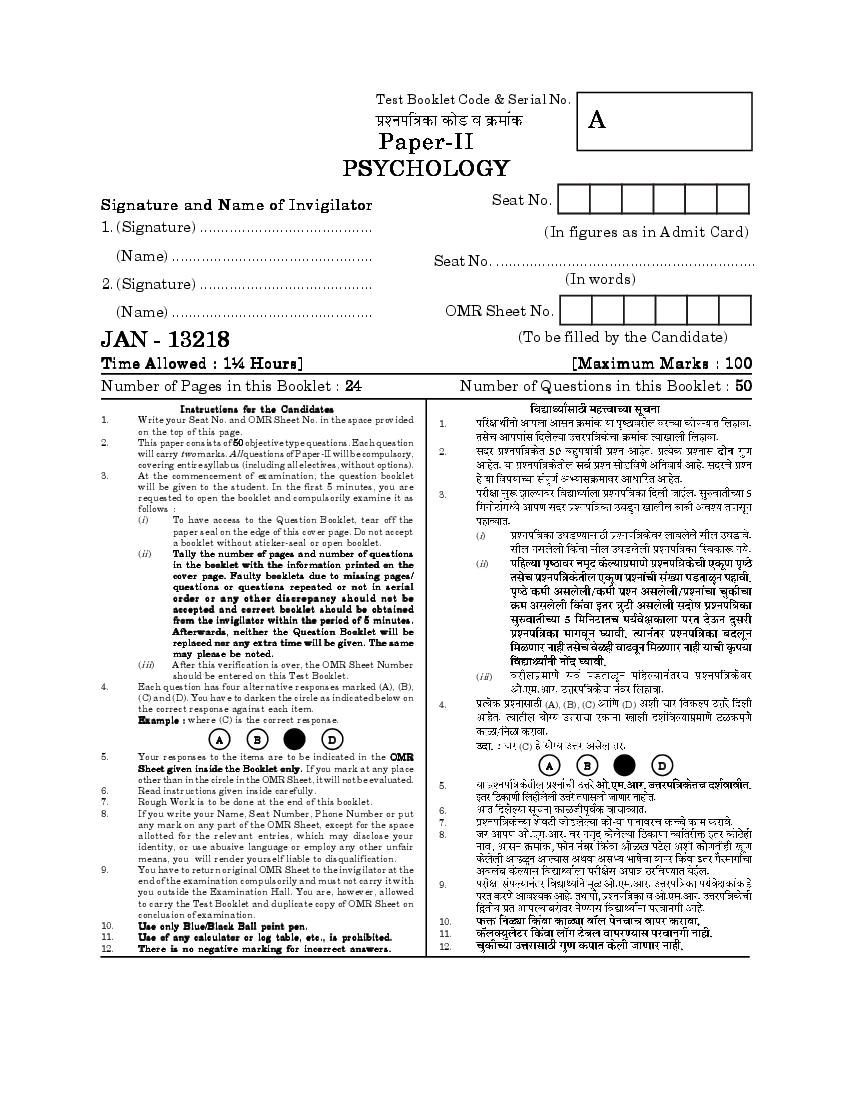
A
PSYCHOLOGY
Signature and Name of Invigilator Seat No.
1. (Signature) ......................................... (In figures as in Admit Card)
(Name) ................................................ Seat No. ..............................................................
2. (Signature) ......................................... (In words)
(Name) ................................................ OMR Sheet No.
JAN - 13218 (To be filled by the Candidate)
Time Allowed : 1¼ Hours] [Maximum Marks : 100
Number of Pages in this Booklet : 24 Number of Questions in this Booklet : 50
Instructions for the Candidates
1. Write your Seat No. and OMR Sheet No. in the space provided 1.
on the top of this page.
2. This paper consists of 50 objective type questions. Each question
will carry two marks. All questions of Paper-II will be compulsory, 2.
covering entire syllabus (including all electives, without options).
3. At the commencement of examination, the question booklet
will be given to the student. In the first 5 minutes, you are
requested to open the booklet and compulsorily examine it as 3.
follows :
(i) To have access to the Question Booklet, tear off the
paper seal on the edge of this cover page. Do not accept (i)
a booklet without sticker-seal or open booklet.
(ii) Tally the number of pages and number of questions
in the booklet with the information printed on the (ii)
cover page. Faulty booklets due to missing pages/
questions or questions repeated or not in serial
o rder or any other discre pancy should not be
accepted and correct booklet should be obtained
from the invigilator within the period of 5 minutes.
Afterwards, neither the Question Booklet will be
replaced nor any extra time will be given. The same
may please be noted.
(iii) After this verification is over, the OMR Sheet Number
should be entered on this Test Booklet. (iii)
4. Each question has four alternative responses marked (A), (B),
(C) and (D). You have to darken the circle as indicated below on
the correct response against each item. 4. (A), (B), (C) (D)
Example : where (C) is the correct response.
A B D
(C)
5. Your responses to the items are to be indicated in the OMR
Sheet given inside the Booklet only. If you mark at any place A B D
other than in the circle in the OMR Sheet, it will not be evaluated.
5.
6. Read instructions given inside carefully.
7. Rough Work is to be done at the end of this booklet.
8. If you write your Name, Seat Number, Phone Number or put 6.
any mark on any part of the OMR Sheet, except for the space 7.
allotted for the relevant entries, which may disclose your 8.
identity, or use abusive language or employ any other unfair
means, you will render yourself liable to disqualification.
9. You have to return original OMR Sheet to the invigilator at the
end of the examination compulsorily and must not carry it with 9.
you outside the Examination Hall. You are, however, allowed
to carry the Test Booklet and duplicate copy of OMR Sheet on
conclusion of examination.
10. Use only Blue/Black Ball point pen. 10.
11. Use of any calculator or log table, etc., is prohibited. 11.
12. There is no negative marking for incorrect answers. 12.
Page 2
Page 3
Paper II
II
Time Allowed : 75 Minutes] [Maximum Marks : 100
Note : This paper contains Fifty (50) multiple choice questions, each carrying
Two (2) marks. Attempt All questions.
(50) (2)
1. Aguesia is the inability to 1.
recognize :
(A) Tastes (A)
(B) Colours (B)
(C) Odors (C)
(D) Shapes (D)
2. Two-factor theory, that is a 2.
combination of classical conditioning
and operant conditioning, is one of
the explanations of :
(A)
(A) Generalization
(B)
(B) Discrimination
(C) Shaping (C)
(D) Avoidance learning (D)
3 [P.T.O.
Page 4
to information presented after the
material that is to be remembered
is known as :
(A)
(A) Positive transfer
(B)
(B) Negative transfer
(C) Zero transfer (C)
(D) Retroactive interference (D)
4. A common logical error that people 4.
make is to seek information that
supports their ideas rather than
evidence that would invalidate those
ideas. This is known as :
(A)
(A) Deductive reasoning
(B) The confirmatory bias (B)
(C) Affirming the consequent (C)
(D) Affirming the antecedent (D)
5. Which part of the brain is 5.
responsible for biologically driven
motivational processes ?
(A)
(A) Thalamus
(B)
(B) Hippocampus
(C)
(C) Limbic system
(D) Hypothalmus (D)
4
Page 5
using the codes given below :
Column-I Column-II
-I -II
(Psychologists) (Concepts/
Scales)
(P) Cattell (1) Masculinity
(Q) Hathaway & (2) Intelligence (P) (1)
McKinley Quotient (Q) (2)
(R) Holland (3) Mental (R) (3)
ability (S) (4)
(S) Binet (4) Enterprising
Codes :
(P) (Q) (R) (S)
(P) (Q) (R) (S)
(A) (4) (3) (2) (1)
(A) (4) (3) (2) (1)
(B) (2) (4) (1) (3)
(B) (2) (4) (1) (3)
(C) (1) (2) (3) (4) (C) (1) (2) (3) (4)
(D) (3) (1) (4) (2) (D) (3) (1) (4) (2)
7. The ego attempts to mediate 7.
demands of id in relation to real
work according to :
(A) The pleasure principle (A)
(B) The reality principle (B)
(C) The primary process principle (C)
(D) Both (A) and (C) are correct (D) (A) (C)
5 [P.T.O.
Page 6
collection technique is not well suited
for studying attitude ?
(A)
(A) Questionnaire
(B)
(B) Direct observation
(C) Psychological tests (C)
(D) Physiological recordings (D)
9. Match List-I with List-II and select 9. -I -II
the correct answer by using the
codes given below :
-I -II
List-I List-II
(P) Summated (1) Osgood (P) (1)
rating scale
(Q) Successive (2) Stephenson (Q) (2)
intervals
method
(R) (3)
(R) Semantic (3) Likert
differential (4)
(S) Q-sort (4) Thurston
Codes : (P) (Q) (R) (S)
(P) (Q) (R) (S)
(A) (3) (4) (1) (2)
(A) (3) (4) (1) (2)
(B) (3) (1) (4) (2)
(B) (3) (1) (4) (2)
(C) (4) (2) (1) (3)
(C) (4) (2) (1) (3)
(D) (1) (3) (2) (4) (D) (1) (3) (2) (4)
6
Page 7
the correct answer by using the
codes given below :
List-I List-II
Types of Modality -I -II
Cutaneous Best
Receptors Handled
(P) Pacinian (1) Pressure
(P) (1)
corpuscle
(Q) Ruffini ending (2) Pain and (Q) (2)
temperature (R) (3)
(R) Merkel ending (3) Touch
(S) (4)
(S) Free nerve (4) Vibration
ending
Codes : (P) (Q) (R) (S)
(P) (Q) (R) (S) (A) (1) (4) (2) (3)
(A) (1) (4) (2) (3)
(B) (2) (3) (1) (4)
(B) (2) (3) (1) (4)
(C) (4) (1) (3) (2)
(C) (4) (1) (3) (2)
(D) (3) (2) (4) (1) (D) (3) (2) (4) (1)
11. Divided attention tasks require 11.
the subject to :
(A) Respond quickly to one among (A)
many stimuli
(B) Attend to multiple stimuli (B)
(C) Search for missing features (C)
(D) Concentrate on the task (D)
7 [P.T.O.
Page 8
12.
(A) Brief pause in response occurs
(A)
immediately after reinforce-
ment
(B)
(B) Negligible responding immedi-
ately after reinforcement (C)
(C) Rapid stable rate maintained
between reinforcements
(D)
(D) Generally lower rate of respond-
ing
13. The capacity of short-term memory 13.
is assumed to be :
(A) 10 ± 2 (A) 10 ± 2
(B) 5 ± 2 (B) 5 ± 2
(C) 6 ± 2 (C) 6 ± 2
(D) 7 ± 2 (D) 7 ± 2
14. Which of the following is not a 14.
theory of reasoning ?
(A) Mental models (A)
(B) Mental logic (B)
(C) Prospect theory (C)
(D) Probabilistic approach (D)
8
Page 9
chemical during and just after a
meal :
(A)
(A) Insulin
(B)
(B) Glycogen
(C)
(C) Pepsin
(D) Glucagon (D)
16. Match List-I with List-II and select 16. -I -II
the correct answer by using the
codes given below :
List-I List-II
(Theorists) (Concepts) -I -II
(P) Sternberg (1) Convergent
thinking
(P) (1)
(Q) Cattell (2) Performance
(Q) (2)
intelligence
(R) Guilford (3) Contextual (R) (3)
intelligence (S) (4)
(S) Wechsler (4) Crystalized
intelligence
(P) (Q) (R) (S)
Codes :
(P) (Q) (R) (S) (A) (3) (4) (1) (2)
(A) (3) (4) (1) (2)
(B) (2) (3) (4) (1)
(B) (2) (3) (4) (1)
(C) (1) (2) (3) (4)
(C) (1) (2) (3) (4)
(D) (4) (1) (2) (3) (D) (4) (1) (2) (3)
9 [P.T.O.
Page 10
what it is supposed to measure,
then it has :
(A) Face validity (A)
(B) Split-half validity (B)
(C) Construct validity (C)
(D) Concurrent validity (D)
18. Which of the following is the 18.
best example of an operational
definition ?
(A)
(A) Hypotheses are educated
guesses that can be confirmed
or rejected by evidence
(B) Class participation is the (B)
number of times a student
raises his or her hand in class
(C) Cognitive processes include
(C)
perception, remembering,
problem solving and
understanding.
(D) Reading ability can be used to (D)
predict success in introductory
psychology classes
10
Page 11
could be performed by using :
(1) Alpha coefficient (1)
(2) Item discrimination index (2)
(3) Item difficulty level (3)
(4) KR-20 (4) -20
Select the correct option from the
codes given below :
(A) (1) only (A) (1)
(B) (2) and (3) (B) (2) (3)
(C) (3) and (4) (C) (3) (4)
(D) (2), (3) and (4) (D) (2), (3) (4)
20. The circle of Willis is : 20.
(1) Named after English anatomist (1)
Thomas Willis.
(2) Formed by anterior branches of
(2)
internal carotid artery.
(3) Formed by anterior and
posterior communicating artery. (3)
(4) Formed by posterior cerebral (4)
branches of basilar artery.
Codes :
(A) (1) (2)
(A) (1) and (2) only
(B) (1) (3)
(B) (1) and (3) only
(C) (1), (2) and (3) only (C) (1), (2) (3)
(D) (1), (2), (3) and (4) (D) (1), (2), (3) (4)
11 [P.T.O.
Page 12
occurs during transmission of a
nerve impulse :
(1)
(1) Action potential
(2)
(2) Refractory period
(3)
(3) Resting potential
Codes :
(A) (3) (1) (2)
(A) (3) (1) (2)
(B) (1) (2) (3) (B) (1) (2) (3)
(C) (3) (2) (1) (C) (3) (2) (1)
(D) (1) (3) (2) (D) (1) (3) (2)
22. The projective test that has been 22.
used a great deal to measure
affiliation need is the :
(A) TAT (A)
(B) MMPI (B)
(C) Sarason Sociability Scale (C)
(D) RIBT (D)
23. In experimental research, the data 23.
collected by the researcher are the :
(A) Primary variable (A)
(B) Secondary variable (B)
(C) Independent variable (C)
(D) Dependent variable (D)
12
Page 13
order of steps in test construction ?
(1) Development of norms (1)
(2)
(2) Identification of construct
(3)
(3) Item analysis
(4)
(4) Validity analysis
(5)
(5) Test-retest reliability analysis
Codes :
(A) (2) (3) (5) (4) (1) (A) (2) (3) (5) (4) (1)
(B) (3) (4) (5) (2) (1) (B) (3) (4) (5) (2) (1)
(C) (2) (5) (3) (1) (4) (C) (2) (5) (3) (1) (4)
(D) (1) (2) (3) (4) (5) (D) (1) (2) (3) (4) (5)
25. Approaches to perception that 25.
involve direct reception of
information from environment are
called :
(A)
(A) Constructivist approaches
(B)
(B) Computational approaches
(C) Ecological approaches (C)
(D) Feature analytical approaches (D)
13 [P.T.O.
Page 14
upon number of responses given by
respondent it is :
(1)
(1) Fixed interval schedule
(2)
(2) Fixed ratio schedule
(3)
(3) Variable ratio schedule
(4)
(4) Variable interval schedule
Codes :
(A) (2) and (3) only (A) (2) (3)
(B) (3) and (4) only (B) (3) (4)
(C) (1) and (2) only (C) (1) (2)
(D) (1) and (4) only (D) (1) (4)
27. Information in long-term memory is 27.
primarily stored in :
(A) Sensory form (A)
(B) Semantic form (B)
(C) Acoustic form (C)
(D) Tactile form (D)
14
Page 15
hinder your ability to solve a
problem, especially if you become
stuck on that one interpretation.
This barrier is called :
(A)
(A) The representational problem
(B) Algorithm interference (B)
(C) A blocked solution path (C)
(D) Functional fixedness (D)
29. Selection of moderately challenging 29.
tasks characterized the behaviour of
people who have :
(A) Fear of failing (A)
(B) High need for achievement (B)
(C) Fear of success (C)
(D) Low need for achievement (D)
30. DIQ is a measure of :
30.
(A) Deviation in personality
disorder (A)
(B) Deviation in intelligence
(B)
disorder
(C) Intelligence in standard scores (C)
(D) Intelligence in the form of
(D)
ratio I.Q.
15 [P.T.O.
Page 16
is a : (A)
(A) Visual and auditory mismatch (B)
(B) Visual and tactile mismatch (C)
(C) Proprioceptive and auditory
mismatch (D)
(D) Visual and proprioceptive
mismatch 32.
32. Stimulus similar to original CS will
elicit similar response is called :
(A) Generalization (A)
(B) Discrimination (B)
(C) Shaping (C)
(D) Substitution (D)
33. Concepts are learned through 33.
psychological processes. That are :
(1) generalisation (1)
(2) classification (2)
(3) categorization (3)
(4) discrimination (4)
Select the correct option from the
codes given below :
(A) (1) and (3) only (A) (1) (3)
(B) (2) and (3) only (B) (2) (3)
(C) (1) and (4) only (C) (1) (4)
(D) (3) and (4) only (D) (3) (4)
16
Page 17
internal states of the body ?
(A) Drive (A)
(B) Homeostasis (B)
(C) Hemoglobin (C)
(D) Needs (D)
35. Spearman’s two-factor theory defines 35.
intelligence as :
(A) Composed of multiple abilities (A)
(B) A global, unitary ability (B)
(C) Composed of 120 unique (C)
combinations
(D) A set of primary abilities (D)
36. A person is asked to respond to 36.
vague/ambiguous stimuli when
taking a :
(A) Pencil and paper test (A)
(B) Projective test (B)
(C) Personality inventory (C)
(D) Behavioural assessment (D)
17 [P.T.O.
Page 18
subjects in the experimental and
control groups are very similar to
each other in order to reduce the
effects of : (A)
(A) Extraneous variable
(B)
(B) Random variable
(C)
(C) Dependent variable
(D) Independent variable (D)
38. Match Column-I with Column-II by 38. -I -II
using the codes given below :
Column-I Column-II
-I -II
(Types of Norms) (Features)
(P) Age Norms (1) Scores are
expressed in (P) (1)
SD units
(Q) Percentile (2) Sequential
Norms formation of (Q) (2)
concepts and
motor skills
(R) Ordinal Norms (3) Mental
(R) (3)
development
(S) Standard Score (4) Unequal (S) (4)
Norms units of
measurement
Codes : (P) (Q) (R) (S)
(P) (Q) (R) (S)
(A) (3) (4) (2) (1)
(A) (3) (4) (2) (1)
(B) (2) (1) (3) (4)
(B) (2) (1) (3) (4)
(C) (1) (2) (4) (3) (C) (1) (2) (4) (3)
(D) (4) (3) (1) (2) (D) (4) (3) (1) (2)
18
Page 19
blanks, from the choices given
below :
There are ..................... segments in
the human spinal cord : .....................
cervical, ..................... thoracic,
..................... lumbar, .....................
sacral & ..................... coccygeal.
(A) 35 : 10, 10, 12, 1, 2 (A) 35 : 10, 10, 12, 1, 2
(B) 31 : 8, 12, 5, 5, 1 (B) 31 : 8, 12, 5, 5, 1
(C) 30 : 10, 10, 7, 1, 2 (C) 30 : 10, 10, 7, 1, 2
(D) 33 : 9, 11, 6, 4, 3 (D) 33 : 9, 11, 6, 4, 3
40. Gibson’s theory of direct perception 40.
implies that :
(1) Perception is used to adapt to (1)
environment
(2) Perception is used to control (2)
action
(3) When observer moves, optic (3)
array changes
(4) Sensory systems are perceptual (4)
systems
Codes :
(A) (1) and (2) only (A) (1) (2)
(B) (1) and (3) only (B) (1) (3)
(C) (1), (2) and (3) only (C) (1), (2) (3)
(D) (1), (2), (3) and (4) (D) (1), (2), (3) (4)
19 [P.T.O.
Page 20
built by method of successive
approximation it is called :
(A) Higher order conditioning (A)
(B) Reinforcement (B)
(C) Shaping (C)
(D) Generalization (D)
42. The ........................ model of memory 42.
proposes physical, acoustic and
semantic parts.
(A) Structural model (A)
(B) Connectionist model (B)
(C) Processing model (C)
(D) Non-declarative model (D)
43. The activated portion of long-term 43.
memory is called :
(A) Declarative memory (A)
(B) Working memory (B)
(C) Sensory memory (C)
(D) Procedural memory (D)
20
Page 21
high-quality cosmetics, Hema
reminds herself that most expensive
brands are the best. Hema’s self-
reminder illustrates the use of :
(A) An algorithm (A)
(B) A heuristic (B)
(C) The farming effects (C)
(D) Functional fixedness (D)
45. A substance that can act directly 45.
on brain receptors to stimulate
thirst is :
(A)
(A) Angiotensin
(B)
(B) Endorphin
(C)
(C) Lipoprotein
(D)
(D) Acetylcholine
21 [P.T.O.
Page 22
intelligence in order to demonstrate
that intelligence was determined
by :
(A)
(A) Heredity
(B)
(B) Experience
(C) Neither heredity nor experience (C)
(D) Both heredity and experience (D)
47. Which of the following test is most 47.
similar to Rorschach ?
(A) TAT (A)
(B) 16 PF (B)
(C) TMAS (C)
(D) MMPI (D)
48. Which of the following is not a 48.
descriptive/correlational research
method ?
(A)
(A) Survey
(B)
(B) Experiment
(C)
(C) Case Study
(D) Naturalistic Observation (D)
22
Page 23
and give your answer with the help
of codes given below :
-I -II
Column-I Column-II
(Psychologist) (Terms/
Concepts)
(P) Guilford (1) Measure of (P) (1)
‘g’ factor
(Q) Cattell (2) Performance
(Q) (2)
factor
(R) (3)
(R) Wechsler (3) Fluid
(S) (4)
intelligence
(S) Binet (4) Content and
operations
Codes : (P) (Q) (R) (S)
(P) (Q) (R) (S)
(A) (1) (2) (3) (4)
(A) (1) (2) (3) (4)
(B) (3) (4) (1) (2)
(B) (3) (4) (1) (2)
(C) (4) (3) (2) (1)
(C) (4) (3) (2) (1)
(D) (2) (1) (4) (3) (D) (2) (1) (4) (3)
50. The following is not a structure 50.
included in the meninges :
(A)
(A) Mastoid process
(B)
(B) Piamater
(C) Arachnoid membrane (C)
(D) Duramater (D)
23 [P.T.O.
Page 24
24
Document Details
| Board / Org | Maharashtra Exams |
| Exam | Maharashtra State Eligibility Test |
| Type | Question Paper |
| Pages | 24 |
| Updated | 30 Apr 2026 |