MAHA SET 2019 Question Paper 2 Philosophy
Finished viewing? Save it for later —
Download MAHA SET 2019 Question Paper 2 Philosophy (PDF · 32 pages)About MAHA SET 2019 Question Paper 2 Philosophy
MAHA SET 2019 Question Paper 2 Philosophy is available here for free download. Published by Maharashtra Exams for Maharashtra State Eligibility Test, this question paper can be viewed online or downloaded as a PDF (32 pages). Candidates preparing for Maharashtra State Eligibility Test can use MAHA SET 2019 Question Paper 2 Philosophy to understand the exam pattern, the type of questions asked, and the overall difficulty level.
Frequently Asked Questions
How can I download MAHA SET 2019 Question Paper 2 Philosophy?
Open this page and click the Download button to save MAHA SET 2019 Question Paper 2 Philosophy as a PDF. It is completely free on AglaSem Docs.
Is MAHA SET 2019 Question Paper 2 Philosophy free to download?
Yes. MAHA SET 2019 Question Paper 2 Philosophy can be viewed online and downloaded as a PDF free of cost on AglaSem Docs.
How many pages does MAHA SET 2019 Question Paper 2 Philosophy have?
MAHA SET 2019 Question Paper 2 Philosophy contains 32 pages, which you can read online or download together as a single PDF.
Where can I find more Maharashtra State Eligibility Test study material?
You can find more Maharashtra State Eligibility Test question papers, sample papers, syllabus, and answer keys on AglaSem Docs.
MAHA SET 2019 Question Paper 2 Philosophy – Text
Read the full text of this question paper below — useful to quickly search, copy and reference the content online without downloading the PDF.
📄 View text version (32 pages)
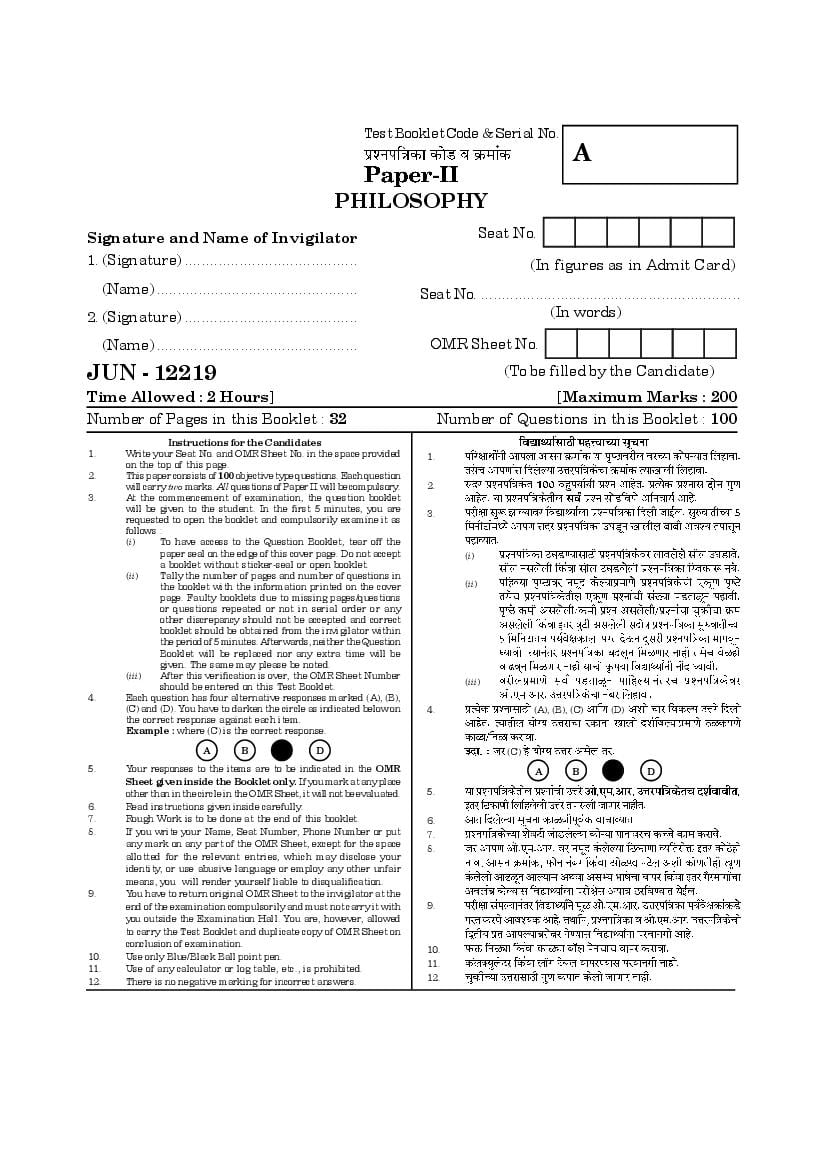
Page 1
A
PHILOSOPHY
Signature and Name of Invigilator Seat No.
1. (Signature) ......................................... (In figures as in Admit Card)
(Name) ................................................ Seat No. ..............................................................
2. (Signature) ......................................... (In words)
(Name) ................................................ OMR Sheet No.
JUN - 12219 (To be filled by the Candidate)
Time Allowed : 2 Hours] [Maximum Marks : 200
Number of Pages in this Booklet : 32 Number of Questions in this Booklet : 100
Instructions for the Candidates
1. Write your Seat No. and OMR Sheet No. in the space provided 1.
on the top of this page.
2. This paper consists of 100 objective type questions. Each question
will carry two marks. All questions of Paper II will be compulsory. 2.
3. At the commencement of examination, the question booklet
will be given to the student. In the first 5 minutes, you are 3.
requested to open the booklet and compulsorily examine it as
follows :
(i) To have access to the Question Booklet, tear off the
paper seal on the edge of this cover page. Do not accept (i)
a booklet without sticker-seal or open booklet.
(ii) Tally the number of pages and number of questions in
the booklet with the information printed on the cover (ii)
page. Faulty booklets due to missing pages/questions
or questions repeated or not in serial order or any
other discrepancy should not be accepted and correct
booklet should be obtained from the invigilator within
the period of 5 minutes. Afterwards, neither the Question
Booklet will be replaced nor any extra time will be
given. The same may please be noted.
(iii) After this verification is over, the OMR Sheet Number
(iii)
should be entered on this Test Booklet.
4. Each question has four alternative responses marked (A), (B),
(C) and (D). You have to darken the circle as indicated below on 4. (A), (B), (C) (D)
the correct response against each item.
Example : where (C) is the correct response.
A B D (C)
5. Your responses to the items are to be indicated in the OMR A B D
Sheet given inside the Booklet only. If you mark at any place
other than in the circle in the OMR Sheet, it will not be evaluated. 5.
6. Read instructions given inside carefully.
7. Rough Work is to be done at the end of this booklet. 6.
8. If you write your Name, Seat Number, Phone Number or put 7.
any mark on any part of the OMR Sheet, except for the space
8.
allotted for the relevant entries, which may disclose your
identity, or use abusive language or employ any other unfair
means, you will render yourself liable to disqualification.
9. You have to return original OMR Sheet to the invigilator at the
end of the examination compulsorily and must not carry it with 9.
you outside the Examination Hall. You are, however, allowed
to carry the Test Booklet and duplicate copy of OMR Sheet on
conclusion of examination.
10.
10. Use only Blue/Black Ball point pen.
11.
11. Use of any calculator or log table, etc., is prohibited.
12. There is no negative marking for incorrect answers. 12.
Page 2
Page 3
Paper II
II
Time Allowed : 120 Minutes] [Maximum Marks : 200
Note : This Paper contains Hundred (100) multiple choice questions. Each question
carrying Two (2) marks. Attempt All questions.
(100) (2)
1. Choose the correct order of the 1.
stages of life according to
pratityasamutpada of Buddhism :
(A) Bhava, Vedana , Jati and
Upadana (A)
(B) Bhava, Jati , Vedana and
(B)
Upadana
(C) Vedana , Upadana , Bhava (C)
and Jati
(D) Bhava, Vedana , Upadana and (D)
Jati
2. Consider the following statements 2.
with reference to the schools of
Vedanta and mark the correct (1)
code :
(1) Shankara accepted Nirguna
brahman and rejected Saguna (2)
brahman
(2) Shankara and Ramanuja (3)
accepted Saguna brahman
(3) Shankara accepted both
Saguna and Nirguna brahman (4)
(4) Shankara and Ramanuja both
rejected Nirguna brahman
Codes :
(A) (1)
(A) Only (1) is true
(B) (1) (4)
(B) Only (1) and (4) are true
(C) Only (2) and (3) are true (C) (2) (3)
(D) Only (3) and (4) are true (D) (3) (4)
3 [P.T.O.
Page 4
but they have the potential to be
identical” is the philosophical
perspective of : (A)
(A) Advaita Vedanta (B)
(B) Visishtadvaita Vedanta
(C)
(C) Dvaita Vedanta
(D)
(D) Jainism
4. Given below are two statements 4. (A) (R)
labelled Assertion (A) and Reason
(R). Examine both with respect to
the Yoga and select the correct
code :
(A)
Assertion (A) :
Yoga is a theistic system.
Reason (R) : (R)
God is the creator, preserver and
destroyer of the world.
Codes :
(A) Both (A) and (R) are true and
(R) is the correct explanation (A) (A) (R)
of (A) (R) (A)
(B) Both (A) and (R) are true and
(B) (A) (R)
(R) is not the correct
(R) (A)
explanation of (A)
(C) (A) is true and (R) is false (C) (A) (R)
(D) (A) is false and (R) is true (D) (A) (R)
4
Page 5
reference to the Vedic sacrifice from
the following :
(A) The sacrifice is enjoined by the
Veda (A)
(B) The Vedic Gods are invoked in (B)
the sacrifice, but they are only
instruments for the proper
completion of the sacrifice
(C) It is not the case that, the result
of the sacrifice is produced by (C)
an inherent potency—the
apurva
(D) Out of the many kinds of (D)
sacrifices enjoined, one among
them has its aims the fulfilment
of the desire of the person
performing the sacrifice
6. Which one of the following theories 6.
of validity of knowledge is upheld by
Samkhya ?
(A) Svatah pramanyavada,
Paratah apramanyavada (A)
(B) Svatah pramanyavada,
(B)
Svatah apramanyavada
(C) Paratah pramanyavada, (C)
Paratah apramanyavada
(D) Paratah pramanyavada, (D)
Svatah apramanyavada
7. ‘It is not the case that everything 7.
can be produced by everything
merely by a change of arrangement
of constituting atoms. This means to
say, it is not the case that the effect
is potentially pre-existent in the (A)
cause.’ This view is upheld by :
(A) Samkhya-Yoga (B)
(B) Madhyamika Buddhists (C)
(C) Nyaya-Vaisesika
(D) Mimamsa (D)
5 [P.T.O.
Page 6
upheld by :
(A) Naiyayikas (A)
(B) Mimamsakas (B)
(C) (C)
(D) Buddhists (D)
9. Given below are two statements 9. (A) (R)
labelled Assertion (A) and Reason
(R). Examine both with reference to
Mimamsa system and select the
correct code.
Assertion (A) : (A)
Vidhi vakya and Nisedha vakya
of the Vedas are injunctions that
give forth the Vedic actions that are
to be followed and those that are to
be avoided respectively.
(R)
Reason (R) :
Vidhi and Nisedha are to be
adhered to because the
Mimamsakas consider the Veda to
be their final authority.
Codes : (A) (A) (R)
(A) Both (A) and (R) are true and (R) (A)
(R) is the correct explanation
(B) (A) (R)
of (A)
(R) (A)
(B) Both (A) and (R) are true and
(R) is not the correct
explanation of (A)
(C) (A) (R)
(C) (A) is true and (R) is false
(D) (A) is false and (R) is true (D) (A) (R)
6
Page 7
the correct code :
List I
I
(a) We may notice manifold
qualities and characteristics of (a)
a thing, but view them as
unified in the thing. Eg. We say,
“This is a book”, we do not look
at characteristics being different
from it.
(b)
(b) We may notice qualities
separately and regard the
unified thing as non-existent.
Eg. Perceiving different
qualities of the book and alone
regarding those as real, apart
from the unified object, i.e. the
book. (c)
(c) Liberation is not a negative (d)
state of cessation of misery.
(d) Liberation is for and by the II
individual.
List II (1)
(1) Paryaya-naya (2)
(2) Dravya-naya (3)
(3) Mahayana
(4)
(4) Hinayana
Codes :
(a) (b) (c) (d)
(a) (b) (c) (d)
(A) (4) (2) (3) (1) (A) (4) (2) (3) (1)
(B) (3) (2) (1) (4) (B) (3) (2) (1) (4)
(C) (3) (1) (2) (4) (C) (3) (1) (2) (4)
(D) (2) (1) (3) (4) (D) (2) (1) (3) (4)
7 [P.T.O.
Page 8
Anaximenes are known as :
(A) physikoi (B) mystics (A) (B)
(C) myth-makers (D) politicians (C) (D)
12. The view that human beings were 12.
playthings at the hands of powerful
but morally weak deities was held
by :
(A) (B)
(A) Heraclitus (B) Aristotle
(C) (D)
(C) Homer (D) Thales
13. For Plato Mathematics provides : 13.
(A) a bridge from the sensible would (A)
to the intelligible
(B)
(B) a discontinuity from the sensible
world to the intelligible
(C)
(C) an illusory means from the
sensible world to the intelligible
(D)
(D) an obstacle in the sensible world
to the intelligible
14. According to Aristotle, form is not : 14.
(A) for the sake of matter (A)
(B) immanent in matter (B)
(C) functional in matter (C)
(D) differential in matter (D)
8
Page 9
According to Locke, the real essence
of any physical object is not known
to us.
Reason (R) : (R)
The internal constitution of the
object is in reach our experience.
(A) Both (A) and (R) are
individually true (A) (A) (R)
(B) (A) is true but (R) is false (B) (A) (R)
(C) (A) is false but (R) is true (C) (A) (R)
(D) Both (A) and (R) are
(D) (A) (R)
individually false
16. Who claimed that the exclusive 16.
concern of mathematics is with
questions of order or measure ?
(A) (B)
(A) Leibniz (B) Kant
(C) (D)
(C) Descartes (D) Russell
17. For Kant, necessity and contingency 17.
are categories of :
(A) Relation (B) Quality (A) (B)
(C) Modality (D) Quantity (C) (D)
18. Which of the following is incorrect 18.
match ? (A) (Epoche)
(A) Husserl—epoche (B) (Cogito
(B) Descartes—cogito ergo sum ergo sum)
(C) (Tabula rasa)
(C) Spinoza—tabula rasa
(D) (Esse est
(D) Berkeley—esse est percipi percipi)
9 [P.T.O.
Page 10
Hume, is an :
(A)
(A) Innate idea
(B)
(B) Causal idea
(C)
(C) Dissociative idea
(D) Associative idea (D)
20. According to whom the proposition 20.
‘God exists’ is a quasi-ontological
proposition :
(A) (B)
(A) Kant (B) Anselm
(C) (D)
(C) Descartes (D) Ryle
21. The distinction between Shreyas and 21.
Preyas is maintained in the :
(A)
(A) Taittir iya Upanisad
(B)
(B) Brhadaranyaka Upanisad
(C)
(C) Katha Upanisad
(D)
(D)
22. Adrsta , as agency, is conceived 22.
by : (A)
(A) Naiyyayikas only
(B)
(B) only
(C) Naiyyayikas as well as (C)
Mimamsakas (D)
(D) Mimamsakas only
23.
23. ‘Death as Moksa ’ is uphold by :
(A) Samkhyas (B) Jainas (A) (B)
(C) Bauddhas (D) Carvakas (C) (D)
10
Page 11
(A) One’s own duties (A)
(B) Prakrti (B)
(C) Self-knowledge (C)
(D) Self-realization (D)
25. Which of the following is not given 25.
in Vedic tradition ?
(A) Pitr-rna (B) Deva-rna (A) (B)
(C) Manava-rna (D) Rs i-rna (C) (D)
26. Which of the following is not covered 26.
in yamas ?
(A)
(A) Don’t drink intoxicants
(B)
(B) Don’t steal
(C)
(C) Don’t harm
(D) Don’t hoard (D)
27. Carvaka views on Purushartha 27.
may be labelled as :
(A) Psychological Hedonism (A)
(B) Ethical Hedonism (B)
(C) Paradox of Hedonism (C)
(D) Universal Hedonism (D)
28. Which of the following is not a task 28.
of phenomenological reduction ?
(A) To enable the naturalistic point (A)
of view
(B) To enable holistic knowledge (B)
claims
(C)
(C) To enable presuppositionless
claims
(D)
(D) To enable grounding of entities
11 [P.T.O.
Page 12
t h e correct answer from the codes
given below : I
List I
(a)
(a) Maitri
(b)
(b) Karuna
(c)
(c) Mudita
(d)
(d) Upeksa
List II II
(1) Punya (1)
(2) Sukha (2)
(3) Apunya (3)
(4) Duhkha (4)
Codes :
(a) (b) (c) (d) (a) (b) (c) (d)
(A) (2) (4) (3) (1) (A) (2) (4) (3) (1)
(B) (2) (4) (1) (3) (B) (2) (4) (1) (3)
(C) (2) (1) (3) (4) (C) (2) (1) (3) (4)
(D) (3) (4) (1) (2) (D) (3) (4) (1) (2)
30. Which of the following is the socially 30.
binding principle ?
(A) Dharma (B) Artha (A) (B)
(C) Kama (D) Moksa (C) (D)
31. According to Ryle a category 31.
mistake is committed when :
(A) A fact belonging to one category (A)
is presented in the idiom
appropriate to another
(B) A fact belonging to one category (B)
is reduced to the idiom
appropriate to another
(C) A fact belonging to one category (C)
is totally denied
(D) The relation between the two (D)
categories is wrongly presented
12
Page 13
philosophers advocated Qualitative
distinctions in Pleasure and Pain ?
(A) (B)
(A) J. S. Mill (B) Bentham
(C) Sidgwick (D) Kant (C) (D)
33. “Eye for an eye” is advocated by 33.
which one of the following theories
of punishment ?
(A)
(A) Deterrent theory
(B)
(B) Retributive theory
(C) Preventive theory (C)
(D) Reformative theory (D)
34. ‘Ethical sentences are about the 34.
attitudes of the people’—is the stand
point of which one of the following
ethical theories.
(A)
(A) Moral Subjectivism
(B)
(B) Moral Realism
(C) Universal Prescriptivism (C)
(D) Emotivism (D)
35. Which one of the following 35.
statements is not true of Altruism ?
(A) In case of “pure” altruism self-
interested motives are entirely (A)
absent
(B) An altruistic and has to be (B)
necessarily self-sacrificing
(C) An act is altruistic in the weak
sense if it is motivated by the (C)
tort that it benefits at least does
not injure anyone
(D) An act is altruistic in the strong (D)
sense if one undertakes it
inspite of the perception that it
involves some loss of one’s well-
being
13 [P.T.O.
Page 14
in traditional ethics ?
(A) All good actions are right but
(A)
all right actions are not
necessarily good
(B) All good actions are duties but (B)
all duties are not necessarily
good
(C) All right actions are not duties (C)
and all duties are not right
actions
(D)
(D) Right actions and duties are
incompatible
37. Teleology and Deontology get 37.
synthesized in :
(A) Rule-ethics (A)
(B) Principle-ethics (B)
(C) Virtue-ethics (C)
(D) Meta-ethics (D)
38. According to Plato, the existence of 38.
which virtues ensure justice ?
(A) Truth, Knowledge, Beauty (A)
(B) Truth, Goodness, Beauty (B)
(C) Wisdom, Courage, Temperance (C)
(D) Wisdom, Fortitude, Love (D)
39. Deontological performance of duties 39.
is prescribed by :
(A) Bentham (B) Mill (A) (B)
(C) Kant (D) Hume (C) (D)
14
Page 15
as :
(A)
(A) Benevolence
(B)
(B) Magnificience
(C) Excellence (C)
(D) Patience (D)
41. Select the four sanctions of morality
41.
given by Bentham :
(A) Physical, Mental, Linguistic,
Social
(A)
(B) Physical, Social, Political,
Religious (B)
(C) Physical, Mental, Linguistic,
Political (C)
(D) Physical, Social, Linguistic,
(D)
Religious
42. The problem of means and ends and 42.
the insistence on the purity of means
are the highlights of whose
philosophy ? (A)
(A) K. C. Bhattacharya (B)
(B) J. Krishnamurti
(C)
(C) M. N. Roy
(D) Mahatma Gandhi (D)
43. Satkhyati is maintained by : 43.
(A) Ramanuja and Prabhakara (A)
(B) Ramanuja (B)
(C) Prabhakara (C)
(D) Ramanuja and Kumar ila (D)
15 [P.T.O.
Page 16
known through : (A)
(A) Postulation
(B)
(B) Intuition
(C)
(C) Testimony
(D) Sense-perception (D)
45. Which aspect of Dharma is 45.
emphasized by Phule ?
(A) (B)
(A) Devotion (B) Truth
(C) Goodness (D) Beauty (C) (D)
46. The Absolute, as conceived by 46.
Radhakrishnan is pure consciousness,
pure freedom and :
(A)
(A) Infinite
(B)
(B) Infinite descriptions
(C) Infinite possibility (C)
(D) End of possibles (D)
47. Who among the following asserts 47.
“Religion without philosophy runs
into superstition; and philosophy
without religion becomes a dry
atheism”. (A)
(A) Radhakrishnan (B)
(B) Swami Vivekananda
(C)
(C) Sri Aurobindo
(D) Tagore (D)
48. The statement—“Intuition brings to 48.
man those brilliant messages from
the unknown which is the beginning
of his higher knowledge” can be
attributed to :
(A)
(A) Radhakrishnan
(B) Sri Aurobindo (B)
(C) Swami Vivekananda (C)
(D) Tagore (D)
16
Page 17
“politics have their roots in the
spiritual life of man” ?
(A) Mohammad Iqbal (A)
(B) Mahatma Gandhi (B)
(C) Sri Aurobindo (C)
(D) Swami Vivekananda (D)
50. Absolute for Radhakrishnan has to 50.
be :
(A)
(A) Materially real
(B) Of the nature of spirit alone (B)
(C) Of the nature of void (C)
(D) Of the nature of both material
(D)
and spirit
51. According to Jiddu Krishnamurti 51.
freedom is :
(A)
(A) Free response to nature
(B) Exercising choice without any (B)
preconceptions (C)
(C) Pure observation
(D)
(D) Knowing self in isolation from
relation
52. Sartre’s humanism orients itself 52.
towards :
(A) an open future of collective
responsibility (A)
(B) an open future of solitary
(B)
responsibility
(C) an open future of ecological (C)
responsibility
(D) an open future of scientific
responsibility (D)
17 [P.T.O.
Page 18
response to technology is to :
(A) understand it within Being (A)
(Sein)
(B) abandon it within Being (Sein)
(B)
(C) accelerate it within Being (Sein)
(C)
(D) manipulate it within Being
(Sein) (D)
54. According to Nietzsche, the 54.
assumption of identity underlying
logic is :
(A)
(A) culturally fulfilled
(B)
(B) rationally fulfilled
(C)
(C) spiritually fulfilled
(D) fictitiously fulfilled (D)
55. For Levinas, the face of the other
55.
is :
(A) a moral summon for (A)
responsibility
(B) an epistemological summon for (B)
science
(C) an aesthetic summon for (C)
pleasure
(D) an intellectual summon for (D)
reason
56. James attempted to replace ‘the 56.
truth’ with a diversified plurality
of :
(A) (B)
(A) appearances (B) truths
(C) percepts (D) concepts (C) (D)
18
Page 19
of mind is based on a confusion
between :
(A) Mental description and (A)
disposition
(B)
(B) Mind and brain
(C) Mental and physical properties (C)
(D) Logical and psychological
(D)
properties
58. According to C.S. Pierce, truth is : 58.
(A) the ideal limit of knowledge
(B) the ultimate goal of knowledge (A)
(C) the expedient in the way of (B)
thinking
(C)
(D) the logical requirement of
enquiry (D)
59. The distinction between actual and 59.
probable verification was upheld
by :
(A) (B)
(A) Schlick (B) Ayer
(C) Carnap (D) Wittgenstein (C) (D)
60. ‘Incomplete symbols’ of Russell are 60.
those which fulfil the following :
(A) their contribution to meaning (A)
did not consist in denotation
(B) their contribution to meaning
(B)
consists in denotation
(C) they are used as names
(C)
(D) they are not susceptible of
analysis (D)
19 [P.T.O.
Page 20
Quine criticizes as “two dogmas of
Empiricism” ?
(A) The distinction between
analytic and synthetic (A)
propositions
(B)
(B) Phenomenalism
(C) The reducibility of each (C)
meaningful statements to the
set of immediate experiences
(D)
(D) Totality of our so called beliefs
is man-made
62. The objective of total revolution is : 62.
(A) to change government, but not (A)
society and the individual
(B)
(B) not only to change government,
but also society and the
individual (C)
(C) not to change government, but
society and the individual
(D) to change government and (D)
society, but not the individual
63. Swadeshi was : 63.
(A) not just an economic doctrine,
but covered all aspects of (A)
human life
(B) just an economic doctrine and
(B)
did not cover all aspects of
human life
(C) not an economic doctrine, but (C)
covered all aspects of human life
(D) neither an economic doctrine
and nor did it cover all aspects (D)
of human life
20
Page 21
(A) cannot be reduced to pure (A)
normativity or pure legal form
(B) cannot be reduced to pure
(B)
normativity and pure legal form
(C) can be reduced to pure
(C)
normativity but not to pure
legal form
(D) cannot be reduced to pure (D)
normativity but to pure legal
form
65. Freedom to practice religion is 65.
..................... right in India.
(A) a fundamental right (A)
(B) a cultural right (B)
(C) a political right (C)
(D) an informal right (D)
66. In the Indian Constitution, the right 66.
to property is not :
(A) a fundamental right (A)
(B) a legal right (B)
(C) a moral right (C)
(D) an individual right (D)
67. Affirmative action aims at : 67.
(A) social justice (A)
(B) political justice (B)
(C) individual justice (C)
(D) global justice (D)
21 [P.T.O.
Page 22
of selecting a new king :
(A) A state must have a king even
(A)
if deserving candidate is not
available
(B) A person from the relations of (B)
the previous king must be
selected
(C) It is better to keep a state (C)
without a king instead of
selecting an undeserving
person
(D)
(D) The eldest prince of the previous
king must be selected
69. According to Kautilya, what brings 69.
glory to king and the citizens ?
(A) Beauty of the land (A)
(B) Magnitude of the army (B)
(C) Good governance (C)
(D) Enormous wealth (D)
70. In the context of foreign policy, 70.
according to Kautilya, the following
principle should be followed by a
king :
(A)
(A) King must always remain
aggressive
(B)
(B) King can enter into war with
any enemy (C)
(C) King should not enter into war
with more powerful enemy
(D) King must always think of (D)
treaty to avoid any war
situation
22
Page 23
foreign policy according to
Kautilya ?
(A)
(A) Enemy of enemy is one’s friend
(B)
(B) Enemy of friend is one’s enemy
(C)
(C) Friend of enemy is one’s enemy
(D) Friend of friend is one’s friend (D)
72. Which one of the following 72.
statements is not true of patriarchy ?
(A) Patriarchy is caused by the
biological inequalities between (A)
women and men
(B) Male control over women’s
(B)
sexuality and reproductive
functions is a fundamental
cause and result of patriarchy
(C) Patriarchy causes oppression as
(C)
a result of alienating women
from their bodies
(D) Patriarchy is essential condition (D)
for women to demand their
rights as equal citizens
73. Who among the following political 73.
thinkers defends the Aristotelian
ideal of intimate, reciprocating focal
community bound by shared ends,
where people simply assume and
fulfill socially given roles ?
(A)
(A) Alasdair Macintyre
(B) Charles Taylor (B)
(C) John Rawls (C)
(D) Isaiah Berlin (D)
23 [P.T.O.
Page 24
alienation is commodity fetishism.
Which of the following is not a part
of Marx’s explanation of alienation ?
(A) Inanimate things (commodities)
have human powers (i.e. value) (A)
(B) Inanimate things (commodities)
are able to govern the activity
(B)
of human beings
(C) Social relationships involved in
production are not relationships (C)
among people, but only
economic relationships
(D) Inanimate things (commodities)
(D)
are incapable of governing the
activity of human beings
75. Which one of the following is not 75.
true of normative claims that are
entailed in the theoretical
framework proposed by Amartya
Sen’s capability approach ?
(A) The freedom to achieve well- (A)
being is of primary moral
importance
(B)
(B) Freedom to achieve well-being
is to be understood in terms of
people’s capabilities
(C) People’s capabilities mean their (C)
real opportunities to do and be
what they have reason to value
(D) The freedom to sell one’s
(D)
produce at a desired price in the
free market
24
Page 25
world, not belonging to anyone,
become appropriate objects, pertains
to which of the following principles
of justice according to Robert
Nozick ?
(A) A principle of justice in
(A)
Acquisition
(B) A principle of justice in Transfer (B)
(C) A principle of justice in
rectification (C)
(D) A principle of justice in decision-
(D)
making
77. One of the dominant reasons for 77.
people to enter into social contract
according to Hobbes is :
(A)
(A) Self-preservation
(B)
(B) Inner sense of justice
(C) Universal love (C)
(D) Love of wisdom (D)
78. According to socialist feminism 78.
which of the following is the foremost
reason for the subjugation of
women ? (A)
(A) Their financial dependence
upon men (B)
(B) Their biological difference from
men
(C)
(C) Lack of political representation
(D) Lack of education (D)
25 [P.T.O.
Page 26
distinguishes between equality of
opportunity and equality of respect
on two elements in the idea of
equality ? (A)
(A) John Rawls (B)
(B) Karl Marx
(C)
(C) Bernard Williams
(D)
(D) Charles Taylor
80. The statement “Female subordination 80.
is rooted in a set of customary and
legal constraints that blocks
women’s entrance to and success in
the so-called public world” belongs
to which of the following feminist
theories ? (A)
(A) Radical feminism
(B)
(B) Eco-feminism
(C)
(C) Liberal feminism
(D) Socialist feminism (D)
81. In Plato’s Republic which one of 81.
the following is a reason why
philosophers should rule a city ?
(A) They hate poetry
(A)
(B) They are mindful of both body
(B)
and spirit
(C) They are easily able to convince
others (C)
(D) They love what is rather than (D)
what becomes
26
Page 27
and only if .................. .
(A) all its premises are true and the (A)
conclusion is false
(B) all its premises are false and (B)
conclusion is also false
(C) some of its premises are false (C)
and conclusion also false
(D) all its premises false and (D)
conclusion true
83. According to quality, propositions 83.
are divided into :
(A)
(A) Universal and Particular
(B)
(B) Simple and Compound
(C)
(C) Affirmative and Negative
(D) Necessary and Probable (D)
84. Which one of the following is not a 84.
valid mood of first figure of a
syllogism ?
(A) (B)
(A) Barbara (B) Celarent
(C) Darii (D) Boroco (C) (D)
85. The law that states—‘A is either B 85. B B
or not B’ is :
(A) Law of Excluded Middle (A)
(B) Law of Contradiction (B)
(C) Law of Identity (C)
(D) Law of Nature (D)
86. ................ opposition is the relation 86.
between two particular propositions,
which have the same subject and the
same predicate but which differ in
quality.
(A)
(A) Contrary
(B)
(B) Sub-contrary
(C) Contradictory (C)
(D) Subalternation (D)
27 [P.T.O.
Page 28
propositional form is a ................ .
(A) Tautology (A)
(B) Contradiction (B)
(C) Contingent (C)
(D) Complete (D)
88. Identify the correct formulation of 88. (UI)
the Rule Universal Generalization
(UI) :
(A) Y
(A) Y
(X) ( X)
(X) ( X)
(where Y denotes “any (Y
arbitrarily selected individual) )
(B) X (B) X
(X) X (X) X
(where X denotes individual
(X )
variable)
(C) (C) X
X
( Y) ( Y)
(where Y denotes “any (Y
arbitrarily selected individual) )
(D) X (D) X
(X) X
(X) X
(where X is any individual
variable) (X )
89. Select the correct symbolization of 89.
the following statement :
“Only policeman and fireman are
indispensable and underpaid.” (Px, (Px, Fx, Ix, Ux)
Fx, Ix, Ux)
(A) (X) [(Px . Fx) (Ix . Ux)]
(A) (X) [(Px . Fx) (Ix . Ux)]
(B) (X) [(Px Fx) (Ix . Ux)] (B) (X) [(Px Fx) (Ix . Ux)]
(C) ( X) [(Px . Fx) . (Ix . Ux)] (C) ( X) [(Px . Fx) . (Ix . Ux)]
(D) (X) [(Ix . Ux) (Px Fx)] (D) (X) [(Ix . Ux) (Px Fx)]
28
Page 29
following syllogism :
No men are perfect
All men are animals
No animals are perfect.
(A)
(A) Fallacy of Illicit Major
(B)
(B) Fallacy of Illicit Minor
(C)
(C) Fallacy of Negative Premises
(D) Fallacy of Undistributed Middle (D)
91. Find out the incorrect option : 91.
(A) If an Axiomatic system is (A)
constistent it can’t be complete
(B) If an Axiomatic system is (B)
consistent it does not contain ‘p’ ’ ’
and ‘~p’ as its axioms or theorems
(C) An axiomatic system is (C)
consistent iff not every wff is a
theorem of that system
(D) An axiomatic system is (D)
consistent iff every wff is a
theorem of that system
92. Who is propounder of the view that 92.
animals do have intrinsic value ?
(A) Peter Singer (A)
(B) Tom Regen (B)
(C) Aldo Leopold (C)
(D) Arne Naess (D)
93. Community includes both biotic and 93.
abiotic factors. This assertion is
made by :
(A) Land Ethics (A)
(B) Deep Ecology (B)
(C) Shallow Ecology (C)
(D) Medical Ethics (D)
29 [P.T.O.
Page 30
(A) Life begins with birth
(A)
(B) Birth is morally insignificant
phenomenon (B)
(C) Life begins with conception (C)
(D) Conception is morally (D)
insignificant phenomenon
95. A slippery slope argument about 95.
Abortion states :
(A) Abortion is justified but killing
the child is not (A)
(B) If abortion is justified, killing (B)
the child is also justified
(C) Both abortion and killing the
child are justified (C)
(D) There is no link between the (D)
justifiability of abortion and
that of killing the child
96. Match the pairs : 96.
Group I I
(a) Peter Singer (a)
(b) Tom Regen (b)
(c) Aldo Leopold (c)
(d) Arne Naess (d)
Group II II
(1) Land Ethics (1)
(2) Deep Ecology (2)
(3) Practical Ethics (3)
(4) Animal Rights (4)
Codes :
(a) (b) (c) (d) (a) (b) (c) (d)
(A) (1) (2) (3) (4) (A) (1) (2) (3) (4)
(B) (4) (3) (2) (1) (B) (4) (3) (2) (1)
(C) (3) (4) (1) (2) (C) (3) (4) (1) (2)
(D) (2) (3) (4) (1) (D) (2) (3) (4) (1)
30
Page 31
related to the Adhaar in 24 24 2017
September 2017 is related to :
(A) Right to Privacy (A)
(B) Right to Technology (B)
(C) Right to Travel (C)
(D) Right to Property (D)
98. Who is the author of Silent Spring ? 98.
(A) Rachel Carson (A)
(B) Arne Naess (B)
(C) Aldo Leopold (C)
(D) Peter Singer (D)
99. Which of the following isn’t principle 99.
of media ethics ?
(A) Ensuring the authenticity of the
(A)
news
(B)
(B) Unbiased attitude
(C) Maintaining privacy (C)
(D) Propaganda (D)
100. Justice is ............ concept. 100.
(A) Legal (A)
(B) Moral (B)
(C) Psychological (C)
(D) Scientific (D)
31 [P.T.O.
Page 32
32
Document Details
| Board / Org | Maharashtra Exams |
| Exam | Maharashtra State Eligibility Test |
| Type | Question Paper |
| Pages | 32 |
| Updated | 30 Apr 2026 |