CBSE Class 10 Marking Scheme 2022 for Science
Finished viewing? Save it for later —
Download CBSE Class 10 Marking Scheme 2022 for Science (PDF · 5 pages)About CBSE Class 10 Marking Scheme 2022 for Science
CBSE Class 10 Marking Scheme 2022 for Science is available here for free download. Published by CBSE for Class 10, this marking scheme can be viewed online or downloaded as a PDF (5 pages). Candidates preparing for Class 10 can use CBSE Class 10 Marking Scheme 2022 for Science to understand the exam pattern, the type of questions asked, and the overall difficulty level.
Frequently Asked Questions
How can I download CBSE Class 10 Marking Scheme 2022 for Science?
Open this page and click the Download button to save CBSE Class 10 Marking Scheme 2022 for Science as a PDF. It is completely free on AglaSem Docs.
Is CBSE Class 10 Marking Scheme 2022 for Science free to download?
Yes. CBSE Class 10 Marking Scheme 2022 for Science can be viewed online and downloaded as a PDF free of cost on AglaSem Docs.
How many pages does CBSE Class 10 Marking Scheme 2022 for Science have?
CBSE Class 10 Marking Scheme 2022 for Science contains 5 pages, which you can read online or download together as a single PDF.
Where can I find more Class 10 study material?
You can find more Class 10 question papers, sample papers, syllabus, and answer keys on AglaSem Docs.
CBSE Class 10 Marking Scheme 2022 for Science – Text
Read the full text of this marking scheme below — useful to quickly search, copy and reference the content online without downloading the PDF.
📄 View text version (5 pages)
Page 1
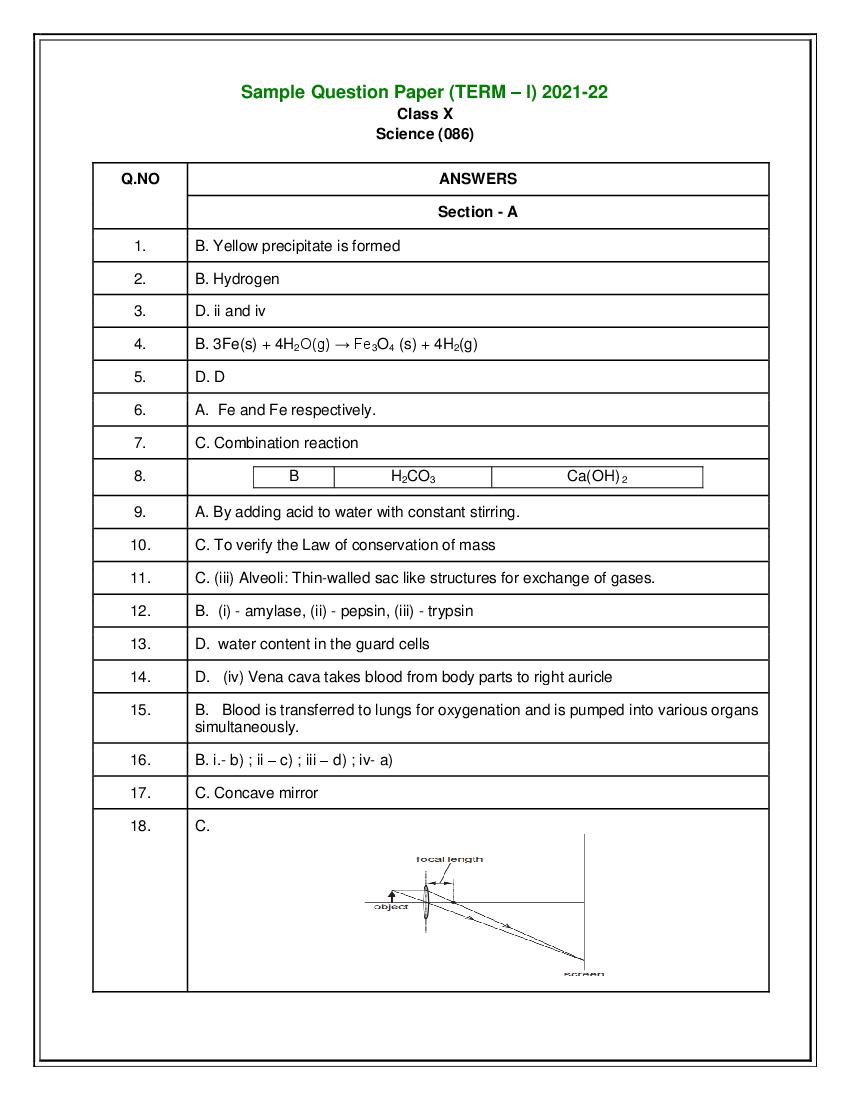
Class X
Science (086)
Q.NO ANSWERS
Section - A
1. B. Yellow precipitate is formed
2. B. Hydrogen
3. D. ii and iv
4. B. 3Fe(s) + 4H2O(g) → Fe3O4 (s) + 4H2(g)
5. D. D
6. A. Fe and Fe respectively.
7. C. Combination reaction
8. B H2CO3 Ca(OH) 2
9. A. By adding acid to water with constant stirring.
10. C. To verify the Law of conservation of mass
11. C. (iii) Alveoli: Thin-walled sac like structures for exchange of gases.
12. B. (i) - amylase, (ii) - pepsin, (iii) - trypsin
13. D. water content in the guard cells
14. D. (iv) Vena cava takes blood from body parts to right auricle
15. B. Blood is transferred to lungs for oxygenation and is pumped into various organs
simultaneously.
16. B. i.- b) ; ii – c) ; iii – d) ; iv- a)
17. C. Concave mirror
18. C.
Page 2
20. C. The speed of light in air > the speed of light in water > the speed of light in glass.
21. D. r < v
22. B. The mirror has a focal length of -3 cm and will produce an image of magnification
-1.
23. B. 0°
24. B. (ii)
Section - B
25. C.
26. A. 2002
27. B. Mg reacts with dil. HCl to produce H2 gas which helps in floating
28. B. B, C
29. B. ii and iii
30. B. i and iv
31. C. A is true but R is false
32. D. A is False but R is true
33. C. A is true but R is false.
34. B. Both A and R are true and R is not the correct explanation of A.
35. B. B and D
36. D. Shark, dog fish, sting ray
37. D. Thin walled capillaries richly supplied with blood.
38. B. They selectively filter toxic substances through their leaves.
39. C. concave lens of focal length -25 cm
P = -4 D
100
P =
𝑓(𝑐𝑚 )
100
f(cm) = 𝑝
100
−4
= -25 cm.
Negative focal length means concave lens. Concave lens of focal length -25cm.
Page 3
If rays converge at a point 15cm from the mirror, then,
f = -15cm
then, C = -30cm
An object kept at C makes an image of the same size as object correct answer –
(A) 30cm in front of mirror
41. B. yeast, mushroom, bread mould
42. D. Urine is more diluted.
43. D. -80/3 cm
m = -3
V = 80cm
𝑣
m=
𝑢
80
-3 =
𝑢
80 −80
u = −3 = 3 cm.
−80
Correct answer = (D) cm.
3
44. C. ii, iii and iv
45. D. Medium 1 and 3 are essentially the same medium, but medium 2 is denser than
1 and 3
46. B. 1.21
𝑅.𝐼 𝑜𝑓 𝑓𝑙𝑖𝑛𝑡 𝑔𝑙𝑎𝑠𝑠
Refractive index of flint glass w.r.t alcohol =
𝑅.𝐼 𝑜𝑓 𝑎𝑙𝑐𝑜 𝑜𝑙
1.65
= 1.36 = 1.21
Correct answer –(B)1.21
47. C. 4 mm
f = +10cm (Convex lens)
1 = 2mm = 0.2cm.
u = -5cm.
1 1 1
𝑓
= 𝑣−5
1 1 1
= −
𝑣 10 5
1−2 −1
10
= 10
V = -10cm.
𝑣
m= 𝑢 = 2
1
−10
m= −5 = 0.22
2 = 0.4cm.
2 = 4mm
Page 4
48. B. X, Y, Z
Section - C
49. C. CaCO3
50. C. 18 g
51. A. Brine
52. A. Between 1 to 3
53. C. Carbon dioxide
54. B. Carbon dioxide
55. B. Blue - black colour would be obtained on the leaf of plant Y and no change in
colour on leaf of plant X.
56. C. i. and iii
57. B. a parallel-sided glass block
58. C. 300
sin 𝑖
Refractive index of medium =
sin 𝑟
sin 48.6°
1.5 = sin 𝑟
0.75
1.5 =
sin 𝑟
0.75
sin 𝑟 = 0.5
sin 𝑟 =0.5
r= sin−1 (0.5)
r= 30°
Correct answer (C) 30°
59. D. III and V are correct.
60. A. lateral shift of the rays would have been less.
***
Page 5
Section - A
2. B. Hydrogen
3. D. Zinc
5. B. Acidic
11 A. Alveoli: Thin-walled sac like structures for exchange of gases.
12
L M N
B amylase pepsin trypsin
14 D. Vena cava - takes deoxygenated blood from body parts to right atrium
15. B. Blood is transferred to lungs for oxygenation and is pumped into
various organs simultaneously.
16. B. i.- b) ; ii – c) ; iii – d) ; iv- a)
18. C. It is a convex lens and the object is placed between pole and focus.
22. B. The mirror will produce an image of magnification -1.
23. B. 0°
24. B. Violet.
Section - B
26. B. Rain water consists of dissolved oxides of sulphur.
27. B. Mg reacts with dil. HCL to produce H2 gas which helps in floating.
30. B. I and iv
44. C. pass through the centre of curvature.
45. D. glass is optically denser than water.
47. C. 4 mm
Section - C
53. C. Carbon dioxide
54. B. Carbon dioxide
55. B. Blue - black colour would be obtained on the leaf of plant B
56. C. i. and iii
57. A. Dispersion
58. B. Red colour is monochromatic.
59. D. Different wavelengths travel at different speeds in the glass.
60. C. Rainbow.
***
Document Details
| Board / Org | CBSE |
| Exam | Class 10 |
| Type | Solution |
| Pages | 5 |
| Updated | 30 Apr 2026 |