MAHA SET 2018 Question Paper 2 Political Science
Finished viewing? Save it for later —
Download MAHA SET 2018 Question Paper 2 Political Science (PDF · 32 pages)About MAHA SET 2018 Question Paper 2 Political Science
MAHA SET 2018 Question Paper 2 Political Science is available here for free download. Published by Maharashtra Exams for Maharashtra State Eligibility Test, this question paper can be viewed online or downloaded as a PDF (32 pages). Candidates preparing for Maharashtra State Eligibility Test can use MAHA SET 2018 Question Paper 2 Political Science to understand the exam pattern, the type of questions asked, and the overall difficulty level.
Frequently Asked Questions
How can I download MAHA SET 2018 Question Paper 2 Political Science?
Open this page and click the Download button to save MAHA SET 2018 Question Paper 2 Political Science as a PDF. It is completely free on AglaSem Docs.
Is MAHA SET 2018 Question Paper 2 Political Science free to download?
Yes. MAHA SET 2018 Question Paper 2 Political Science can be viewed online and downloaded as a PDF free of cost on AglaSem Docs.
How many pages does MAHA SET 2018 Question Paper 2 Political Science have?
MAHA SET 2018 Question Paper 2 Political Science contains 32 pages, which you can read online or download together as a single PDF.
Where can I find more Maharashtra State Eligibility Test study material?
You can find more Maharashtra State Eligibility Test question papers, sample papers, syllabus, and answer keys on AglaSem Docs.
MAHA SET 2018 Question Paper 2 Political Science – Text
Read the full text of this question paper below — useful to quickly search, copy and reference the content online without downloading the PDF.
📄 View text version (32 pages)
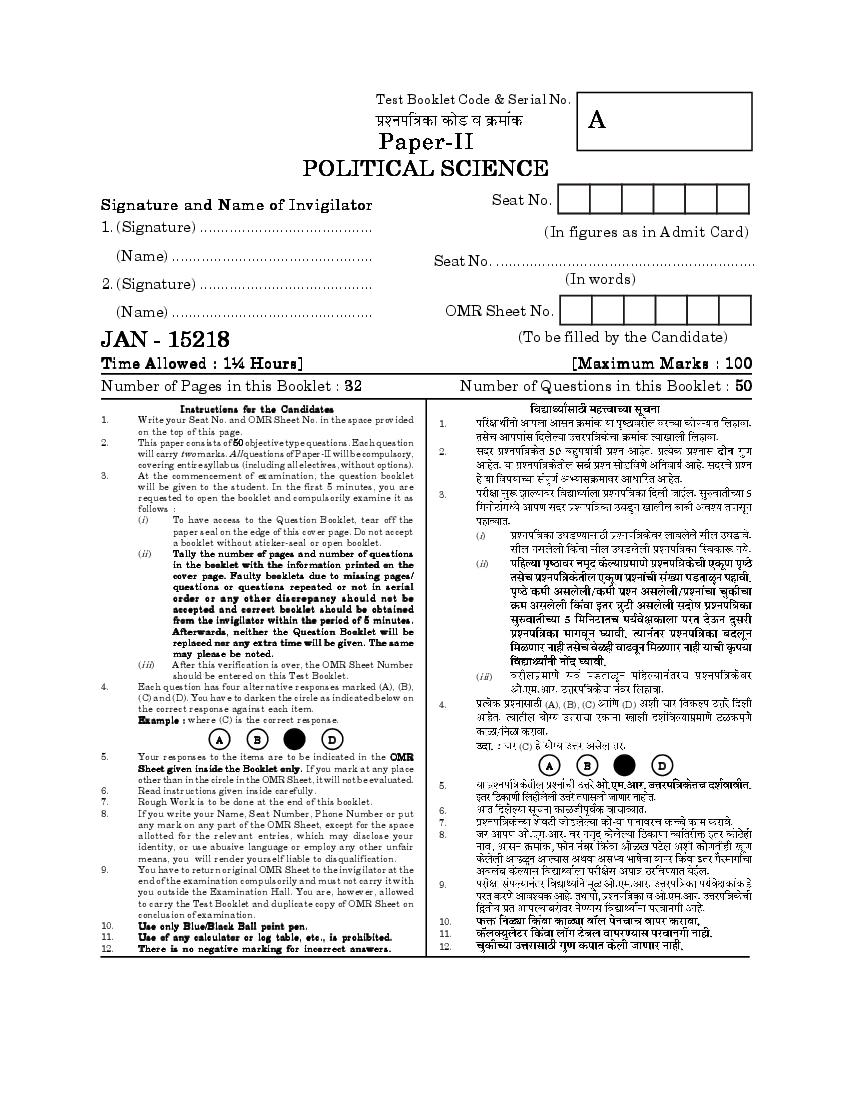
Page 1
A
POLITICAL SCIENCE
Signature and Name of Invigilator Seat No.
1. (Signature) ......................................... (In figures as in Admit Card)
(Name) ................................................ Seat No. ..............................................................
2. (Signature) ......................................... (In words)
(Name) ................................................ OMR Sheet No.
JAN - 15218 (To be filled by the Candidate)
Time Allowed : 1¼ Hours] [Maximum Marks : 100
Number of Pages in this Booklet : 32 Number of Questions in this Booklet : 50
Instructions for the Candidates
1. Write your Seat No. and OMR Sheet No. in the space provided 1.
on the top of this page.
2. This paper consists of 50 objective type questions. Each question
will carry two marks. All questions of Paper-II will be compulsory, 2.
covering entire syllabus (including all electives, without options).
3. At the commencement of examination, the question booklet
will be given to the student. In the first 5 minutes, you are
requested to open the booklet and compulsorily examine it as 3.
follows :
(i) To have access to the Question Booklet, tear off the
paper seal on the edge of this cover page. Do not accept (i)
a booklet without sticker-seal or open booklet.
(ii) Tally the number of pages and number of questions
in the booklet with the information printed on the (ii)
cover page. Faulty booklets due to missing pages/
questions or questions repeated or not in serial
o rder or any other discre pancy should not be
accepted and correct booklet should be obtained
from the invigilator within the period of 5 minutes.
Afterwards, neither the Question Booklet will be
replaced nor any extra time will be given. The same
may please be noted.
(iii) After this verification is over, the OMR Sheet Number
should be entered on this Test Booklet. (iii)
4. Each question has four alternative responses marked (A), (B),
(C) and (D). You have to darken the circle as indicated below on
the correct response against each item. 4. (A), (B), (C) (D)
Example : where (C) is the correct response.
A B D
(C)
5. Your responses to the items are to be indicated in the OMR
Sheet given inside the Booklet only. If you mark at any place A B D
other than in the circle in the OMR Sheet, it will not be evaluated.
5.
6. Read instructions given inside carefully.
7. Rough Work is to be done at the end of this booklet.
8. If you write your Name, Seat Number, Phone Number or put 6.
any mark on any part of the OMR Sheet, except for the space 7.
allotted for the relevant entries, which may disclose your 8.
identity, or use abusive language or employ any other unfair
means, you will render yourself liable to disqualification.
9. You have to return original OMR Sheet to the invigilator at the
end of the examination compulsorily and must not carry it with 9.
you outside the Examination Hall. You are, however, allowed
to carry the Test Booklet and duplicate copy of OMR Sheet on
conclusion of examination.
10. Use only Blue/Black Ball point pen. 10.
11. Use of any calculator or log table, etc., is prohibited. 11.
12. There is no negative marking for incorrect answers. 12.
Page 2
Page 3
Paper II
II
Time Allowed : 75 Minutes] [Maximum Marks : 100
Note : This paper contains Fifty (50) multiple choice questions, each carrying
Two (2) marks. Attempt All questions.
(50) (2)
1. Match List-I (Treaty) with List-II 1. I II
(Year) and choose the correct
code :
List-I I
(Treaty)
(a) Treaty of Westphalia (a)
(b) Treaty of Utrecht (b)
(c) Treaty of Paris (c)
(d) Peace Treaty of Versailles (d)
List-II II
(Year)
(1) 1713 (1) 1713
(2) 1814 (2) 1814
(3) 1919 (3) 1919
(4) 1648 (4) 1648
Codes :
(a) (b) (c) (d) (a) (b) (c) (d)
(A) (1) (2) (3) (4) (A) (1) (2) (3) (4)
(B) (4) (3) (2) (1) (B) (4) (3) (2) (1)
(C) (4) (1) (2) (3) (C) (4) (1) (2) (3)
(D) (4) (2) (1) (3) (D) (4) (2) (1) (3)
3 [P.T.O.
Page 4
resolution was adopted by the UN
General Assembly ?
(A) 1961
(A) 1961
(B) 1951
(B) 1951
(C) 1950 (C) 1950
(D) 1952 (D) 1952
3. Match List-I with List-II and select 3. I
the correct answer from the codes II
given below :
List-I I
(a) India in Transition (a)
(b) My Picture of Socialism (b)
(c) My Experiments with Truth (c)
(d) Annihilation of Caste (d)
List-II II
(1) Jai Prakash Narayan (1)
(2) Babasaheb Ambedkar (2)
(3) Manvendra Nath Roy (3)
(4) M.K. Gandhi (4)
Codes :
(a) (b) (c) (d) (a) (b) (c) (d)
(A) (4) (2) (3) (1) (A) (4) (2) (3) (1)
(B) (3) (1) (4) (2) (B) (3) (1) (4) (2)
(C) (3) (2) (1) (4) (C) (3) (2) (1) (4)
(D) (2) (1) (4) (3) (D) (2) (1) (4) (3)
4
Page 5
Government is :
(A) Supremacy of Judiciary (A)
(B) Supremacy of Parliament (B)
(C) Division of powers between the (C)
Federal and State Government
(D) Local Government (D)
5. Political Science is a discipline : 5.
(A) Which does not subscribe to any
values (A)
(B) Which provides value-free (B)
analysis
(C) Meant to study values (C)
(D) That cannot ignore values (D)
6. Which of the following countries has 6.
adopted the method of amending the
constitution by a popular vote ?
(A) U.K. (A)
(B) U.S.A. (B)
(C) Switzerland (C)
(D) India (D)
5 [P.T.O.
Page 6
the American federation was
formed ?
(A)
(A) Legislature
(B)
(B) The Act of Senate
(C)
(C) A voluntary agreement
(D)
(D) By revolution
8. Which one of the following 8.
political theorists made a clear
distinction between two levels of
superstructure (a) Political society,
(b) Civil society ?
(A)
(A) F. Engels
(B)
(B) Mao
(C)
(C) Gramsci
(D) Lenin (D)
6
Page 7
9.
philosophers is associated with
Egalitarian Liberal Theory of
Justice ? (A)
(A) Immanuel Kant
(B)
(B) John Rawls
(C)
(C) Robert Nozick
(D) T.H. Green (D)
10. The Joint River Commission 10.
constituted in 1972 was expected to
solve the water dispute between :
(A) India and China (A)
(B) India and Bhutan (B)
(C) India and Bangladesh (C)
(D) India and Nepal (D)
7 [P.T.O.
Page 8
11.
of contemporary political thinkers
are staunch supporters of
communitarianism ?
(A) Rousseau, Hegel and Green
(A)
(B) Berlin, Hayek and Milton
(B)
Friedman
(C) Adam Smith, John Locke and (C)
Jeremy Bentham
(D) Michael Okeshott and Hannah
(D)
Arendt
12. Who is the author of the following 12.
statement “traditional political theory
is the production of the turmoil that
characterise past ages” ?
(A)
(A) David Easton
(B)
(B) Germino
(C)
(C) Cobban
(D) Lipset (D)
8
Page 9
the correct answer from the codes
given below :
List-I I
(a) Bureaucracy (a)
(b) Dependency Theory (b)
(c) Elitist Theory (c)
(d) World System Theory (d)
List-II II
(1) Vilfredo Pareto (1)
(2) Immanuel Wallerstein (2)
(3) Samir Amin (3)
(4) Max Weber (4)
Codes :
(a) (b) (c) (d) (a) (b) (c) (d)
(A) (4) (3) (1) (2) (A) (4) (3) (1) (2)
(B) (1) (2) (4) (3) (B) (1) (2) (4) (3)
(C) (3) (1) (2) (4) (C) (3) (1) (2) (4)
(D) (2) (4) (3) (1) (D) (2) (4) (3) (1)
14. Which one of the following is not the 14.
characteristic of behaviourism ?
(A) Regularities (A)
(B) Verification (B)
(C) Value-neutrality (C)
(D) Action (D)
9 [P.T.O.
Page 10
the correct answer by using the codes
given below the list :
List-I I
(a) Traditional approach to the (a)
study of Comparative Politics
(b) Systems approach to the study (b)
of Comparative Politics
(c) Structural-functional approach
(c)
to the study of Comparative
Politics
(d)
(d) Marxist approach to the study
of Comparative Politics
II
List-II
(1)
(1) Interest Articulation, Interest
Aggregation
(2)
(2) Eurocentric, Normative
(3)
(3) Input-Output-Feedback
(4) Economic aspects (4)
Codes :
(a) (b) (c) (d) (a) (b) (c) (d)
(A) (3) (2) (1) (4) (A) (3) (2) (1) (4)
(B) (3) (1) (2) (4) (B) (3) (1) (2) (4)
(C) (1) (2) (3) (4) (C) (1) (2) (3) (4)
(D) (2) (3) (1) (4) (D) (2) (3) (1) (4)
10
Page 11
the correct answer from the codes
given below :
List-I I
(a) Gabriel Almond (a)
(b) Karl Deutsch (b)
(c) Daniel Lerner
(c)
(d) Lucian Pye
(d)
List-II
II
(1) Social mobilization and Political
(1)
Development
(2) Aspects of Political Development
(2)
(3) The Politics of Developing
(3)
Areas
(4)
(4) Passing of Traditional Societies
Codes :
(a) (b) (c) (d)
(a) (b) (c) (d)
(A) (2) (3) (4) (1)
(A) (2) (3) (4) (1)
(B) (4) (2) (1) (3) (B) (4) (2) (1) (3)
(C) (1) (4) (3) (2) (C) (1) (4) (3) (2)
(D) (3) (1) (4) (2) (D) (3) (1) (4) (2)
11 [P.T.O.
Page 12
codes given below :
Assertion (A) : (A)
Legitimacy is the right and
acceptance of an authority usually
a governing law or a regime.
Reason (R) : (R)
Authority denotes specific position
in an established government.
Codes :
(A) Both (A) and (R) are true and (A) (A) (R)
(R) is the correct explanation (R) (A)
of (A)
(B) Both (A) and (R) are true but (B) (A) (R)
(R) is not the correct explanation (R) (A)
of (A)
(C) (A) is true but (R) is false (C) (A) (R)
(D) (R) is true but (A) is false (D) (R) (A)
12
Page 13
codes given below :
Assertion (A) : (A)
Narendra Modi has more power.
Reason (R) :
(R)
Narendra Modi is the Prime Minister
of India.
Codes :
(A) (A) (R)
(A) Both (A) and (R) are true and
(R) (A)
(R) is the correct explanation
of (A)
(B) (A) (R)
(B) Both (A) and (R) are true but
(R) (A)
(R) is not the correct explanation
of (A)
(C) (A) (R)
(C) (A) is true but (R) is false
(D) (R) is true but (A) is false (D) (R) (A)
13 [P.T.O.
Page 14
System has certain key aspects.
Identify the correct aspects :
(i) Political system is just one (i)
among other forms of social
system.
(ii) Political system allocates by (ii)
means of policies.
(iii) Its allocations are not (iii)
authoritative.
(iv) Its allocations are not binding (iv)
on society.
Codes :
(A) (i) and (ii) are correct (A) (i) (ii)
(B) (ii) and (iii) are correct (B) (ii) (iii)
(C) (i), (ii) (iii)
(C) (i), (ii) and (iii) are incorrect
(D) (iv)
(D) Only (iv) is incorrect
20. Which of the following sets of 20.
values emphasised by the classical
model of Public Administration is
challenged by the New Public
Management ?
(A) Rationality, hierarchy,
centralization
(A)
(B) Professionalism, efficiency,
economy
(B)
(C) Decentralization, governance,
accountability (C)
(D) Communication, leadership,
authority (D)
14
Page 15
an organization is overextended ?
(1) Organizational efficiency
(1)
increases.
(2)
(2) Lower levels are neglected.
(3) Communication becomes more (3)
effective. (4)
(4) Chief executive looses touch
with the bottom level.
Codes :
(A) (1) (2)
(A) (1) and (2) are true
(B) (2) (3)
(B) (2) and (3) are true
(C) (1) and (3) are true (C) (1) (3)
(D) (2) and (4) are true (D) (2) (4)
22. The scrutiny of the expenditure of 22.
the government by the Public
Accounts Committee is effective.
Which of the following is its correct
reason for the same ? (A)
(A) It identifies the unlawful
expenditure. (B)
(B) Its scrutiny is based on the
report of the CAG.
(C)
(C) Its composition provides
representation to all the
political parties.
(D)
(D) It is an ad-hoc committee.
15 [P.T.O.
Page 16
post-behaviourism ?
(A) Quantification (A)
(B) Relevance (B)
(C) Value free (C)
(D) Pure science (D)
24. Which of the following is the 24.
correct description of India’s federal
system ?
(A)
(A) A classical federal system
(B)
(B) A cooperative federal system
(C)
(C) A three-tier federal system
(D) A liberal federal system (D)
25. Which one of the following is not 25.
separatist movement ?
(A) JKLF (A)
(B) ULFA (B)
(C) PLA (C)
(D) Naxalism (D)
16
Page 17
is correct ?
(A) Collegium system of the (A)
Supreme Court has been
introduced by the Act of
Parliament.
(B) Collegium system has been (B)
introduced by Government
Resolution.
(C) Collegium system has been (C)
already incorporated in the
Constitution.
(D) Collegium system has been (D)
created by the judgement of
the Supreme Court without
constitutional mandate.
27. What is reason of recent conflict 27.
between executive and judiciary ?
(A) On the issue of appointment of
(A)
judges in the High Courts
(B) On the issue of appointment of
judges in lower judiciary (B)
(C) On the issue of hike in the
salary of judges of Supreme (C)
Court
(D) On the issue of protection of
(D)
judges of Supreme Court and
High Courts
17 [P.T.O.
Page 18
statements is correct ?
(A)
(A) Judicial Activism means an
encroachment on the powers of
executive by Judiciary
(B)
(B) Judicial Activism means
judicial excess
(C) Judicial Activism is an inherent (C)
power of the judiciary while
interpreting law
(D)
(D) Judicial Activism is curtailment
of the power of states
29. Which one of the following 29.
statements is correct ?
(A)
(A) National Judicial appointment
commission is working as per
the Act of Parliament
(B)
(B) National Judicial appointment
commission has been declared
unconstitutional by Apex
Judiciary recently
(C) National Judicial appointment (C)
commission was appointed by
President of India as per
constitutional provisions.
(D) Even after striking down the
(D)
law of National Judicial
appointment commission by
Supreme Court, the said
commission is still functioning
18
Page 19
about Elections ?
(A) Elections in India provide the
(A)
opportunity for the widest
degree of popular porticipation
and for genuine competition
between political groups
(B)
(B) Elections encourage political
violence
(C)
(C) Elections empower women
voters
(D) Elections maintain status quo (D)
31. Which one of the following national 31.
political party was instrumental in
introducing economic development
programme i.e., Zamindari abolition,
land reforms, cooperative farming
and compulsory primary education
etc.
(A)
(A) Parties in UPA Alliance at the
centre (B)
(B) Congress Party (INC)
(C)
(C) Bhartiya Janata Party along
with NDA Alliance (D)
(D) CPM & CPI (Leftist Parties)
19 [P.T.O.
Page 20
Dominant System prior to 1967
politics ?
(A)
(A) Norman D. Palmer
(B)
(B) Subhash C. Kashyap
(C) W.H. Morris & Rajani Kothari (C)
(D) M.V. Pylee (D)
33. Which one of the techniques is not 33.
used by pressure group ?
(A) Framing of draft bills with skill (A)
and expert knowledge
(B) Lobbying to influence
(B)
government policy
(C) Securing nomination and
(C)
elections of sympathetic
legislators
(D) Election campaign for candidate (D)
34. Which one is the regulatory 34.
authority for controlling and
regulating print media ?
(A) Ministry of Information & (A)
Broadcasting
(B)
(B) Press Council of India
(C) Election Commission of India (C)
(D) Comptroller & Auditor General
(D)
of India (CAG)
20
Page 21
peasants movement ?
(A) Champaran Movement (Bihar (A)
1917)
(B)
(B) Khera Satyagraha (1918)
(C)
(C) Chipko Andolan
(D)
(D) Bardoli Satyagraha
36. Which one of the following 36.
statements is correct ?
(A) Of the four pillars of the (A)
Constitution, the election
commission is one, the three
being the Supreme Court, the
Public Service Commission and
the Comptroller and Auditor
General of India
(B)
(B) Of the four pillars of the
Constitution, the election
commission is one, the other
three are Media, Political
Parties and the Supreme Court
(C)
(C) Of the four pillars of the
Constitution, the election
commission is one, the other
three are legislature, executive
and judiciary
(D)
(D) None of the above
21 [P.T.O.
Page 22
about decentralised planning and
select the correct code :
(i)
(i) Decentralised planning is
bottom-up planning
(ii)
(ii) It is undertaken at the grass
roots level
(iii)
(iii) It ensures peoples’ participation
(iv) The 73rd and 74th constitu-
(iv) 73 74
tional amendments made
decentralised planning
mandatory in India.
Codes : (A) (i), (ii) , (iii), (iv)
(A) (i), (ii) correct, (iii), (iv) incorrect
(B) (i), (ii) are incorrect, (iii), (iv) are (B) (i), (ii) , (iii), (iv)
correct
(C) (i), (ii), (iii) and (iv) are correct (C) (i), (ii), (iii), (iv)
(D) (i), (ii), (iii) are correct, (iv) is (D) (i), (ii), (iii) , (iv)
incorrect
38. Who was the first to coin the word 38. (Bureaucracy)
‘Bureaucracy’ ?
(A) Max Weber
(A)
(B) Vincent de Gournay
(B)
(C) Gaetano Mosca
(C)
(D) Thomas Carlyle (D)
22
Page 23
of organisation requires that every
member of an organisation should
report to one, and only one leader
‘superior’ ?
(A) Span of Control (A)
(B) Unity of Command (B)
(C) Integration (C)
(D) Decentralisation (D)
40. The importance of a comparative 40.
approach to Public Administration
was first emphasised by whom of the
following ?
(A)
(A) Woodrow Wilson
(B)
(B) L.D. White
(C) Robert Merton (C)
(D) Frederick Taylor (D)
23 [P.T.O.
Page 24
Theories of Conflict Resolution and II
List-II gives the author of the Model/ I II
Theory. Match List-I and List-II and
select the correct answer from the
codes given below :
I
List-I
(Models/Theories in
Conflict Resolution)
(i)
(i) Conflict Prevention
(ii)
(ii) Four Worlds Model
(iii)
(iii) Relative Deprivation
(iv)
(iv) Conflict Transformation
II
List-II
(Authors)
(a)
(a) Ted Robert Gurr
(b) John Galtung (b)
(c) John Burton (c)
(d) Dennis Sandole (d)
Codes :
(i) (ii) (iii) (iv) (i) (ii) (iii) (iv)
(A) (b) (d) (a) (c) (A) (b) (d) (a) (c)
(B) (c) (d) (a) (b) (B) (c) (d) (a) (b)
(C) (d) (a) (b) (c) (C) (d) (a) (b) (c)
(D) (c) (a) (d) (b) (D) (c) (a) (d) (b)
24
Page 25
42.
statement with regard to Indus
Water Treaty of 1960 between India
and Pakistan ?
(A) Under the treaty India is
(A)
allowed to share 20% of water
20%
of the six rivers flowing from
India to Pakistan.
(B) India is restrained from
(B)
building any dams on the six
rivers.
(C) The treaty was suspended (C)
whenever there were wars or
serious tensions on the borders.
(D)
(D) The treaty can be revoked only
through mutual consultation.
25 [P.T.O.
Page 26
to global environment in correct
chronological order and choose the
correct answer from the codes given
below : (i)
(i) Doha Conference (ii)
(ii) Paris Agreement (iii)
(iii) Kyoto Protocol
(iv)
(iv) Earth Summit
Codes :
(A) (i), (iv), (iii), (ii)
(A) (i), (iv), (iii), (ii)
(B) (iv), (iii), (i), (ii)
(B) (iv), (iii), (i), (ii)
(C) (iii), (iv), (i), (ii)
(C) (iii), (iv), (i), (ii)
(D) (ii), (i), (iv), (iii) (D) (ii), (i), (iv), (iii)
44. The Global Competitiveness Report 44.
is prepared by :
(A) World Economic Forum (A)
(B) World Bank (B)
(C) IMF (C)
(D) Asian Development Bank (D)
26
Page 27
is/are correct ?
(i) Special UN Fund for Economic
(i) 1957
Development (SUNFED) was
(SUNFED)
established in 1957 to give
financial assistance to the third
world countries.
(ii) SUNFED could not achieve its (ii) SUNFED
goals mainly due to cold war
politics.
(iii) In 1965, SUNFED was replaced
by UNDP, which became a (iii) 1965 SUNFED
subsidiary organ of UN General UNDP
Assembly.
(iv) North-South politics became
(iv)
a power struggle based on
strategic issues and not on
developmental issues.
Select the correct answer from the
following codes :
Codes :
(A) (i), (ii), (iii)
(A) (i), (ii), (iii) are correct
(B) (ii), (iii), (iv)
(B) (ii), (iii), (iv) are correct
(C) (iii)
(C) Only (iii) is correct
(D) Only (iv) is correct (D) (iv)
27 [P.T.O.
Page 28
Indians, who served on some UN
bodies given in List-II. Match the II
two lists and select the correct
answer from the codes given
below :
I
List-I
(Indian)
(i) Hansa Mehta (i)
(ii) Vijayalaxmi Pandit (ii)
(iii) Nagendra Singh (iii)
(iv) Vinod Rai (iv)
List-II II
(UN Bodies and the Post)
(a) Chairman of UN Panel of
(a)
External Auditors
(b) Member of Drafting Panel of
UN Declaration of Human (b)
Rights
(c) President of 8th Session of UN (c)
General Assembly
(d) President of International (d)
Court of Justice
Codes :
(i) (ii) (iii) (iv)
(i) (ii) (iii) (iv)
(A) (d) (a) (b) (c)
(A) (d) (a) (b) (c)
(B) (b) (a) (d) (c) (B) (b) (a) (d) (c)
(C) (c) (d) (b) (a) (C) (c) (d) (b) (a)
(D) (b) (c) (d) (a) (D) (b) (c) (d) (a)
28
Page 29
regarding propositions of Dependency
Theory :
(A) Developing/underdeveloped (A)
countries do not exist in
isolation. They can only be
understood in the context of
world economic and political
system.
(B)
(B) The relationship between core
and periphery countries is
disadvantageous for core
countries.
(C)
(C) As long as capitalism remains
the dominant world economic
system there is no reason for the
situation of developed and
underdeveloped countries to
change. (D)
(D) Poor states are impoverished
and rich ones enriched by the
way poor states are integrated
into the world system.
29 [P.T.O.
Page 30
the correct answer from the codes
given below :
List-I I
(a) Media and Friends (a)
(b) Centre and Periphery (b)
(c) Input and Output (c)
(d) Family and School (d)
List-II II
(1) Systems approach (1)
(2) Political socialization (2)
(3) Political communication (3)
(4) Dependency theory (4)
Codes :
(a) (b) (c) (d) (a) (b) (c) (d)
(A) (3) (2) (1) (4) (A) (3) (2) (1) (4)
(B) (3) (4) (1) (2) (B) (3) (4) (1) (2)
(C) (2) (1) (4) (3) (C) (2) (1) (4) (3)
(D) (1) (2) (3) (4) (D) (1) (2) (3) (4)
30
Page 31
the correct answer by using the codes
given below :
List-I I
(a) Capitalism, Socialism and (a)
Democracy
(b)
(b) Capitalism and under-
development in Latin America
(c)
(c) Capitalism in the age of
globalization
(d)
(d) The Modern World System
II
List-II
(1)
(1) Andre Gunder Frank
(2) Samir Amin (2)
(3) Joseph Schumpeter (3)
(4) Immanuel Wallerstein (4)
Codes :
(a) (b) (c) (d) (a) (b) (c) (d)
(A) (4) (3) (1) (2) (A) (4) (3) (1) (2)
(B) (3) (2) (1) (4) (B) (3) (2) (1) (4)
(C) (3) (1) (2) (4) (C) (3) (1) (2) (4)
(D) (2) (4) (1) (3) (D) (2) (4) (1) (3)
50. Which electoral system is used in 50.
USA and Britain to elect members
of Legislature ?
(A) Simple plurality vote (A)
(B) Alternative vote (B)
(C) Proportional Representation (C)
(D) Single transferable vote (D)
31 [P.T.O.
Page 32
32
Document Details
| Board / Org | Maharashtra Exams |
| Exam | Maharashtra State Eligibility Test |
| Type | Question Paper |
| Pages | 32 |
| Updated | 30 Apr 2026 |